Software
Houzz Logo Print
webuser_9599282

Please help ID and tell me if it's sick

10 years ago
last modified: 10 years ago
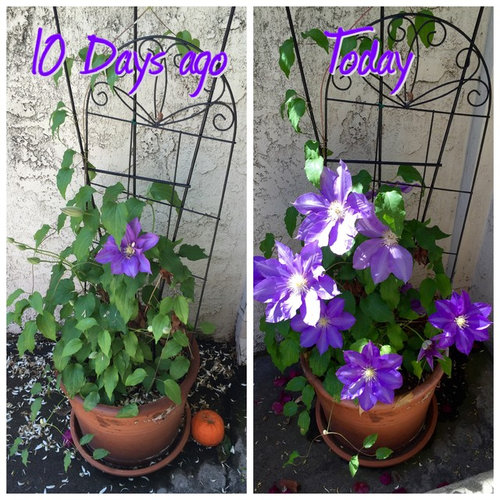
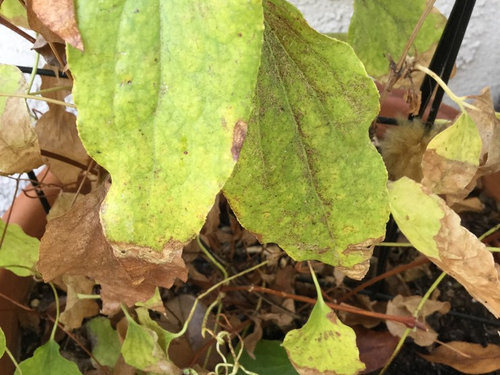
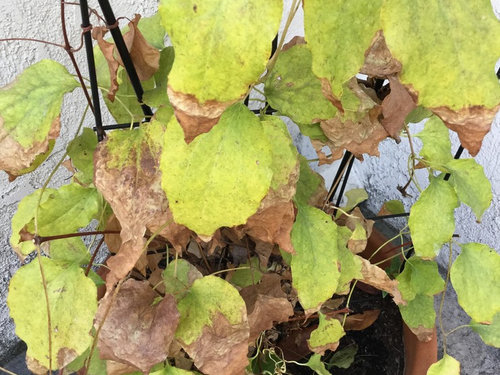
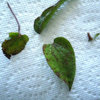
Hi! I'm new to gardenweb, and sort of new to clematis. I currently have two plants, one in the ground in front of the house (western side), and one in a container in the back (eastern side). Neither looks great, but I've attached photos of the one in back, which is my main concern right now. I don't know the variety, because I bought it on a whim at Trader Joe's a couple of years ago, and it wasn't labeled well (only very basic care instructions on the tag). I transplanted it into the big container last year, and it grew a bit this spring and bloomed decently for a smallish plant. But I fear my dreams of a large, romantic clematis that grows over the kitchen door awning and explodes into blossoms each spring/summer may be in jeopardy. Based on the photos I've seen of clematis wilt, I don't think it looks like that, so any thoughts on what might (if anything) be wrong with it? I try to keep the roots cool and damp, but I also try to be careful not to over water. Thanks in advance!

These photos were taken March 12 and March 22. Promising, right?

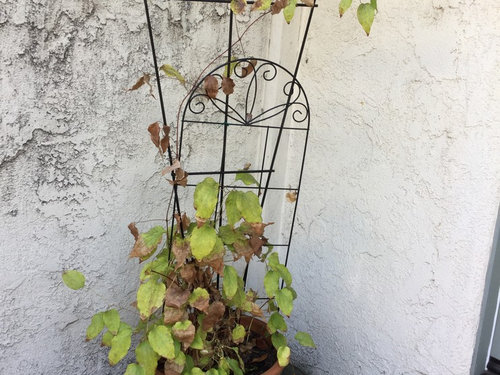
Three months later. It looks so sad.

Comments (11)

  • 10 years ago

    Roots are probably not staying cool enough. They like cool and shade. I would plant in a deeper pot and mulch with moss or grow some small annuals to cool roots. Or grow in a grouping with other pots that might be able to offer a bit of shade. You probably also need to water more often.

    MLO - USDA 10a, Sunset 20 thanked Kaillean (zone 8, Vancouver)
  • 10 years ago

    Thanks, Kaillean! I'll give those ideas a try. It's in a mostly shaded spot, but the pot can get warm.

  • 10 years ago

    babs is correct - the pots is far too small for your plant to grow into a large, prolifically blooming vine. And her other comments are spot-on as well. Growing plants in containers requires far more hands-on care and attention to detail than growing that same plant in the ground.

    btw, the concept of clematis roots needing to be shaded is a bit misleading. It is not that the roots require shade....they just require consistent, even moisture. Shading the root zone with another plant can certainly help with reducing soil moisture evaporation but making sure you water as frequently as necessary will accomplish the same thing. I grow many clematis in containers in full sun and they do just fine with attention to watering. A larger container will certainly help, as will one of a less easy to dry out material. I prefer large resin containers (for ease of mobility) or glazed ceramic.

    MLO - USDA 10a, Sunset 20 thanked gardengal48 (PNW Z8/9)
  • 10 years ago
    last modified: 10 years ago
    Thank you, NHBabs and gardengal48. I don't know the exact pH of my local water supply, but I do know it's quite hard, which means it would be more alkaline than acidic, I believe. I did use potting soil when I transplanted it from the 6" pot it was sold in at Trader Joe's to its current 18" container; so would you suggest, if I decide to keep it in a larger container rather than put it in the ground, that I switch to planting compost? My garden has clay soil, so I could mix some of that with potting soil to add some weight and help retain moisture longer. I have been fertilizing maybe once a month with E.B. Stone's 0-10-10 UltraBloom plant food granules, and I water twice a week, or when the first inch of soil feels dry or barely damp. As Babs suggested, I'll check out the container gardening forums for planting mix suggestions.

  • 10 years ago

    Oh, sorry, one more question: any idea what kind of clematis this is?

  • 10 years ago

    If you are growing anything in a pot or container then all you want to use is "potting soil" - no garden soil, no planting compost. Potting soils have been formulated specifically for container culture and address the unique requirements of growing in containers. But not all potting soils are created equally - there are both good and bad products on the market, which is why the suggestion to make your own often comes up :-) How practical that is to do for a single plant is the question!! In general, you want a bark based potting soil (rather than just all peat, like Miracle Gro) that offers both a good textural component as well as durability, resulting in both fast drainage and adequate moisture retention. Something like the 5-1-1 mix often referred to in the Container Gardening forum.

    And you may want to change out your fertilizer as well. Dry organics - like the E.B. Stone - are not very efficient for containers. These need to be broken down into a plant usable form by soil organisms and there just aren't sufficient populations of soil organisms in any kind of potting soil to manage that well. No real "soil", no soil organisms :-)) A water soluble fertilizer will work much better. I use Dyna Gro's Liquid Grow but even Miracle Gro would work. The alternative is to apply a slow release fertilizer like Osmocote once at the beginning of the season.

    As to the ID, there's an awful lot of LFH that look like that. 'Rhapsody" is a possibility.

    MLO - USDA 10a, Sunset 20 thanked gardengal48 (PNW Z8/9)
  • 10 years ago

    Great, thanks again gardengal48! I mistook Babs's comment about potting soil breaking down too quickly for perennials as an indication that I should not use it with clematis, or that I should mix it with something else. The potting soil I use is also E.B. Stone, the primary ingredients of which are listed as: Aged Fir Bark, Sphagnum Peat Moss, Aged Redwood, Volcanic Pumice, Earthworm Castings, Washed Sand, Kelp Meal, Bat Guano, Feather Meal, Gypsum and Mycorrhizae. Since peat is the second ingredient, perhaps it's still too much? I'll find a liquid fertilizer for all my container plants going forward. Also, thank you for the possible ID.

  • 9 years ago
    last modified: 9 years ago

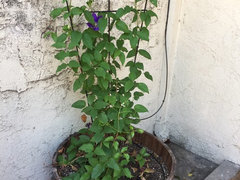
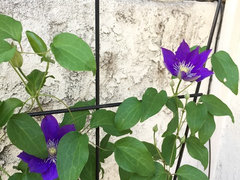
    Well, it took 11 months, but I finally got around to transplanting my poor clematis (which, by the way, I've finally likely identified as early large-flowered Shisen) per the suggestions here. I went out and bought the whiskey barrel planter shortly after receiving all the advice in June 2016, but due to chronic back problems, I procrastinated with the transplantation. I finally got around to it this past May, and while I was at it, I added a drip watering line that runs twice a week for 45 minutes. I gave the poor thing all new potting mix, a good dose of Osmocote flower and vegetable fertilizer, freed its potbound roots, trimmed off all the dead leaves but left the vines intact as much as I could manage (some were so entwined around the trellis, they had to be cut off), and now it has about 3 times the amount of space it had before. Here are the results! It's in its second flush of blooming, the first having been in March, before transplanting; it has four active blooms and at least nine additional buds. It seems so happy with this new arrangement! So thank you all for the sage advice, even if it took me a while to implement.

  • 9 years ago

    Wonderful ! I'm sorry about your back , I hope it is better now. Your clematis looks very happy now !

  • 9 years ago

    Looks great!

Sponsored