Software
Houzz Logo Print
marn_bitterman

Sickly Money Tree

10 years ago
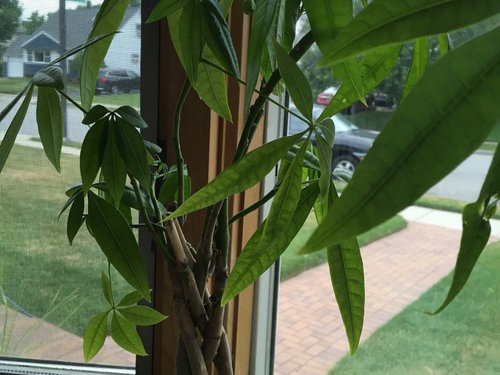
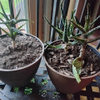
I'm hoping someone can help me. I've had my money tree since April of 2015. It was thriving, getting taller with more and more leaves. I used miracle grow plant food spikes once, around June and it made it even bigger. I moved in January and it immediately started losing leaves. They would turn yellow and just fall off with the slightest touch. The tree is a shell of what it used to be. The leaves now bend downward as you can see in the photo below. Not sure why as it never did that s there any saving it? Other than moving houses the conditions the tree is in hasn't changed. Indirect, bright sunlight and watering it once a week. Please see the picture below. Thanks for any advice!!


Comments (11)

  • 10 years ago

    M: Relocation shock. It will recover with good care.

  • 10 years ago
    last modified: 10 years ago

    If the light is significantly lower where it's sited than previous, that could account for the leaf loss. VERY often, over-watering is a significant issue that causes leaf loss, as can under-watering, but if you haven't noticed wilting of foliage as indication of under-watering, over-watering is the more likely of the two.

    The plant is planted too deep, too. Soil against the bark can kill cambial tissues - inhibits gas exchange through openings in the bark (lenticels), which inhibits movement of water to the top of the plant and nutrients + other biocompounds to the roots.

    If it was my plant, I'd repot immediately at the proper depth into a soil that allows you to water correctly and move it outdoors into shade at first and then to partial sun. If you don't repot, I would start monitoring soil moisture levels with a wooden dowel rod sharpened in a pencil sharpener. Push it deep into the soil and don't water until it comes out clean/not stained dark or wet by moisture deep in the pot. My guess is you're watering unnecessarily when the top looks/feels dry but there is still a lot of moisture deep in the pot. This creates an unhealthy environment for roots and promotes root dysfunction and diseases.

    I'd also abandon the fertilizer spikes and start using a fertilizer more appropriate. There are a number of good reasons to choose Foliage-Pro 9-3-6 as your 'go to' fertilizer for almost everything you grow. I currently use it for all of around 200 species of plants in at least 80 genera.

    Al

  • 10 years ago

    Yep, re-pot and get rid of those fertilizer spikes.

    Also, the plant doesn't look that bad. I've seen far, far worse easily come back to full vitality. If the trunks are still alive, it'll be no problem. If trunks are dead, remove them.

    As Al said, switch to a very free-draining mix that will allow you to water and fertilize copiously.

    Josh

  • 10 years ago

    Can you recommend a soil mix to use?

  • 10 years ago
    last modified: 10 years ago

    5 pine bark fines, 1 part peat, 1 part coarse perlite with some dolomite lime works great. Referred to as the 5:1:1 mix.

  • 10 years ago

    Where do you live?

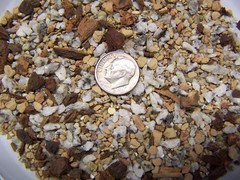
    Josh and I both make our own soils. I have somewhere around 250 trees in various stages of development, many of them older than 25 years. All are growing in this:

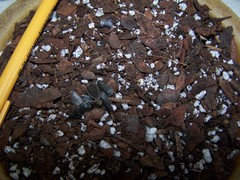
    When business wasn't so hectic and I wasn't spending so much time at work, I put together a lot of mixed display containers for the decks and gardens, and grew a lot of veggies in pots. For those, I used this:

    which also serves very admirably as a medium for houseplants. It's somewhere around 75% pine bark + equal measures of sphagnum peat and perlite, which, if the size is appropriate, offers excellent aeration and drainage properties.

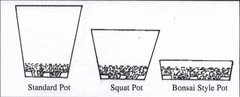
    The problem with many soils is the volume of water they retain in a saturated layer at the bottom of the pot, represented by the shaded area in the pots below.

    Some out-of-the-bag soils will retain a soggy layer that is 6" or more deep. Commonly, 3-5" is the norm for most. This layer of saturation deprives the plant of the oxygen needed for normal root function and can cause any of several common root diseases. My suspicion is that your planting is being affected by the soggy layer I'm talking about, which is called a perched water table. Soils based on very large fractions of coarse materials support little to no perched water, which means the potential for excellent root health is much greater than when using soils that support significant volumes of perched water. Most of the experienced growers here that know their business either make their own media or heavily amend commercially prepared soils.

    Thoughts?

    Al


  • 10 years ago

    I heartily recommend both of Al's mixes. I personally use something closer to the 5-1-1, but instead of peat or potting mix, I substitute in red lava rock (scoria) and a bit of Turface. Both of these ingredients increase moisture retention, without compromising the durability and longevity of the mix. I water and fertilize heavily during the Summer, and regularly during the Winter.

    Josh

  • 10 years ago

    Thank you all for your help and advice. I really appreciate it.

    Al and Josh - l live in New York. I am a complete novice to plants and gardening. This money tree was my first ever plant. So I unfortunately don't know how to make my own soil mix. Is there any brands you can't recommend that would be an ok substitute?

  • 10 years ago
    last modified: 10 years ago

    M.... Your soil is OK. The trick is how you water. Let top of soil dry out good before watering and avoid a.c. vents. ( overwatering will do nothing to help relocation shock )

  • 10 years ago

    Choice of potting mix is probably the most important choice you can make to improve your gardening experience.

    M, if you can find an "Orchid Mix" that is *fine-grade* small bark, then add perlite and a pinch of potting, you can make a decent mix.

Sponsored
Custom Home Works
Average rating: 4.6 out of 5 stars10 Reviews
Franklin County's Award-Winning Design, Build and Remodeling Expert