Software
Houzz Logo Print
ontario_canada5a_usda4b

Looking for small umbrella shaped evergreen tree

10 years ago
last modified: 10 years ago

What small evergreen
species grows in an umbrella shape or can be pruned like in the photo below?
Ideal is a relatively fast growing tree that grows to a height of about 4 to 5 feet. I am in Canadian zone 5a which is about
equivalent to USDA 4b.

P.S. I got the photo
from Google images to explain what I need, it may not even be the photo of a real tree. Anyway, if it's not allowed, I'll edit the
photo out.

Comments (25)

  • PRO
    10 years ago

    so I am assuming you want a shrub like this, about 4ft tall. I would train a burford holly. you may be able to buy them this way.

  • 10 years ago

    relatively fast growing tree that grows to a height of about 4 to 5 feet.


    ==>>> fast growing trees... grow 5 to 10 feet per year ... so where do we go with that ...


    you should provide the link to a pic .. even if you paste it here.. to credit the maker ...


    many of the plants you are looking for.. are weeping plants.. grafted to a standard of 4 feet.. in this case ... in other words.. you buy them the height you want .. and then prune away on them.. over the years ... weeping mulberry comes to mind ....


    if you showed us the space.. maybe we can make suggestions ...


    ken

    you give them the Beatles hair cut.. if that is what you want

    https://www.google.com/search?q=weeping+mulberry&source=lnms&tbm=isch&sa=X&ved=0ahUKEwj6pI-lkdjNAhUow4MKHUiYAVYQ_AUICSgC&biw=940&bih=745&dpr=0.9


  • 10 years ago

    It will go in an
    empty space, where an overgrown tree was removed last year. The space is not
    large, but now looks bald and boring. I thought I would put a small umbrella
    tree/shrub to shade a buddha statue that will accentuate the space even in
    winter time.

    The photo that I
    posted has a www link at the bottom, it should be ok, then. Thanks for the
    links to the other photos.

    So, if I buy ready
    made (I am not much of a gardener myself) I would be looking for a tree/shrub
    with a single stem (that I can plant a bit slanted) with a clearance of 2.5 to
    3 feet from the ground to the umbrella-shaped canopy, and a spread of the canopy
    of about 4 to 5 feet diameter. I hope it does not 'weep' or I would be pruning a lot to keep the clearance. I hope it does not grow higher than 5 feet or I would need a stepladder to prune the top.

    What
    evergreen species grows or can be pruned like that? Not that it says much, but
    I have never seen a ready made evergreen like that. How are they made/grown/pruned?

  • 10 years ago

    There are no trees evergreen or otherwise that naturally grow in the shape you are looking for. There are some specialty nurseries that produce topiary plants where you might find something like this. If you do, it's likely to be extremely expensive. Achieving this shape and the dimensions you indicate would represent many, many years of training and pruning. Things are also complicated by your hardiness zone. The number of species likely to do well in Z4 is pretty limited. No matter what the species involved, you would have to maintain it by pruning, probably at least twice a year.

  • 10 years ago
    last modified: 10 years ago

    Could Japanese Maple work? It's not evergreen, but I think the weeping ones can be pruned to look like an umbrella-ish shape. They thrive here in Z5, but I have no idea about Z4.

  • 10 years ago
    last modified: 10 years ago

    Someone in town has this beautiful small tree. It is not an evergreen and it is a little bit too big, but it would otherwise be ideal.

  • 10 years ago

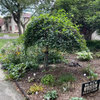
    There are a number of trees/shrubs that could be shaped like the one in the second photo. Unlike the first photo, the second does not have the classic mushroom shape provided by weeping forms. Once again, however, what we see in the second photo is the result of years of pinching, pruning and shaping. The diameter of the trunk is a clear indication that this plant is many years old. Growers usually start such plants with an unbranched whip, rub out any growth on the lower trunk, then pinch, prune and shape to produce a dense crown at the desired height. Trees and shrubs with short internodes - spaces between growth points - are best suited to such treatment as the crown grows more naturally dense. Once planted, they will require a good deal of pruning to maintain the way they were when purchased. They will also require pretty much full, direct sun to keep their symmetry. I would suggest that you email your photos to some large Canadian nurseries, explain what you're looking for and see what they suggest.

    One further possibility that occurred to me is weeping hemlock. This could be one of the smaller forms such as Cole's Prostrate high grafted onto a standard hemlock trunk or a full size weeping form that has been staked to the height you're looking for. Pruning would still be required to maintain the shape, but hardiness would not be an issue and it is an evergreen. If the hemlock adelgid is a problem in your part of Ontario, this would not be a good choice.

  • 10 years ago
    last modified: 10 years ago

    Ah, yes, specialty grafts! Local garden centers here do sell Globe Cedars with a spread of say 2 feet grafted on a straight trunk of 2 to 3 feet. I did ask about them and if I remember correctly, in 10 years they will grow to 5 feet tall with a spread of 6 feet. I am sure the canopy can be pruned to at least a dome shape (if not a mushroom shape) and that would be great!

    The trunks are spindly, though, and I kept thinking that the next strong wind will fly away with the entire canopy. Hope I am wrong.

  • 10 years ago

    If you decide to go with one of the cedars, some sort of protection from heavy wet snow would be important. The tree will not blow away, but a slender trunk with an evergreen canopy could be badly damaged, even broken, by snow load. A wooden A frame structure would provide the best sort of protection when the tree is small. As the tree grows and the trunk increases in diameter, such protection becomes less necessary. If you live in area that frequently sees deep and heavy snow, protection for the life of the tree is pretty cheap insurance.

  • 10 years ago

    Caldwell, the OP is in zone 4. Burford Holly is out of the question.


  • 10 years ago

    ontario_backyard, that tree above (2nd photo) is a lilac grafted onto a standard (dwarf lilac grafted up high on a trunk.)

    It would be easy to maintain shape of one with a hedge trimmer annually after it flowers. You wouldn't want to prune it the following spring or late in the same growing season because you would lose the buds that produce the flowers for next (years) flowering period.

    Some miscellaneous growth that occurs after maintaining its shape with electric/gas hedge shears could easily be maintained with hand pruners to keep it tight in form. There are always a few wild hairs that are going to pop up.

    Dax

  • 10 years ago

    Probably a 'Miss Kim' lilac I'll add.

    Dax

  • 10 years ago

    Dax - maybe dwarf Korean rather than Miss Kim?

  • 10 years ago

    Certainly a possibility. Miss Kim is a Dwf. Korean, too. We used to have a lot of Miss Kim on standards for sale at the places I worked . . . it must be very popular.

    Dax

  • PRO
    10 years ago

    I have a lot of people asking about common lilac, I don't see why they like it so much. mine is a stick with leaves on top, about 50 suckers at the bottom and hasn't bloomed in years. I never trim it, it never grows much.

  • 10 years ago

    Awesome.

    Dax

  • 10 years ago
    last modified: 10 years ago

    So, I bought my
    umbrella-shaped specialty graft :-) It is a dwarf Scotch pine with a spread of
    somewhat over 2' grafted on a mere 16" short but unusually strong trunk. It came in a
    15" nursery container and I had it delivered in the center of the 30"
    planting hole that I dug up beforehand. I had to cut up the container because
    it was too heavy to lift.

    There were a couple
    of surprises. I discovered that the burlap-wrapped root ball was sitting on
    about 4" of peat moss. I left it there for drainage because I could not
    remove the bottom of the container from underneath the whole thing which is
    very heavy. (I had already damaged a little bit of the beautiful bark because
    of all the handling that I did) The sides of the container have been completely
    removed.

    I cut open the
    burlap and there was the second surprise. The dark-yellow-colored soil of the
    root ball was very hard, almost like rock. I did try to poke holes on the sides
    of the root ball/soil with the tip of a weed puller. I did not see roots
    growing in circles, so I am not sure if the plant is root bound or not. (Again,
    I could not remove the bottom of the burlap sitting on the peat moss) The sides
    and top of the burlap have been completely removed.

    Currently, the plant
    looks very healthy. I did put granular fertilizer in the planting hole,
    provided the planting with a generous mound of top dressing soil, etc. but I am still a bit concerned about the long term survival and
    health of the plant because of the above described surprises. The manager of the garden center merely told me to water until the ground freezes.

    What else can I do to
    best ensure long term survival and health of the plant? Thanks!

  • 10 years ago

    First, congratulations on finding the sort of plant you've been looking for. It's always nice to read follow ups to plant searches.

    Second, much of this you are probably not going to be happy to read.

    It sounds as if the pine was field grown, then balled and burlaped, then placed in a container to make a more attractive presentation. The peat moss in the bottom was most likely used to raise the root ball so it did not look odd in the container. Peat moss does not improve drainage. It does pretty much the opposite.

    Balled and burlapped plants are commonly grown in clay soils or have clay packed around the roots so the ball holds together well. That's what you found beneath the burlap.

    Fertilizer is not necessary when planting and can be harmful if overdone

    My suggestion would be to gently remove the soil from around the root ball so the clay is again exposed. This ought to remove some of the fertilizer as well. Use a forceful stream from a hose and/or something like a hand cultivator to expose the root tips all around. A half inch or so of the root tips is enough, but it is important to do this. The only thing I can think of to do about the peat moss is to pry up one side of the root ball with a lever, place a rock underneath and rake out as much of the peat as you can. Pack soil to replace the rock and move around the circumference of the root ball doing the same thing as you proceed. That all sounds pretty good in theory, but may be impossible in practice. In that case, you'll have to leave the peat and pot bottom as is and hope for the best.

    You do need to keep it watered until the ground freezes, but it's disappointing to say the least that the nursery manager did not offer any more detailed instructions.

  • 10 years ago
    last modified: 10 years ago

    I am afraid of doing anything big (and heavy) because I might damage the tree.

    I removed the dry needles from the crown with a little wooden stick. The tree also attracts ants, so I sprayed some insecticide on it.

    Not sure what extra tender loving care I could give to the tree.

  • 10 years ago

    Your concern about doing harm to the tree is understandable. At least remove enough of the loose new soil so that some portion - the upper half would be fine -,of the root ball is uncovered, then use the hose and/or hand cultivator to expose the root ends. This will not do any harm to the tree and is necessary to encourage rooting into the surrounding soil. If not done, the tree can sit and sulk for years with all of the roots still within the clay. Because of the weight and awkwardness involved, leave the bottom of the pot and peat as is.

    Removing dead needles from the interior was a good idea as they can encourage fungal infection if not periodically removed.

    Ants will not harm trees. Spraying them with insecticide definitely can. Don't indiscriminately spray unless there is a serious, identified pest problem and you're certain that the treatment is safe for this species. At this time of year, spraying with a fine mist of plain water can be very helpful in raising the moisture level around the needles, lowering the air temperature and keeping common pests such as aphids and mites away.

  • 10 years ago
    last modified: 10 years ago

    Thanks for all the advice, akamainegrower, you must have noticed by now that I am not much of a gardener, but I really like my new little tree.

    The root ball is really really really hard, I first tried to scrape it with an (aluminum) cultivator to no avail, that was the reason why I then picked the sides of the root ball with the tip of an (aluminum) weed puller and stopped when I became concerned that I would be doing more harm than good if I continued.

    I did not try a water jet stream to work the root ball, but it gives me the idea of drilling (1/4") holes in the root ball with a power drill. Perhaps drilling on the surface top-down first, let water work for a month, then dig the top 4" and drill (1/4") holes from the sides on an downwardly angle.

    What do you think?

    I would be doing it for the long term survival and health of the tree, I would not be doing it for growth. I rather like the current size of the small tree and would not mind at all if it does not grow any larger or only grows a little larger.

  • 10 years ago

    The drill idea is definitely worth a try. I think I would drill from an inch or two in from the root ball edge and angle toward the outer circumference. Then use the hose to blast away in the same direction. It's the force of the water that's important, not soaking the clay. A cultivator with sharp tines should also be more effective with the holes from the drill. Sometimes you really need to use a lot of force in this process. It really will not harm the tree even if you sever some roots. This actually stimulates new root growth. There isn't any reason to uncover the tree again in the future. Once some of the root tips are exposed all you really need to do is keep the tree watered and keep an eye out for any pests on the above ground portion. As for how fast and how much the tree grows, this is pretty much dependent on what understock the Scotch pine was grafted onto. It may well be ordinary Scotch pine with a dwarf variety grafted to it. This combination should be relatively slow growing and the top portion can always be controlled by pruning. It will grow taller, but probably very slowly. Keep a watch for any sprouts from below the graft and remove them as they appear. Wishing you many years of enjoying your tree.

  • 10 years ago

    I should have written "angled downward toward the outer circumference" In the above.

  • 6 years ago

    Is this for sale ?