

Goodbye to Tomatoes
Well, the tomatoes have been pulled and bagged up, with the exception of 5, which will come out this week when I get the last tomatoes off each one. I have 3 new ones in the ground, but they aren't looking all that spiffy. All the fall tomatoes that are potted up look like they either have the russet mites, blight, or whatever, so tomato season is probably over for me altogether.
The oldest of the cucumber plants are looking rough, but still producing, so I'm leaving them.
The hot peppers are doing well, and so they are right in the middle of where I want to redo the beds for fall. I'll have to work around them someway. They are the one constant now.
I've been going through John Jeavons' books, and I like the smaller book best....it doesn't rattle my brain as much as the larger one. Gracious, with the intensive spacing, it seems like it's possible to grow enough to feed the whole neighborhood. I doubt I'll be that lucky. A quarter for the critters, a quarter for the bugs, a quarter lost to disease, and may a quarter left for me? Is that too ambitious?
I feel like I've been crazy lately...distracted and tired. I was pretty sure I had lost my mind yesterday when I was trying to make pickles. I filled the water bath canner, and set it on the stove, started getting everything ready, and I went to put my jars inside to sterilize them....and there wasn't much water in it. I was almost positive I'd filled it! Then I looked.....my stove was full of water! The canner had sprung a leak. Luckily, I had a big stockpot with a rack in it, so I was able to continue on...just had to do it in two batches.
I'm ready for fall, and ready to hear what everyone is planting...so I can copy your ideas;)
Comments (37)
 10 years ago
That's what I do...copycat..and I gladly admit it. When someone comes and compliments me I say oh trust me it's not an original idea I learned that from ______.
There is so much knowledge out there why rack my tired brain to reinvent the wheel.lol
 10 years ago
My tomatoes mostly look like poop but they're still setting fruit, so I'm leaving them. However, I'm not rushing to plant a fall garden. I do have seminole and old fashioned tennessee vining pumpkins growing. And some new pole beans and southern peas and some other stuff like honeydew that hopefully will be productive if we don't get a freeze until November. Marching season starts soon, so we'll be really busy with that too. As well as finishing our home remodel. I'll be paying attention here--for ideas for next year. :)
Related Professionals
Salisbury Landscape Architects & Landscape Designers · Saint Cloud Landscape Architects & Landscape Designers · Edison Landscape Architects & Landscape Designers · Greenville Landscape Contractors · Fayetteville Landscape Contractors · Dayton Landscape Contractors · Myrtle Beach Landscape Contractors · Waterloo Landscape Contractors · Show Low Landscape Contractors · Sierra Vista Landscape Contractors · Victorville Landscape Contractors · Florence Accessory Dwelling Units · Harrisonburg Accessory Dwelling Units · Huntington Accessory Dwelling Units · Burlington Accessory Dwelling Units 10 years ago
I forgot peas! Lots peas direct sown today.
Next:
Turnips
Beets
Chard
Kale
Collards
Lettuce
Turbo Cat (7a)
Original Author10 years agoBon, I'm doing the same thing, except I'm starting indoors. I've got broccoli, cabbage, chard, kale, collards, cilantro, dill, brussel sprouts, mustard, winter squash, more cucumbers, and I want to try carrots, but I don't have seed. I may order some today. I need to try and start as much indoors as I can, because once i mess with the soil outside every weed/grass seed out there will germinate before any garden seeds do. It's amazing to me that the weeds can carpet the whole area in a few days.
My broccoli seems really leggy, but I have it right up next to the lights. It was just up and tall overnight.
I was reading some old posts about carrots last night....I have never tried to grow carrots, that I can remember, or if I did I failed at it. I'd like to try one of the short fat parisian-type varieties. Has anyone ever ordered from Henry Fields? Their prices seem reasonable, but I don't have any experience with them. I was thinking about starting them in little dixie cups with the bottoms cut out.
I have a lot of work to do in the garden before it's ready to fall-plant. I need some composted manure, etc. It's amazing how those raised rows don't seem so raised now, since the tomato plants are gone. Plus, I want to widen the rows for this intensive experiment. Once I get that done, I'll go ahead and get ready for beets, turnips, and get the lettuce and bunching onions started.
mary
 10 years ago
Last year the carrots that performed for me were Nelson, Napoli and Muscade. I direct seed, last year was August 28th. I sometimes cover the seed with vermiculite to keep it moist. Then I lay wet burlap over it. It keeps the seeds from floating off when you water and keeps the soil moist and hopefully "uncrusted".
- 10 years ago
Mary,
I have been pulling out tomato plants after harvesting the last big fruit. I ignore tiny green ones that aren't going to have a chance to mature before the heat, disease and spider mites can kill the plant. This week, I've gotten behind on yanking out plants because (a) it is too hot, (b) it is too hot, and (c) it is too hot. Oh, really it is because (a) it is too hot, (b) I spend my small amount of time in the garden harvesting (this week's harvest mostly is southern peas, lima beans, squash and peppers....and a stray cuke here or there), and hand-watering random containers that need it, and (c) it is too hot. So, okay, I have two good reasons that I'm not yanking tomatoes since harvesting must come first (and watering containers is imperative) and then 5 better reasons---because human health and survival come first. If we ever have an evening again where it still isn't in the 90s by dark, I'll go out in the evening and yank out plants.
Most of my cucumber plants are succumbing to bacterial wilt now, but the ones that haven't died yet are still producing, though they aren't producing much, and I'm just chopping up those cucumbers and feeding them to the chickens daily. The chickens love having a water-filled treat on hot afternoons and I hate to waste pickling cukes but I am so done making pickles this year that it isn't even funny.
Most of what I have planted now for a fall harvest is winter squash. I planted these varieties: Seminole, Seminole larger-fruited, Musquee de Provence, Sucrine de Berry, Butterpie, White Crookneck,Tan Cheese Pumpkin and Dickinsen. I also planted a succession planting of icebox melons (Sugar Baby, Yellow Baby, Yellow Doll, New Orchid, Tiger Baby) and a third succession crop of cantaloupes/muskmelons: Old Israeli, Ha'Ogen, Alvaro Charentais, and Hakucho Charentais. They should be producing melons in Sept and Oct, long after the Hale's Best Jumbo from the first two plantings have finished up. For late-summer fall color I planted Amaranth 'Cinco de Mayo' (Renee's Garden Seeds) and Cleome. I also planted fall tomato plants. One of the fall plants (Solar Flare) that I planted in a container in June is about to produce its first ripe tomato. The other varieties haven't set fruit yet.
I have a bunch of cool-season seeds sitting on the kitchen counter waiting, waiting, waiting. I haven't had time to sow them indoors in flats yet, but hope to get that done this afternoon. So far, the only cool-season seeds I've sown indoors are kale, broccoli, brussels sprouts and cauliflower. Oh, and some very old seed of six ornamental kale/cabbage varieties that may or may not sprout.
I'm further south than most of y'all, so can plant significantly later, so you'd better not be copying me (grin) or you'll be planting too late. Y'all are supposed to be a couple of weeks ahead of me a this time of the year and I am supposed to be copying you.
We are very dry here. It is hard to explain how we can look as green as we do (called Visual Greenness) and yet still have such poor moisture in the upper levels of the soil, especially since there is good moisture down deep in the soil. I assume our Relative Greenness is not as good as our Visual Greenness. It happens though, and often it happens because we get one good rainy day in the midst of a dry spell and it quickly greens up fields that still remain deceptively dry anyway. The rain from two weekends back greened us up in this manner. It makes us look very green but, as we learned yesterday, the green grass is dry enough to burn. Sadly, when green plants burn they actually can burn hotter than dormant plants burn. Yesterday's grass fire moved through a green field pretty rapidly. Before yesterday's little grass fire (5 acres, or roughly the equivalent of 5 football fields), I would have thought we still were too green to burn, and I would have been wrong. This makes me stop and assess how much more I can plant for fall and that is largely based on how much money I'm willing to spend on irrigation. I wanted to put all the winter squash in the back garden, but that would have meant irrigating two large garden plots, so I crammed them all into the front garden where they will be too crowded, will fight for space and likely will succeed in over-running everything else I've planted. My icebox melons and cantaloupe/muskmelons are trellised, and I will keep the winter squash from overrunning those simply by pulling the winter squash vines down and rerouting them each time they try to move into the melon beds. My plan has been that I can put all the cool-season plants in the ground out back later onif it starts raining, but if it doesn't start raining, I'll have to find ways to cram them into the crowded front garden. Regardless, cool season root crops only can be planted in the front garden.
I've reserved two of the spring potato beds at the far north end of the garden for fall root crops, but won't plant those until August. One of those beds has southern peas in it now, but I harvested just about the last of that crop yesterday and will yank out those plants in another week or two as soon as I harvest what's left developing on them now. They are the second succession crop of southern peas and are about finished. The first crop of southern peas already is done, and the remaining 4 succession southern pea crops still are producing really well. I'll likely have to remove them while they still are producing merely to make room for more fall crops. The other potato bed that will be available has the second succession crop of summer squash in it. I can yank that out whenever I need the bed for root crops if the SVBs don't find the squash first. The third potato beds has a nice bunch of Hale's Best Jumbo muskmelons growing in it and probably will be succession planted with spinach or collards in fall. Or turnips. It depends on how much I cram into the other two hardware-cloth lined beds.
Winter cole crops will go into the southernmost raised bed where I still have a handful of tomato plants, including too many SunGold plants, and lots of hollyhocks, Laura Bush petunias and a few daturas that spontaneously sprouted where I pulled out the Tasti-Lee, Bella Rosa and St. Pierre tomato plants when they'd produced all I wanted form them.
It seems ridiculous to be talking about planting the fall garden on what is likely to be our hottest day of the year so far, but then the heat at planting time always is an issue in starting a fall garden just like the cold weather in late winter/early spring is an issue when we are planting our spring gardens.
My spring planting of Swiss Chard will carry over into fall and winter, and it looks like I see a bunch of little lettuce sprouts popping up in a bed where I let two lettuce plants go to seed this spring. At least I hope it is lettuce. They are popping up in the shade of a tall trellised areas of Sieva lima beans, but there was lettuce there earlier in the year and the two lettuce plants that went to seed are still there, sticking up like ugly sore thumbs beside the lima beans, spreading lettuce seed far and wide.
Otherwise, I'll probably sow lettuce seeds in the flat black concrete tubs where I grew lettuce in spring. Right now there's Balconi Yellow tomato plants growing in those tubs. I did leave one Cherokee lettuce plant in a former tomato-lettuce bed that now has Sugar Baby watermelons growing in it, and that plant is going to seed now, so it is possible some lettuce plants will pop up in the midst of the watermelon plants.
If our dry conditions advance to drought, I don't know if I am willing to water as much as I'd need to water in the August heat to keep it all alive and thriving. Time will tell.
Dawn
- 10 years ago
I have some of those bonsai tomatoes, too. The seedlings I planted in April were about an inch tall. Now they're about 7inches, but look like beautiful spring plants so I'm staying optimistic. The ones I got at the fling are humongous, even if they're not producing very well.
- 10 years ago
I don't understand the plants that just won't grow. Are y'all feeding them? Stunted growth like that normally is a result of root damage or lack of nutrition.
- 10 years ago
Feeding them regularly, just like the bigger ones. And they're in the same soil, maybe 4ft away, so you'd think there would be similar growth. Only difference is I planted one when it was tiny, the other a good 3ft. But I will say theyve taken off in the last week or so, so maybe they just want to be fall tomatoes.
- 10 years ago
Maybe, but it defies logic for a plant to sit and sulk and just not grow like that.
- 10 years ago
I have raised beds, and whatever I plant sulks until, in my imagination, the roots reach the lower soil or water table or whatever. Now things I planted in April are well past that point, so it's probably not the same, but maybe there's a big rock under them they're having to work arpound.
- 10 years ago
That's so weird that y'all have tiny plants that look like healthy spring seedlings...but they're really several months old. I could understand if they looked nasty and sick...but they look healthy. So strange. My stunted plants were sickly and yellowish. Maybe they're just holding out for fall.
 10 years ago
I have a Big Beef and a Cherokee Purple that are both doing the same thing, just hanging out in their little well amended holes, sucking up water and fertilizer, not doing much of anything. Of course, my Early Girl did the same thing for a good 6 weeks before she decided to start growing, and now is over 5 feet tall. So I dunno.
I'll be yanking out the 3 Solar Flares tomorrow, and the Husky Cherry. Came home from work and they're 90% dead from blight. Weren't like that 2 days ago. I did get to pick one blushed SF to bring in to ripen. Buying replacement plants at TMD tomorrow. I know I can't plant more tomatoes in those containers, but I can throw in something like beans or sugar snaps, right? Or bunching onions, or save them for root crops?- 10 years ago
Yes, you can put other things in those containers. You likely even could put tomatoes in them again if you added some compost and added a little sulfur, which serves as a fungicide and might keep any residual fungal spores in the growing medium from moving to your plants. Just mulch the soil surface after planting so any surviving fungal spores don't splash up onto any of the new plants when you're watering. I've followed spring tomatoes with fall tomatoes many times and not regretter it. Once the fungal diseases exist in the garden, they are airborne and can go anywhere any way.
- 10 years ago
So, Dawn, you're saying my gardening is illogical. Well, I could've told you that! Here's my plants today. Sprouted in early March, now about 3ft high. To me, they look just as healthy as spring plants.
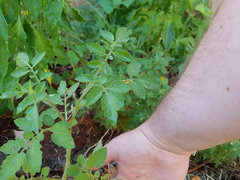
- 10 years ago
And it's not a total loss. My big boy that I've been watching is ready for eating. He had to get picked early, something else was starting to sample him.
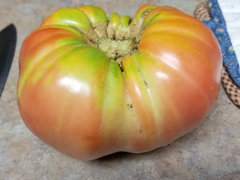
- 10 years ago
I have 7 new tomato plants to plant, but I can't get back to the yard to do it because of a fallen tree branch blocking the garden gate. I can hack my way through to get back to water, but not to drag bags of compost and potting mix. So, the 'maters are temporarily hanging out in an empty lettuce planter until the handyman removes the branch tomorrow afternoon. By Tuesday it should be cooler and better for planting anyway. Trying to remember everything I got - Sioux, Delicious, German Johnson, Tommy Toe, Arkansas Traveler, Bloody Butcher, and Fourth of July. Mom dropped the bomb on me that she really only wants large red slicers - period. No pink, purple, yellow, orange, green, bicolor. Mediums are ok and better than nothing, but she also wants no large cores. Apparently that infuriates her. And she hates cherry tomatoes of all kinds. So. Now that I have the Black Cherry and Sungold taking off, she tells me this. At least I have a few large slicers in the ground for her, but I guess I'll have to plant a good number of those for her next year. Maybe what I have this year will change her mind, if I get anything.
- 10 years ago
If you can get her to taste black cherry and sungold you may convert her.
- 10 years ago
Ha. When people tell me they only want large reds, I tell them that's okay and that I will eat all the other colors and they can have the reds. I don't plant many reds, so the joke is on them. My dad always wanted only red or pink tomatoes, but he grew his own so I didn't care. I just told him he didn't know what he was missing with the others. I think he had grown Lemon Boy a few times in my childhood, but he didn't think it had good flavor.
I had a friend who tried his first black tomato ever, from our garden, around 2005. He couldn't get his adult kids or his great-grandkids to try the black ones, so he told them "never mind, that leaves more for me", which certainly made them realize that he was too happy about them rejecting the black tomatoes, which could only mean one thing---that the black ones were really great. He and I always got a good laugh out of that. I do know people who only want Celebrity or Better Boy or Rutgers or whatever, and that's fine if they are growing them, but they shouldn't expect me to choose what I'm growing to suit them.
Can you get your mom to tell you exactly what varieties she likes? Then you could grow those specific varieties for her without trying to read her mind and figure out what she likes. With my mom, she really didn't care---to her all red tomatoes were the same and were adequate. I don't think she ever loved tomatoes the way Daddy and I did though. I don't mind cores. I just cut them out. Any tomato you grow, red or not, with a core or without, still will be better than anything she can find in a local store.
- 10 years ago
Any tomato is delicious, but my dad feels the same. Red slicers only, everything else "tastes funny". Oh well, more for me.
- 10 years agolast modified: 10 years ago
Oh, I am so going to try to get a Sun Gold and Black Cherry into her. I think I can convert her to the darker reds and purples too. I'm not a huge fan of yellows and oranges in slicers either, though. They always taste too acidic for me. I have that problem in a lot of tomatoes, so I find I'm leaning towards sweeter varieties. I just like the smaller fruits, where she prefers giant ones. Either way, she did admit that any homegrown tomato is better than a grocery store one, for certain. Her pick at TMD (we ran errands together) was Sioux, which she went for because of the flavor description, not size. So maybe there's hope.
Dawn, I'm pretty sure she wouldn't be able to name varieties, but I do know she likes old-fashioned flavor, the balanced sweetness and acidity. I think that's why she gravitated to Sioux. Brandywines are one we both love, but hate that they're so hard to grow here. My last Sioux is the one that keeled over and died within 48 hours of planting, so fingers crossed that this one makes it. As I'm mainly growing for us both, I want to grow things that we both like.
- 10 years ago
Here's the most interesting thing I have learned about growing Brandywine here. For years I planted on-time, as recommended by OSU, and got good harvests in cooler, wetter years when we stayed cool long enough for the Brandywines to set fruit before the heat set in, and got poor harvests in the years we heated up early.
I love Brandywines so I just kept stubbornly planting them anyway, knowing it was a crapshoot and I might get nothing from them some years. Then I started buying Brandywine to plant in containers in February when the transplants first hit the stores, figuring maybe the earlier I planted them the better. I've done this for about 5 years now, always trying to find a Brandywine or two when the plants first pop up in Dallas around the first week of February. I do this even if raising my own Brandywines indoors from seed sown on Super Bowl Sunday. Guess what happens?
The early, purchased Brandywine plants from my February trip to Dallas to find early tomato plants always produce huge loads of fruit compared to the ones I raise and transplant into the ground after mid-March. I bet each of my two Brandywine plants that I started out in 1 gallon containers on Feb 1st (they were in 4" peat pots when I bought them) this year and carried indoors on cold nights and outdoors on warm days probably produced at least 30-40 fruit per plant. I did put those plants in the ground in March before I transplanted my own plants into the ground and they were so far ahead of my homegrown plants in size and flowering that it wasn't even funny. We had so many ripe Brandywines at one time this summer that we couldn't even eat them all so I used them in salsa. So with the Brandywines, more than any othr tomato variety I've ever grown here, it seems like the extra early start helps them beat the heat in terms of fruit set. It is a method I intend to keep using.
One of these days I'll start tomato seeds in late November to get them the same size by February as the plants I see in stores then, but saying I'll do it is easier than actually doing it because I'm always so busy with holiday stuff at that time of the year. If I could find the time to start the seeds on the light shelf around Thanksgivng, then I can grow all the early Brandywines I want without having to search the stores in Dallas for the arrival of the first tomato transplants. Since I stay home and avoid going anywhere on Black Friday, maybe I'll make that my new tomato seed starting day for Brandywine and other large-fruited varieties that perform best if they can an extra-early start. And, of course, the last two years have had plentiful rainfall in winter and early spring, so that may have contributed to how well the Brandywines set fruit early. I might not get the same results in a really horrific drought year when the winter and early spring rains are skimpy to non-existent.
Dawn
- 10 years ago
I just want to GET enough edible tomatoes to be able to say I grow tomatoes. Right now I just grow tomato PLANTS. They are such brats sometimes.
- 10 years ago
LOL, Rebecca, been there, done that. I am formuating a plan to start them earlier this year.
- 10 years ago
I understand why you feel that way, but it actually is the weather that is the brat. The tomato plants want to grow and set fruit and the weather won't let them. That is the plain and simple truth. Don't blame the sweet little tomato plants. Blame the evil temperatures.
When we hit 90 degrees at our house one day in February, I knew right then in my heart exactly what sort of year we were going to have with our gardens in 2016. When we hit the 90s, even for one day, in mid-Winter, that's the sign of a coming summer apocalypse at least as far as the garden is concerned. I didn't recognize the warning I was getting from a stray hot February day in 2003, 2005 and 2006, but by 2008, I understood it. Finally. It just took me a few years of seeing how an early hot winter day here and there seemed to be an omen of what was to come. Then I had to figure out how early I could plant and how I could cover up early plantings well enough to keep them from freezing. That took a few years but I just about have it figured out now.
This year, after that early heat, I did everything I could do to rush tomato plants, bush beans, sugar snap peas, lettuce, collards, spinach, cauliflower, broccoli, and cabbage plants into the ground as soon as I could (not too long after I got all the potatoes and onions planted) because I knew that planting early was our best hope. Then I tried to get sweet corn and cuke seeds planted by mid-March. Was it ridiculously early? Yes. Did it pay off? Yes.
When nature sends us weather clues like that, I heed them and go into full-on hurry-up-and-plant-early mode. I don't know anything else to do in that case. Early planting pays off, and on-time and late planting don't because we rarely have abnormally late cold but often have abnormally early warmth that can ruin our ability to get harvests. This year, it didn't even get so cold that I had to cover up much of anything overnight, which was a relief. Sometimes I covered up tomato plants out of an abundance of caution, but there was only one or perhaps two nights when we got close to freezing and the covering up of the tomatoes really was more or less necessary.
I expect next year to be worse. While the year in which an El Nino ends often starts out rainy and ends dry, the year after an El Nino (often, but not always) often gives us a La Nina and is dry throughout. I'll try just as hard, or maybe even harder, to plant early next year. It is the singlemost thing I do that affects the garden output. It doesn't matter how well-improved the soil is, how much I irrigate, what I use as fertilizer, how much I mulch or weed or whatever. Everything has to get into the ground early enough to beat the heat, or all that other work is not going to matter very much.
At the various times that I have bought rolls (and rolls and rolls) of winter weight floating row cover, I hated spending that much money for something that seems to be unnecessary. You know, it sounds like a luxury product that you don't really need, but in our climate, I consider it a necessity. When all is said and done, it has been a wise investment. Floating row cover extends the harvest in fall/winter and allows early planting in spring, so every penny I spent on it was money well-invested. I take good care of it, hoping to make it last as long as possible. One plus is that the heavier the row cover, the longer it lasts since it doesn't tear and shred so easily, so these winter weights last much longer than the lighter weight ones do.
I just harvested the first tomato from a fall plant today. It isn't very big, and it is Solar Flare, so it won't be anything special taste wise, but at least we'll be able to say we got 1 tomato from the fall plants, even if everything else all goes to hell from this point onward.
Today is supposed to be cooler and more comfortable, but our heat index has already hit 105 so I'm not feeling any happier than I felt yesterday, though so far our heat index is lower than yesterday's. Some of the spring tomatoes still are producing, but except for the cherry types, this is fruit that set a while back--probably mostly in May or maybe early in June. The fruit quality isn't even all that great because there's so much stink bug damage. July is just what we call a sucky month around here.
I need to go outside and water the chickens. We make puddles. We splash. We lay in the mud. We play in the sprinkler. Well, I man the hose and they have the fun. It helps get them through the heat.
- 10 years ago
Duh! I tried to get my girls to wade in a pool when it first got hot, they wouldn't even go in for meal worms. But they did not seem to mind the puddle I just made, though they walked in by accident and didn't seem to be playing. Maybe later.
- 10 years ago
I think chickens have rules. Like, do not accept any sort of pool provided for you by humans, even if they bought it especially for you. Ignore it, but then insist upon the humans making you a nice puddle under a shrub so you can walk in it, splash in it, and lie down in it, leaving a ring of brownish-red mud around your white feathered body. Or, ignore the pool thoughtfully provided for you by your humans, but go stand in the turkey's water dish. Or, wait until the humans are washing the car and go try to grab soap suds in your mouth because, who knows, maybe soap suds look like cotton candy to chickens.
Ours love sprinklers, but they are even happier when you turn off the sprinkler so they can waddle around in the wet grass or just lie down in it. They also love for me to turn on the soaker hose around the foundation. It takes a long time for it to provide enough water to turn dry clay into mud, but then they delightfully stomp around in the mud, and even peck at the hose. (Maybe they think it is a snake. I don't know.)
Set down a glass of water on a porch step and a chicken will have its head in that glass of water in the blink of an eye. Any drink container I take outdoors has, by necessity, a lid on it unless I'm planning to have an iced tea party with the chickens.
I feel sorry for them so I'm running the hose right now making them big old puddles. So far today, our heat index has topped out at 110 and the chickens are very hot. Where's my cooldown and where's my rain? Chickens with enquiring minds want to know!
- 10 years ago
Tulsa's heat index is supposed to be 101, but it is cloudy here and my patio temp is only 91 and the chickens are foraging like they usually do in the evening. We've had a good breeze most of the day, too. I actually worked in the garden for awhile today. It loked like there was rain east of you. I was hoping you'd get some.
- 10 years ago
I am going to have to formulate a plan to plant earlier this year. I don't have the space or equipment to start my own seeds, though. I'm at the mercy of when plants appear in the stores, and when TMD opens up. I want to try to wintersow peppers next spring, because I want more variety than just California Wonder(?) and Bonnie's Bell. Maybe I should consider doing tomatoes too. Amy, you and I are close enough together, I bet we could plant around the same time. Buying row cover could be bad for the budget, though.
- 10 years ago
Yeah, row cover. I have some frost blankets. I don't know if that is enough. You can put jugs of water around a plant like a homemade wall-o-water. Some people cover plants when a freeze is expected with buckets, extra pots, card board boxes. It might be worth it to plant a bed and experiment with the options side by side and see what works and what suits my personality. I know it gets old running out to cover plants all the time. Row cover that could be left in place would be much easier. Maybe I'll ask for rowcover for Christmas, that and grow lights ;)
Funny you should mention California Wonder, THAT is what I winter sowed, LOL. It did great that year, but no bells have done much since.
- 10 years ago
For me, the investment in row cover was worthwhile. The first whole roll I bought was 250' long x 6' wide and cost less than it would cost me to buy replacement pepper plants and tomato plants if a freeze the first week of May killed all my plants. It was precisely because a late freeze in May killed all but 4 of my tomato plants one year (and wiped out the corn, peppers, squash, beans, etc.) that I bought that big roll of frost blanket weight row cover to replace a hodgepodge of methods I previously used that included using buckets, boxes, baskets, blankets, etc. to cover individual plants.
For me, the frost blanket weight row cover was a great investment, because for at least 7 years in the 2000s, beginning around 2006 or 2007, we had 7 (yes, 7!) straight years with a killing freeze the first week in May despite having an average last freeze date of March 28th. Want to know what misery is? Going outside to your garden on a morning when your forecast low was 50 and your actual overnight low was 32. On May 3rd. Imagine having tomato fruit that were breaking color destroyed by a surprise freeze that froze the plants back down to the ground. Imagine having that happen over and over. I don't know why that long string of late freezes in May occurred, and it likely had something to do with our low-lying microclimate, but there's no way I was going to start putting off planting until May.
Long before I bought the heavier weight row cover, I had a lighter weight one that gave 4-6 degrees of protection, or maybe 8 degrees if I used a double layer. The first piece of that weight that I bought was 6' wide by 50' long and cost less than $20. It worked okay for a typical cool spring night when there was a chance of temperatures near freezing, but after we started having repeated late freezes in May when my large garden was already maturing and producing harvests of many veggies, I bought the best stuff I could find. I've never regretted it.
I have a huge garden and the row cover gives me peace of mind that is priceless. If it saves the garden from freezing one time per year, then it has saved me the massive cost and time required to start over from scratch with everything, not to mention that starting over in May with tomatoes means likely no fruit harvested until fall, which is just unacceptable at our house.
We haven't had the late hard freeze in May the last 2 years, but the row cover is stored in the garage, just waiting. Because the heavier duty row cover is so heavy, it lasts forever, unlike lighter weights that only last a couple of years. Nothing has changed my gardening life the way the row cover has. It was money I hated to spend at the time, but when I saw what a difference it made, my only regret was that I had waited so long to buy it. I also can use it at the end of the season to cover up and protect my plants from the first freeze or frost. Often if you can get your plants through the first cold night or two in autumn, then we get another 4-6 weeks of warm weather with no freezing nights or frosty mornings. Thanks to the row cover, my harvest period usually runs from March through at least December, and if I wanted to be more serious about using it, I could harvest year-round.
While row cover seems like an unwarranted expense, if I had to choose between my Mantis soil cultivator, my drip irrigation lines or my row covers and had to garden for the rest of my life with only one of them, I'd choose the row covers. They make that big of a difference. When row covers first became available to home gardeners in the 1980s, I laughed and scoffed at them and said it was just utterly ridiculous to buy a pricey textile material to cover up plants. I mean, I made fun of the idea endlessly. I feel completely different about it a few decades, and some really hard/late/killing freezes, later.
Turbo Cat (7a)
Original Author10 years agoDawn, I agree about the value of row covers. I only have a small garden, and therefore my cost for them is pretty negligible, but they serve more than one function for me. I can't imagine what it costs you to keep enough to protect your garden, but I'm sure it's worth it.
- 10 years ago
I think that's an advantage I have to planting mainly in containers, I can move them if necessary. For spring, when things are still small, I can snuggle them up against the house in a sheltered area, and it won't take much to cover them up. Still potentially possible in the fall, but more difficult with bigger plants. Cost is an issue, even though I know the investment would be worthwhile. It's the initial layout.
Amy, California Wonder are good peppers, I just want to try something different. Seems like that's all I can find around here. I'd grow it happily if I needed to, I just want to try everything, and a few things I haven't found around here yet. And, I'm thinking we can aim to plant about 2-3 weeks after Dawn plants. Channel 6 tends to be good about talking about planting weather. - 10 years ago
Mary, At least I bought increasing amounts of row cover over 3 springs. Had I bought it all at once, Tim might have had a stroke when he saw what I spent. I just weighed the cost of covering up and protecting the garden versus the cost of replanting it, and added in the knowledge that replanting it meant a lot of our usual spring harvest wouldn't come until fall. So, now that I have a great supply of heavy duty row cover, we haven't needed it much at all the last two years, but they have been El Nino years, and my worst late freezes mostly come in La Nina or neutral years, so I guess I'll be needing them again soon. Part of the consideration isn't only the cost of plants and replanting, but the amount of time spent to get the garden to a certain point and then losing that time investment to a late freeze.
It was pretty funny when I was ordering them for those three years. By the second year, the FedEx guy stopped to ask if I wanted the row cover at the garden or at the house (I was working in the garden when he arrived) and I choose to have him leave it right at the garden. The third year I ordered more as a huge late freeze was bearing down on all of OK and he stopped at the garden, unloaded the two rolls there and then came up to the house to tell me he left them there. Then he asked if I was going to have time to get it all covered up before the freeze was expected, which was not expected that night, but the following night. I told him I expected I would. It turned out he lived/gardened in OKC and had bought row covers himself after seeing how they protected my garden. He's not our FedEx guy any more, but it was great having a FedEx delivery person who understood gardening and weather well enough to just drop the row covers right at the garden gate.
Rebecca, Containers are what give me the earliest tomatoes. Just by carrying 4 to 8 containers in on cold nights and out on warm days, we are able to begin harvesting tomatoes in April, which I think is pretty amazing. I probably could leave them in the unheated greenhouse at night, but I just put them on a baker's rake that sits in one corner of the mudroom that is just one step inside the back door. It doesn't take long to haul in a few containers at night. That way I don't have to worry that the greenhouse might drop down too cold at night. I could just heat the greenhouse and not have to worry about it, but I'd rather not start heating the greenhouse. I think if I ever got use to having a heated greenhouse in winter, I'd want to keep it heated all winter, and the cost would add up. I do keep some plants in the greenhouse all winter (brugmansias, one fig tree, one Texas Lantana in a molasses feed tub, a few trees (including a lemon and an orange tree) and my rhubarb (it burns up in our summer heat and dies in our waterlogged clay in winter, but works in large containers) plants. All of those, except the citrus, can tolerate sub-freezing temperatures. To protect the citrus trees, I just throw a layer of 10-degree row cover over them if we are expected to go down to freezing or below.
In some years I've grown tons of stuff in containers, but now it mostly is just the items I listed above, plus a rosemary plant in a container in the front garden, but I leave it out there year-round. I believe it is "Arp" and can handle our fairly mild winters here in southern OK. I also have a few cannas in containers in the front garden, but that's to protect them from voles and they stay out in the winter too.
My 'old age' garden is going to be a bunch of Earth Boxes on a deck or slab, but I hope that's still a couple of decades away at least, or at least more than a decade away.
Dawn





chickencoupe