Software
Houzz Logo Print
germain_wong

Metal Roofs

10 years ago

Are all metal roofs (Aluminum, specifically) created equal?


Which manufacturer puts out the highest quality product? So far the only company I've looked into is Atas, but I feel like I should get to know at least a couple more before deciding.....


Any insights would be appreciated!

Comments (33)

  • PRO
    10 years ago

    The two main things I looked at when I put a metal roof on my house was the thickness of the metal and how it was attached to the roof sheathing.

    Germain Wong thanked Mark Bischak, Architect
  • 10 years ago

    What thickness is recommended?


  • PRO
    10 years ago

    The manufacturer I chose offered 26 gauge and 29 gauge, I chose the thicker 26 gauge.

    If you live in a snow area, make sure you make allowances for show accumulating and falling off the roof.

  • 10 years ago

    So the smaller the number the thicker the material...


    Yes, snow is a concern for me, especially when I have a 2:12 pitched roof!


  • 10 years ago

    With a 12:2 roof pitch you need to be sure the option you choose is rated for such a shill pitch. Not all are.

  • 10 years ago
    last modified: 10 years ago

    At that pitch I would not use aluminum. In fact, I would not use metal. That's a roof pitch that needs fully adhered EPDM single-ply synthetic rubber roofing.

  • 10 years ago
    My architect and the roofing company (Atas) didin't seem concerned with using aluminum. The roof has a "cricket" designed into it (sort of like a tent structure in the middle of the building) to help guide water.
  • PRO
    10 years ago

    2 in 12 is a very shallow roof pitch, which will require very good workmanship, especially at all joints, connections and drains. If you are in freezing weather climate special attention should be given to insulation and ice shielding to mitigate ice ponding. Have you talked with your local building department for experience and guidance? Do your due diligence before proceeding.

  • 10 years ago

    That is not an appropriate pitch for metal roofing.

  • 10 years ago

    I agree with the others; at that low of a pitch, the workmanship has to be IMMACULATE if you're going to use metal. Perssonally; I can't understand WHY you'd go with metal at that low of a pitch, but just heed our words.

  • 10 years ago

    Why? Cuz it's a modern house.... Thanks for the warning, will discuss with the architect and roofer.

  • PRO
    10 years ago

    It doesn't matter if the house is modern, un-modern or mid-century modern. Water and ice do what they do regardless of architectural nomenclature. By all means, talk long and hard with your architect and roofer. At 2:12, I'd be looking at other membrane roofing systems. 4:12 or over, metal will work fine.

  • 10 years ago

    I think we are at 2:12 and our roofing installer is not concerned. Granted we don't have the snow load really, but we get the rain. We are using a commercial product that is specified / rated at lower pitches - this has never been brought up are a concern. We are using metal-span

  • 10 years ago

    At 2 in 12 I recommend installing Grace Products Ice & Water Shield under all metal roofing. That's what our roofing consultant recommended for slightly steeper TCS roofing at a dining hall and dormitory at Carnegie Mellon Univ.

  • 10 years ago

    We have a 2:-12 roof with standing seam metal - 16”X1.5” x24 gauge. I know there was discussion about what metal roof product would be suitable early in the design phase. We rarely get snow, but get lots of rain. We live next to timberland so a metal roof was in the plan for fire resistance.

  • PRO
    10 years ago

    The challenge of roofing at a very low slope such as 2:12 is less about the surface material and a lot more about the underlayment, the seams/joints/connections, workmanship and drainage. The more challenging the climate the more this becomes reality. 2:12 is really an almost flat roof.

  • 10 years ago

    Here's the product we're using - since it is the underlayment / insulation and metal exterior all in one, with large (up to 50' in length) panels - the seaming is minimal and in the case of a single slope roof, runs entirely along the slope direction - it should be easier to install correctly and less prone to the problems of more traditional metal roofing materials.

    http://www.metlspan.com/products/cfr-roof-systems/cfr-roof-panel-commercial-industrial/f-a-q/

  • PRO
    10 years ago

    I live in an area where standing-seam terne roofing has been prevalent for almost 200 years, and the same style of metal work is still carried out in the traditional way. I have met some older roofers who were trained old-school, down to the charcoal-heated soldering irons.

    Those guys would not be cajoled into installing a seamed metal roof on 2/12; for them it would have to be a flat-soldered box-metal roof. Which is the costliest (most labor-intensive) way of doing a metal roof.

    But even flat-soldered is no panacea, because for wide expanses, some kind of expansion joints would have to be planned in, and don't ask me how that would work on a flat roof.

    Take the rubber roof route, it will mean many fewer headaches.


  • 10 years ago

    Personally if I was in a high snow area, I wouldn't do such a low pitch roof at all. Good luck with that. I speak from experience.

  • 10 years ago
    last modified: 10 years ago

    Who plans a low pitch roof in a snow area???? RED FLAG. And then to suggest metal??? SECOND RED FLAG. What kind of supporting steel beams will be carrying that load? Or is that the THIRD RED FLAG?

  • 10 years ago
    last modified: 10 years ago

    To put it simply, with a low-slope such as 2:12, you'll have a couple issues:

    - Snow will pile up (instead of sliding off, as it would with a steeper roofline), and if in your climate snow accumulates heavily, the weight may be too much for the roof. It could potentially collapse.

    - Second, with "weather" piling up on a relatively flat roofline, water has a greater opportunity to seep into cracks ... and then possibly re-freeze, depending upon what else is still on the roof. This will weaken seams and cause leaks over time.

    - Leaves and other gunk won't "run off" as they would with a more steep roof.

    I love metal roofs and think they're a great idea, but in a snowy area, I question the 2:12 slope. In my area, where we get 4-6" of snow every other year, and it's gone within two days, this type of roof would be fine. Not true everywhere.

  • 10 years ago

    Agreed on the snow area - there will be a lot of load, AND it will never be "self cleaning".

  • 10 years ago
    last modified: 10 years ago

    I know everyone here hates the idea of metal on a low pitch but there are low profile metal roofs that can go as low as 1 : 12. Apparently standing seam roofs are the type that can go on low slope.

    http://www.metalroofing.com/v2/forums/index.cfm?action=mboard.members.viewmessages&ForumTopicID=7842&ForumCategoryID=60

    I believe the real fear here is the snow load. You could get away with that roof pitch in a more southern area. Is this for a new build or is this what your current house has and it hasn't had problems with snow load?

    Honestly I have not seen much snow on metal roofs before, would it even accumulate or would it melt off? The roof doesn't absorb much energy it reflects most of it. Perhaps the roofs I have seen have a pitch high enough the snow just slides off.

  • 10 years ago

    Thanks for the link Vith. This is a tear down job, the current house actually has a flat roof. We've reached out to our structural engineer to confirm that snow load calculations were done to ensure the roof will hold up during a heavy snow storm, waiting to hear back from them....

  • PRO
    10 years ago
    last modified: 10 years ago

    Snow issues aside, I agree a concealed fastener metal roofing like standing seam could keep water out for a very long time on such low slopes. It's the transitions and penetrations that readily invite leaks, even with "perfect" installation. Continuous, properly lapped membranes can do wonders for wall and roof pitch transitions but plumbing and other vents are best reduced or eliminated.

  • PRO
    10 years ago

    If there is snow remaining on roofs for extended periods, ice damning can be a big problem. Carefully consider this!

  • 10 years ago

    So, the answer came back. Structural engineer said the roof will be built to handle snow load of 40 psf. No idea what that translates to how many inches of wet show the roof can withstand before caving in on me!

  • 10 years ago

    And I should mention that the ground snow load in my town (Short Hills) is 30 psf (I believe the range in NJ is something like 20-50 psf depending on location).

  • 10 years ago
    last modified: 10 years ago

    New Jersey -- keep in mind most winters aren't going to be like last winter!! Those psf numbers are averages -- one year you'll get 15, the next, 60. Not worth it to me. I'd either do another type of roof (and be prepared to shovel your roof no matter what) or do a better angle if you really want metal. Those "modern" homes with flat roofs don't have a real long life expectancy in Snow Country.

  • 10 years ago

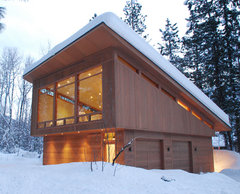
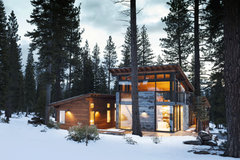
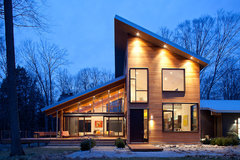
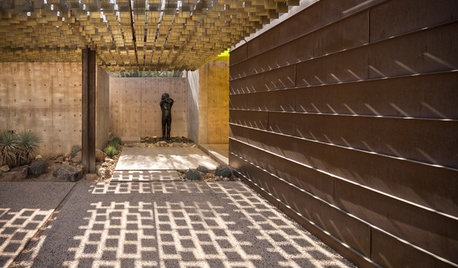
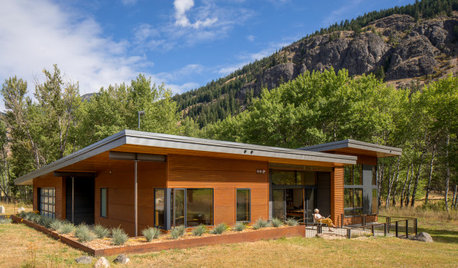
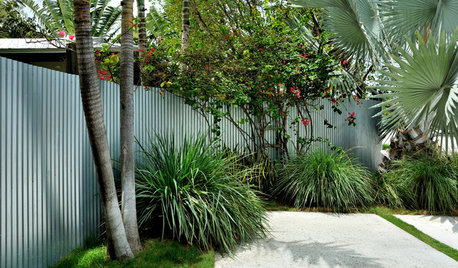
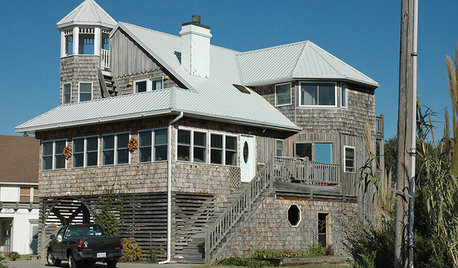
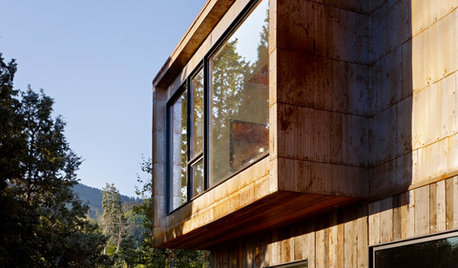
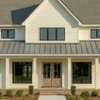
    The answer to a modern design style and desiring a metal roof is a shed roof.

    Mazama Guest Cabin · More Info

    Modern Exterior · More Info

    Pigeon Creek Residence · More Info


  • 10 years ago
    last modified: 10 years ago

    Very attractive, Sophie!!! AND practical! I'd love the second one if I were going Modern.

  • 10 years ago

    Remember in the winter of 1995-6 I believe it was, we wound up with over 80" of snow that year and most of it didn't melt until late April. (I am in the tri-state area) We had several storms that year where we had 18-30" of snow dumped on us within a 24 hour period. Are you sure you want to take that chance?

    Honestly such a low pitched roof is looking for trouble where you are.