

blister beetles in Northeastern Oklahoma
Hey folks,
I thought I’d
dedicate a thread to blister beetles. As Dawn and I have commented
elsewhere, it seems that my area in NE Oklahoma has a MUCH greater
problem with blister beetles than hers. I would suspect it has a MUCH
greater problem with them than most places. Everywhere I’ve lived
and gardened, I’ve seen blister beetles. But I’ve never worried
about them before arriving in Tahlequah, Oklahoma. Here, they arrive
in swarms of thousands and can wipe out an entire tomato plant in
less than two hours. They regularly attack beans, tomatoes and pepper
plants.
For years I
would try to deal with them by hand picking. But that was
overwhelming. Then, in my haste to kill as many as I could reach, as
quickly as I could, I figured out how to hand pick and crush their
heads between thumb and forefinger. That works better than hand
picking and dropping them into soapy water or water with vegetable
oil on top. Still, there have been times when I have despaired. I
could not kill them rapidly enough to overtake them in their rampage.
Over the years
my garden has built up a nice population of predatory insects. I HATE
the idea of hurting them. So I steadfastly resist spraying or dusting
with anything which would kill them. But last year I had purchased
some NEEM oil and, when I found thousands of blister beetles
defoliating my bush beans, I mixed up a batch of NEEM and went in
spraying. I soaked leaves, stems and litter around the plants,
hitting every beetle I could. Amazingly, the attack stopped. I had no
more trouble with blister beetles in 2015. But, I tend to be a
skeptic. What if it wasn’t the NEEM? After all, we had a lot more
precipitation in 2015, and, I had only one attack of blister beetles.
Maybe they went somewhere else where I wouldn’t notice them.
A bit over a
week ago I noticed that my Sioux tomato plants were looking ragged. I
also spotted and killed one striped blister beetle. I was busy and
didn’t get to really look hard again, until last weekend. Saturday
I went into the main garden and discovered that three out of four
tomato plantings were almost 75% defoliated. I found thousands of
blister beetles hanging in the plants and scurrying in the mulch. I
knew I couldn’t kill them all by hand. It seemed improbable that I
could stop them. But I mixed up some NEEM and meticulously soaked
every beetle I could find and every inch of every plant, where I had
observed them. By the time I finished and went back to where I had
started, I was dismayed to find that the beetles had climbed back up
in the plants and appeared ready to chow down. But I was out of time.
There was little more I could afford to do, and … I was getting
overheated. I needed to go inside and drink something.
While inside I
looked up NEEM on the Internet and found that the manufacturer
informs consumers that NEEM probably isn’t an instant fix. Unless
mixed in a very high concentration, it won’t simply kill and
insect. But for chewing insects it has a complex affect which causes
them to lose their appetite. They feel full, and simply stop eating.
They usually die within days.
I went back out
and looked at my poor tomatoes, that evening, as the sun went down. I
still found some blister beetles partying on a couple spoiled
tomatoes. But I didn’t see hordes running through the mulch or
climbing on the plants. Sunday evening I went and looked again. Wow!
I didn’t see any beetles. Monday afternoon I looked again, and …
I didn’t see any beetles! There were way too many blister beetles
for me to be mistake. It appears that NEEM is the way to go with
blister beetles.
Monday morning ,
when I went out to milk at 4:15 AM, I discovered that someone had
left our porch light on. The back porch is about 100’ from the main
garden. The screen door and part of the siding were covered in over
100 blister beetles. They were so thick that some came into the house
when I opened the door. I took time from my hurried morning routine
to crush heads of every beetle I could find by our back door. I was
not happy and thought that it bode evil for my garden. But, in the
afternoon I discovered that there were no visible beetles or beetle
damage in our tomatoes or peppers.
After killing
the blister beetles by the back door I was very careful to wash my
hands, and not to touch my face. I knew by experience that this could
be very bad. But, by the time I got home from work, that afternoon, I
had a dime sized water blister on my left forearm. It rose up and
filled more and more as the afternoon went on. Finally, at bed time I
broke it. Today (Tuesday) it is still weeping. But it doesn’t hurt.
This is why it is so important not to crush blister beetles other
than their little heads, and why it’s important to avoid getting
any of their juices on the skin.
Hopefully this
will help others, especially in Northeast Oklahoma. If one has only a
few, it would be better to leave them be. They do help in the control
of grasshoppers, by eating their larva. A few would be no problem.
But thousands, now that’s another story!
George
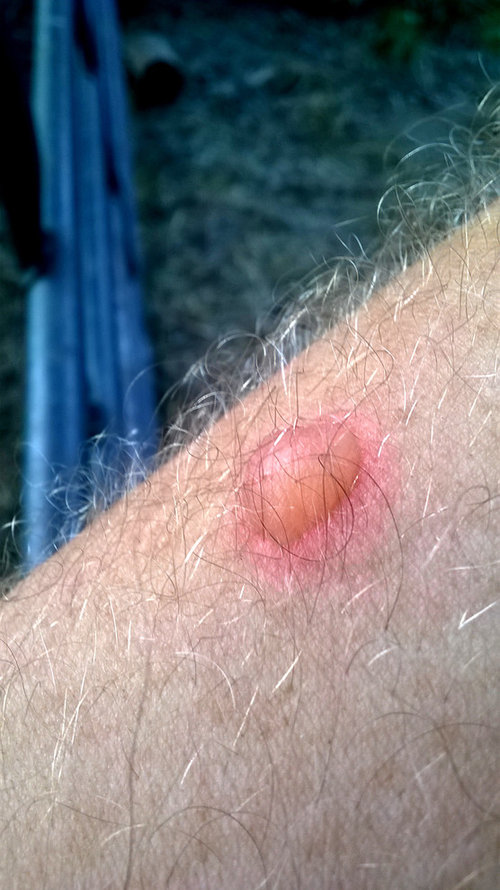
Here's a picture of the blister I got yesterday.
Comments (10)
 10 years ago
George, I wonder why the blister beetles are so bad there. Are there any commercial growers near you growing soybeans?
Thanks for sharing your story.
I agree that neem is not a quick fix, but it is a good fix if you don't need an instant kill, and I don't think it harms beneficials as much as some other organic products do.
Your poor arm! I am glad it doesn't hurt because just looking at it makes me think that it would hurt.
I bet I haven't seen more than 10 blister beetles so far this summer, and only 2 of them were together. I usually see them in what we jokingly refer to as onsies and twosies. I cannot imagine having them in huge numbers. I did not replace my sweet autumn clematis after they killed it about 6 or 8 years ago because that was the one place where I'd have dozens, if not hundreds, of them at once. That makes me wonder if y'all might have one of the native clematis vines in your area and if they might attrack huge blister beetle populations.
I also rarely get the grasshopper outbreaks that are as bad as you and Dorothy both see in your worst years. Even in our worst year, I don't think I've had as many at once as you have had in your worst years. Maybe it is that y'all live in the Green Country and all that green is just more attractive to the pests than our grasslands are.
Dawn
 10 years ago
Yikes! George, that looks mean! Is it only when you squish them this happens? They don't sting you if you brush up against them by accident? Will chickens eat them or does this blister juice make them unpalatable? (Maybe they are the habanero of chicken cusine?) Knock wood, I haven't noticed any. If it weren't so hot, some time in the garden with a magnifying glass would be a good idea.
I have heard people say that using a lot of neem changes the taste of the plants. Supposedly the plants can take it up from the roots. I've slept since then, but I believe it was used on a continuing basis, maybe even as a soil drench. I am not fond of the smell. I wonder if it would keep flea beetles off eggplant?
Related Professionals
Baton Rouge Landscape Architects & Landscape Designers · Austin Landscape Architects & Landscape Designers · Auburn Landscape Architects & Landscape Designers · Amherst Landscape Architects & Landscape Designers · Augusta Landscape Architects & Landscape Designers · Belleville Landscape Contractors · Richmond Landscape Contractors · Oxford Landscape Contractors · Potsdam Landscape Contractors · Utica Landscape Contractors · Bainbridge Accessory Dwelling Units · Elizabeth City Accessory Dwelling Units · Akron Accessory Dwelling Units · Marinette Accessory Dwelling Units · Vancouver Accessory Dwelling Units- 10 years ago
I saw what I "think" is a blister beetle this evening. I had to google it. It was a fairly large red beetle, with a thick black horizontal stripe across the back. Is that what they look like?
- 10 years ago
George, I have read that one type gets into alfalfa hay and if a horse gets too many it can be lethal. It is curious why you have so many. I normally have a few, but I haven't seen any this year.
- 10 years ago
The threat of blister beetle poisoning to horses is a very real threat, and if a horse ingests enough blister beetles while eating hay, it can be lethal to the horse within a few hours. As far as I know, this is no cure. At lower levels it can make horses sick with symptoms like colic, but at that lower level the horse usually survives. I know horse people who avoid using alfalfa hay (unless they grow it themselves or buy it from the first cutting) for that reason, but in really horrific drought years, sometimes you have to buy whatever kind of hay you can find that is being trucked in because the hay shortage is so severe that you can't be choosy. Here in OK if you grow alfalfa for hay, you usually can get your first cutting cut, baled and stored well before the blister beetles show up. I don't think I ever see any of the blister beetles before July and most first hay cuttings down here are in May.
I don't use neem often enough for it to affect the plants, Amy, but I've read the same thing about neem being systemic. Genearlly I never would use a systemic pesticide (not even an organic one) because I don't want to eat a plant that has taken up the pesticide within itself, so I probably don't use neem more than 3 times a year, and I just spray it on whatever specific plant has a problem. I don't like the smell of it either, but if you need to call in the big guns for a big pest, neem's a great choice.
If it is any comfort, George, blister beetles seem to arrive in mass, do their thing, and they go away. OSU says they have only one generation here in OK, so I guess that is something for which to be grateful.
Macmex
Original Author10 years agolast modified: 10 years agoI found another swarm last night, and they had some really tiny ones in there.
My friend Ron Cook commented to me that he has used their attraction to light to kill them. He hangs a light over a kid's sled, filled with soapy water. He's practically filled the thing with dead beetles! I need to try this.
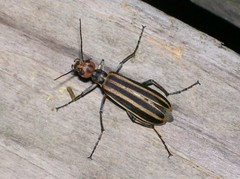
I don't recall a blister beetle with a red stripe on it. But I did a search on Photobucket and saw some which were definitely blister beetles and came in colors I have never seen. Here's a picture of the striped blister beetle I'm dealing with.
- 10 years ago
Thank you. I don't know what these things are, then. I saw some photos on google that looked very similar, but who knows. It looks mean to me, whatever it is.
- 10 years ago
I've only had black ones, striped ones and, rarely, an ashgray one, but they do come in a variety of colors worldwide. I'm not sure how many species are found in the USA, but worldwide there's an estimated 7500 species of them, so there's room for a lot of variation. There's also some closely related beetles that are fungal beetles.
 10 years ago
I have seen them in all colors out here, mostly black. They grow in numbers if I don't weed eat the Johnson grass along the edges of the property (same with grasshoppers).


MacmexOriginal Author