Software
Houzz Logo Print
rosefollyz5

Rethinking drip irrigation

10 years ago
last modified: 10 years ago

My DH and I converted about 2/3 of the garden to drip last year in an effort to reduce our water usage. We did save water, but I don't know if it was actually the drip or the fact that I cut back on watering frequency. In any case we have decided to convert back to spray irrigation. We'll save as much water as we can by shrinking the garden a bit more. We will keep drip for the tomato beds.

Why? Drip is simply not robust enough for our conditions. I step on it and break the manifolds. The dogs chew the spaghetti lines into shreds and rip it out of the ground for a game. Squirrels and other rodents eat the lines, too. Frankly, it is just too fragile. Tomorrow is the first of August and I still have not completely finished repairing the winter destruction of our water system. I'm doing a lot of supplemental hand watering and surely that must be wasteful.

So now we'll have shrubblers for the fruit trees and spray for the ornamental beds, with drip on the tomato beds. And I will have more time to actually enjoy working with my plants.

Comments (21)

  • 10 years ago

    I can understand your attitude, Rosefolly. The fact that you can't see the emitters working without crawling around makes it harder to see that the system is intact than watching a spray. OTOH both are easier than hauling H2O cans or a hose around.

    Rosefolly z5 thanked Sheila z8a Rogue Valley OR
  • 10 years ago

    Thank you, Sheila. But it is not actually any easier than hauling around hoses, because I am still doing quite a bit of that! It is a big garden (about an acre) and the drip lines are buried under the mulch, so I don't actually know something is broken until the plants are in advanced distress. I need to be able to trust my irrigation system, and drip is not trustworthy, at least on a hillside property near lots of wildlife.

  • 10 years ago

    My garden is entirely drip, and I regret changing the lawn sprinklers to drip when I removed the lawn. Every time I stick a shovel into the ground, I break a line and have to repair it! There is constant adjusting of lines and water volumes. There is constant change of mineral encrusted emitters, and I don't know if an emitter is clogged until I see a plant failing, then I have to go rooting around the base of the plant looking for those darned emitters. It's easier to see if there is coverage with sprinklers. If I win the lottery, I'm ripping out all the irrigation and starting over.

    Rosefolly z5 thanked noseometer...(7A, SZ10, Albuquerque)
  • 10 years ago

    We started from the beginning with "bubblers" and that is for the most part what we have. We knew, going in, that drip would be a disaster with our mineral-laden water. I think we made the right decision.

    Of course, it's NOT perfect. And as the system ages, we have breaks and leaks, and we really need to replace some of the 3/4-inch tubing. But it works. And isn't nearly the hassle that drip would be, here.


    Rosefolly z5 thanked jerijen
  • 10 years ago
    last modified: 10 years ago

    I would not have a garden here ( due to the summer heat and drought) without tubing, drip line irrigation and emitters... professionally installed. This system is the gold standard, used in residential and commercial landscapes/gardens here. Everything requires maintenance. Sprinklers are excessively wasteful of water, especially during the heat, however, a poorly installed or broken irrigation system can be just as bad.

    Broken lines here (my garden)..... rare.... there are flags used to identify irrigation lines.

    Edited a bit. Typing... deleting.. typing. from an I Phone with its small screen previously..

    Rosefolly z5 thanked Lynn-in-TX-Z8b- Austin Area/Hill Country
  • 10 years ago

    My neighbor has drip and constant "Old Faithful" geyser effects due to the squirrels chewing into the lines, something that became particularly acute during the recent drought. Fortuitously, the squirrels (and rats, probably) tended to chew the tubing next to our common fence line and the resulting water fountains often watered the plants on my side of the fence...bonus! :-) (Alister Stella Gray and Phil Edinger's Noisette loved it!)

    I use weeper hoses, which, since they don't retain water, don't invite rodent attacks. You still have to keep an eye on the lines to watch for leaks created by age and cats using them as "scratchy" material, but I have 10-year old weepers that (knock on wood) are still good and unpatched. If they get broken, I patch with hose menders. The downside is that I have to connect and move around the water-providing hose at irrigation time. However, this keeps me physically aware of how much water I use, which is a good thing -- there is a limit.


    Rosefolly z5 thanked User
  • 10 years ago

    We are going to try a bit different drippers. Notice future tense. Seems the yard crew (DH) mowed over the feeder line and I dont know when we'll get that part redone, probably when the fall rains start.

    I'm sorry, I shouldn't be b****ing about this, but if he weren't scalping the yard, he .... well, you know the rest.

    I hate the tendency of the emmitters NOT to emit anything, and goof plugs that fail.

    Rosefolly z5 thanked stillanntn6b
  • 10 years ago
    last modified: 10 years ago

    I'm glad that drip works well for you, Desert Garden Las Vegas. I'm sure it does work for some people. I do understand that different solutions are best for different circumstances.

    Here, the main ways that spray is inefficient are when it sprays outside the area you want, when it leaks, when it is used in the hot part of the day, or when it is used when it is windy. All of these things except windiness can be managed. I do check my irrigation, not every time, but several times a year. As for wind, we are most apt to get wind in the winter when I have it turned off anyway.

  • 10 years ago

    Thanks for the comments, Henry. It is possible to create a customized system for exactly your needs. Much of my garden is on a hill, which makes it trickier here. I have tried soaker hoses but they did not work well for me. And I do water in the hours just before and after dawn for reasons of conserving water.

    We are each of us working out what works best in our own situation.

  • 10 years ago

    I agree with you - we put in drip irrigation all over about 15 years ago, and changed it all about 12 years ago. The itty bitty lines got clogged all the time, or chewed by animals, or just did not put out enough water, or the water went straight down from the one little place where the drip was, and did not spread out to where the roots were. My wonderful DH changed everything over to either soaker hoses, or little spray emitters. Now we have some of those new, very small soaker hoses in pots, too. We do have to check it several times a year, but we now have 22 different areas which are watered automatically - and it works - wonderful! We water in the middle of the night (required by our water district), 2-3 days a week, and it seems to be working fine.

    I hasten to add that much of our garden is very old, established plants (think 10 ft high by 15 ft wide pomegranite bush, fig & plum trees, lots of other trees, etc) which get no water at all except in the winter when it rains. Most of the irrigated places are flower beds, and roses.

    Jackie


    Rosefolly z5 thanked jacqueline9CA
  • 10 years ago

    I think Ingrid's idea of tubing with no emitters allowing more of a flooding effect, that she turns on periodically, might suit roses well. A moat around each rose that would hold the "flooding" water would be ideal. I think the emitter concept makes for less weeds throughout a bed in its defense. I do know I can grow a greater number of plants with an emitter system than I could hand watering. My Dramm water wands and watering cans were very reliable, but too much work to continue "forever". My Hunter control box works well as do the valve boxes, but the emitters can be erratic here too and need adjusting or replacing. It is very frustrating at times. The spray emitters could be nicely visible when on allowing more security that it is actually working.

    Rosefolly z5 thanked Sheila z8a Rogue Valley OR
  • 10 years ago

    The late Field Roebuck talked about his irrigation system on here years ago. He lived in Dallas Texas and (IIRC) was on city water. What he did was a drip system, but near each rose three emitters, so all sides of the roses' roots would get wet and at depth.

    Rosefolly z5 thanked stillanntn6b
  • 10 years ago
    last modified: 10 years ago

    "What he did was a drip system, but near each rose three emitters, so all sides of the roses' roots would get wet and at depth."

    I wonder if Mr. Roebuck was one of the pioneers of this style of irrigation?

    Residing in desert areas, plagued by drought for decades, depending upon artificial means of watering gardens, year round, led to the use of systems that water plants in the manner Henry described out of necessity, for various reasons. It is not a luxury and is extremely commonplace/ standard home equipment here. Over time, one thing is for sure, regular homeowners learned to master artificial means of irrigation.

    We all learn to master what works best in our gardening environments.

    Rosefolly z5 thanked Lynn-in-TX-Z8b- Austin Area/Hill Country
  • 10 years ago

    My system was working quite well but the squirrels or other rodents have discovered the water and the other day there was a geyser where the line had been chewed through. However, I'm hoping it won't happen too often. We do also have sprinklers, but many of them are in the wrong place for us. Some are in the right place and we're using these lately to water the roses in Tea Rose Row.

    Rosefolly z5 thanked ingrid_vc so. CA zone 9
  • 10 years ago

    When you consider drip, I think you must consider the quality of your water. One big reason we did NOT install drip was that on our water, it quickly clogs up emitters. Well, it's so bad, it clogs up ANYTHING. A plumbing guy at Home Depot remarked that low-flow toilets on Camarillo water are a plumber's nightmare.

    Anywhere you have very mineral-laden water, drip is probably not the best choice.

    Rosefolly z5 thanked jerijen
  • 10 years ago
    last modified: 10 years ago

    We only had misters over a covered patio to enjoy and cool off but the squirrels loved eating those little tubes and my husband was always climbing on ladders replacing or cleaning the emitters. I use soaker hoses and plant everything along the lines :)

    But then, we don't have meters yet...

    Rosefolly z5 thanked Anne Zone 7a Northern CA
  • 10 years ago

    Here's what I've spent the last two weekends working on...

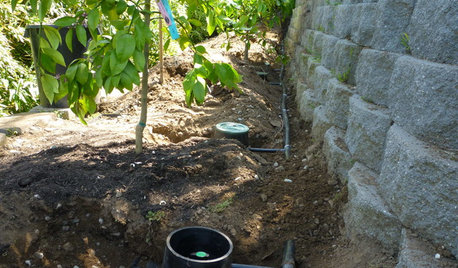
    ...finding the places where the tree roots have crushed the main lines between large roots. Then cutting out the section, replacing and reconnecting the section, rerouting drip lines, testing the line for leaks, then replacing soil, dealing with the weed barrier (pre-existing), gravel mulch, organic mulch. Oh, my back!

    Rosefolly z5 thanked noseometer...(7A, SZ10, Albuquerque)
  • 10 years ago

    Wow, how long have those lines been down there???

  • 10 years ago

    About 15 years.

  • 10 years ago

    Wow! Noseometer, you are a trooper.