Software
Houzz Logo Print
daniel_cluley_orlando_fl_9b

This is Surely not an Obesium?

10 years ago
last modified: 10 years ago
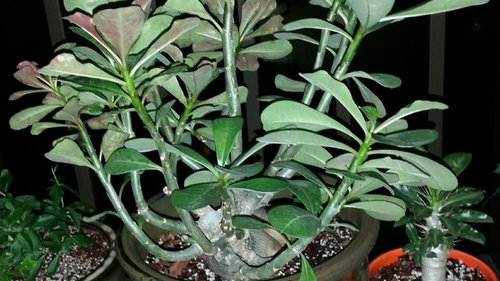
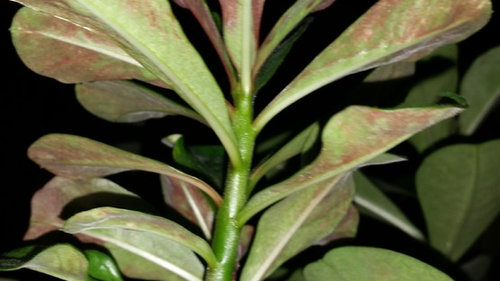
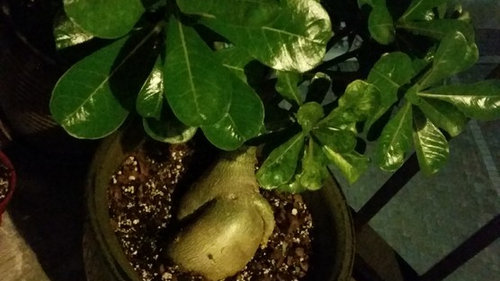
I took a bunch of other pictures of my summering adenium plants, and this one stood out. It has a red tinge to it and when it turned to the sun, the bottom of the leaves were clearly different than the rest. I think it may be a burgundy colored adenium multiflora? Not experienced enough in these plants to know for sure, but it is robust and different:


and I am sorry for calling you Shirley.


Ahem, ahem. . . JOKES!


Thanks if you can ID.

Comments (20)

  • 10 years ago
    last modified: 10 years ago
    Daniel,

    I believe it is in fact an A. obesum. I have seen this on a few of my plants over the years, but has never been an issue and must have passed, as it is no longer there.

    Rick

  • 10 years ago

    Thanks rick. If it is, it is the only one I have ever had that has red under the leaves.

  • 10 years ago

    You could be right. That midday sun is kinda stressing the ones closest to my porch opening. It has been pretty brutal lately. Still greener on the top where it gets less of a direct hit.

  • 10 years ago

    Jedoba, I believe that is possibly the case. I remember seeing a similar color on undersides of leaves from plants under intense LED lights.

    Rick

    Daniel Cluley (Orlando, FL 9b) thanked rcharles_gw (Canada)
  • 10 years ago

    Thanks Rick. It is not affecting my other plants. This one just may be sensitive to the light. I may try shuffling them around some!

  • 10 years ago

    Daniel,

    The leaves on that plant look so healthy on top and very nice shape.

    Rick

    Daniel Cluley (Orlando, FL 9b) thanked rcharles_gw (Canada)
  • 10 years ago
    last modified: 10 years ago
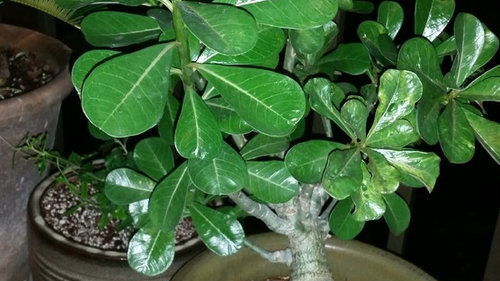
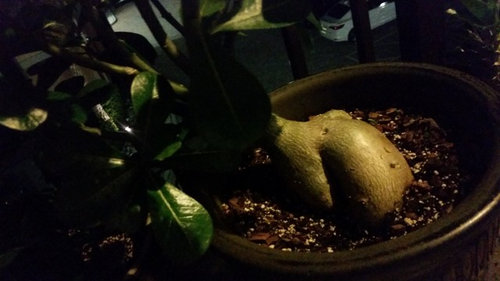
    Thanks Rick, I was actually putting it in most direct sun spot because I was trying to train the branches up in a curved shape after repotting it with the caudex on it's side slightly to show off some of its form. Kinda like "bonsai via sun" effect. I call it "The Moose" to go along with my "Little Spider" (one of my faves). It looks kinda like a moose with a large rack in profile:

  • 10 years ago

    Yes, could be due to your lights but also check your PH to make sure it's not getting acidic. When the PH tips it can often make pink, red or purplish makings under leaves on almost any kind of plant.

    Daniel Cluley (Orlando, FL 9b) thanked Hyn Patty, Western NC Mountains (USA)
  • 10 years ago

    Daniel, it is an obesum, I can tell you got it from either HD or Lowes'. It was from Costa Farm in Florida.

    Marie

    Daniel Cluley (Orlando, FL 9b) thanked Marie Tran
  • 10 years ago

    Daniel, am I right?

    Marie

  • 10 years ago
    last modified: 10 years ago
    That's pretty good Marie. I believe it was actually from a local retail nursery in central Florida, but likely that they use the same supplier in Florida as a HD or Lowes. I do have a couple HD plants, and a couple from local nurseries and Ebay. I don't usually like the HD as much because they are the standard weak pink usually. This one is not a standard pinky, but a darker color. One of my original HD plants is a standard pink single (probably the first one I got before I knew of such variety you can find elsewhere), and another is white with pink tip single.

    Have you ever been to TropiFlora in Sarasota, Marie? They have a LOT of exotics.

  • 10 years ago

    Daniel, I wish I have, but I never been to Sarasota.

    I bought many from HD and Lowes for my rootstocks.

    Marie

  • 10 years ago

    It's worth a trip sometime if you are in the area. They specialize in producing bromeliads, air plants, and orchids, but have all kinds of other exotics too:

    http://www.tropiflora.com/

    Google site with some images here


  • 10 years ago
    last modified: 10 years ago
    Hi Daniel,

    I have 4 obesum seedlings of 11, grown from two different mixed seed batches that show a distinct reddish hue on the underside of the leaves, not as pronounced as yours. The tops are completely green. An additional 4 seedlings from the same seed pod of a known pink show no such variation.

    I am new to adenium and my experience dates only to the age of my 6 month old seedlings. However, I have a propensity to believe these may present genetically reddish to fuschia flowers because I see the same on other (non adenium) flower leaves ... amaryllis, lilies, orchids & cacti. My 15 seedlings are kept together on a tray and all receive the same soil, fertilizer, sun exposure treatment.

    There is no other logical explanation for that reddish hue on my four seedlings. We should know within the next few months as they begin to bloom ... Very brief dormancy (Feb) for these in the Caribe. Of course, with my luck, they'll all be pink!

    - Maria Elena

  • 10 years ago

    I bet you are right, Maria. I see this a lot on other kinds of plants that have pink, red, or purple flowers so that is probably all it is if the PH is fine.

  • 10 years ago
    last modified: 10 years ago

    I went to a HD today and they had a display of plants by Costa, euphorbia, succulents, cacti, and grafted adenium. Quite impressive. They were branded as desert expressIon I think. Nice call, Itran. As for the red leaves, I do believe it is somewhat due to sun exposure and the mix of the plant, as the plants are in Florida, but grown on a west facing porch, not in direct noon light.

  • 10 years ago

    Typically, red tones to the stem of seedlings "could" mean red type flower and some say a green stem "could" be a white type flower. This is only apparent on seedlings in early stages and disappears as they grow older.

    With "Pink" being the most prevalent color in the gene pool, it is all just supposition. We would have to mark/label each seedling to know when they actually are of blooming age.

    See the red hue on many plants in intense sunlight as well as artificial lighting (too close).

    Rick

  • 10 years ago

    Thanks, Rick. I have read exactly that.

    I am keeping a Grow Journal. Here, I am documenting everything from sow date to origin to cross info to specific characteristics for every seedling. Each seedling is numbered. Given this, we will know for sure how accurate this information is as soon as the blooms come in...I am testing the theory.

    - Maria Elena

  • 10 years ago

    I'm working on doing the same thing, Marie. Which means a lot of record keeping and snapping plenty of photos.

0