Software
Houzz Logo Print
torontogardener38

Help with succulent

10 years ago
last modified: 10 years ago
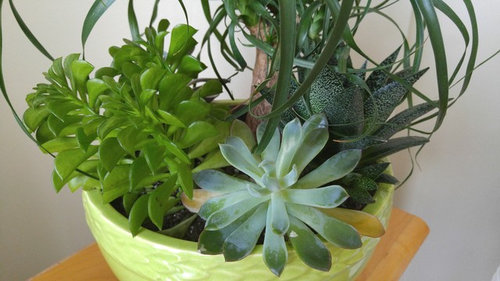
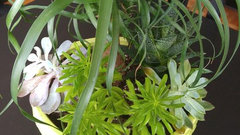
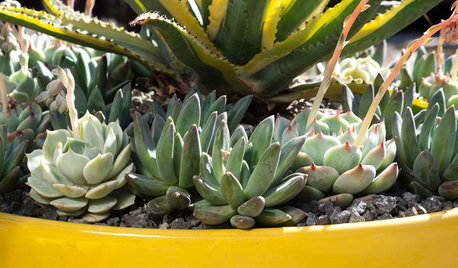
I have a lovely pot of mixed succulents and a bonsai tree that I picked up from Home Depot a few months ago. I've been keeping it indoors, and it has generally been doing well.

The succulent in the foreground of this picture, however, has been giving me a bit of grief. Since I've had it, a routine pattern seems to have been occurring: lower leaves start to fade in colour, turn from deep green to pale green/yellow, lose their turgidity, then whilst yellow start to shrivel up and fall off. I probably lost 5 or 6 leaves back in July... two more look like they're on their way out.

I'm not quite sure if this is the normal cycle for this plant, or if it's not happy with its environment. I had the planter in my living room a few feet from a south-facing window that has horizontal shades that I leave open all day... I've since relocated it to my bedroom, where there is a bit more direct light (the brighest spot in my house).

I've also been trying to monitor the moisture levels of the soil with a moisture meter... giving the pot a good watering (I've been using distilled water) when it's 'dry', then waiting again until the soil completely dries out. This ends up being once every 1-2 weeks.

So, I'm not sure what's up. Underwatering (the loss of turgidity)? Overwatering (the yellowness)? Light? Nutrients? Normal?

Any suggestions would be appreciated! The other plants in the pot (the two green ones, the bonsai, and a purple one hidden from view, seem just fine).

Comments (17)

  • 10 years ago

    Is there a drain hole? If not, that's likely the issue. Are you flushing he soil when you water? Fertilizing? with what (brand & NPK %s plz)?

    Al

  • 10 years ago
    last modified: 10 years ago

    Hi Al,

    Yes, there's a drain hole.

    I flushed the soil the first couple times I've watered (it's a bit of an awkward pot to hold, so my floor got nice and wet in the process).

    Someone took care of the plant when I was on vacation for a couple weeks, so I can't comment on how it was watered then (other than that it was). I gave it a good drenching the most recent time (about 5 days ago, which was roughly 2 weeks since its previous watering).

    Haven't fertilized yet.

  • 10 years ago

    The plant on left is probably Peperomia dolabriformis; plant on right could be a gasteraloe; one in front Echeveria? Is the 'bonsai' possibly a pony tail palm?

    What kind of soil are they in?

  • 10 years ago

    It's likely the plants are in need of N, a shortage of which will cause loss of older leaves. Since you can't know if it was over-watered, best you can do is make sure it's not from now forward. Rina's question about what kind of soil the plants are in is a good one, as soil choice determines whether you or the soil has control over your plant's o/a vitality and the health of its roots. At a minimum, they should be in a medium that allows you to flush the soil at will w/o worrying about extended periods of soggy soil wrecking root function/health. You really do need to fertilize containerized plants on a regular basis, and how you should fertilize is closely tied to your soil choice and how you water.

    Al

  • 10 years ago
    last modified: 10 years ago

    They seem to be in a relatively loose soil for tropical plants; probably just something you could pick off the shelf at Home Depot.

    What would you recommend by way of fertilizer, and how often?

    I try to give it a good drenching until some water runs out the bottom -- is this a good idea? And then I just wait till it's completely dry again, which right now in my hot apartment here in the summer, that's about 1-2 weeks.

  • 10 years ago

    If it takes 2 weeks for the soil to dry, it inherently has problems in that it retains too much water. Increasing the particle size of what's in your soil (by adding a significant amount of pine bark or an inorganic fraction would be very helpful. Probably not available in Canada, but Foliage-Pro 9-3-6 is an excellent choice as your 'go to' fertilizer. It has ALL the essential nutrients in a favorable ratio (to each other, which is an important consideration), and doesn't get its N from urea, so helps to keep plants full & compact. I don't know what you have available there. Miracle-Gro 24-8-16 or 12-4-8 are good second choices. The 12-4-8 is liquid and easier o/a than 24-8-16.

    Watering to beyond saturation is the right way to water - so at least 15-20% of the total volume of water applied exits the pot. You can fertilize as little as monthly (when watering correctly) or as often as every time you water, by varying the dose. More frequently at low doses is easier on the plant.

    Al

    torontogardener38 thanked tapla (mid-Michigan, USDA z5b-6a)
  • 10 years ago
    last modified: 10 years ago

    Thanks for the tips! Looks like HD nearby has some 12-4-8 in stock, so I'll pick that up today. Good idea to use with some/all of my other containered houseplants too? I have a dieffenbachia, peperomia, pothos, chlorophyto cosmosum, aglaonema, a tropical of an unknown variety (seems like it might be in the dracaena family), a ZZ, and dracaena massangeana.

    The two weeks for the succulent is probably extra conservative on my part. I killed one a while back by overwatering. The soil is dry to the touch much, much faster than 2 weeks so it is draining relatively fine I think, but I've been going by the moisture meter rather than pure instinct (when it says below 1.5/3 dry). Should I bump it up a bit more?

    Thanks for all this advice!

  • 10 years ago

    Moisture meters aren't accurate. They measure electrical conductivity. If you test a cup of distilled water with a clean probe it will read "DRY". If you add a little fertilizer or table salt, it says "WET". Use a wood dowel stuck deep in the pot & water when it first comes out dry. That way - no over or under-watering.

    See if you can get Foliage-Pro 9-3-6 in Canada (Rina?). If not, stick with the 12-4-8 for everything except hibiscus and maybe tomatoes.

    Al

    torontogardener38 thanked tapla (mid-Michigan, USDA z5b-6a)
  • 10 years ago

    Thanks for the tip about the dowel. I'll use that as my guide from now on.

    Couldn't feel any moisture when I stuck one in the pot, so I rewatered (it's been a little under a week) and applied the 12-4-8 until I can find some 9-3-6. Fingers crossed!

  • 10 years ago

    FoliagePro could be found (sometimes) on Amazon. I didn't find any stores that carry it.

    TOgardener

    Are you planning on repotting into different mix? Are they kept indoors or outside?

  • 10 years ago

    They're kept indoors. I fertilized a couple weeks ago but again that same plant looks like it's going yellow. It seems to be losing a leaf or so a week and definitely not replacing it at that rate. Always from the bottom up. I'm wondering if the potting medium they have in there is simply just retaining too much water.

  • 10 years ago

    There's a high likelihood .....

    Al

    torontogardener38 thanked tapla (mid-Michigan, USDA z5b-6a)
  • 10 years ago
    last modified: 10 years ago

    If I were to repot, Al, what would this combination of plants do best in?

    For what it's worth, the echeverias seem to be the only one with troubles... the green one looks like it's getting too much; the purple one seems borderline too dry. Peperomia and gasteraloe look great.

  • 10 years ago
    last modified: 10 years ago

    Your plants would have much better opportunity to realize much more of their genetic potential if you used a medium that held its water inside of soil particles instead of between them. What limits root function and causes plants to rebel is primarily the water held in potential air spaces between soil particles. Conceptually, you achieve this by using larger soil particles so the air spaces between soil particles are too large to hold water in defiance of the law of gravity. If you imagine a jar full of BBs and all the large air spaces between the BBs, you get the idea. Pour a pint of water through a quart jar of BBs and you'll get about 15.5-15.75 oz of drainage. Pour a pint of water into a quart of fine sand and you'll likely get no drainage at all, or very little. That's the water that limits.

    Adding a bunch of perlite to a peat-based soil isn't very effective unless you have so much perlite (well over 50%) there isn't enough peat or other fine material to fill the spaces between the perlite particles. In the example of the quart of BBs above, if you add a pint of sand, you destroy aeration and invite a tall PWT that negatively affects root function.

    What you're seeing in your plants is the difference in their ability to tolerate the stress of soil saturation. A high % of succulents all prefer the same thing - a soil you can keep damp but never gets soggy. In order to achieve that end, you have to build your soils with larger particles OR figure out a way to trick excess water into leaving the pot when gravity won't do the job. The later is fine if the pots are smaller, but the best way is to make sure your soils are based on a very high % of particles larger than 1/10" in size. Mixing particles with lots of internal porosity (so they hold lots of water) with particles that don't have internal porosity ensures you have the ability to adjust water retention.

    Al

    torontogardener38 thanked tapla (mid-Michigan, USDA z5b-6a)
  • 10 years ago

    I've learned a lot from you, Al! Thanks for sharing your wealth of knowledge. Is there an 'ideal' time to repot?

  • 10 years ago

    Plants that have predictive dormant periods (like temperate deciduous plants that go dormant in winter) are usually best repotted in spring just before they pass from quiescence to active growth. Houseplants and most succulents are best repotted in the month where their most active growth occurs, which means right around the summer solstice; this, because they recover MUCH faster if their energy levels are high and their food-making ability is peaking when you repot - both occur in June and early July.I usually reference Father's Day because it's easier to remember than the solstice. Those houseplants or succulents that need regular pruning are best pruned in early summer, too. If you get into the habit of pruning your jades, portulacaria, and other branching houseplants, you can prune off ALL the lanky growth that occurred over winter. Any new growth that occurs will be very compact due to increased light levels. This is the growth you want to keep. As nights lengthen, the growth will gradually turn lanky, but no worries because it's coming off next summer.

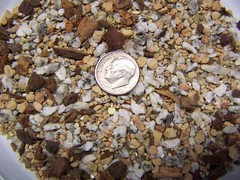
    This is what I use for all my succulents, houseplants, bonsai, and trees temporarily posing as wannabe bonsai.

    Al