Software
Houzz Logo Print
bird_of_paradise

Humor me ... Pruning for branching

I have a stupid question, but one of my grade school teachers told me that the stupid question is the one not asked because it never gets a response! Simple, yet profound ... That comment stayed with me forever.

So here's the crazy question that's been burning my grey matter:

If pruning a branch during an active growth cycle stimulates branching at multiple internodes adjacent to the cut, is there a method of lancing below an internode to activate branching, without excising the branch?

Comments (41)

  • 10 years ago
    last modified: 10 years ago

    The axillary buds at the nodes (an internode is the distance between them) are, as you know, usually dormant. The growth of these buds is inhibited by the plant hormone auxin. Auxin stimulates ethylene synthesis which causes inhibition of their growth and instead induces shoot apical dominance. The hormone is produced by the apical meristem (the apex/top of the stem). That is why axillary buds are dormant and a plant grows vertically (without branching out).

    If the apical meristem (the apex of the plant) is removed (for instance, by pruning), or has grown a sufficient distance away from an axillary bud, the inhibitory effect is removed and the axillary bud may become activated. That is why plants branch out by themselves.

    So to answer your question: You can simply wait for the plant to branch out - without pruning. ;-) But until this happens (which can take like forever), you have no control of the growth of plant.

    Maria Elena (Caribbean - USDA Zone 13a) thanked Martin (retired viking from Denmark)
  • 10 years ago
    last modified: 10 years ago

    I cannot recommend lancing your adeniums. Most likely it will not have the intended effect. You just end up with scarred plants...

    Maria Elena (Caribbean - USDA Zone 13a) thanked Martin (retired viking from Denmark)
  • 10 years ago

    I do not believe that the cut is what stimulates the branching.

    I think the branching is stimulated because the roots were supporting X amount of stem, and once it is trimmed, the plant has additional energy to be diverted to new growth to replace the old, trimmed growth.

    Of course, I've been wrong before. (Many times, lol.)

    Maria Elena (Caribbean - USDA Zone 13a) thanked jedobaTX9b
  • 10 years ago
    last modified: 10 years ago

    Well, jedoba, you are wrong. Sorry. ;-) I just explained the facts/science behind it (well, I can elaborate but then it gets really nerdy). No offence but actually this is pretty basic plant physiology. ;-)

    Maria Elena (Caribbean - USDA Zone 13a) thanked Martin (retired viking from Denmark)
  • 10 years ago
    last modified: 10 years ago

    Makes perfect sense now.

    Auxins promote stem elongation, inhibit growth of lateral buds (maintains apical dominance). They are produced in the stem, buds, and root tips. Example: Indole Acetic Acid (IA). Auxin is a plant hormone produced in the stem tip that promotes cell elongation. Auxin moves to the darker side of the plant, causing the cells there to grow larger than corresponding cells on the lighter side of the plant. This produces a curving of the plant stem tip toward the light, a plant movement known asphototropism.

    Auxin also plays a role in maintaining apical dominance. Most plants have lateral (sometimes called axillary) buds located atnodes (where leaves attach to the stem). Buds are embryonic meristemsmaintained in a dormant state. Auxin maintains this dormancy. As long as sufficient auxin is produced by the apical meristem, the lateral buds remain dormant. If the apex of the shoot is removed (by a browsing animal or a scientist), the auxin is no longer produced. This will cause the lateral buds to break their dormancy and begin to grow. In effect, the plant becomes bushier. When a gardener trims a hedge, they are applying apical dominance.

    Maria Elena (Caribbean - USDA Zone 13a) thanked jedobaTX9b
  • 10 years ago

    Not really. ;-) Ramnification has always something to do with auxin - or lack of. On a branch the main stem of the branch is dominant over its own side branchlets. Here again, auxin induces shoot apical dominance. That is why a branch mainly grows towards the light and does not branch out (well, initially).

    Maria Elena (Caribbean - USDA Zone 13a) thanked Martin (retired viking from Denmark)
  • 10 years ago

    If you want a branch to branch out: 1) Prune it/pinch the apical bud, or 2) Wait for the plant to branch out by itself. It has really nothing to do with the branch:root mass ratio. Well, of course, if you remove x amount of root mass, this will stunt the plant.

  • 10 years ago

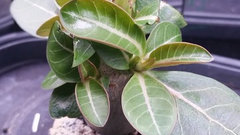
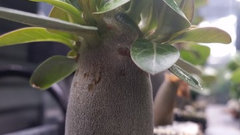
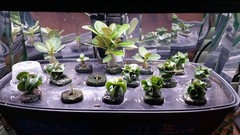
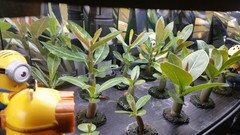
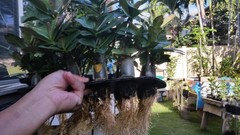
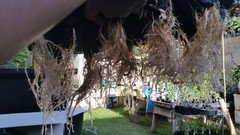
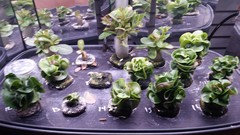
    if you want to branch out your plants or any kind of plants, grow them in hydroponics, and i vouch for it, from peppers to adeniums, they branch out at young age,

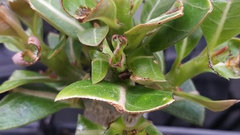
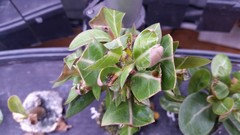
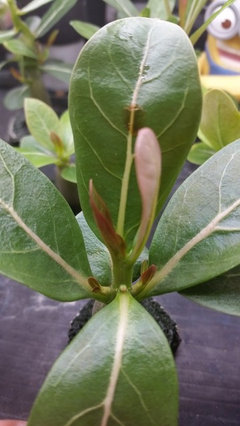
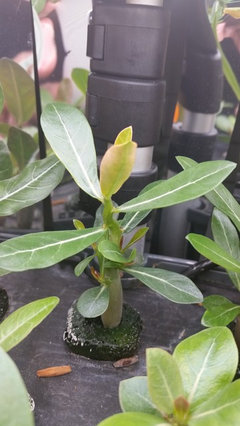
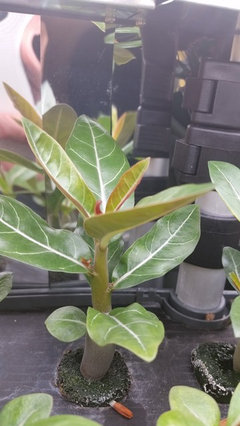
    this is planted planted 6.18.16 to now 8.13.16, i end up cutting the leafs so that the light can penetrate all the way through the other stems and make it sturdier instead of longer,

    #1


    #2

    and the rest of the plant is my DH

    Maria Elena (Caribbean - USDA Zone 13a) thanked Jericson Pastor
  • 10 years ago

    Seriously, your plants make me drool....

    Maria Elena (Caribbean - USDA Zone 13a) thanked ConnyNL (The Netherlands, 8b)
  • 10 years ago

    Does the plants actual genetics also play a part in its ability to branch or not? I've got one mature plant that has so many branches it's impossible to count them all. Admittedly, I don't know whether either of its 'germination partners' are from the same seeds, but without doing any pruning this one plant has really excelled in this way.

    Gill

  • 10 years ago
    last modified: 10 years ago

    Jericson, honestly, I highly doubt that hydroponics promotes branching. Your results are most likely biased. First of all, you cannot conclude anything simply by sowing a handful of seeds. Sow, say, 100-200 seeds of different species and/or cultivars (more seeds means a greater reliability of the outcome and vice versa). If you stick to arabicums, the results are biased. Most arabicums branch out by themselves from early on anyway.

    Secondly, you should not pinch the leaves at all (if you want to test the hypothesis). By pinching the apical leaves, you could actually, by mistake, damage the apical growth points (and therefore, lowering the concentration of auxin at the apex). In some of your photos, it looks like that you have done exactly that. Damaged the growth points, that is.

    Yummy seedlings anyway. ;-)

    Gill, yes, without doubt. Genetics plays a major part in ramnification. For instance and as stated above, arabicums have a natural tendency to branch out from a very young age. And the Asian adenium growers undoubtedly select (by hybridization) for this particular trait. Even to the extreme.

    Maria Elena (Caribbean - USDA Zone 13a) thanked Martin (retired viking from Denmark)
  • 10 years ago

    Two excellent points, Gill. Genetics largely dictate how much a plant will branch under ideal conditions and how it will respond to injury (in this case, pruning or lancing). Culture can only alter so much but not past what the plant can do based on its genetic template.


    The one and only reason adeniums often behave unpredictably is because we are never really sure that our plants or seeds have the provenances they are supposed to have.


    I think it's an excellent question, Elena. And thank you, Martin, for nerding this so well.


    Pagan

    Maria Elena (Caribbean - USDA Zone 13a) thanked User
  • 10 years ago

    ...and of course, thirdly, you should grow all seedlings in the experiment under the same growing conditions.

  • 10 years ago

    And of course (being a nerd, that is), it could be real fun to actually do this controlled experiment. ;-) Hypothesis: Hydroponics promote ramnification in adenium seedlings. We then test the results statistically and write a scientific paper to be reviewed (peer review) by a board of horticultural experts. Oh, well... Got carried away. ;-)

  • 10 years ago

    ...but to start with known givens, you can't base this on phenotype since common adenium sources are unreliable, at best. You have to start with samples of proven genotype. In short you have to go to Africa, Viking. Start paddling, hehe.


    Pagan

  • 10 years ago

    Pagan, yes, but that is why you are all going to help. ;-) Start paddling, too. ;-)

  • 10 years ago

    Great discussion!

    Martin, your explanation is excellent. Thank you for taking the time to humor me ... and HUMOR me. No, I won't be scarring & maiming needlessly ... just selectively. I want to train at least one arabicum for a classic bonsai cascade effect.

    Gill, yes, genetics dominates and is always a major factor in everything. This is so evident when seeds from even the same pod grow so differently . Makes sense ... Plants can be compared to people in this aspect.

    My parents had 7 children. Two came out with straight blonde hair, 3 with curly dk brown, 2 with sandy brown neither curly nor straight. None have my father's green eyes but 4 of us have a green swirl within the brown iris, 2 more pronounced creating hazel eyes. Five of us are tall, two are average height. I could go on and on but believe I've made my point.

    Well, it's time to help our nerd / viking friend paddle ... or not. I believe Stuart has struck gold and may have scored some pods from an unblemished original AO.

    - Maria Elena

    PS: Nerd / viking ... Pagan, you're such a bully! I love that! Martin, forgive me ... all in fun.

  • 10 years ago
    last modified: 10 years ago

    Maria Elena, you are welcome. ;-)

    I am actually flattered being called a nerd and/or a viking. You see, I am very much in contact with my inner nerd and viking - but I stopped enslaving and slaugthering people and pillaging a long time ago. I turned to Nature, to books and reading, a more friendly and tranquil lifestyle more suitable for the modern age. I must admit, though, that I miss swinging my Great Dane Axe feared by foe and friend alike...

    Okay, when I set sails on my authentic Norse battle longship for the Island of Socotra (to collect wild seeds for scientific purposes), I have a seat for you. And for Pagan. ;-)


    Maria Elena (Caribbean - USDA Zone 13a) thanked Martin (retired viking from Denmark)
  • 10 years ago

    Wow, amazing scientific conversation.......good to try and understand....:)

  • 10 years ago

    Question, when we graft, sometimes we get just one branch.. was looking at the above explanations and wondering on what that cut means...in above terms...

  • 10 years ago

    Ah, the "Sea Stallion!" How great is that name ... I love it! Looking forward to the voyage. I'm just flattered to be one of the 12 women on board.

    Martin, love this stuff and actually watched 20 minutes. Promise to watch it all later today. Thanks.

  • 10 years ago

    Maria Elena, actually "The Sea Stallion of Glendalough"!

    Yes, what a great name for a ship - even though I hate horses. Actually I would rather eat them than ride them. ;-)

    If you ever come to cold Norseland Denmark/Copenhagen, you should visit The Viking Ship Museum: http://www.vikingeskibsmuseet.dk/en/. ;-)

    Oh, sorry for this off-topic ship-viking-thing...


    Maria Elena (Caribbean - USDA Zone 13a) thanked Martin (retired viking from Denmark)
  • 10 years ago
    last modified: 10 years ago

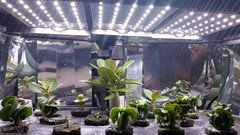
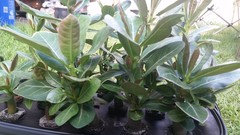
    martin this is them a week ago before i cut the leafs yesterday, the no i did not damage the apical growth areas of the plant, those are the saps after i cut them last night because i always take picture after i do something to the plant.

    and yes it always comes in with the genetics. but for me i love to experiment and show facts that it works or not, im just sharing my opinion, i dont sow hundreds of seedlings as you can see theirs only 16 slots for me to put them in.

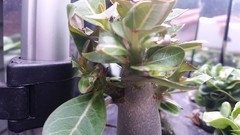
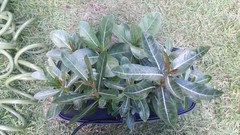
    and this is my obesums from last year that i also grew in the same method

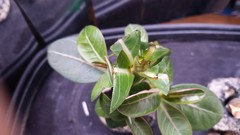
    and this is them with out cutting the leafs after 2 months

    Maria Elena (Caribbean - USDA Zone 13a) thanked Jericson Pastor
  • 10 years ago

    Wow. This is a great thread. A couple of things: Martin, is ramnification a proper spelling? Everywhere I see online drops the 'n'.

    I have always had a hypothesis that strong light has the ability to induce branching. Most plant hormone are phototropic, which means they are created in response to light. In this scenario, Jericson's branching is not related to the hydroponics so much as the bright light the plants are under.

  • 10 years ago

    dain the lights they are under has the lowest lumen not even reaching 6500k, after 2 months they stay outside, since the light cannot cover the whole seedlings because the leafs are blocking everything and acts like a big canopy and making the other seedlings to grow slower.

  • 10 years ago

    OMG, Dain. You are totally going to get me into trouble lol You are right that the word is actually "ram·i·fi·ca·tion". It means to "form branches". I'll stop there before I get driven out of town with pitchforks.

    Pagan

    Maria Elena (Caribbean - USDA Zone 13a) thanked User
  • 10 years ago
    last modified: 10 years ago

    Jericson, If I'm not mistaken the 6500K you refer to is the color temperature of the the light the bulb emits and not the intensity, lumen is the output of the bulb.

    Joe

  • 10 years ago

    yes joe, and the lights on those are white leds, and i can put my hand underneath it without getting burn,in my own observation plants react more on color temps of the light rather than the heat itself

  • 10 years ago

    I am very interested in what kinds of lights each of you use when you do have to bring them indoors. Fantastic thread. I have T5's set up 6500 k, 5,000 lumens per tube if it's 4 foot (which also varies with distance). I am trying to figure out how many tubes I'm going to need per shelf for over wintering seedlings with bottom heating.

  • 10 years ago

    If I understand everything I'm reading about this subject, what we call "great ramification" in a plant is actually a shortage of auxin.

  • 10 years ago

    Could the Auxin be stimulated by Keiki paste? As in this post http://forums.gardenweb.com/discussions/4066719/keiki-paste?n=13

  • 10 years ago

    From Martin's post, it sounds like cutting off tips just triggers dormant embryonic buds to grow into branches, Jerry. I'm guessing this is because the auxin-loaded tip has disappeared. This tells me there is more going on there on that growth tip than just the presence of auxin. There are probably more growth-signaling processes going on there. In short, if a plant does not have that many embryonic buds to start with, pruning will only trigger development of those that are already there.


    The number of these dormant proto-branches would depend on the cultivar. The question now is how to coax the plant to grow the maximum number of dormant branch buds so that every time it is pruned, it goes crazy with branching. Or whether that is possible at all. It might be like mammalian egg cells where the number is finite and fixed at birth. The viability can be tweaked but the number of cells is constant.


    Interpreting Viking writing is fun lol


    Pagan


    Maria Elena (Caribbean - USDA Zone 13a) thanked User
  • 10 years ago
    last modified: 10 years ago

    We're basically saying the same thing. From the text:

    Auxin also plays a role in maintaining apical dominance. Most plants have lateral (sometimes called axillary) buds located at nodes (where leaves attach to the stem). Buds are embryonic meristems maintained in a dormant state. Auxin maintains this dormancy. As long as sufficient auxin is produced by the apical meristem, the lateral buds remain dormant.

  • 10 years ago

    Here's a good read on the topic:

    http://www.ncbi.nlm.nih.gov/pmc/articles/PMC3091808/

    Interesting, Conny (NL) is currently trying an experiment using Keiki Paste on both dormant & active adenium nodes.

  • 10 years ago

    An extremely interesting article Maria, thanks for sharing the link.

    Must admit that as as a newbie to growing plants and everything that I picked up during biology class being long gone, as well as being a non-native English speaker I needed to consult my dictionary several times. Will have to read it a couple more times anyway :-)

    Maria Elena (Caribbean - USDA Zone 13a) thanked ConnyNL (The Netherlands, 8b)
  • 9 years ago

    bump … for the good discussion here ...

    Maria Elena (Caribbean - USDA Zone 13a) thanked bragu_DSM 5
  • 9 years ago

    I remember learning about trans-cinnamic acid (derived from cinnamon) as an anti-auxin when researching Keiki paste. There are so many pathways involved it's mind boggling. It seems trans-cinnamic acid and cis-cinnamic acid have been studied as an anti-auxin for branching and root formation. It's probably why Adenium growers love dusting their plants with cinnamon. This stuff is way over my head. . I've had some success with node branching with Keiki paste but mine did not contain t-ca like others had and I've not purchased one that has. I'm going to try a Keiki/cinnamon powder combo and see what happens. I read in another study that t-ca is readily found in cinnamon powder. Here's a fun read.....NOT
    https://www.ncbi.nlm.nih.gov/pmc/articles/PMC5210711/

    Maria Elena (Caribbean - USDA Zone 13a) thanked Halfway There
  • 9 years ago

    I'm so gonna get into hydroponics lol. My 2 months old seedlings are less than half of those in the pictures...

    Maria Elena (Caribbean - USDA Zone 13a) thanked Agartta
  • 9 years ago

    I've actually tried a variation of pinching on my seedlings that caused branching.


    Instead of cutting the tip completely off, I scratched up the growth tip. It stopped the growth in the tip for about a week or two, triggered branching, and then kept growing.


    It may well have been a fluke, but you may want to try it. It's not terribly damaging and won't really hurt the plant if it doesn't work.

    Maria Elena (Caribbean - USDA Zone 13a) thanked thezombies