Software
Houzz Logo Print

I love picking up the lovely bromeliads at my local garden centers and even at Lowe's, but they never are named. I'm fortunately in an area where I can plant most if not all of them outdoors. Hoping the forum members here can help me ID a few I picked up today. They're going outside tomorrow, to be planted underneath my palms and bamboo. Lovely dappled sun, and the bromeliads I currently have outside just love this area. I do have one planted outside in a large pot - very common bromeliad I don't know the name of, either. Any help with IDs would be much appreciated:


Patty S.

Comments (9)

  • 9 years ago

    Hi everyone.

    Patty – First let me say what a great healthy
    looking collection of bromeliads you’ve posted pictures of.

    We have the same problem here in Australia when we buy bromeliads
    from the larger stores as they get their plants in bulk from professional
    companies who for some reason only ever put a generic name label on them. I’ve
    never worked this out as it wouldn’t be any harder to put the correct name on
    the plant than it is to use a generic name.

    My main interest is with Neoregelias, so I won’t be much
    help identifying your plants as they seem to be mainly Guzmanias and Vrieseas,
    but I’ll do what I can.

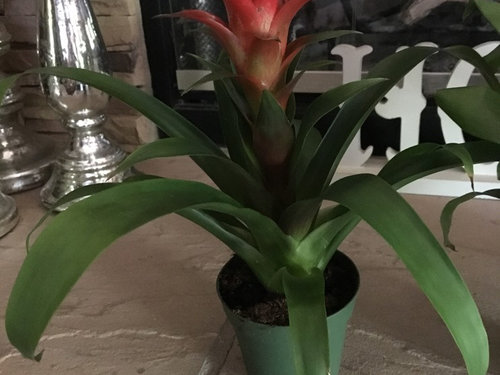
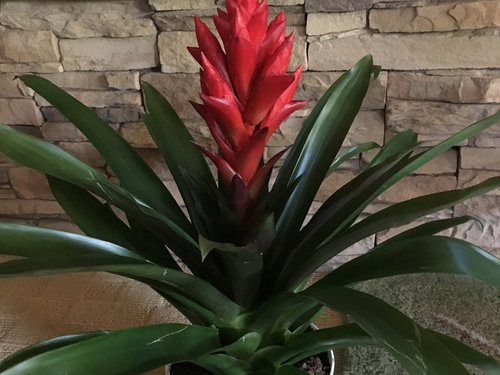
    Picture 1

    This is a beautiful looking plant and I think it’s
    probably a Guzmania but I wouldn’t have a clue as to the correct varietal name.

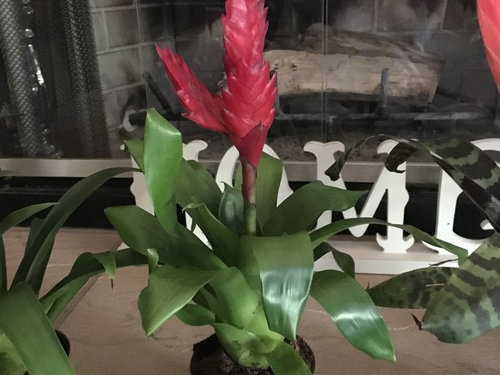
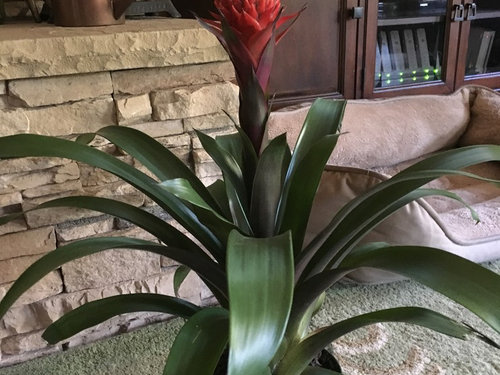
    Picture 2

    This is a Vriesea, and again I wouldn’t know the correct varietal
    name although it does look a bit like one I have called Vr. Barbara. See the Bromeliad Cultivar Register at http://registry.bsi.org/?genus=VRIESEA&id=8391#8391

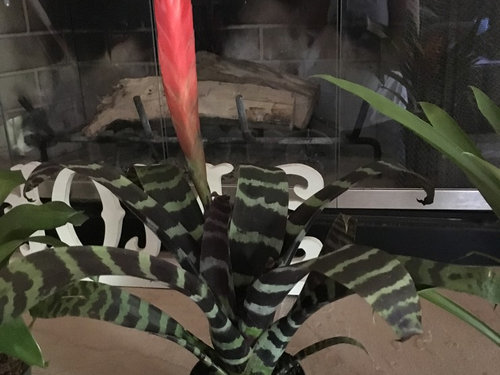
    Picture 3

    This too is a Vriesea and could probably be Vriesea Splenriet
    or one of its hybrids again check the register and see what you think

    http://registry.bsi.org/?genus=VRIESEA&id=9127#9127

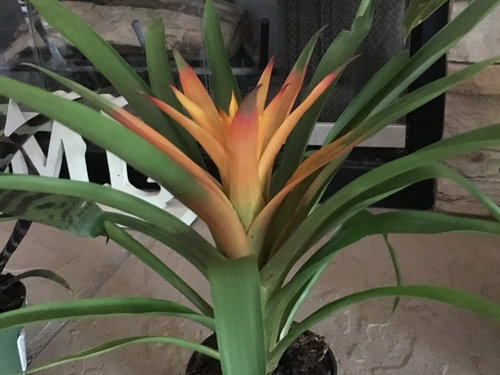
    Picture 4

    This one again looks like
    a Guzmania and is just one of thousands of commercially produced annually to be
    used in place of cut flowers in the home. Sorry but I can’t help with a
    varietal name.

    Picture 5

    This amazing looking plant
    I think could be a xGuzvriesea. This is what’s known as a bi-generic hybrid
    which is the result of crossing two different genera together.

    One that looks a bit
    similar is xGUZVRIESEA ‘Star Fire’ which you can see at: http://registry.bsi.org/?genus=xGUZVRIESEA&id=9378#9378

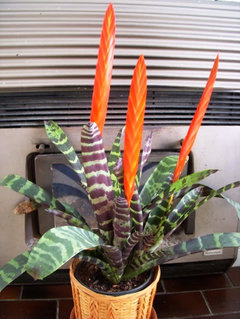
    Picture 6

    This one too could either be
    a Guzmania or a xGuzvriesea, but I have no idea of the name. All I’d like to
    add is that it’s a very attractive plant and I wish it was in my collection.

    Picture 7

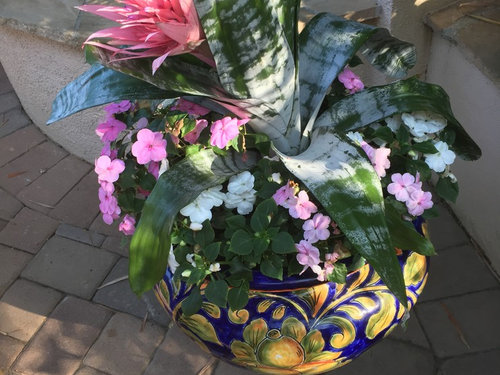
    This one I can Identify
    for sure, it’s Aechmea fasciata and is one of the first bromeliad species ever to
    be grown and sold commercially. It is grown and sold in the millions all over
    the world annually and I read where it is still the most popular and biggest
    selling bromeliad world wide.

    That’s about the best I
    can do and hopefully someone in your own country with a better knowledge of
    these plants can give you more assistance.

    All the best, Nev.

    hoosierquilt USDA 10A Sunset 23 Vista CA thanked splinter1804
  • 9 years ago
    last modified: 9 years ago

    Picture 6 could possibly be an interspecific Guzmania hybrid named `Torch.`

    'Torch' was bred in the Netherlands -- the male or pollen parent was a selection of Guzmania conifera ; the female or seed parent was a selection of Guzmania lingulata .

  • 9 years ago

    Thank you, Dave & Nev. I knew the one in the pot was a very commonly sold brom, but I thought Aechmea fasciata has spiny leaves? My brom does not. Anywhere. Or, look like it will ever have any, which is what sort of threw me.

    Patty S.

  • 9 years ago

    Thanks, Nev, that makes complete sense. I know this is a very common brom, but it is still so very lovely, and this particular specimen was so big and healthy, with some tiny pups just barely visible. I always try to pick up specimens with pups or the beginnings of one. Fortunately, we rarely have temps at or below freezing when I live, so my outdoor broms have done well. These will be up pretty close to my house, on the south side of my lot, under a palm and bamboo canopy. The broms already in the ground are pretty happy there. Your collection is very lovely! I especially love the Ae. fasciatain the peppercorn tree, spectacular!

    Patty S.

  • 9 years ago

    I have pretty much all the same bromeliads that you have, as they are distributed widely in Southern California. I am up the coast from you in Los Angeles, but I am close enough to the beach never to have frost, but many bromeliads can handle a light temporary frost, such as 31 or maybe 28 degrees for a few hours. Of the group you show, the third one (Vriesea Splenriet) is probably the most difficult to grow and especially to get to bloom. It needs a good deal of protection from sun, but it also needs good air circulation. I've gotten several pups from mine, but friends have had no luck at all, and I've never gotten blooms from my pups, even though they are growing healthily.

    For me, the Aechmea fasciata is one of the most prolific bloomers (of those you show) and is the easiest to grow, which may be why it is so common. Also, the flowers last for months.

    You are smart to buy plants that already have pups, as these are generally removed as soon as possible for the growers to use, which may mean that you would have to wait quite a while to get pups, if you get any at all.

    I am pretty much in the same situation as you - not having full names for the plants, but I do know their genus, as a rule. Even the nurseries such as Marina Garden Center and Rainforest Flora do not always give complete names for their bromeliads, but Rainforest Flora (in Torrance) is better than most. The Marina Garden Center often identifies plants as "Neoregelia, assorted", especially when the plants are small and/or inexpensive. When the plants are bigger and more expensive, they put more information.

    hoosierquilt USDA 10A Sunset 23 Vista CA thanked Lars
  • 9 years ago

    Thanks, Lars. Wow, this is just a very nice forum, and I've received so much great feedback. Lars, interesting that you say that about Vrisesea Splenriet - I did plant one a few years ago in my lower yard - all shade, but the coolest part of my yard - and I don't think it made it. Have to go down there and check. All other broms doing well and thriving down there. I will be very careful where I place this one in my upper yard, now.


    Patty S.

  • 9 years ago

    Hi everyone - In view of what’s been said about “store-bought
    plants” as opposed to plants bought from specialist nurseries and private
    growers, I’d like to share what I have found here where I live in Australia with plants I have purchased from
    large department like stores such as K-Mart, Big W and Bunnings.

    I have found that suppliers of plants to these
    retailers for "on-selling" are usually professional bromeliad nurseries who obtain
    their stock as tissue cultured plants in flasks and import them from various overseas
    companies.

    Without going into the technicalities of “tissue culture” I’ll
    just say it’s a specialist field where plants are (for want of a better word)
    mass produced from a tiny piece of tissue taken from the parent plant. Any
    plants produced from this tissue (in theory) should all be identical to the
    original parent. (This is usually the
    case with the original plant purchased, but after then, the subsequent pups
    produced seem to go astray and do strange things).

    These plantlets are taken from the flasks and grown on in
    various steps so they become acclimatised to their new growing medium and conditions.
    They are force fed to make them grow quickly and when they are near flowering
    size they are treated with a chemical to make them flower prematurely and all at the same time so that flowering corresponds with special occasions such
    as Mother’s Day, Christmas time or other occasions where gifts are given.

    I personally have had very mixed and unsuccessful results
    with tissue cultured plants (or should I say) with the pups produced from them.
    If I buy a plant already in flower, there isn’t a problem because what you buy
    is what you see, “a plant in flower”. (We
    shouldn’t lose sight of the fact that the object of producing these tissue cultured
    plants in the first place is to take the place of a bunch of cut flowers with
    the idea being, when they have finished flowering, they are tossed out and
    another flowering plant purchase to take their place).

    I have sometimes found that plants bought “in spike” but yet
    to flower, sometimes produce deformed inflorescences and flowers. I have also
    found that the pups are often produced more productively than usual; for
    example where a plant would normally produce just the one pup, these plants
    often produce multiple pups.

    I have also found that these pups will grow well and reach maturity
    in the usual time frame or even faster, but rarely flower in the first
    generation.

    I had one plant (an Ae. fasciata hybrid called ‘Morgana’) which
    over the course of a couple of years produced in excess of twenty pups and even
    six years on, none had flowered but just
    kept producing more pups of their own with the same result; eventually they were all
    “binned”.

    My theory is that somewhere during this production process, factors
    arising from the tissue culturing combined with the forced growth and
    flowering, everything within the plant’s genetic makeup becomes “muddled up”
    and the genes of the plant are so confused they don’t work as they do normally.
    What is it they say, if you mess with “Mother Nature”, she will surely bite you
    on the bum.

    I can honestly say that with approximately twenty of these
    tissue cultured plants of various genera I have purchased over a period of a
    few years, I have yet to get a pup that behaves the way a normal pup should
    with the main problem being they just won’t flower initially and it’s not until
    I’m on plants grown from the second or even third generation of pups, that
    flowering sometimes commences normally.

    To sum up; I think we shouldn't forget that the aim behind
    the production of this type of mass produced “store bought plant”, is to
    provide an alternative to cut flowers and not a “cheap” reproduction of a “special”
    and possibly very expensive plant. This too is possibly the reason why these
    plants aren’t named; retailers don’t name the flowers you buy in a bunch so why name
    a plant which is just a substitution for a bunch of flowers?

    All the best, Nev.

  • 9 years ago

    Hi everyone - Following on from my previous post I’d like to take up on Lar’s
    comment about Vriesea ‘Splenriet’. I have found exactly the same with that
    plant here where I live in regards to flowering. Your experience with
    difficulty getting pups to bloom bears out what I said about tissue cultured
    plants in general in my previous post.

    I have had several of these plants now as I think they’re a
    fantastic looking plant and I was determined to learn how to grow them properly,
    however “Mother Nature” had other ideas and on each occasion they succumbed to
    the cold winter weather before the pups could flower except in one case.

    It’s interesting to observe nature’s in-built survival
    mechanisms in bromeliad plants which are usually activated when the plant is
    put under such severe stress that it’s possible it will die. There are two main defenses
    it can employ to reproduce itself and that is by producing extra pups, which
    eventually may produce flowers which eventually (if successfully fertilized) will
    produce fertile seed, and thus guarantee the continuity of the particular
    plant.

    Because I only have a budget that runs to shade houses of
    shade cloth and not covered with fiber-glass, Laze-light or glass, my plants
    have to take their chances with the cold weather. I decided long ago, if plants
    won’t grow under these shade-house conditions I won’t go spending huge amounts
    of money (I don’t have) on elaborate temperature controlled growing houses just
    to satisfy my desire to grow a couple of
    favourite plants; instead I will just concentrate on the ones I can grow.

    This brings me back to Vriesea ‘Splenriet’ and the stress
    that was caused by some very cold weather to my plant and how it reacted to this
    stress.; I had a nice plant in full flower when an unexpected cold snap struck while
    I was away for a few days and caused extensive cold damage to that plant. Even
    though I trimmed off the damaged leaves and gave the plant a drink of Seaweed
    tonic as a “pick-me-up”, it was still a very sad looking plant and I knew that if
    I left the inflorescence attached it would drain the pant of any chance of rejuvenating
    itself so I removed it, and the plant was put away in a corner, hoping for but
    not expecting a miracle.

    It wasn’t until several months later I saw that the old
    Mother plant had produce three pups which continued to grow as the Mother plant gradually declined and eventually died. This was unusual to say the least because in our
    area I’d only ever seen these plants produce single pups. Anyway, each of these
    three pups eventually produced an inflorescence making for a spectacular
    feature in our house. (See picture below). Once the flowers were finished and without
    any sign of fertile seed capsules, the pot was put back outside but these
    plants never produced any pups and eventually declined and never recovered.

    The fact is, that Mother Nature’s survival mechanism did work
    on the original Mother and even though three pups were produced, they just couldn’t
    compete with the cold winter weather. So now after accepting I just can’t grow
    this plant in my area, I just look at the picture below and think how lucky I was to
    get those flowers.

    All the best, Nev.

Sponsored
Whisler Home Improvement
Average rating: 5 out of 5 stars9 Reviews
Franklin County's Committed Home Improvement Professionals