

Venthoods and grease...?
I have a question about how a "real" vent is supposed to work, and what I'm supposed to do post cooking....I've only been "adulting" for about 8 years, and until now have only had a microwave vent, which I only turned on when smoke from the pan got to crazy in attempt to avoid setting off fire alarms.
I've been using my new vent now for a couple months, and I have to wipe the grease off the outside every time I finish cooking (I almost exclusively pan fry, saute, brown, etc. on the stove). There is also this wire mesh up inside the vent that looks like I should probably be cleaning it off every so often as well. So what is the normal way to take care of a vent? Does everyone's vent collect grease and you wipe it off every time?
Comments (22)
 10 years ago
If you are getting grease that needs to be wiped off every time you cook than your vent hood is totally inadequate. Is it actually vented through the ceiling or wall to the outside. How many CFMs is your blower/fan. My vent hood only needs to be cleaned 2 or 3 times per year. There is rarely any grease on the outside. It's inside and the blower housing that gets greasy. You might need to think about getting a different hood vent.
 10 years ago
I agree with badgergal it should not have to be cleaned that often. If you can identify the brand/make of your vent you can often look up the owner's manual on the internet. It should tell you how to remove the mesh filter, how often it should be cleaned and how to clean it.
Related Professionals
Danville Kitchen & Bathroom Designers · Akron Kitchen & Bathroom Designers · Allentown Kitchen & Bathroom Designers · Helena Kitchen & Bathroom Designers · Ogden Kitchen & Bathroom Designers · Queens Kitchen & Bathroom Designers · Murfreesboro Kitchen Remodelers · Milwaukee Kitchen Remodelers · Saint Joseph Custom Countertops · Cincinnati Custom Countertops · Longview Custom Countertops · Huntington Custom Countertops · Elgin Custom Countertops · Grand Island Custom Countertops · Plattsburgh Custom Countertops- 10 years agolast modified: 10 years ago
Some easy troubleshooting questions first (things you can do):
- Are you turning the hood on before you start cooking?
- Are you using the hood at its highest fan speed?
- Does it improve if you open a window so the fan can draw air through the house?
Then some harder ones (design and install of the hood):
- How deep is the hood? For heavy frying you want it to extend out over the burners you are using so 22" to 24" is ideal.- How high above the cooktop is the hood mounted?
- How many cfm is it rated at?
- Does the hood have a large capture volume (space enclosed under the hood)?
Then the really hard ones (ducting):
- How wide is the ducting (diameter in inches)?
- How long is the ducting run?
- If opening the window improves the situation but you don't want to do that year round because of weather then you have an expensive make up air problem to fix.
- 10 years agolast modified: 10 years ago
The OP describes a mesh filter hood, rather than a baffle filter hood. The mesh filters need frequent cleaning -- they quickly become clogged with grease and as a result block efficient exhaust. The OP needs to keep the mesh filter as clean as possible.
For other people looking at this thread who may be shopping for a hood: it is preferable to have a hood with baffle filters because they do not become clogged with use. Of course baffle filters need to be cleaned, but if you forget or don't get to it right away, the baffle filters will continue to work, while mesh filters will not. A baffle filter hood is usually more expensive than a mesh filter hood, but it is a worthwhile expense.
 10 years ago
The best way to clean the mesh panels is to run a sink of hot water with a capful of Calgon Water Softener. Swish them through the water, after soaking a few minutes, then rinse well and drain to dry.
I have also used Persil liquid for this....
 10 years ago
My hood draws only 390cfm (probably only 350 actual), it has a mesh filter, and I don't get grease on the outside of the hood. I clean the mesh in a sink of hot, soapy water, every couple of months. I don't do a lot of deep frying--mostly saute onions and mirepoix, fry eggs, and sear meats.
I always use a grease screen on the skillet, and start the hood on high, before the grease and steam start to rise. I have low ceilings, and if I don't turn on the hood fan, my smoke detector sometimes goes off in hot weather, with only a large pot of water boiling for pasta or canning.
amylachney
Original Author10 years agoThis is the one I have:
https://www.build.com/broan-pm390/s651824
I don't have time to read all the specs right now as I have to leave to get my son from preschool, but there it is.- 10 years agolast modified: 10 years ago
That's the insert, what about the hood the insert is inside of?
- Width?
- Depth?
- Is it "cup shaped" so the grease/steam/smoke/etc., are captured for venting to the outside (I hope to the outside...)
What options did you get for the insert?
- CFMs?
- Recirculating or vented to the outside?
- Duct diameter?
- How high is it off the cooking surface?
.
 PRO10 years ago
Even if her hood is adequate, if she is cooking with a gas stove with pilot lights, she may get a greasy film on her hood (and lots of other things as well!).
- 10 years agolast modified: 10 years ago
Anglophilia, you are incorrect. "Cooking with a gas stove with pilot lights" will not cause the OP's complaint of grease on and in the hood. Grease is not an output of gas. The bottom line is that when you cook, the smoke and grease from what you are cooking is supposed to be exhausted by the hood to the outside. If they are not, it is because of the several causes listed on this thread - low cfms, mesh filter clogging, inadequate capture area, inadequate ducting.
amylachney
Original Author10 years agoThe hood (Silver box thingy? I thought it was all one thing, but the measurements on the link I have say it's like 20x11, but the whole gray part is 36x maybe 18? 20? The pipe is 6in diameter. The hood is just a flat rectangle.
I don't open windows, we are having energy problems so I don't want to waste any AC! I will take a picture real quick of the grease that accumulated in just one session of cooking steaks in cast iron WITH a grease cover thingy over the pan.amylachney
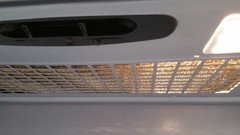
Original Author10 years agothis is the grease left behind on the stove top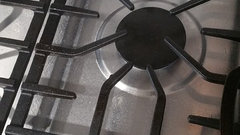 and if you can see that droplet to the right of the red light thingy on the black part, that's grease that collects there
- 10 years agolast modified: 10 years ago
If you are cooking on the front burner and your hood only projects 18 or 20 inches over your cooking surface, there's your problem. Could you take a picture of the underside of your hood also? ETA: we crossposted!
amylachney
Original Author10 years agoYes I do cook on the front! Should I be doing the greasiest on the back?
- 10 years ago
I'm sure someone will correct me if I'm wrong but a vent hood doesn't prevent grease splatters on the stove, even with a grease screen, small splatters are going to happen...no amount of CFM's are going to stop that. It's the grease carried in the smoke/steam that the vent fan will help with. It's hard to tell in the pic but the right side looks like alot of grease is captured in the screen material so it's probably time to clean that.
- 10 years agolast modified: 10 years ago
Could you please take a picture of the entire setup from a few feet away? The picture should show the entire hood, entire range (or cooktop), and some of the surrounding upper cabinets.
++++++++++++++++++++++++++++
The link you included is for an insert - it is installed inside a custom hood:
Silver 390 CFM Custom Range Hood Insert with Incandescent Lighting from the Insert CollectionNote that it's for inserting into a "custom range hood".
++++++++++++++++++++++++++++
I suspect one of the following (hopefully, it's the first b/c that's the easiest to "fix"!)
(1) It isn't cleaned often enough. If you do a lot of high-grease cooking, you need to clean the mesh filter frequently - probably once a week, at least. If you haven't been doing that, then it's probably clogged and cannot collect anymore grease. (I rarely cook with grease and still try to clean my range hood's "squirrel cage" at least once every two or three months - I have a Vent-A-Hood. I started out doing it once a month, but it was usually pretty clean, so I don't do it as often now.)
(2) The hood was installed too high off the cooking surface. Per the Broan website, "The bottom of the hood MUST NOT BE LESS than 24" and recommended at a maximum of 30" above cooktop for best capture of cooking impurities." If your hood is installed more than 30" above the cooking surface, see if you can get it re-installed correctly.
(3) The overall hood is under sized. Since you do a lot of high-grease cooking, the overall hood should be at least 6" wider than your cooking appliance and 24" deep (so it covers the front burners) - with a bare minimum of being the same width as your cooking appliance & 24" deep. So, if you have a 36" wide range/cooktop, the hood should be 42" wide x 24" deep; but at least 36" wide x 24" deep with upper cabinets flanking the hood to help with the capture. Unfortunately, this is something that cannot be easily fixed unless you have space around your hood for a wider hood. A deeper hood would be easier install - but you probably would not be able to use your custom hood (assuming you have one.)
While the insert is 20" x 11", what is the size of the overall hood? And, does it have a "cupped" area to collect grease/steam/smoke/etc. while the fan does its work exhausting them to the outside (I hope it's going to the outside...see #5).
(4) The hood is under powered. With the type of cooking you do, you should have one that's stronger than this particular model - even the highest option isn't really powerful enough.
(5) It's a recirculating model. Recirculating hoods do not work very well.
- 10 years agolast modified: 10 years ago
However, be aware that since grease is heavy, not all will be captured by a hood, some will not be captured, so you may very well see grease on the cooking surface. The outside of the hood, though, is a different matter. If your hood is sized and powered sufficiently and installed correctly, there shouldn't be any grease on the outside of the hood. Yes, there will be some on the inside as the grease is captured and vented out - but that's what you want!
I also wonder if using the grease/splatter guard is making it harder for your hood to do its job - anything that escapes has had its "rising rate" slowed down by the obstacle and the hood has a more difficult time trying to capture it. Anything that doesn't escape the guard will stick to it and drip down to either the pan or the cooking surface. Have you tried it without the splatter guard? (Just a thought!)
- 10 years agolast modified: 10 years ago
Here's a picture of my hood...it's 42" wide x 24" deep over a 36" wide cooktop and installed 30" off the cooking surface.
.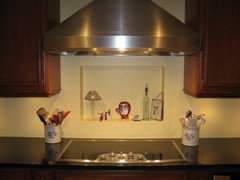
Unfortunately, I don't have any of the inside of the hood, but it's a "cup" shape with the squirrel cage on the back. The squirrel cage is an insert inside the overall hood you see on the outside.
- 10 years agolast modified: 10 years ago
This thread inspired me to clean my hood and filter this afternoon. I have the same model insert, in a 30" x 19" hood over a 30" electric range. The bottom of the hood is 29" from the surface of the cooktop. I plugged it in between existing upper cabinets, so going wider was not an option.
What I observed, was grease on a paper towel that I used to wipe the filter cover before removing it, but no grease at all on the liner/deck, which was a surprise. I looked for lurking droplets on the cover before wiping with the paper towel, and didn't see any. There was a film of grunge (grease/dust) on the top of the hood. Been there too long--when I wipe the hood more often, it's not a problem. I think it's been a couple of months since I'd cleaned the filter,
probably twice that long since I'd wiped the top of the hood (I need a
step-stool, and what I can't see, I ignore--I'm just admitting this so
that you can compare your MO).The filter was full, with a few droplets of grease on the inside of the cover, and the squirrel cage had some droplets of grease on the bottom and a grungy film around the vents.
I always fry and saute on the front burner, because I hate getting grease on the tall back of the range, and I use the spatter screen for the same reason. Maybe the fact that you have gas, and the amount of frying you do is responsible for the large amount of grease produced.
amylachney
Original Author10 years agoBeuhl thank you for your very in depth post!
This is my overall set up:
Could you guide me in the direction of something I could shoot for in a few years when I can re-do the cabinets and the hood? Like whatever I would need to buy in order to have a good-enough hood at 42 inches, with a wood casing around it? I have no idea what parts I need to buy...did my contractor just purchase the Broan insert and then got the big silver part that it fits into from somewhere else?
The vent is as low as it can be per code, my kitchen guy said that I am not allowed to have combustible material (wood hood cover) closer than (I'm pretty sure) 32 inches from the cook top.
I will definitely start cleaning the mesh part more often!- 10 years ago
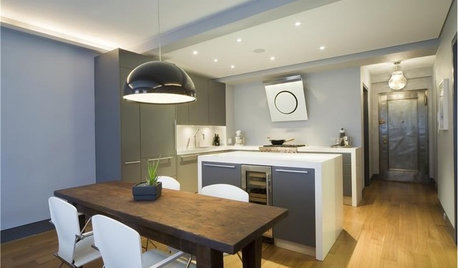
The appliance forum is frequented by people who know a LOT about hoods. If you have a few years, just lurk there some and you should be quite knowledgeable when the time comes!
amylachney thanked nancyjwb



nancyjwb