Software
Houzz Logo Print
margi46

What's the best source for garlic for planting?

Zone 6.

Soft neck? Hard neck? What's best for cold winters and hot summers?

I'm hoping to find one that will store well. Asking too much?

Comments (28)

  • 10 years ago

    You could probably grow just about any type (hard neck or soft neck); but Artichoke (soft neck) varieties might be your best bet. They prefer warmer weather, and store better than most hard neck varieties.

  • 10 years ago

    Define 'store well'...6 months, 9 months, 12 months? Do you want to eat scapes in June that are only found on the hard necks?

    For hard necks the porcelain types like Music and German White usually store the longest at 7-9 months. Rocambole types like Spanish Roja or Russian Red typically have the shortest storage at around 4-5 months with proper curing and storage conditions. Purple stripes like Chesnok Red, Siberian are somewhere in between.

    Softneck types can store a year or more with proper curing and storage conditions. I have not had good luck with Artichoke types here in the KC area the few times I have grown them. I would like to try a Silverskin type soft neck sometime to see if they do better.

  • 10 years ago

    Zone 6, at least my zone 6 (your winters are probably shorter), does well with most hardnecks, and I have not had luck with Home Depot softnecks here.

    I did have success with artichoke garlic one year, which is not actually garlic but in the leek family and makes scapes and thus is not softneck.

    I would recommend hardnecks by far. I bought my garlic from Big Red Barn and have been very happy with the garlic and the service. But of course there are many other good sources.

    http://www.bigredbarngourmetgarlic.com/online-catalog.html

  • 10 years ago

    "I did have success with artichoke garlic one year, which is not actually
    garlic but in the leek family and makes scapes and thus is not softneck"

    With respect, Peter, I think that you might be confusing elephant garlic (which is a bulbing leek) with artichoke garlic. "Artichoke" is one of the garlic sub-categories that is often referred to as "soft neck"; "Silverskin" is another. Neither forms scapes, although they may form stem cloves under some conditions.

    To the good summary of storage characteristics given by LoneJack, I will add my own observations:

    "Hard necks" (rocambole, porcelain, and the purple stripes) are the most winter hardy (although I have one very temperamental rocambole). They have also proven to be more tolerant of poorly drained soil, or periods of excessive rainfall... so they are very reliable. However, IMO, they are more sensitive to weed pressure, and to scapes being cut late, both of which can reduce bulb size. They tend to have larger cloves, but fewer of them; so they multiply more slowly, and a greater percentage of the crop must be set aside for the next year's planting.

    "Soft necks" have had unpredictable winter hardiness here; some years losses have been severe, while other years (like this one) survival was close to 100%. They are much more sensitive to excessive soil moisture, which can severely reduce bulb size - to the point that, in a very wet Spring, they may form rounds instead of bulbs. They are, however, more tolerant of weed pressure; and given rich, well-drained soil, can perform as well as hard necks. As a rule, they form smaller cloves, but many of them - so they can be multiplied quickly, and a smaller portion of the crop needs to be set aside for planting.

    For most gardeners, the hard neck garlic varieties will be the most reliable, and generally produce the largest bulbs. If you only have space for one or two varieties, they might be the safest choice. For me, the soft necks are not as reliable... but in a good year, they can be very good, even out-performing the hard necks. There are flavorful varieties of both hard neck and soft neck, but the rocamboles as a class tend to have the richest flavor.


  • 10 years ago

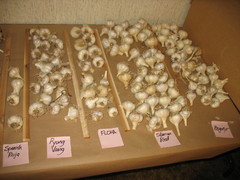
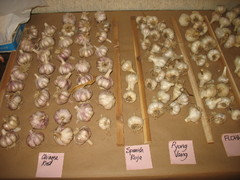
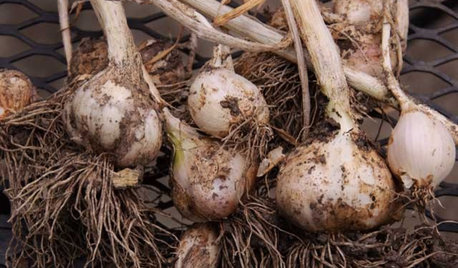
    Here in southcentral KS the best sizing varieties for me have been Siberian, Bogatyr and Chinese red. Of course the outcome depends on good watering, fertilizing, soil, etc. as well as tolerance for our hot summers and cold winters. These were grown in clay that has been modified with a 3" layer of compost every other year for over 15 years (tested about 6% OM, pH around 6.5). A handful of soil now crumbles through one's fingers. I've had lousy luck for several years trying to get Spanish Roja to size up and am dropping it. The four in the picture are the largest out of 60! I grow a few Floha and Pyong Vang because they are more novel and a bit different from the rest.

    Obviously, Chinese red has the largest bulbs, but Siberian has by far the largest cloves and seems to store quite well. I grow Bogatyr for its heat when eaten raw.


  • 10 years ago
    last modified: 10 years ago

    Once you get started the best source will be your own stock. To get started either order the largest seed bulbs you can find, and Music and Siberian are both very widely adapted and dependable types (Music and German White are very similar to each other if not actually identical) or if you can find a local grower such as in a local farmers' market, buy the best they have grown themselves and be a leg up on local adaptation. Or perhaps you know some nearby Amish whom you can ask for advice.

    There are quite a few very sound Internet suppliers, all you gotta do is Google seed garlic. But don't wait much longer; many of them are already sold out or close to it. My best variety is Music and that originally came from Red Gate out west, but it adapted to my Minneapolis garden rapidly.

  • 10 years ago

    zeedman, you are correct I am confusing elephant and artichoke garlic. Thanks for the clarification.

  • 10 years ago
    Wow...thanks, all, for the wealth of information. I think I'll hit up the local farmers market on Saturday and see if I can find some to get me going.
  • 10 years ago

    What part of Kansas are you located? Hopefully the farmer's market will have something for you to buy. Do try to find out from the grower what type of garlic they are offering. Sometimes they don't know sometimes they do.

    If you aren't able to find any at the market, then online vendors would be a good option. The vendor that Peter mentioned above is a good one that I have used as well and they have some really nice garlic, good prices, great service, and a decent selection of varieties to choose from.

    Vendor prices might seem pretty high at first glance, but if you hold back some of the best bulbs from your harvest each year and replant it year after year you end of with a nice return on your initial investment.

  • 10 years ago

    @LoneJack - I live in Wichita.

    Back to your original questions, I would hope to be able to grow garlic for use year-round, so storing for nearly a year would be ideal in my mind. In KC when are you typically harvesting? I don't know about eating the scapes, so that was not on my original list of wants...but I've since done a little research and now I understand that they are very good. Who knew?

    I have a large garden, but haven't really grown garlic. I rototill both in the fall and in the spring, so I'd have to designate a spot out of the way for the garlic. I will hope to find some at the Farmer's Market tomorrow. Just a few heads to get me going on a couple different varieties is all I'm after.

  • 10 years ago

    @LoneJack - I'm already dreaming about my garlic patch. I had it all worked out in my mind...an area that is too difficult to rototill...perfect, right? Well...then I remembered that the neighbor's globe willow is providing a fair amount of shade in that spot from mid-day on. What do you think? A waste to try it there? How much shade can garlic take and still produce well?

  • 10 years ago

    I have found garlic to do well in part shade -- don't forget it sprouts and does a lot of growing before the trees come in.

    But, full shade from noon onwards sounds excessive... morning sun is not very good. Does it not get any afternoon or evening sun at all?

    If you can grow good grass, you can probably grow garlic.

  • 10 years ago
    last modified: 10 years ago

    Partial shade is not ideal so I would try to find some place that gets at least 6 hours of full sun if you can. I would also be leery of tree roots from the willow sapping the nutrients from the bed.

    What makes that bed too difficult to till? Garlic likes loose, well draining soil with a decent amount of organic matter incorporated.

    Were you able to find any garlic at the farmer's market Saturday?

  • 10 years ago

    @LoneJack - a few answers: The part of the garden that I was contemplating for the garlic is about a 4 x 7' section that bumps up against my compost bin on one side and the other side is a few herbs growing along the fence. The biggest problem, I suppose, is that my rototiller is pretty big. I could walk it in and then back it out. I guess really, the biggest problem may be the shade. It probably gets at least 6 hours, but not much more. My second idea is to put the garlic all along the other end of the garden. The whole garden space is about 25 x 60. Seems like I could grow plenty of garlic in a 25' row or double row. When it comes time to rototill, I'd just have to remember to not go all the way to the end before turning the corner. I look forward to minced garlic, but I'd like to do it in the kitchen with a knife, not in the garden with the tiller!

    I feel like I scored (kinda) at the Farmer's Market. There were 6 or so different venders which were selling garlic. In visiting with one gal who had un-named hardneck available, I told her that I was wanting it to plant to start my own. She broke into a head and cut into a clove for my sampling. Wasn't up for a slice of garlic, but it had a nice smell. When I mentioned I was wanting it for "seed", she grabbed a small bag which contained bulbils. She gave me the head that she broke open and she also GAVE me several globes of bulbils. I figure I'll plant the cloves and also the bulbils and see which does better.

    Additionally, I found another vender that had several named varieties. (this is what I was after in the first place) Since I already had some un-named hard neck, I was interested in the softneck varieties that she had. I settled on Bianca Italia and Viola Francesa. I just bought one head of each...the biggest I could find in her baskets. Do you know anything about these varieties? She also had French Rose, Music, and Bogatyr.

  • 10 years ago
    last modified: 10 years ago

    French Rose is probably the Creole also known as Rose de Lautrec. If you are being offered large local bulbs you may have a find on your hands well worth trying out. Music is a porcelain and Bogatyr is a marbled purple stripe both hardnecks. Music is the better keeper of the two, but both are very dependable over wide areas, although most of the soft necks will out last either of them if properly cured. Music is my favorite of all the garlics here in Minneapolis. Softnecks do not do well for me here, although other locals around here generally do ok with most of them.

    Garlic is not the allium for out of the way places, however, especially if at all shaded. Better use the tree or walking onions for those locations. Garlic likes the same conditions that grow good bulb onions: full sun, well drained and well fertilized beds, and careful attention to side dressing, watering and mulch during the growing season. Also best when fall planted like one does for tulips, just later. Here in zone 4 I shoot for planting my tulips and my garlic (I plant them together with the tulips between the various garlic varieties) in mid October. In Kansas probably better to wait for November.

    One other thing: I like to prepare my beds in advance if possible and let them simmer a few weeks at least before planting. Hopefully I will get my sweet potatoes and carrots dug this coming week and work their former spaces up for later garlics.

    About small spaces, I find my little Mantis electric tiller is just what the doctor ordered for the size beds I plant.

  • 10 years ago

    Good to see you post Dutch....hope your sweet taters and carrots give good harvests.

    I have not heard of the Bianca Italia (Italian White) but it may be the Silverskin listed as Italian Late in this link to the Heirloom garlic archive. French Rose may also be the one listed in the archive as the Rocambole French Red. I can't find anything on Viola Francesca (French Purple???) but a lot of garlic varieties have aka's so it is sometimes hard to identify the common name.

    How large are the bulbils for the unknown hard neck? Growing from bulbils is usually a 2 to 3 year endeavor depending on the type. If they are large bulbils the size of a pea or so then the first year you may get large rounds followed by full sized bulbs the second year. If the bulbils are small it may take 3 years to get full sized bulbs. Personally I have never grown garlic from bulbils but I believe Dutch has and Zeedman has a great deal of experience with them in building his garlic collection.

    Here in KC, I also plant my garlic in mid October and then mulch them with about 4" of shredded leaves in November after they have sprouted a couple inches. Winter kill should not be a problem for you in Wichita but the mulch helps to keep the soil temperature more moderated over the winter to avoid frost heave that can rip the roots off the garlic. I pull off some of the mulch after the garlic has resumed top growth in early March to avoid rot from over saturated soil.

    +1 on the Mantis. My garden is all raised beds and it is so much easier and faster to use my Mantis rather than haul out my 5 horse front tine tiller. Mine is the 4 stroke gas powered model.

  • 10 years ago

    Bulbils are certainly a multi-year process in order to get decent sized bulbs. Different varieties have different sized bulbils and behave differently as well. One type I have, a collected feral, produces very tiny but divided bulbs the first year. I have had to replant the biggest cloves for a couple of years following to get this one to size up, but it has done pretty well and now is producing bulbs up to about an inch and a half or perhaps maybe 4 times the size of the bulbs I originally collected out of my sister's one flower bed. That one even the first year bulbils produced tiny scapes on very tiny plants. The stem bulbils from the Japanese did quite a bit better, but those produced rounds. I have not worked with porcelain bulbils such as from Music. I have had good response just replanting the largest cloves. Same for Siberian and VietNamese Red and Japanese too for that matter. Those will be my main 5 varieties with Xian on trial.

    My electric mantis is just the right size for an old man to handle for a couple of rows at a time. :-) I can see that it would be about as good as anything for raised beds. You can carry it around. I prefer electric over having gasoline around the house.

  • 10 years ago
    last modified: 10 years ago

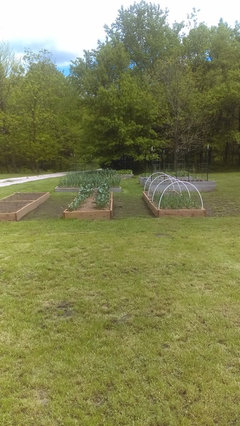
    Electric wouldn't work for me here as most of my beds are over 100 yards from my house and a electric outlet. It's bad enough having 300' of hose to irrigate the garden without also having to drag out 300' of extension cord to till it. At least the 4 stroke Mantis doesn't require pre-mix gasoline/oil like the 2 stroke.

    Picture from spring 2016. The house is hidden from view but the house is about 250' behind the tree line and across a creek from the gardens.

    Garden pictures · More Info

  • 10 years ago

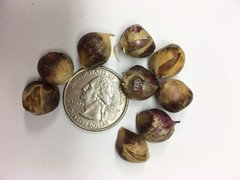
    The gal at the farmer's market from which I obtained the hardneck bulbils didn't give any indication that it would take any more than a year to go from bulbil to bulb. In fact, she actually said (holding one of each in either hand), "plant this and you'll get this", changing focus from one hand to the other. From the reading I've done since Saturday, these bulbils are really big, much bigger than the "size of a grain of rice" that some varieties produce. Maybe there's hope.

    I intend to go back to the market next week and visit with her further. I will also go back to the vendor who had several named varieties. From what @OldDutch says, it seems like there are a couple of the other varieties that she offers that I should try.

  • 10 years ago

    Those are nice sized bulbils. I would guess that they are probably a Rocambole type which are supposed to have the largest bulbils IIRC. You may get a full differentiated bulb but smaller than if you planted a clove at harvest or a large round. Either way it will be edible and you will have learned something along the way.

    If you have the room I would go ahead and try the French Rose, Music, and Bogatyr this year and see how they do in your garden. You will be one year ahead on finding what types do best in your garden. Sometimes it takes garlic a couple years to adapt to local growing conditions but since you sourced your seed locally that should not be a problem for you. A 25' double row at the end of your garden should allow for about 100 plants.

    I am planting 10 varieties this fall for a total of about 220. Music, German White, Siberian, Spanish Roja, Russian Red, Metechi, Estonia Red, Chesnok Red, Purple Glazer, and Persian Star. Most of them have done really well in my garden and a few not so well but I have not given up on them.

  • 10 years ago
    last modified: 10 years ago

    Be sure to map out where you put what and how many cloves of each you put out. Jack may have to walk 300 feet to get to his beds, but I only have a lot that is 40x120 and that is from center of alley to center of front street, including a 9 room house and an ancient model T width detached garage. I would still be lost without my maps.

  • 10 years ago
    last modified: 10 years ago

    When are you guys planting schedules? I have planted around the first frost (late October) and it has worked out well for me.

  • 10 years ago
    last modified: 10 years ago

    Our first frost in zone 4 is generally earlier. I shoot for planting in mid October with bed prep in mid September. That works for me for garlic, fall potato onions, tree onion bulbils, and tulips. With the beds prepared earlier, I have a bit of latitude should we get an early winter and have to plant earlier. Things have gotten a bit unpredictable with global warming stirring the pot. I normally water in my fall plantings and then immediately take up my hoses.

  • 10 years ago

    I amended my 3 garlic beds with compost and tilled them with my Mantis a couple weeks ago. Currently 2 of the beds have radishes growing in them but they should be done by early October. I plan to plant my garlic the weekend of October 15 weather permitting but I may split it up and plant some of it the following weekend.

    It doesn't take long to plant but it does take a bit of time to break open the bulbs and select the seed cloves.

    The %$#& squirrels are already burying their acorn and hickory nuts in my garlic beds and since I have the radishes growing I can't cover 2 of them with chicken wire. I may till them lightly again and evict the nuts and add some garden tone just before planting.

  • 10 years ago

    Turns out I am developing a tree problem with my garden. The lot right north has a huge old elm growing in it that reaches well over the lot line at about 40 to 50 ft high and has huge numbers of rootlets invading my yard. Remember these lots are only 40' wide. Nothing I can do about it either. Decades ago we thought this tree which was much smaller then would succumb to Dutch elm disease, but it has not. Actually it is a pretty enough tree in its own right.

    Carrots were decent more less under it, although it took them all summer, but the Beauregard sweet potatoes were nothing but twisted and curled tubers and the Patriot sweet potatoes had a few blooms but no roots at all. That was where I was going to put this fall's garlic. I am going to have to rethink that some. I sorta doubt my Mantis will till deep enough to clear the tree rootlets enough. It sorta looks like the Beauregards ran up against some kind of barrier. I'm guessing a tree root layer.

  • 10 years ago

    That stinks Dutch! I have somewhat of a root problem on a few of my perimeter beds but I am able to use a spade when the soil around my beds in soft/wet in the early spring to sever the roots in the top 2' or so which alleviates the problem for a year or even 2. One of my raised beds that has the biggest root problem is going to be moved this fall.

  • 10 years ago

    I guess one gardens with the space one has. There have been some distractions this summer, too; so the best of care was not always provided. I had not realized just how big that tree had gotten and how much actual shade it provided either, but then that is life in a city lot. Now if I really liked Japanese eggplant, they did fabulously sorta tucked in under the partial shade. Not a big fan, although I think the plants were real pretty. Sorta the same for okra which is now setting some pods. Neither of them next year, I think. The more open garden will get more special attention from here on out.