Software
Houzz Logo Print
mtvhike

Terracing Retaining Wall

10 years ago
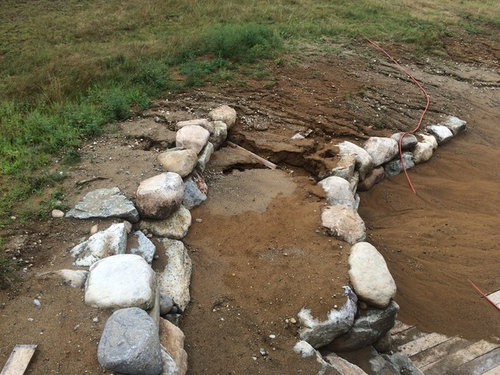
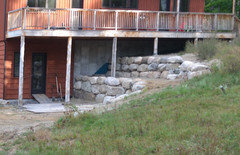
My new house was built on a fairly steep slope, abut 1 in 5, sloping to the west. The ground is mostly sand, so we feel the necessity to terrace the land on the north and south sides. We started with the south side and hired a contractor to build two boulder walls, each about 4 feet high. The space between the walls was filled with the same sand which was excavated. The bottom wall is about 20 feet from the west edge of the house, so there is room for a 20 x about 20 foot patio outside the basement door, which opens out there. The plan is for the landscaper to come back in the fall and replace the top 6" of sand with topsoil and either plant grass or built some raised bed plots.

A drainage ditch (actually a swale) was earlier dug across the slope uphill from these terraces, but it was overwhelmed.

A month ago, there was a heavy rainfall, and water coming down the slope from above eroded much of the sand in the terraces. My question is how should this be prevented. Landscape cloth on the uphill side of the boulders? Gravel or crushed stone there? We will make the swale more aggressive, more like a drainage ditch. However, it is part of the landscaping so we don't want it to be too industrial looking.

I attach a picture taken from the deck looking at the damage. In the foreground are steps built into the walls.


Comments (12)

  • PRO
    10 years ago

    seeing only the little mess at the end of a chain of events cannot help anyone to determine how to stop the mess from occurring. It is what is happening adjacent to and uphill of the retaining walls that one needs to know about. We would need to see a COMPLETE scene. If you stand at ONE spot and take slightly overlapping pictures, we can see how everything is connected in the layout. You must include where the water is coming from, the walls in question, and where the water goes.

  • 10 years ago

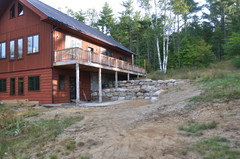
    I had to wait until daylight to take three. The first is a distant view, with an enlarged closeup.

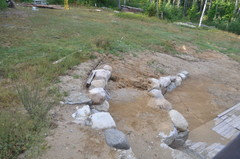
    Here is the second, with another closeup:


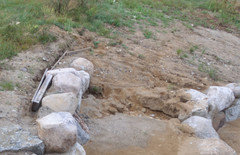
    And finally, another view from the deck. Since the deluge, I added a temporary diversion ditch with a wood board to divert any more rainwater; there haven't been any.


  • 10 years ago

    After I took these pictures and sent them to you, the landscaper who did the wall stopped by and said that I don't want to block the water from going through the wall, because pressure would build up and possibly push one of the rocks out. He said that once he replaces the top few inches of sand with topsoil on these terraces, and a good mat of grass is established, the problem will be reduced. In addition, he said he would make the diversion ditch which is uphill more aggressive.

  • PRO
    10 years ago

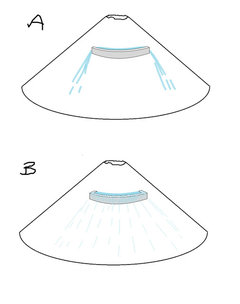
    The retaining wall is capturing rainwater runoff and guiding it outward (away from house) along the back of the wall. The nearer the water gets to the end of the wall, the more of it there is and the faster its running. The faster it runs, the more it has a capability for carrying particles, sediment and for causing erosion. You are concentrating the water until it has destructive force instead of keeping it spread out so it can remain harmless. The flaw is two-fold: the retaining wall top should be level; and the retaining wall layout should return to the grade. If that were the case, instead of water gathering speed and force along the back of the wall, it would pour uniformly over the face of the wall or it would drain via a gentle swale (several feet wide, not a few inches) behind each wall. Once you correct the wall, plants will be capable of holding soil in place.

    [The illustration is for showing a general concept, not a specific layout.]

  • 10 years ago
    last modified: 10 years ago

    Thanks, Yardvaark. The subsurface is all glacial gravel and sand and drains exceedingly well, so the plan was to have the rain drain through the surface sand. Clearly that doesn't work when there is too much rain, so we need a way to divert the runoff away from the house. I'm thinking that putting a swale along the top of the upper wall (to protect the terrace between the walls) would work. What is the purpose of turning the tail of the wall back toward the hill? And, are you proposing extending the wall? The current plan is for the contractor to remove some of the sand above the walls and replace it with topsoil, which he would seed and put straw over it for the winter. In the spring, if there are any more incidents, fill in the gullys and reseed. He is confident that a good grass cover will prevent the erosion (look at the distant slope in the second of the views you edited). He will also enlarge the swale (which is just off the right side of the first to uncropped photos).

    I never said where I am located: in northern New York. Very cold winters and fairly dry summers (especially this year). If we can keep everything together until the ground freezes (probably mid-October), then I think this plan may work.

  • PRO
    10 years ago

    "What is the purpose of turning the tail of the wall back toward the hill?"

    Near the house, the retaining wall is oriented PERPENDICULAR to the direction of slope and is level. Farther away, the wall gradually turns and begins to orient IN LINE WITH the direction of slope (not level.) If you are going to place a lot of water along the soil surface at the back of the wall ... for which orientation of the wall is the water likeliest to cause the most erosion? Where the wall is perpendicular to the direction of slope and LEVEL, the water will pool up until it runs over the face of the wall. It is not going to dig soil out from behind the wall. In the other scenario, where the wall runs in line with the direction of slope, and consequently is NOT level, the water is going to run downhill along the back of the wall. As it picks up speed it will begin to mine soil and carry it downhill.

    Let's compare two retaining walls on the side of a volcano. At retaining wall "A" ALL the water will opt to leave from behind the wall at the ENDS because there is nothing to hold it in. Without question, erosion is going to occur over time at each end of the wall.

    At retaining wall "B" the ends return to grade so the surface water will spill uniformly over all top edges of the wall, with no erosion occurring behind the wall or at its ends.

    [This illustration has nothing whatsoever to do with water that accumulates behind a retaining wall and how to deal with it. That is a separate subject.]

  • 10 years ago

    However, my walls do not have flat tops, so any water ponding and overflowing will concentrate in the low spots. The problem last month was that the water found a low spot in the upper wall and poured over it causing erosion behind the lower wall. If you look at the original photo, you'll see relative little erosion above the upper wall but lots above the lower wall.

    If I follow your suggestion, should there be an underground drain at the low point (where the wall turns uphill?

    Incidentally, not shown but there is a 4" drain tube from the gutter downspout which exits just beyond the end of the upper wall. However, there was no evidence of excessive flow at the exit of this drain.

  • PRO
    10 years ago

    "However, my walls do not have flat tops, so any water ponding and overflowing will concentrate in the low spots." ... And that's why I said earlier that your walls not being level was another one of your problems! Walls can be built that slope under certain conditions, but it requires additional measures in order to protect them from failure. Remember, a key component of making the wall work right is to NOT CONCENTRATE water at some low spot.

    Depending on the wall layout, a swale is sometimes created behind the wall in order to move the water away before it gets to the wall immediately in front of it. You could create such a swale above all the walls here, but it would be difficult to create one between the walls because they are so close together ... no room for a meaningful swale.

    "... an underground drain ...?" So far, we have been speaking of general retaining wall principles, but not really talking about drainage of earth from behind the wall itself. It's a separate issue. I don't have experience with boulder walls per se, but my educated guess is that they can probably survive without any drainage structure ... since they are not built with mortar, are not watertight, and leak everywhere. I can't imagine in most cases that there is appreciable hydrostatic pressure building up behind this type of wall. Many times, people incorporate safety features for added insurance, even though they are not absolutely necessary and since it never hurts to do so, except in higher cost. (That said, don't anyone build a wall based on that comment! I'm speculating about likelihood of something being the case, not the actuality of it based on certifiable knowledge.) If there is someone who builds these type of walls, maybe they will advise if a drain is necessary.

  • 10 years ago

    The underground drain is not from the wall, but from the gutters on the roof of the house; it simply terminates beyond the south end of the walls (and could easily be extended, if desirable).

  • PRO
    10 years ago

    You ask, "If I follow your suggestion, should there be an underground drain at the low point (where the wall turns uphill?]" I took it that you were asking about a drain for the wall itself ... different than from the roof gutters.

  • 10 years ago

    Yes, that's correct. I think I don't need a drain from the wall, because the subsurface is so porous/permeable, being sand and gravel.