Software
Houzz Logo Print
goldstar135

Watering after repot?

9 years ago

So I've read a lot of posts on the forum on repotting. I've noticed one thing that seems to differ between repots.

Some people water the soil directly after repotting, while others don't and water maybe a week after repot.

I guess that some water directly after repotting so the plant can settle in and stay hydrated while it establishes itself in its new home. However, those who don't water directly after repot say that they do so so any root wounds that occured during repotting can dry so rot doesn't set in. So far I have been waiting to water after repotting-I water about a week after.

Which one would you all recommend? I'm interested to hear what you all think.

Thanks in advance.

Comments (15)

  • 9 years ago
    last modified: 9 years ago

    I water all of my plants after repotting. No matter what type of plant it is. When potted correctly, you don't have to worry about how much water you give your plants.

    I read all of the time on here where people seem almost too afraid to give their plants any water. If people seen me watering my plants, they would think I was crazy, haha. Yet, not once have I ever lost a plant to "overwatering." I hate using that term, because it leads people to believe that giving their plants too much water is the problem. But really, it's about how much water lingers in the soil after you've watered them; keeping the soil too saturated, and cutting off the supply of fresh air from reaching the roots. Not letting them breathe and function correctly.

    During the summer months it gets very hot here in the South. My plants tend to dry out quite fast. I typically water them as much as possible. I read advice where people say to let the soil dry out before watering again, but I don't do this. I never let the soil dry out between waterings. Because, like I said earlier, when your plants are potted correctly, you don't have to worry about how much water you give them.

    The late Steve Lucas knew exactly what he was doing, and always gave out the best advice. His website, Exotic Rainforest, has a wealth of accurate information to sift through. It's the only place that I go to to learn more about growing plants. Here is an excerpt taken directly from one of those pages:

    "The common advice on most garden websites is to allow a plant to dry between watering is not always good advice. Anyone that has asthma knows the difficulty of getting air out and then drawing it back in. A potted plant is much like your lungs. As a result the top layer of a potted plant's soil should not be allowed to dry since that dry soil prevents the intake of fresh air including oxygen! Although plants give off oxygen through their leaves they take in oxygen through the roots.

    Once the soil dries it creates a 'blanket effect' to hold in the stale moisture and keep out fresh oxygen. Once the upper soil dries the moist layer below cannot easily breathe in order to re-oxygenate the soil. The dry upper layer actually prevents the capillary effect of the wet surface evaporation when damp soil is exposed to air. When you pour water in the soil the air inside the soil is displaced. The oxygenated air inside has now left the pot. If the upper soil layer completely dries the 'lungs' of the pot cannot work and can no longer continue to draw in another breath of fresh air. As a result the entirety of the soil needs to remain evenly damp so the roots can continue to draw in fresh oxygen."

    goldstar135 thanked Photo Synthesis
  • 9 years ago
    last modified: 9 years ago

    I own several desert roses that have relatively thick caudices. Whenever I repot them, I always water right after. But these are healthy plants. If they were pruned beforehand or something, then I would give them time to scar over and heal first. I also own several other cacti and succulents. Since they're grown outdoors during the warm months, I water them quite often, though not as much. When I bring them back indoors, I pretty much forget about them; probably watering them once a month at most.

    There are always exceptions to the rule. Cacti and succulents grow in naturally arid regions that receive very little rain. Of course we don't keep their soil consistently damp. I was referring to the vast majority of houseplants that come predominantly from our rainforests.

    goldstar135 thanked Photo Synthesis
  • 9 years ago
    last modified: 9 years ago

    I drowned a spider plant and a monstera by watering heavily after a repot. Last week I repotted a spider plant, and this time, I only watered it in lightly. I left it until this morning, watered it again lightly, and returned it to its temporary shade spot. That plant, in one week, has started putting out new growth.

    so, I'm thinking that it is a matter of watering in lightly. Of course, this is different for cacti and succulents. I still struggle a bit with how to water after repotting those. But with the gritty mix, things got much easier.

    if I had to make a decision one or the other, I'd rather repot into a dampish soil and leave the plant be without watering it. Especially for plants with thick roots.

    Ive had a very steep learning curve on repotting. It is not as easy as I originally thought. But now that I've stopped drenching the plant after repotting it and with the switch to gritty or 511 mix, things seem to be going better.

    i wish Al would write an extensive post on repotting, pruning, and aftercare.

    goldstar135 thanked Lauren (Zone 9a)
  • 9 years ago

    Most succulents benefit from a period of dry soil after work involving the roots, especially when repotting as opposed to potting up. Since the genesis of all calamitous (fungal) root infections stems from seemingly inconsequential smaller infections, "better safe than sorry", meaning a period during which the soil is kept dry after a repot or the repot is delayed until callus tissue has formed is probably the best habitual course. When potting up though, it's just "business as usual" - no need to do anything special other than be cognizant of the fact you just increased the soil volume, and depending on what you used for soil, it might not be a good idea to hold tight to the watering habits of the very immediate past.

    I don't think there's much relativity in comparing gas exchange in container media to an asthmatic's breathing difficulties. The processes are so markedly different that the only similarity I can think of is that they both involve gas exchange. That the top layer of soil should not be allowed to dry is something to be decided on a case by case basis, with allowing the top layer of soil to dry being fine in every case.

    Let's examine both extremes, with extreme 'A' being a plant in a Miracle-Gro Moisture Control product or its equal. and extreme B being a plant in the gritty mix or its equal. The MG example probably REQUIRES that at least the top 2/3 of the soil would be allowed to dry or else severe over-watering would almost certainly take a heavy toll on vitality, root function, and root health, due to a significant fraction of the soil being completely saturated perpetually.

    In the second extreme, the upper part of soils like the gritty mix dry as a matter of course. The only potential problem with this occurring would be related to where the roots are located immediately after a repot. If the roots are in the upper part of the soil mass, the grower must water often enough to ensure that roots are kept moist; so, in that very specific case, the top of the soil should not be allowed to dry. In all other cases - no problem.

    If we examine the suggestion that allowing the top layer of soil to dry limits gas exchange, there is a troubling fact that must be dealt with. Air diffuses in/through a gas 6,000 to 10,000 faster than it diffuses through water. So dry soils actually significantly facilitate gas exchange, while continually moist and especially saturated soils significantly inhibit gas exchange. IF the inhibition of gas exchange is caused by the formation of an algal layer on the soil surface, wet algae would inhibit gas exchange significantly more than would the same layer when dry.

    The fact is that the roots of containerized plants normally sort out their function based on soil type and where they are in the pot. Typically, healthy plant roots growing in the upper 1/3 of the medium serve almost exclusively as anchors and plumbing. Roots in the bottom 2/3 of the pot do the heavy lifting, absorbing water and nutrients. In unhealthy plants where the top 1/3 of the soil is always moist, the bottom 2/3 is always saturated. The only way that would not be true is if the planting used a soil like the gritty mix that doesn't hold perched water AND the planting was watered often enough to keep the top 1/3 of the soil wet - which would be a minimum of once daily except in extreme conditions (like cool humid overcast weather), and as many as 5 or more times per day in hot/sunny/breezy conditions.

    Since none of my plants are ever evenly damp except in the first few minutes after a good watering, and they must not be having difficulty getting an ample measure of oxygen because they all enjoy exemplary good health, it also cannot be said with accuracy that "the entirety of the soil needs to remain evenly damp so the roots can continue to draw in fresh oxygen".

    Al

    goldstar135 thanked tapla (mid-Michigan, USDA z5b-6a)
  • 9 years ago

    Al, did you see what I wrote above? We were writing at the same time. -L

    goldstar135 thanked Lauren (Zone 9a)
  • 9 years ago

    ;-) Who do you think liked your post (first)?

    Al

    goldstar135 thanked tapla (mid-Michigan, USDA z5b-6a)
  • 9 years ago

    LOL! Yay!! Thank you:))

    goldstar135 thanked Lauren (Zone 9a)
  • 9 years ago
    last modified: 9 years ago

    "if I had to make a decision one or the other, I'd rather repot into a dampish soil and leave the plant be without watering it."

    The soil I use for repotting comes packaged moist. I leave the top open after opening it for the first time so it can dry out a little, but when I repot plants into new soil and new pots they are potted in with moist mix. I just wasn't sure if plants should be watered in after a repot, because for now I just repot with moist soil, let the soil dry, then water.

  • 9 years ago
    last modified: 9 years ago

    It sounds like you are doing it like Al suggests:). I am just getting the hang of it myself, but it seems like things go better when I do it that way, as you just said. I just pottted up some coleus a few minutes ago. And I tamped down gently on the moist soil, then very, very lightly with the thin stream of water , watered them in.

    In the past, I would have just watered the plant in like I water a normal plant. I am surprised any of those plants lived through the repotting!

  • 9 years ago
    last modified: 9 years ago

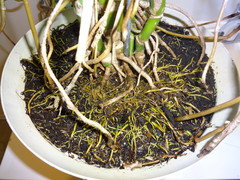
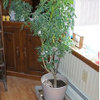
    Here is my Monstera deliciosa. I repotted it back at the beginning of spring. Its roots were so tangled up and intertwined that there was no hope of loosening them up. So I just hacked them away. Probably two-thirds or three-fourths of the potted roots. Then I redirected some of the lower aerial roots back into the pot before I potted it back up. I use a soil very similar to that for cacti and succulents. I didn't mix in any perlite or other soil amendments. I gave it a good watering after the repotting. Half a year later, and it has completely filled up the pot once again with roots. Though I've noticed that once it has done this, it doesn't keep growing, root-wise. It sends out plenty of aerial roots, but the potted roots don't get any larger. I left my Monstera soaking overnight in a bucket of water with some diluted fertilizers. Then I flush its pot out with fresh water until it runs clear from the drainage holes. I do this for all of my plants with no concerns about "overwatering" them whatsoever. You can clearly see that the soil is damp, but it still lets the roots breathe. It never stays soggy. No matter how much water my plants receive.

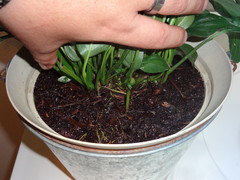
    Here's my Spathiphyllum, back when I let it soak overnight...

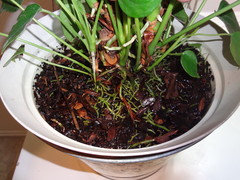
    The same goes for my Anthuriums...

    These are just a few examples. Though I pretty much do this for all of my plants. As you can see, they have very healthy root systems. Almost all of my plants are potted in these self-watering pots. Even though they hold water in the bottom of the pots, most of the soil stays above the water reservoir, letting air circulate through the soil. As long as the roots can still breathe, then you can't "overwater" them.

    Some more wonderful advice from the late Steve Lucas:

    "Despite the belief of far too many growers, growing plants is not just about the water content of the soil! The advice to water only once a week and keep the top two inches of the soil dry is not always good advice! Many aroids and other plant species grow in very wet soil!

    Instead it is about the fast flow of water through the soil or the lack thereof that causes a lack of oxygen, anerobic fermentation and saprophytes that turn into pathogens. Saprophytes are organisms including fungus or bacteria that grow on and draw nourishment from dead or decaying organic matter that often includes soggy wet soil. The pathogens attack the roots and cause them to rot so all of the advice to 'slow down on the water' is really about how to control the pathogens.

    Fermentation and saprophytes often occur in muddy soil that will not not allow the roots to breathe but they don't necessarily occur in water which is why we can cause a plant that is about to die to grow new roots in clean water. As a result, it is necessary to use soil mixes that allow the roots to breathe and will not remain soggy. I've attempted in many threads to explain the necessity of mixing proper soil for plants but the advice is often ignored since it requires some 'work' on the part of the plant's keeper. The reason plants rot is not the amount of water given to the plant! These are rainforest plants and are literally drowned for months at a time!"

  • 9 years ago
    last modified: 9 years ago

    That's sort of like saying it doesn't matter how much water is in the soil, as long as all the roots are getting their fair share of oxygen, but the fact that they're not getting their fair share of oxygen and it's because of the high volume of water in the soil is what puts the error in the message. What plants thrive in in situ has precious little to do with what they need in different forms of culture, namely conventional container culture. Lifting a healthy radish or beet or a tomato plant from the garden with a measure of the soil it was in and situating it in a pot with a drain hole is going to end in disappointment; which illustrates that as the form of culture changes, the rules change as well.

    If all it took was a fast flow of water through a pot to make plants grow well, all we'd need is a kid's swimming pool or a big tub and a recirculating pump to keep the water constantly flowing over the pots to grow perfectly healthy plants, but we know that's folly.

    To a very significant degree, 'slowing down on the water' IS about reducing or eliminating the likelihood of the fungaluglies getting a firm grip on our plants; this, because the main bad actors thrive on anaerobic conditions. However, if you have a healthy plant growing in a solid, well-aerated medium and you decide to inundate that medium. The plant will die unless it can completely change the way the root system operates and make a transition from getting the oxygen that drives root metabolism, oxygen the plant is conditioned to extract from the soil, to getting it from the upper part of the plant by way of diffusion through a completely different type of root tissue that forms in response to anaerobic conditions.

    "The pathogens attack the roots and cause them to rot so all of the
    advice to 'slow down on the water' is really about how to control the
    pathogens."
    Any realistic person knows this statement hinges on the word 'all', and the word 'all' is what makes it incorrect. If you sift back through my offerings for the last 15 years, you find that the only advice that is focused on convincing the grower that more air and less water in the rhizosphere will fix a disease problem is when the relatively few discussions are specifically focused on disease. All other conversations about increasing the volume of air in the rhizosphere and by default decreasing the volume of water soils are capable of holding are focused specifically on metabolic considerations, essentially that root function is inhibited by lack of oxygen availability to roots. The analogy commonly used to compare a plant deprived of oxygen to a grower trying to run a marathon while breathing through a drinking straw doesn't even visit the idea of diseases; it focuses solely on the plant's ability to function normally. It just so happens, that the same PROBLEM that levies limitations on root function also causes root diseases, so by acting to increase root function by increasing the availability of oxygen in the rhizosphere, you get a twofer (a two for one deal). You get improved root function and less likelihood of diseases. To be sure, both are important considerations, but because root function is affected before disease is an issue and root function is responsible for the onset of symptoms to a much more significant degree and far more frequently than diseases. it can never be accurately said that "all of the
    advice to 'slow down on the water' is really about how to control the
    pathogens."
    Pathogens often come along for the ride, but they certainly aren't a prerequisite to impaired root function due to saturated soils, which means ALL 'watch the watering' advice isn't about the fungaluglies.

    Which brings us full circle to the advice that we should make sure the top of the soil never dries out. In many cases, and especially where the grower is using any of many very popular brands of commercially prepared potting medium, the advice represents a death sentence if followed; so obviously so that anyone offering it on practically any forum is going to get called for it because of its potential to seriously limit people's growing experience. If you have even the slightest doubts about whether that is true, you have only to search this forum using the search words "fungus gnats". If you read the constructs of people offering guidance in any/every one of those threads, the overwhelming consensus is that the top of the soil needs to dry out not only for relief from the gnats, but for the wellbeing of the plants.

    Al

  • 9 years ago
    last modified: 9 years ago

    "If all it took was a fast flow of water through a pot to make plants grow well, all we'd need is a kid's swimming pool or a big tub and a recirculating pump to keep the water constantly flowing over the pots to grow perfectly healthy plants, but we know that's folly."

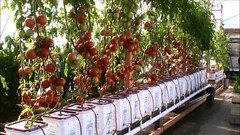
    Perhaps you should google hydroponics? You know, where people grow plants in nothing but water? There are entire farms like these grown all over the world. Are these plants growing in nothing but water being overwatered? No. Because, just like I stated previously, as long as a plant's roots can still breathe, then you can't "overwater" them. I've also stated before in other posts that there's a significant difference between growing alongside a riverbank with freshwater constantly flowing by, and growing in a poorly draining pot with water that has stagnated.


    If I didn't know any better, I'd say that there was a really big tub and a recirculating pump keeping these tomato plants healthy by pumping water (and fertilizers) over their roots. How strange...

    I wasn't trying to claim that I was right or that anybody else was wrong. I was simply pointing out that plants love water. We can't be afraid to water them. Nor do we have to wait until their soil is dry/partially dry before watering them again. As long as they are potted up correctly, you can't "overwater" them. Let me reiterate that first part again, as long as they are potted up correctly. Whatever medium you choose to use is entirely up to you.

  • 9 years ago

    It's just as obvious I'm discussing your comments as they apply to conventional container culture and not riparian settings or hydroponics as it is that your and Steve's comments were about conventional container culture, which is actually much closer to hydroponics than growing in the earth, but still much different. You might not be stating something is right or wrong, but I was, and I explained carefully why it was wrong. Changing the topic to hydroponics so you could appear at least a little closer to correct won't work.

    I don't want to argue over things so obviously counterfactual. You make a statement, then conjure up a set of conditions under which it might be true, but in reality never occur. The fact is, keeping the top of most soils moist in conventional container culture is a death sentence and should be avoided like plague.

    Plants don't 'love' water, but they need it and are able to take it up most efficiently when soils are evenly damp, when NO part of the soil mass is saturated by perched water. The more water retentive a soil is, the more nearly impossible the condition 'evenly moist/damp' is to achieve, Soils like the 5:1:1 mix and the gritty mix come closest to allowing the grower to replicate this imagined state, but even these soils require the compromise of allowing the top of the soil to dry down between waterings to prevent limitations related to excess water in the soil. Thousands upon thousands of posts all across the sight, and simple reason, support this fact.

    Al

  • 5 years ago

    I agree. I just had to repot my hindu rope because of root rot. I just can't see the logic in watering right now. I agree wait a wk or so.