

Why I like Gallicas
Gallicas are such a pleasure to work with. I'm starting my first pruning, a little early, as I do fall cleanup, and found myself in the jungle down by the ditch at the bottom of the garden. Nettles, roses, and lots of hops, of whose Napoleonic tendencies I'm slowly becoming conscious. They have wonderfully handsome foliage, though.
Well, the Gallicas. They grow in suckering clumps, so that when a cane is old or damaged, you can just cut it out without removing half your plant: there's plenty left. This particular group is in part shade, but even out in the sun Gallicas don't seem susceptible to sunburn, perhaps because they're clothed in foliage right down to the ground; they also don't suffer much damage from cane girdler, that is, they aren't attacked often and they take the damage well, the canes not breaking or dying at once.
They're a nice size, huggable, like a Labrador retriever: big enough to have presence, and not get buried in weeds, but you don't have to climb a ladder to get at them. I like the bristly nubbly texture of their canes and their rough foliage. As a group they're low on thorns, so you can take hold of them without worrying about being stabbed; the canes are long-lived. I like the shape of their leaves. Many color well in fall, valuable in our area which is poor in this particular beauty, and they don't get blackspot--some suffer from mildew, others are exempt. The canes are easy to prune when pruning is called for, not requiring loppers or, Heaven forbid, a saw.
Of course the flowers are glorious, full or semi-double, shapely, in shades of cool pink and wine red, often aging with tints of lavender and gray, sometimes streaked or spotted. They're fragrant, as well, often, as the glandular buds. Many Gallicas form hips. Being once-blooming and deciduous, they don't mind summer drought and heat and winter flood and chill, and they do fine in heavy soil: perfect roses for Italy, where R. gallica is native. I don't grow roses just for the blooms. The Gallicas are a friendly presence in the garden all year round, and when I get to work this time of year after avoiding the garden all summer, I greet them as old friends.
Comments (33)
 10 years ago
Nice post, Melissa! I have yet to embark on gallicas; guess I was under the impression that you had to pick them very carefully for Italy, because many wouldn't bloom well in such a warm climate. Which ones do you have? How long is their bloom period?
Melissa Northern Italy zone 8
Original Author10 years agoGallicas need chill hours, but not a cold climate. The Mediterranean winter we get here, with its weeks of temperatures in the thirties and forties, suits them fine. I imagine your conditions are similar. If apples and cherries and tulips grow where you are, Gallicas should do well. I don't know how long their bloom period is, to be honest. The once-flowering old roses of European origin get going around mid-May here and keep on for around a month. It all comes in one great, prolonged show, and I don't keep track, but by the time official summer comes along, I feel like I've had plenty of roses. Flowering lasts longer if the weather is coolish and if the roses have some shade.
I have a lot of varieties. Back in 2007-08 I made big orders from La Campanella, which has a very respectable collection, and from Schultheis in Germany; before that I had bought from Anna Peyron; and in 2012 we made a huge order from Petrovic in Serbia. The roses take years to settle in here, and I'm not happy until they get off their rootstocks and begin to sucker, though of course then you have to deal with the suckers. Compared with the Damasks, which are both massive and thorny, Gallicas seem relatively benign. Oh, and I forgot all the roses I got from my friend Paolo: he shares my love of once-blooming old roses and has collected them ambitiously.
A list of the varieties I have in the garden follows. Many of them are doubtfully correctly identified, or confused in commerce, or both, and I don't take it for granted that what I have is correctly named, even when I buy from a conscientious nursery like La Campanella.
'Agar', 'Agathe Rose', 'Aimable Amie' (may be identical with 'Belle Sans Flatterie' which I also grow), 'Aimable Rouge', 'Alain Blanchard', 'Anais Segalas', 'Assemblage des Beautes', 'Beau Narcisse', 'Belle de Crecy', 'Belle des Jardins', 'Belle Helene', 'Belle Isis', "Bouquet de Venus (of commerce)", 'Camaieux', 'Cardinal de Richelieu', 'Charles de Mills', 'Conditorum', 'D'Aguesseau', 'De la Maitre-Ecole', Duc de Guiche', 'Duchesse d'Angouleme', 'Duchesse de Berry', 'Duchesse de Montebello', 'Elisa Rovella', 'Empress Josephine', 'Gil Blas', 'Gloire de France', 'Haddington' (this looks identical to my 'Tuscany' and 'Tuscany Superb'), 'Henry Fouquier', 'Hippolyte', 'Incomparable', 'Jenny Duval' (I also have 'President de Seze'; there's debate as to whether these are two different varieties), 'Juno' (hybrid, but looks more like a Gallica than like anything else), 'Kawkasskaja', 'La Plus Belle des Ponctuees', 'Le Grand Sultan', 'Le Rosier Eveque' ('The Bishop'), 'Marie Louise' (this is often listed as a Damask or Centifolia, but it looks like a Gallica to me), 'Moise', Nanette', 'Nouvelle Pivione', 'Oeillait Flamand', 'Oeillait Parfait', 'Ohl', 'Ombree Parfaite', 'Ornement de la Nature', 'Orpheline de Juillet', 'Paeonienrose', 'Panachee Superbe' (hybrid, and possibly belongs in a different category), 'Pompon Panachee', 'Officinalis', 'Splendens', 'Versicolor' (I'm not sure how much of this is left; it may have reverted), 'Robert le Diable' (hybrid, sometimes classed as a Centifolia, but I think closer to the Gallicas than to anything), 'Violacea', 'Ypsilante'. There also some without a name, mostly from Paolo, of which I lost the labels and couldn't match up afterwards, or which Paolo himself collected and didn't know the names of. They include some fine varieties. Many of the varieties listed here are hybrids and can be found catalogued accordingly, but I've stuck everything under the Gallica heading that seemed to me to be more like a Gallica than anything else. I'm always glad to hear others' thoughts on classification, particularly since I'm not especially strong on the technical aspects. But I spend a fair amount of time looking at my roses.
Related Professionals
Sarasota Landscape Architects & Landscape Designers · Rocky Mount Landscape Architects & Landscape Designers · Spring Landscape Architects & Landscape Designers · Chicago Landscape Architects & Landscape Designers · Chico Landscape Architects & Landscape Designers · Hannibal Landscape Contractors · Danville Landscape Contractors · Elgin Landscape Contractors · Boston Landscape Contractors · Grand Forks Landscape Contractors · Seattle Landscape Contractors · Little Rock Home Builders · Niles Home Builders · Newark Home Builders · Kenosha Home Builders- 10 years agolast modified: 10 years ago
I too love my gallicas; I think I have said before that my first love was Charles de Mills. I lack space for more than half a dozen though. I have CdM, L'Ingeue, Furstin Leonille, (a found gallica in a lovely shade of pale violet), Tuscany Superb (twice), Juno, Antoine d'Ormois and Ombree Parfaite. Edited: and the classic Cardinal of course!
I have a sneaking suspicion L'Ingeue might more properly fall under the heading hybrid gallica although it for me behaves much like the rest of its class.
 10 years ago
I agree with everything Melissa says about my favourite group of roses (except that none of my gallicas get autumn colours here, a pity). I have about 30 and I like that a large group among them stays almost the same height without clipping and work well as an internal hedge, low enough to see over. The taller varieties look good at the back of borders. Charles de Mills and Violacea became climbers because they happened to have supports near, meant for other plants.
Melissa Northern Italy zone 8
Original Author10 years agolast modified: 10 years agoI'm always happy to meet other Gallica lovers! Marianne, what varieties do you have? fduk, thanks for listing yours.
 10 years ago
That's a pretty impressive list, Melissa. I don't think I've ever even seen a Galica in real life. Thank you for the lovely description. Lisa
- 10 years agolast modified: 10 years ago
Two of my gallicas are locally found roses named after where they were first found and a few I bought as gallicas have been proven to be something else, among them Adèle Heu from Loubert and Fulgens from Weingart but my named (hopefully correctly) varieties are: Adèle Prévost, Agatha Incarnata, Alain Blanchard, Assemblage de Beauté, Belle de Crécy, Belle Isis, Bijou des Amateurs, Cardinal de Richelieu, Charles de Mills, Complicata (has a lot of macrantha in it), Conditorum, Cosimo Ridolfi, De la Maître d'Ecole, Dona Sol, Duchesse de Buccleuch, Duchesse de Montebello, Gloire de France, Haddington, Hippolyte, La Belle Sultane (Violacea), Léa, Louis van Tyll, Manteau Pourpre, Marianne, Officinalis, Ombrée Parfaite, Pourpre Charmant, Rosa Mundi (Versicolor), Tuscany, van Huyssum, Ypsilanti. I may have lost Aimable Amie unless it is the same rose as Louis van Tyll in Sweden as sometimes claimed. I can't help suspecting that Agatha Incarnata is a damask. I think my Haddington is slightly different from Tuscany, fuller than the semidouble Tuscany. I don't grow Tuscany Superb so can't compare it to Haddington.
 10 years ago
Melissa I love Gallicas, although for me the hybrids do better thus far, but I keep trying. I'm bumping this back up, hoping for more read on my favorite class of roses. Would love to see some pictures too..hint, hint ;)
 10 years ago
Melissa, I've never grown a number remotely approaching yours, even when I gardened on a double lot, but Gallicas are at the top of my list, too. Especially purple ones. :-) I have been downsizing, rearranging and passing along roses, but I've also added a few favorites that I plan to grow as "forever roses" in my garden.
My all time favorite rose ever is Tuscany Superb. I created a hedge of this variety and practically live to see it bloom every year!
I am currently growing TS, Cardinal de Richelieu, Orpheline de Juillet, R.gallica Officinalis, Rosa Mundi, Tricolore de Flanders, Camaieux, Duchesse de Montebello, and 3 Paul Barden Gallicas (Rook, an unnamed purple, and Marianne). Plus I'm waitlisted for two more Barden roses, Song of the Stars and Etienne, as well as the antiques Hippolyte and Belle sans Flatterie. My garden is tiny and crowded, so I'll probably to be passing along Gallica suckers for all eternity! Carol
Melissa Northern Italy zone 8
Original Author10 years agolast modified: 10 years agoAlana, thanks for bumping up the post: I was hoping others would chime in. Kelly, thanks for the pictures! The cold-hardiness of the unhybridized Gallicas would really be a talking point for gardeners in areas with severe winters, I imagine. Portland, at the moment I'm almost at the point of wishing I weren't mistress of such vast acreage (we're faced with planting out a huge pot ghetto, and haven't seen the sun for a week), but I do like my collection. I knew vaguely about Paul Barden's Gallica breeding efforts, but went just now and took a look at the varieties you mention, which of course look great. It's very heartening that P.B. is doing this work--creating unabashed once-bloomers, impressive!--and perhaps it will encourage rose lovers who can grow Gallicas or their hybrids, or both, to try them.
I wanted to publish links to some photos on HMF that give an idea of the loveliness of Gallicas, but the link feature doesn't seem to be working, or I can't make it work. For who are curious, go take a look on HMF at Maddalena Piccinini's photo of 'Ypsilante', one of my favorite Gallicas and pictures. Photos aren't all equally expressive: this one works. The color on it is true.
It may be that gardeners who are acquainted only with modern roses might find their suckering thickets of canes strange and even unroselike, so different is the habit from that of Hybrid Teas (I feel this way about Rugosas: I can't appreciate them until I stop thinking of them as roses and just appreciate them as shrubs). One thing worth noting about them, for those who aren't familiar with the Gallicas, is the richness and frequently strangeness of their coloring, a quality that doesn't always come through in photos. Cool pink, mauve, wine red, lavender, gray, purple, and there are many striped and spotted varieties. There's a reason they're called "mad Gallicas". However rich and at times bizarre the flower colors are, they pair well with the foliage, which is rough or matt, sometimes dark, sometimes glaucous. I like the wildish air of Gallica plants, it suits my taste and my garden, while the blooms are as sumptuous as you please. And it all comes in one, harmonious, rose.
P.S. Marianne, would you be interested in a suckers exchange? I can give you a list of varieties I can offer. I should warn you that we have box moth in our garden, and since I'm not sure of how it's transmitted, there might be a risk of its coming along. It's very definitely a pest you don't want to bring in if you or anyone around you has box. It might be worth while carefully removing all soil, washing the suckers; I don't know whether that would compromise their growing afterwards.
I was curious whether you might have 'Agatha', but I see you don't list it. I have questions in my mind about this group of roses (and need to re-read what I've read about it before). I thought for years I had 'Agatha', but have recently concluded that the rose I grow under this name is not the correct variety, which I would like to have. I do have 'Empress Josephine' and R. gallica 'Splendens', which I believe belong in this group.
- 10 years ago
Melissa, thank you for your kind offer but no, thank you. You have so many interesting gallicas I'd love to have but I have lots of box, 92 plants. They have escaped box blight but suffer from Psylla buxi, a kind of flea that makes a white wooly cloud, very disgusting, and I'm afraid to introduce more vermin or pests. Nearly all my roses are grafted plants, only pass-along plants and the local foundlings are own root so I have few suckers. Only Charles de Mills and Belle de Crécy sucker like crazy and you already have both.
- 10 years ago
Correction, my husband now tells me that Adèle Prévost suckers a lot. I've to confess that he knows more about some of our roses than I do. This one grows in a bed or hedge of ten gallicas so I find it difficult to tell the suckers apart and attribute most to Belle de Crécy, the main offender. If you'd like a sucker of Adèle Prévost I'd be glad to send it. My dear husband also says that we'll drive down in two days and give it to you in person but I think that's a bit too much. He really likes to drive and drove to Lübeck in 14 hours last year and then on to Uetersen north of Hamburg, the Tantau headquarters to buy only two roses.
Melissa Northern Italy zone 8
Original Author10 years agoMarianne,
Naturally, the day I don't check the computer is the day I get a message that I need to answer promptly. I'd love the sucker. I wish I could reciprocate, but am wary about the chance of giving you box moth, and it is really bad news. Probably you'll end up with it one day anyway--it spread into Italy from Germany--but I don't want to be the one responsible for introducing it.
Your husband is very sweet. If the two of you, or just he, want to see a northern Italian garden in fall, you're welcome to come! We have room for visitors. I like to show off the garden, which, well, it's terribly far from its spring glory, and there's not a rose in sight, but by now we are recovering somewhat from summer. It has been a dry and warm fall so far, too dry for a fall rose flowering, but the winter grass is starting to grow and freshen up the garden, and it's not unpleasant at the moment.
- 10 years ago
Melissa, where in your garden do you place your Gallicas? Since they do sucker, do you grow them amongst other types of roses, or do you have them all together in a group of their own?
- 10 years agolast modified: 10 years ago
<img src="https://c2.staticflickr.com/6/5471/30558487531_dffe0bd09c_c.jpg">;
<img src="https://c2.staticflickr.com/6/5556/30346634460_e28a3a1ac1_c.jpg">;
<img src="https://c2.staticflickr.com/6/5592/30646365035_fd94dd8dc8_z.jpg">;
I take it we're not allowed to make direct links to images on offsite servers. :-(
Melissa Northern Italy zone 8
Original Author10 years agolast modified: 10 years agotrospero, thanks, those photos give an excellent idea not only of the color, but also of the flower and foliage texture of Gallicas, which is an important element of their character.
Bart, I tend to keep once-flowering and repeat-flowering roses in separate groups, partly because their styles are so different, partly because they have somewhat different cultural needs. After that, it depends. I usually plant roses in a double line, putting (trying to put) the taller roses in the back if there is a back side, but otherwise combining as seems right to me. (edited:) One thing I did learn early on is that lots of dark and richly colored roses planted together make a very dull effect. Now I mix those spectacular and heavy purples and mauves and wine reds with pale pinks and whites with much happier results. Since pale colors are rare among the Gallicas, you will almost inevitably find yourself planting roses from other classes: Albas, Damasks, Centifolias.
Gallicas in our climate like part shade, coolness, and moisture, when they can get it, but will grow in full sun, not as full and lush as in optimum conditions. Our soil is poor in organic matter but is clay so at least offers mineral nutrition. Once established they have no problems with summer drought. We've had a run of very mild winters the last five years or so, and a times I've wondered if it wouldn't compromise the spring flowering of our temperate climate plants. So far, they've been fine, and the Gallicas have bloomed generously every year.
- 10 years agolast modified: 10 years ago
I'm a little worried by how mild our winter have been these last few years too. My CdM did not flower this spring. Instead it has grown upwards, quite a lot. I'm hoping it's just an abberation but I think I might need to prune it, but having never done so before have no idea where to start.
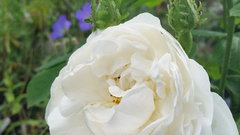
L'ingenue for contrast, as Melissa mentioned the oddball pale gallicas.
- 10 years ago
Melissa, we can't leave Sweden just now but perhaps we can come and visit in early spring? This is normally the best time to dig up suckers here and even more so as we're threatened with -7C next weekend. I can hardly believe it but to be safe I'd like to send Adele Prevost as soon as possible. I have lost your e-mail address but if you still have mine, could you mail me your snail mail address?
- 10 years ago
Trospero, at least you can post photos unlike this technological luddite! If you get a chance, would you provide the name(s) of the georgeous Gallica(s) in your photos?
Bart, just to toss in another perspective, I like to alternate my suckering roses with either non suckering ones or those with different canes (color, thorniness, foliage, etc.) so that I have a shot at untangling the stoloniferous sproutlings that stray from the mother ship.
Melissa, if you feel inclined, please DO post some photos of your Gallicas! Your collection is mind blowing!
Carol
- 10 years ago
I agree with Carol about your collection,Melissa.I'm working on my Petrovic order now. I can't do a huge order as you did, for though it makes sense because of the phytosanitary fee,I really, really have to try to avoid over-extending myself so much; I've already committed to 10 from Becky Hook,so I'm setting myself a limit of 20 from Petrovic. That will give me a "mere" 30-some bare-root roses to pot up, LOL! So,I was wondering, can you especially recommend, say, 3 or 4 Gallicas with which to start? Preferably ones that are decidedly mauve/violet/lilac in colour and dark green foliage. I was thinking of the following: 1) Cardinal de Richelieu 2)Orphelline de Juillet 3)President de Seze ....(is "Jenny Duval" better?) but these are all quite dark. I was hoping for a lilac one like Belle Sans Flatterie, but that is not on Mr. P's "available" list for this season. I'd welcome any comments and/or suggestions about the roses I've tentatively chosen,too. There are just so many possibilities...
- 10 years ago
Hi Carol,
Sorry about not labeling the photos! All three are 'Ellen Tofflemire' blooms, different years.
Melissa Northern Italy zone 8
Original Author10 years agolast modified: 10 years agoMarianne, I'm trying to find an address for you, and not succeeding, but will continue the search. It's quite odd, actually. You, meaning you and your husband, are cordially invited for next spring. Rose season usually begins around the start of May and keeps going through about mid-June. Spring flowering gets going well in April. It's an uncertain world, but April and May offer the best chances of good weather.
Bart, I looked up Petrovic's availability list for this year so I could offer some sensible advice. Even though I have a lot of Gallicas--they're the single largest group of roses in the garden--the bulk of mine I don't know well enough to be able to recommend them or not; I need years to get to know a variety. A few comments. 'Cardinal de Richelieu' I would be wary about: it has never done that well for me, and appears to have shorter-lived canes and a greater susceptibility to sunburn than most Gallicas. I have it in two positions, one favorable, grafted and own root. I have, and like very much, 'Tuscany' and 'Tuscany Superb'; these actually look identical to me, which they're not supposed to be, but I think either of these would be a healthy, sturdy, dark Gallica for you, regardless of the confusion in my own collection. My 'Ipsilante'/'Ypsilante' is utterly superb, though I should add it has about the best spot in the garden and was slow to get going, so I don't know how it would perform in more trying conditions. 'Belle de Crecy' has a great reputation; mine is in a rose-killing part of the garden and its having even survived this long is a credit to its toughness. It is known as a great suckerer. 'Violacea' is tall, handsome, classic Gallica except for its height, supposed to be not very fragrant, though; mad_gallica warns that it suckers madly, mine suckers, not madly. In starved conditions it's shorter. 'Hippolyte' and 'Rosier Eveque' are both present in the garden, both have a reputation for being dark kinds; all my plants are in hot dry spots and poor soil and are hanging on and growing. They're in too poor positions for me to be able to evaluate them fairly, but they're certainly not bad roses, and I think you could consider them. 'Jenny Duval' is handsome, tough, and suckers far and wide.
Some good (great, fabulous) Gallicas in other colors: 'Aimable Amie', pink, full, double large blooms, typical habit, lovely rose in every way (may be identical to 'Louis van Tyll' and 'Belle sans Flatterie'); 'Alain Blanchard', delightfully freckled, this may finally be growing for me; 'Belle Isis', smallish myrrh-scented soft pink flowers, beautiful (similar in appearance to 'Duchesse de Montebello'); 'Duchesse d'Angouleme', delicate pale blooms; 'Mme. Zoetmans', usually not classed as a Gallica but quite like a pale member of the class, fragrant, beautiful, charming. I mention possible identical roses and similar roses so that you won't be so likely to end up with more than one of the same variety or roses too like one another. I ran through P's list hurriedly, and may well have missed interesting varieties that I do know something about. The 'Onex' I got from P. is, I believe, the Moss 'Nuits de Young'. 'Beau Narcisse' I find overly thorny and disease-prone.
Carol has a point about being able to distinguish suckers. Last June I went through part of the bottom bed and flagged suckers of 'Pink Leda', while they were bloom and I could tell them apart, for removal this fall. I try when planting rows of cuttings to alternate different classes so I don't confuse them when they grow.
P.S. Carol, I would be totally happy to post photos of my roses, if I had any photos. We have only a cheap camera, and whether on account of that or because I'm terrible with it, I've never taken decent plant or flower pictures. I know I need a better camera and have posted asking advice. Trospero's photos linked to this thread are exemplary.
- 10 years ago
Melissa, my mail address is imahrnecinnamonrollgmail.com "Cinnamonroll" is the Uppsala University slang for @, unique in Sweden where there are quite a few slang expressions for this character. Please mail me!
- 10 years ago
Thank you so much, Melissa, for taking all that time and trouble for me! I think that Cardinal R. is off the list,at least for now; your criticisma aside, it's also widely available from many other nurseries. I'm considering this new Gallica-type rose called "Fosca" that is on Mr. P's list instead http://www.novaspina.com/it/creazioni-novaspina-4/424-fosca-dalosca-novaspina-2013 This is a rarity;might be worth a try.
Carol, I forgot to ask: what roses do you mix in with your "sucker-ers"?
- 10 years ago
Cardinal de Richelieu seems to be difficult in several ways. It has frozen to the ground in two very cold snowless winters. I suppose this may be proof that it is a hybrid china?
Melissa, I've answered your mail. Melissa Northern Italy zone 8
Original Author10 years agoYou're welcome, Bart. Ought I to add that my not mentioning a rose doesn't mean it's not wonderful? only that I don't know it well enough to give an evaluation.
- 10 years ago
Trospero, thank you for labeling Ellen Tofflemire. She's gorgeous!
Melissa, I understand photo challenges! If you ever take some snaps and post them, I'll be watching.
Bart, with my galloping Gallicas, I mix various OGRs including teas, "new OGR" roses like Austins and Paul Barden's Marianne and suckering but identifiable Rugosas like Basye's Purple with its burgundy/chocolate canes. Alternating suckering but very thorny Damasks/Damask Perpetuals with smoother caned Gallicas works well but the canes must truly be on either end of the thorniness spectrum since foliage can be similar. Blue tinted Alba foliage is fairly recognizable. Some Florinundas like Poseidon and Ebb Tide and Polyanthas like Lauren are lovely with Gallicas. Hybrid Musks are very distinguishable as are Bourbons. I try to stay on top of Gallica suckers 1-2x per year.
 10 years ago
Hi Carol, can you send me a private message? I have a question about one of your roses and don't see a way to message you. Thanks!
I would also like to add that I love gallicas. I of course love their spring display of wild colors, and their strong fragrances, but I also find they mostly make nicely shaped, disease resistant shrubs when not in bloom. I currently grow Belle d'Crecy (which is the only one I have that gets damask crud, but it's small and I love the flowers), Charles de Mills, Belle Isis, Marianne, Tuscany Superb, Song of the Stars and would grow lots more if I had the space. I should try to find a spot for at least one more. Ellen Toflemire looks beautiful.
-Chris
- 10 years ago
Hi, Chris. My apologies for the delay! I'm working with VERY outdated technology. I just managed to email you. If you don't receive your message, drop another comment on the thread.
Melissa, thank you for allowing us a bit of your thread space for a side connection. And thank you for singing the praises of Gallicas!
Carol
Melissa Northern Italy zone 8
Original Author10 years agoSo much my pleasure, Carol. And it's always good to hear from Chris. Who knows, perhaps Gallicas, with their virtues as plants that are good all year round, will come back into fashion.














Kelly Tregaskis Collova