Software
Houzz Logo Print

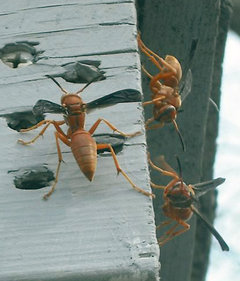
I removed a large paper wasp comb from a decorative hanging, scattering the hundred or so wasps that were attached to it. Did this carefully with a hose and water spray. No stings, but a lot of mad wasps. I figured they would disperse and leave but, nope, they have returned in an eave near where the hanging was. More than a hundred of them. That eave is about two yards from the front door. Ouch. Now, I am very reluctant to just spray them with insecticide and kill them. They're great garden insects! Shooing them away with water spray doesn't work, it seems. They don't fly around. They just sit there. My understanding is that paper wasps are not aggressive, and that sure seems to be the case. I know they'll be gone in a month or two, and I'm willing to be careful about not letting any inside. BUT Halloween approacheth, and I'm kinda torn. I think what I may do is just put up a paper shield so kids can't see the wasps and get freaked, and hope that the wasps don't decide to be suddenly nasty. Other ideas?

Comments (34)

  • 10 years ago
    last modified: 10 years ago

    I have sprayed the stump of the nest with WD40 to keep them from returning to the same spot and rebuilding. You could do this at night by sweeping them away from the area while having a hose end sprayer in the other hand to spray them with a fine spray. Both darkness and water on their wings are said to deter them from stinging when you are close by the nest.

    I do appreciated paper wasps for their non aggressiveness and their control of garden pests. There is not much in the literature about their control of aphids, scale, mealy bugs and similar insects, but thrice I have seen evidence that they do.

    Years ago I decided to go all out in butterfly/caterpillar gardening, and since wasps eat caterpillars, I started early in the year keeping all the nests knocked down. Subsequently I had black sooty mold from honey dew under the pecan tree all over everything, leaves, furniture, etc. What a mess!

    The second time the nests were removed to paint the house. Same thing happened. This year the nests were once again removed when the roof and gutters of the house, store room, and green house were replaced. Again sticky honey dew. Thankfully the rains came and washed it away before much black mildew had formed.

    Since in most cases this year the nests were knocked down and not sprayed the wasps are rebuilding so I hope there is a good population next year. With all the paper wasps I very, very rarely have aphids, scale, or white flies in the garden.

    Now red wasps are another matter entirely. They are aggressive. As much as I hate using insecticides, their nests are sprayed. They especially like to start their nests in vacant bird houses, inside of garden ornaments if they have an opening, and the like.

  • 10 years ago

    Hmm. That's an interesting idea. But I think I'd need to spray much of the front of my house with WD-40.

  • 10 years ago

    Well, I just grabbed the WD-40 can because it was handy and had a tube on it to aim where intended. You could use something like orange oil or Pine-sol in a spray bottle or hose end sprayer. Just don't spray right on the wasps if you don't want to kill them.

  • 10 years ago

    That's sensible. Just spray something with a lingering scent, and they might not want to sit there. I've put up a shield, and they seem very happy, so I'll just leave well enough alone for now. I'll use this strategy with future visits that start off with a smaller number.

  • 10 years ago

    They can be aggressive especially this time of the year when their food supply gets low. I try to keep them knocked down and have been waging war with them for several years. I once got stung 5 times in one attack they made. (I didn't see their nest and was watering nearby). If you want to try to control them, the best strategy is to start looking for them in very early spring. The only ones that survive winter are the queens, so if you kill them in the spring, you are really killing loads of them. Just because you haven't had a reaction to a sting before doesn't mean you are immune to a sting. You can have a reaction if they sting you. And yes, the red hornets are much worse. I got hammered by one on the outside of my pinkie finger and my whole hand and arm was swollen for about a week. Very, very bad.

  • 10 years ago

    OK, I'll watch out. As of now, they are extraordinarily passive. They don't even fly around. They crawl ... very very slowly. I appreciate the fact that some people may be very sensitive to their stings. I am not. I accidentally disturbed a small nest a few weeks ago, and got stung. It was an OW! OW!, followed by formation of very small, non-itchy and non-painful bumps. The bumps disappeared entirely in ten minutes. I've heard that only the females sting.

    Fortunately, I don't think I've ever seen a red hornet.

  • 10 years ago

    I believe red hornets nest in the ground, but I'm not sure of that. I had thrown out the water hose and gone back to turn on the water. The hose was partially laying on a clump of Mexican feather grass. When I picked it up, the hornet got me on the finger. I never saw him coming. I give them a very wide path if I see them anywhere.

  • 10 years ago

    One red hornet crawled under my sheets and got me good one night. It was the really huge kind of red hornet. May leg hurt so bad for hours. I am a real trooper about pain and that thing had me actually moaning and rocking even with a vicodene. I much rather get tagged by a scorpion any day.

  • 10 years ago
    last modified: 10 years ago

    Yes. I am a bit unnerved, but the behavior of these paper wasps is really exemplary. You don't bump them or disturb them. I did once a few weeks ago accidentally, and got stung a few times. If you leave them alone, they'll leave you alone. I have put a paper shield around the particular soffit near our door so the gathering is invisible to people at the door. Very occasionally, one will perch on the paper, probably trying to find its way in to the herd. Now I'm just hoping that some Halloween pirate doesn't start thrashing his or her sword up near that nest or throwing stuff in that direction.

  • 10 years ago
    last modified: 10 years ago

    Bostedo, interesting observation. I often wonder why paper wasps built nests right over a door way. They are almost like purple martins who prefer to nest near people. I've had huge nests right over a doorway and they never bother anyone, even visitors, who walk right under it. Maybe our presence is keeping away certain wasp predators, although I don't know what they could be. Bears? LOL

    Anyway, they are so docile that I have painted right up to the stem of the nest, very carefully, you can be sure. But while they stop and look at me they have never stung me. It's as if they recognize me I pass by them so often. I can reach for a tool in the green house inches from a nest and they do nothing. If I accidentally bump a nest they will give me a very light prick that is nothing, not even as much as a mosquito bite. It doesn't turn red or hurt in the least.. It's as if to say, "Please watch it."

    However, I did get stung recently when I reached into some shrubbery to break off a dead branch and bumped a big nest. This was on the side of the house where I rarely go. Maybe these wasps didn't recognize me? Entomologist have stated that wasps are the geniuses of the insect world.

    Mara, I read that warrior wasps have an extremely painful sting. They have red wings. I wonder if that is what 'got' you. One entomologist said it was like being chained in the flow of an active volcano. So sorry, sounds horrible.

  • 10 years ago

    Roselee, Biggest problem we had with them building right over the doors was one occasionally flying into the house as someone was entering or leaving.... almost always fatal for the wasp. They do seem to favor spots lighted by windows or doors and had once wrongly assumed they might feed on the insects also attracted to those areas. Think you may be right about our presence deterring nest predators - but birds more than bears... at least in Texas ;-). Here's a YouTube video of A Chickadee attacking and eating a paper wasp's nest. The bird/wasp standoff starts about midway through.

  • 10 years ago

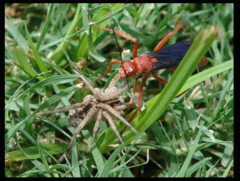
    Ragna, this one was bigger than the normal red paper wasp. I have had a hard time finding it on the internet. I think it is a Red variety of a tarantula Hawk, one of the spider wasps. The entomologist say that if one stings you, you should just lie down and start screaming. In a wikipedia article , I did find a photo of an "unidentified red spider wasp hunting in Texas". Red with black wings , just as I remembered it.


    Spider wasp article Scroll down to the bottom for the photo.

  • 10 years ago

    I know what you are talking about and they are much bigger than regular yellow jackets. They really pack a wallop--wicked, wicked sting.

  • 10 years ago

    Hell , they are bigger than all wasps and hornets then I have ever seen. Easy 2"'s more like 2.5"+. I have seen them since that night and I stay clear of them.

  • 10 years ago

    I'm not sure the photo is the red hornet I'm talking about. I know there are red ones with black wings that eat spiders. They actually bite them, which paralyzes them. Then they drag them back to their hole where they feed on them for a while. Usually, they ignore people. They are very slender and flit their wings most all the time. The red hornet that got me was much bigger and they are really a rust color or orange. Some people call them red wasps and some call them mahogany wasps. I found a very interesting article and thread about them that I'm posting a link to. In the comments below the article some people have had very bad experiences with them and one person died from stings. It would be wise for everyone to be aware of them when out gardening. I can guarantee that you do not want to be hammered by one.

    Red wasp article

  • 10 years ago

    Here's a photo I found that shows how big these things are.

  • 10 years ago
    last modified: 10 years ago

    Oh, yes, we used to get those ginormous spider wasps flitting around in our back yard lawn at my last house. Didn't know what they are called, but gave them a wide path just in case they were aggressive. Haven't seen one here at the new place (yet). We just have the paper wasps making nests around our front door and windows. The idiots that built this place in the 80's installed coastal metal storm shutters on all the windows and the track housing give the wasps a perfect little hidey-hole for nest building/concealment. Makes the nests pretty inacccessible to our view (in most cases) or to knock down at night when they are dormant. Hard to get WD40 or wasp killer up into the top corners where they like to build nests. Grrr. We get rid of 1-2 nests and they build another in under a month. :(

  • 10 years ago

    My neighbor across the street has two very large arborvitae. When I was a kid my uncle had a big one at his house and yellow jackets always had nest in there. They love arborvitae. I'm wondering if that is my "source" for new yellow jackets every year. I keep knocking them down, but a few always seem to be around.

  • 10 years ago

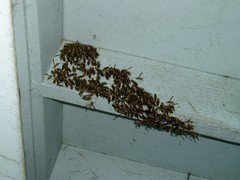
    Getting back to paper wasps, I have to wonder what that herd is actually doing in my soffit right now. They're just sitting there. The comb is gone and they don't seem to be building a new one. Now, it is my understanding that most paper wasps die in the winter. The females allegedly survive but haven't they laid their eggs in the comb, which is now gone? So in the interest of preserving the colony, have I screwed that up by removing the comb? If I'm reluctant to kill the herd because I want them to be around, does that reluctance mean anything anymore? That is, have I already essentially killed the population by removing the comb? Maybe someone with some expertise on the life cycle of paper wasps could explain it to me.

  • 10 years ago
    last modified: 10 years ago

    I hope you get someone with expertise to advise those of us who appreciate paper wasps. I've only done a lot of reading about them.

    IMHO your wasps are just hanging out as they would do if the nest were still there. That's what's happening at my house. There's not a lot of activity since it is too late in the season for the queen to lay eggs and there are no pupa to feed.

    The queen or queens are among the 'herd'. The queens, as you know, will overwinter, but will not lay eggs until they start start building a nest next spring. I've observed the small spring nest. She will lay eggs while it is very shallow and will continue to build the cells around the eggs. When they hatch she will feed and care for the larva. When the workers emerge they will help the queen care for the next generation of larva.

    From the Internet: "If growing vegetables and flowers is your hobby, you may consider paper
    wasps as welcomed guests. Like many other social wasps, paper wasps feed
    on many insect pests of gardens."

    More: "During the winter, most paper wasps die, except new queens. Queens
    survive the winter by nesting in protected places such as under the bark
    of trees, or in cracks and crevices around structures. In the spring,
    several queens commonly get together to start a new nest. Eventually,
    one queen will dominate the others, making them serve as workers for the
    new colony.

    "By scraping and chewing wood into a pasty pulp, paper wasps make
    paper-like nests in the shape of an umbrella. The queen deposits eggs in the comb
    (cells) on the underside of the nest. After the eggs hatch, the
    grub-like immatures are mostly fed other insects, such as caterpillars,
    that the worker wasps collect. Once the larvae have matured, they pupate
    in their cells and join the colony as an adult. Adult paper wasps
    mainly feed on nectar."

    And thus they serve as pollinators. Not as efficient as bees, but they have been observed pollinating berry crops, among other things, when no bees were present. .

  • 10 years ago
    last modified: 10 years ago

    I hope there is someone with expertise to advise those of us who appreciate paper wasps. I've only done some reading about them.

    IMHO your wasps are just hanging out as they would do if the nest were still there. That's what is happening at my house. There's not a lot of activity since it is too late in the season for the queen to lay eggs and there are no pupa to feed. The queen or queens are among the 'herd'. The queens, as you know, will overwinter, but will not lay eggs until they start start building a nest next spring. I've observed the small spring nest. She will lay eggs while it is very shallow and will continue to build the cells around the eggs. When they hatch she will feed and care for the larva. When the workers emerge they will help the queen care for the next generation of larva.

    From the Internet: "If growing vegetables and flowers is your hobby, you may consider paper
    wasps as welcomed guests. Like many other social wasps, paper wasps feed
    on many insect pests of gardens."

    More: "During the winter, most paper wasps die, except new queens. Queens
    survive the winter by nesting in protected places such as under the bark
    of trees, or in cracks and crevices around structures. In the spring,
    several queens commonly get together to start a new nest. Eventually,
    one queen will dominate the others, making them serve as workers for the
    new colony.

    "By scraping and chewing wood into a pasty pulp, paper wasps make
    paper-like nests in the shape of an umbrella. The queen deposits eggs in the comb
    (cells) on the underside of the nest. After the eggs hatch, the
    grub-like immatures are mostly fed other insects, such as caterpillars,
    that the worker wasps collect. Once the larvae have matured, they pupate
    in their cells and join the colony as an adult. Adult paper wasps
    mainly feed on nectar."

    And thus they serve as pollinators. Not as efficient as bees, but they have been observed pollinating berry crops, among other things, when no bees were present. .

  • 10 years ago

    Yes, interesting. So I don't want to eradicate the herd because there are queens in there that I'll depend on next year. Presumably those queens will find some workers or delegate some failed queens to build a new nest next year.

  • 10 years ago
    last modified: 10 years ago

    Thought we had a nest in the clematis vine growing around our mailbox post when paper wasps began swarming there a couple weeks ago. Seems more likely part of their fall mating ritual after looking into it. Something like: the males find a favorite spot from which to emit pheromones that attract the females that have become active to procreate before the males die off.

    This NC State article says relatively tall structures are very popular, but I'm pretty certain I've seen this fall swarming before at lower heights, too.

  • 10 years ago

    Yeah, this herd business may be all about mating. They're just sitting there in a big clump. See photo below. Well, I saw one land in the herd (this happens rarely - they mostly just don't come or go) , and a bunch of the wasps there piled on, or at least congregated around, the newcomer. Maybe a queen?

  • 10 years ago
    last modified: 10 years ago

    Dan, thanks for the photo. Bostedo, great article! NC State article Thank you!

  • 10 years ago

    Appears the future of your "herd" is in the making :-) If they are mating, don't believe they'll stick around all that long.

    Not sure how long the swarm was hanging out on our vine-covered mailbox post before I notice it, but am pretty sure it was all over in something less than 5 days, possibly as short as 2 to 3 days.

  • 10 years ago

    They've been there for about two weeks, and show no sign of moving. If they're waiting for it to get cold, it's going to be a while.

  • 10 years ago

    Interesting... believe it's called "aggregation". May be perfectly normal, but does seem odd to me for such a pre-hibernation gathering to last so long in an unprotected space. Wonder if our record hot October has them messed up a bit.

  • 10 years ago

    I think what may have also screwed them up is that I got rid of their nest. Maybe they think they're nesting ... without a nest.

  • 10 years ago

    Well, none of our forty or
    so Trick or Treaters managed to get stung by my paper wasps. In fact, none of
    them were even aware that there were about 200 wasps a few yards away, and I'm
    pretty sure that none of those wasps ever took to the air. I built up some
    paper shields around the mob of wasps, so they wouldn't be conspicuous. I'm a
    little disappointed that no one even asked "Whatcha got up there behind
    the paper??" Had one asked that I could have said "Well, it's
    Halloween, so I get to scare you and freak you out right? There are a couple of
    platoons of stinging wasps up there, over your head, just waiting for
    you!". At which point the kids would run screaming from the house, and
    inform their fellow Trick or Treaters that our house must be avoided like the
    plague, thereby leaving us with a lot of candy. Yum. But that didn't happen.
    Sigh.

  • 10 years ago
    last modified: 10 years ago

    We got not one trick or treater in 15 years. Our caliche unlit road is just too creepy for them.

  • 10 years ago

    I have to wonder if word got out that I had loads of wasps, and the kids were at the sidewalk daring each other to go ring our doorbell. If that's the case, to attract Trick or Treaters, maybe you just need a load of wasps!

  • 10 years ago

    Oh, would you have had fun if you'd had an excuse to tell them! There are three or four wasps nests on our front porch, but heck I don't even point them out to Bob unless he's going to be working close to them. We had lots of trick or treaters too and none of them knew that dozens of scary creatures that were watching every move they made from the ceiling of the porch. Wooie wooie!

Sponsored