Software
Houzz Logo Print
pat_bamaz7

Crown Gall Questions

10 years ago
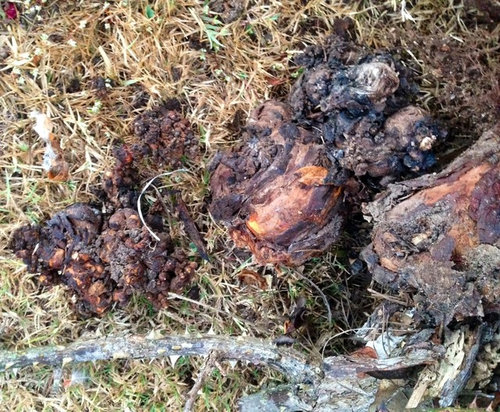
On my quest to go no spray, I’ve
been digging out several of my more bs prone roses each year and replacing with
more resistant ones. This weekend I dug
one out and found huge galls under the soil (see pic below). These weren’t visible from above ground, and
based on the size, could have been growing for quite some time. This is my first known encounter with crown
gall on roses, but now I’m wondering how many others may have it. The rose was in a raised cutting bed with
another 40 or so roses. I’ve been reading
a lot of posts and other online info and seems there are many different
thoughts on what to do about it. My
questions are:

What to do with the
replacement rose? I already have the
rose that I was going plant in its place, but now am afraid to plant it in that
spot. Do I remove as much soil as possible
and plant it there anyway? I could dig a
new hole, but it would need to be only about a foot from the existing spot…is
that good enough?

What about the other roses in
the same bed? Have I been spreading the
bacteria to them through deadheading, etc?
I keep clorox wipes in my pocket during spring when canker and such is
prevalent, but I'm not as faithful about cleaning my pruners between each snip other times of the year.

I really don’t want to go
digging around under the soil of the existing roses looking for underground
galls, but don’t know how else to find and remove them before
they start adversely affecting the existing roses. Wouldn’t digging around the base of them run
the risk of wounding the roots of healthy roses and allowing the bacteria in? Should
I do some kind of soil treatment in that bed instead?

Do nothing and hope the galled
rose was overly susceptible to the disease and the others aren’t? The
diseased rose and many others in that bed are grafted on Dr Huey. Which would have been the susceptible one…rootstock
or rose?

Comments (26)

  • 10 years ago

    Sometimes you see the crown gall, sometimes it is too deep down on the crown to see it. Being a bacterial disease you really don' t know if a visually infected rose is the only one in the bed that is infected. Neither do you know the degree of spread the bacteria has made in the bed's soil. It may be everywhere or localized to just one area\bush. If the rose shows no galls and is growing well then I would assume it is gall free. The gall bacteria is probably in the soil but may never infect a given rose growing in that soil. I would not dig around the roses looking for crown gall, especially on obviously, visually healthy bushes.

    I have heard of differing courses of action regarding crown gall. Some say carefully dig up the rose and destroy it. Others say cut away the gall and watch how the rose responds. It may continue to grow satisfactorily with no gall recurring by some accounts. If the gall returns or the growth is poor, then dig it up and discard it. I have never yet had crown gall myself, but I have seen it elsewhere on others' roses.

    I once dug up a healthy rose in my garden that was being moved, and was surprised to see a root gall the size of a golf ball way out on a slender root. It was as hard as a rock, and the bush showed no signs of the gall, being a vigorous, otherwise healthy looking bush. I did not replant it, but discarded it in the household trash.

    pat_bamaz7 thanked Moses, Pitt PA, cold W & warm/humid S z6
  • 10 years ago

    Does crown occur in all climates, or is it most common in certain parts of the country? Lisa

    pat_bamaz7 thanked Lisa Adams
  • 10 years ago

    The bacterias that cause the galls are present world wide. Infection is via a fresh wound, so avoid damaging rose roots by digging around in the root zone. If you move an uninfected rose and the roots are wounded, infection is possible.

    U of MN extension advises:

    Trees and shrubs can be protected from crown gall infection during planting by dipping roots of bare root plants or drenching potted plants with a solution of water and biological control bacteria, Agrobacterium radiobacter K-84. These bacteria protect roots by producing an antibiotic and occupying wound sites that might be infected by the crown gall bacteria. Galltrol is a commercial formulation of A. radiobacter K-84 that is registered for use in Minnesota.

    pat_bamaz7 thanked hoovb zone 9 sunset 23
  • 10 years ago

    Does anyone do this? it seems like a good idea with bareroots, at least.

    pat_bamaz7 thanked Vaporvac Z6-OhioRiverValley
  • 10 years ago

    I haven't been able to find a source to buy Galltrol, or I would definitely start doing it now.

  • 10 years ago

    I don't think crown gall is very common in this climate. I've never seen it on any of my roses, and the friends I know who grow roses have never had their roses infected that I know of. I also have never seen any chemical sold for controlling this infection in stores around this area. I hope this remains true--it looks like really nasty stuff. Diane

  • 10 years ago
    last modified: 10 years ago

    One of my Teasing Georgias got root galls two or three years back. I researched on this forum. One of the posters said that he (or she?) dig up the plant, cut off the gall, soak the root in bleach water, and, if I remember correctly (or at least that was what I did) pour bleach water in the sole where the infected rose was. I replanted it at the same spot just to see what happens. And it has been three or two years now, I see no sign of infection and the plant seems healthy and thriving. Bleach water makes intuitive sense to me, but don't really know if it was just dumn luck. Whatever it was, it seems to have worked for this plant

    pat_bamaz7 thanked User
  • 10 years ago

    Farmerduck, the strange thing about my case of root gall was that the rose was being dug up to make room for a different rose, not because it had a root gall. There was no evidence of any illness on the bush above ground: no weak, discolored, or disfigured green growth or blooms. It surprising me see the gall which was 10" out from the crown on a thin root. It looked like a husked black walnut in color, size and texture. That is what I thought it was at first, or else a peach stone, until I discovered it was growing on a root. There were no other galls. I believe the bush was a Belinda's Dream.

    I just wonder that if the bush was left in place, would it have eventually grown more galls and also begun to show any disease symptoms above ground? I also wonder how many other roses in my garden have galls right now, but show no above ground symptoms? Perhaps I should consider my case a non-issue at this time, and concentrate on my roses' general care, crossing the, 'root gall bridge,' if and when I get to it.

  • 10 years ago
    last modified: 10 years ago

    This link leads to a 2010 M.S. Thesis:

    Correction, as pointed out in the next post, the thesis is actually 2015.

    http://etd-library.ku.ac.ke/bitstream/handle/123456789/14343/Management%20of%20crown%20gall%20disease%20of%20roses%20using.pdf?sequence=1&isAllowed=y

    pat_bamaz7 thanked henry_kuska
  • 10 years ago

    The opening pages say 2015 actually.

    pat_bamaz7 thanked Embothrium
  • 10 years ago

    Could the rose have come already infected with crown gall? Yes. CP-Star, Green Heart, Ball and several others had to destroy tens of thousands of rose plants this year because they were all infected with crown gall. A breeder friend with whom I was speaking a few weeks ago stated they had to destroy the entire crop of at least three of his roses because they were infected. That represented many tens of thousands of dollars in lost royalties to him, not to mention the tens of thousands of dollars plus, to other affected patent holders and the producers themselves. Roses of Yesterday and Today routinely treated their plants for years with Galltrol to prevent the galls from forming during their break in period, when they would be held responsible for their development. Today's producers COULD also treat their crops with it, IF they cared to. Evidently, they don't. Gall is such a common occurrence here in SoCal I've actually been impressed more weren't knocked down by it. I have seen it in the rose fields; in public and private gardens; in canned nursery stock as well as on commercial bare roots being offered for sale; on potted minis straight from their sources as well as in my own gardens. Some roses go on for years in spite of galls, others seem much more susceptible and dwindle quickly. Here, I've found The Fairy (and its offspring); Ballerina (and its offspring); all Flower Carpets; most Meilland landscape shrubs; Bonica; all of the McGredy "hand painted" roses; Francine Austin (which layers itself all over the garden, galling everywhere it touches the soil) to be highly susceptible. Flower Carpets very often decline and outright die within three to five years around LA in many gardens from my observations.

  • 10 years ago

    The infected rose (Love's Promise grafted on Dr. Huey) had been in my garden for six or seven years...originally planted as a 5 gallon potted rose from a local nursery. I was removing it because of its blackspot issues and that's when I discovered the huge galls just below soil surface...probably why it's been so disease prone these last couple of years. My main concern is infecting the rose I plan to plant in its place (a one gallon own root Poseidon) and the other nearby roses in the same bed.

  • 10 years ago

    The galls are actually the plant's response to the bacterium's presence in the past. Whether it continues to exist in your soil or not, I don't know. It appears very common and wide spread in the desert south west, perhaps other areas too. Supposedly, what is required is a wound at or below the soil level to permit the bacteria entry into the plant. Therefore, it would seem unwise to prune roots when planting or to influence a plant's performance. It would also seem very unwise to "cultivate" your garden soil anywhere there may be rose feeder roots as those "wounds" could, potentially permit any bacteria entry into the plant. Similarly, "companion plantings" might also be potentially damaging, particularly in established rose beds. Digging a hole, of any size, could result in "wounded" rose roots, providing entry to possible infection by the bacterium. And, what about gopher vole or mole damage to the roots? Moles may not eat the roots, but they do dig through them and can cause "wounds" to root tissue. There are instructions all over suggesting you remove and replace the soil from a spot where a galled plant has been removed, though if it's possible the bacterium exists in your soil, what benefit would there be to replacing that soil in that spot? And, could the situation be similar to that of RMV, where, though you've never SEEN symptoms, the causal agent has been present for a long time prior to the expression of symptoms? I can't give you absolute answers, but I do raise these other questions to possibly point out that, other than using something like Galltrol and insuring there will never be any damage to the rose tissues where they may become infected, there really may not be much, if anything, you can do to prevent galls.

  • 10 years ago

    Make sure no fresh wounds on the Poseidon is about all you can do.

    Mine start to decline when the gall sets in. I removed many of my decliners last year because of the drought, and they were all galled. :(

  • 10 years ago

    Thanks for the advice everyone! Dr. Huey roots spread far and wide from the roses in that bed. Dogs & I dig in there frequently, so I'm sure we've wounded some of them. I guess I'll just be very careful going forward and hope for the best.

  • 5 years ago

    I pruned my roses today and one fat branch just fell out like it was dangling out here dead. Looking at the crown and the base of the branch at the crown level made me remind of crown gall. The plant is still green and ready to give new growth. What should I do? Suggestions please:( it is my favorite and the strongest in my rose garden. Easy does it.

  • 5 years ago

    Without an image of the spot in question, it's hard to say, so I'll just speak generically. To me, it is possible to be too paranoid about certain issues; after all, crown gall is not Rose Rosette Disease. If the shrub seems vigorous and healthy,I cartainly wouldn't get rid of it out of fear that it just might have a touch of gall!. I would take a very sharp, clean, dis-infected knife and try to slice off as much as possible of the iffy-looking stuff,being careful to do no damage to the rest of the plant. Then I'd dis-infect the wound with bleach and water and seal it off once dry. I have saved roses with obvious gall by doing this sort of operation, just cutting out the sick part ,disinfecting, and sealing off.

  • 5 years ago

    Bart Bart! Thanku that is what I wanted to know. How do I seal the cut off area?

  • 5 years ago

    Wax,or some non-water-soluable glue

  • 5 days ago

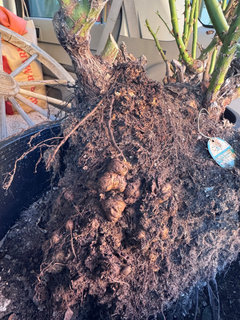
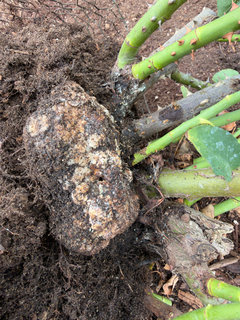
    Reviving an old thread to see if anyone has new information. I dug up a rose that seemed healthy because new fire requirements in my area don't want a woody plant within 5 feet of the structure. Much to my surprise, several roots had small balls -- some maybe 3/4 size of golf balls, most like 1/4 size of golf balls. I was taking the rose up to my sister for her garden, so didn't notice the little balls until I was taking it out of my car after a full day road trip in the summer. Maybe some soil had fallen away? When I saw the balls, I pulled a couple off, and they were cork-like. I told her to wash her hands and throw the bush out. I didn't want to introduce gall in her garden. I took some photos. Local nursery people said it could be gall, might be gall, probably too big of balls for root knot nematodes. I put plastic down in that spot to try to "solarize" the soil -- and we did get a few heatwaves. But since I wasn't planting a rose bush in that spot, I didn't worry too much. Funny enough, @pat_bamaz7 - mine was also a Love's Promise on Dr. Huey purchased from a local nursery several years ago...maybe 12-15 years ago. Fast forward. I've loved my Love Song, but it's kept suckering and I can't really stop the suckers properly because it's in a gopher wire cage. So I finally bought a new one to plant in its place. A guy at the nursery when I bought it said maybe the suckering was a sign of stress in the rose. Anyway, I dug up the suckering Love Song (on Dr. Huey -- that was a bear to get out), and then saw what I feel certain was a huge crown gall. AI says it's textbook crown gall. Well $@#$@. Above posters mention Galltroll -- though I think more recent thinking suggests that the way that one works it could make the bacteria resistant, perhaps? There's a newer one out, called NoGall. The only place I could find that sells it is in Oregon, and it costs a wee fortune. But I've ordered it. I threw my old Love Song in the trash (not green waste or compost). I made a bleach solution and disinfected my gloves, my shovel, my pruners. I dug out some of the surrounding soil and put that in the trash, too. When the NoGall gets here, I think I will start dipping everything in it before planting. In the meantime, I had dug out two bushes nearby to plant elsewhere. But now I'm afraid to move them to a new location for fear of spreading the gall (agrobacterium tumefasciens - sp?) bacteria...they are still young/small plants from one-gallon own-roots. I've done some reading. Over 650 species of plants can be affected by crown gall. Some live with it for years, while others die. The bacteria hijack plant cell processes. The resulting galls can choke off nutrients to key roots and/or stems. Enough of it will kill the plant. But some live with it for years. The bacteria will persist in the soil for years, lying dormant, even without a host plant. Commercial nurseries will steam or solarize soil. that's not real practical in a home garden. But also, I don't see how I'd avoid "wounding" roots in future -- between them growing in gopher wire cages, all the critters that chew on the roots, plus as someone above noted, companion planting... I thought for a bit about giving up on roses -- between the deer, the gophers, the ground squirrels, the changing climate...how much longer can I fight this?? But then I look out while sipping tea and see Eustacia Vye and Moonlight in Paris and Wollerton Old Hall and James L. Austin blooming their heads off, and I think...I will keep going... But now, instead of passing rose bushes (and dahlia tubers) on to friends and family -- I'm wondering if I should just trash whatever I don't keep so I don't pass anything on... Ugh...


    Has anyone lived through crown gall and come out the other side? (hmm...both have Love in the title...maybe I should stay away from the Love roses!)


    Love's Promise


    Love Song


  • 5 days ago

    @DDinSB (Z10b Coastal CA) You may have come across this video already, from the wonderful Dr. Mark Windham. If you haven't, it's well worth a watch. He mentions a product called Ferti-lome Fire Blight Spray as a preventative for bare roots and iirc he said it wouldn't work on potted roses but I am tempted to try anyway. He also discusses a plan for replanting.

    https://www.youtube.com/watch?v=bgdq9b7TpF0


  • 4 days ago

    Thank you, Claudia. I watched his video. All matches what I've found -- except that a 2024 study done in Tennessee seems to indicate that NoGall actually made a difference in actual experiments. I got my NoGall today via FedEx after spending 100 million dollars. But I think I will be doing a lot less "moving around" of plants and roses after this. And in the exact spot where I removed Love Song I might stick an ornamental grass in. Apparently grass does not get crown gall. I don't have a lawn to dig up and plant roses/dahlias in. So...hoping this is not a new "thing" and maybe an isolated case. Thank you again. I plan to look him up to see what he has to say on other topics!

  • 4 days ago

    I am really interested in that NoGall and will look into it. Last year I had a rose arrive through the mail that eventually started getting a lumpy looking knob at the soil line that kept growing. It felt hard, not cork like, but I still made the choice to just trash it out of an abundance of caution. It was an own root rose so I couldn't blame a callousing graft union.


    I'm with you on the fears of damaging roots and I cringe any time I dig and sever one! If could go back in time and redo the garden now that I know more about gall I would do things differently. But I think it's just part of it and as you mentioned there are creatures and mechanical forces underground that can open up wounds so I try not to stress too much. I hope your Love Song was just bad luck and you keep enjoying your roses :)

  • 4 days ago

    Thanks for reviving this, DDinSB — it is reassuring to hear a rose can keep going after crown gall shows up, and Claudia's video tip sounds well worth a watch. I had a similar scare with a grafted rose years ago and ended up leaving the neighbours alone rather than disturbing their roots, just cleaning my pruners more carefully between cuts. Fingers crossed your plant keeps thriving, and please do update us if that 2024 study changes how you handle it.

  • 2 days ago

    Everything I've read says if you know the plant has crown gall, you should dispose of it carefully and disinfect everything that came in contact with the plant or soil. Living with gall means, I think, recognizing that it's real and you do your best to limit spread. I now have the no gall and the fertilome fire blight treatment. My local ACE said I can't buy the fertilome in CA, but Amazon sent it (but it won't send me cedarcide to deter mosquitos...). I plan to do my best with various interventions (not all on one bush). And will hope and pray for the best! I was going to send a sample off to a lab, but it would cost nearly $200 for a test plus overnight shipping, so I think I'll just accept it was crown gall and treat accordingly. But I think this means that I probably won't be giving any rose plants away for a while. I don't want to give someone else crown gall! And, I have a plan for some ornamental grass in the spot where I pulled out Love Song. Monocots don't get crown gall. I hope to starve the bacteria! And society garlic, which I already have, is also immune as a monocot. So...we'll see.