Software
Houzz Logo Print
melle_sacto_gw

"Spring Bouquet" Viburnum

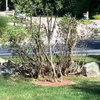
I planted one of these several years ago with the idea to eventually limb it up into a small evergreen tree. However, it grows pretty slowly and is maaaaybe 4 1/2' tall now. It looks kind of awkward at this point since it's planted like a specimen, is it ready to limb up? It's hard to tell the branch structure the way it is. I can attach a picture if needed, but it's pretty much a 4 1/2' tall, 3' wide green mound.

I have no problem pruning/shaping everything else, but this shrub seems daunting. Am I overthinking it? How should I approach this project?

Comments (13)

  • 9 years ago

    There is no bark or stem interest with a shrub like this - pruning the bottom branches off will not result in an attractive effect. Instead it will look like you have a bad deer problem.

    There is more than one cultivar under the name on the market up here. If you have the Monrovia clone of Spring Bouquet ('Compactum') then the main value of the thing - relative to other Laurustinus - is a compact, narrow habit - and an apparent tendency to be completely self-fertile, with a nice set of berries occurring without any sources of cross pollination being visible.

    melle_sacto is hot and dry in CA Zone 9/ thanked Embothrium
  • 9 years ago

    I don't remember anything else about its name, unfortunately. It does have berries in late spring & attracts cute birds. I'm a little bummed that maybe it's not the best specimen for a petite limbed shrub. It's in full sun on a dry slope & has been an easy plant, overall, and prettier than Indian Hawthorne (another shrub that does well in that area). It's so pretty when it blooms, and vibrant green the rest of the year. Most of my yard looks so tired in late summer the viburnum is nice contrast.

    How do they respond to pruning, will lower branches recover or new sprouts from the base?


  • 9 years ago

    Well one way to look at this is: what do you have to lose? At the very worst, if you do not like the way it looks once you've pruned it, you can flush cut it at the base and it will come roaring back in no time (that's how all of mine started - my friend cut hers down, dug them up, put the root balls in the back of her pickup and brought them over). It will likely put out some growth where you make the cuts but that is easy to pull or rub off when small. Go slowly - I'd do this over a few days - and step back and look at it periodically. Remember you can always take more off later but once it's off, it's off. Give it a try - you'll learn about how it responds.

  • 9 years ago

    Also - Melle - there are lots of other things that look good in late summer and fall around here. Crepe myrtle is one for sure, and you have a choice of various sizes and bloom colors. Depending on how cold you get in winter, there are lots of Australian natives that look great, too. I've started to plant a combination of mostly conifers, Australian natives and large succulents like agave, aloe, etc. You might also look at Parkinsonia 'Desert Museum', which here blooms for 3-4 months and has wonderful winter interest with the green trunks. You can also try posting on the California forum for other suggestions.

  • 9 years ago

    Thanks for the ideas!

  • 9 years ago
    last modified: 9 years ago

    To put the shrub into better context, it is supposed to be part of a mixed border. that provides some privacy. However, the border is viewed from both sides because it's the perimeter of our sloped front yard. It is probably not as unified as something professionally designed, but everything does well with the low water/full sun/clay soil situation.

    I'm going to tidy it up later today & maybe share pics. This website captures some of what I've been trying to accomplish:

    http://www.yourgardensanctuary.com/mixed-borders-for-enclosure/

  • 9 years ago

    Makes sense. You might also look at Parrotia persica. Native to Iran, it's very comfortable with dry heat. There are some nice cultivars - 'Persian Lace' is variegated and slower growing than the species and 'Vanessa' is very narrow. They color reliably in autumn in our climate, which is not always the case with trees native to other climates (many Japanese maples, for example). Acer griseum is another tree to look at - great bark, slow growing, incredible fall color. These are trees, mind you, not shrubs, but good 'backbone' plantings. Also look at Cedrus cultivars - some are prostrate, others rounded/bun shaped. They also can stand the heat and dryness.

  • 9 years ago
    last modified: 9 years ago

    Persian ironwood is native to rainy mountain forests. The fact that other parts of the region are desert has no bearing on its preferences. Seattle plantings often look drought stressed in summer - even when long established - unless kept watered.

    I guarantee that limbing up a ~Christmas tree shaped evergreen plant like the Monrovia form of Spring Bouquet ('Compactum') becomes is a bad idea. And if yours is currently providing a welcome note of durable evergreen foliage in your planting, why would you want to do something that might result in having to cut it off and start it over from near the ground?

  • 9 years ago

    Ron I have about six Parrotia that do just fine - no stress, all in full sun. Just fyi. Yes, they get supplemental irrigation but it is drip and not substantial. Their leaves do not burn (even the variegated cultivar) and the fall color is superb.

  • 9 years ago

    My feeling is that the Sonoma climate gets more humidity and coastal breeze than where I live (Sacramento, which is hot and miserable during Central Valley summers) :-( But it's still interesting to learn about new shrubs.

    I'm reluctant to limb up my shrub at this point, instead I'll just shape it a bit. I have a lime tree near it, and a crape myrtle, both in tree form; maybe the viburnum can remain as is.

  • 9 years ago
    last modified: 9 years ago

    Key statements

    they get supplemental irrigation

    and

    where I live [is] Sacramento

    If you are interested in seeing locally proven decorative trees (and large shrubs, like citrus) the grounds around the California Capitol is planted as an arboretum, with most of the plantings dating back a long time - and there being a consistent tendency for the specimens to have informational signs on them.

  • 9 years ago

    Melle yes you are definitely hotter in summer, but the ones that I named should be ok there, as I took that into account. Parkinsonia is native to the SW desert! One of the challenges is that trees and shrubs that have 'worked' for decades - or even centuries - may not work going forward. Around here, for example, native Douglas fir are struggling, as are some native oaks - in their native habitats - due to increased heat and dryness. Several arborists are starting to build lists of trees that we can use to replace some of these. Southern Ca is having an even harder time of it as their rainfall has really been scant relative to normal.