Software
Houzz Logo Print
jenlimes

Space between molding and ceiling

9 years ago
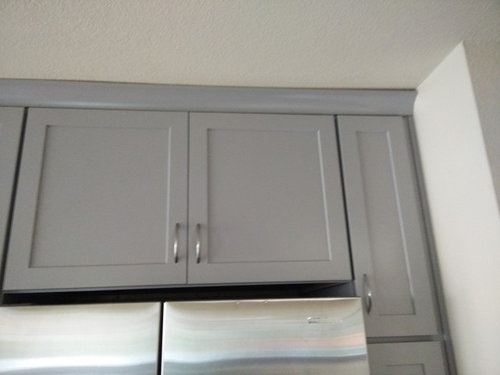
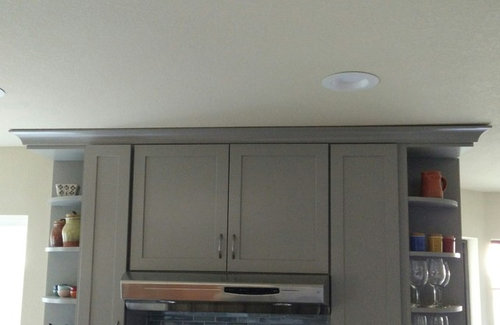
We just had our kitchen remodeled and we noticed a space between the molding on the upper cabinets and the ceiling. We asked our contractor about it and he said it's because the floor and ceiling aren't level or consistently spaced. He also said that he could fill in the space with caulk (?) and paint it the ceiling color but he doesn't usually do it because he thinks it looks worse.

Considering this is likely a common issue in kitchen remodels because almost no house is perfectly level, I'm surprised we'd be stuck with 2 bad options as solutions.

What are your thoughts on this?

The space between the molding is not a consistent height, and is 1/3in. max.

Thanks

Comments (34)

  • 9 years ago

    I would caulk it in a minute. That gap is crazy-making.

  • 9 years ago
    OMG, explain to me what the floor has to do with putting up crown molding correctly. This was not done properly. They also sell colored caulk - but the crown can't be 1/2 from the ceiling. Tell him to fix it.
  • 9 years ago
    Lazy, cheap, no pride of workmanship contractor.
  • PRO
    9 years ago
    last modified: 9 years ago

    Lots of inexperienced remodelers chiming in here. Mud the ceiling to the moulding or caulk. Crown don't bend and the fact that your ceiling isn't flat isn't your contractor's fault.

  • 9 years ago

    These last two comments are the ones you should be listening to. Joe's suggestion about using mud is a good alternative. Most folks caulk these gaps. Unless your home is new built and perfectly plumb (hard to find skilled craftsman like that these days), there will be gaps. Your contractor is right and those are your options.

  • PRO
    9 years ago
    I would ask him to build up the crown making it look larger and more layered. Then repaint.
  • 9 years ago
    Why not add additional trim piece like quarter round?
  • PRO
    9 years ago

    This is a very common issue and it isn't the fault of the contractor unless he was also paid to do the framing and the drywall work. No, the contractor is not being lazy or cheap by installing the materials chosen in the typical manner. There are three choices

    Ignore it

    Caulk and paint the gap, either at the front of the crown or slightly recessed to create a consistent line

    Float the ceiling to fill the gap

    First choice is obviously cheapest but the second approach is most common. Fixing the ceiling is difficult as there are many people who claim to fix drywall but few are talented enough to do a completely invisible fix. Then, unless the ceiling has just been painted in a flat paint, the entire ceiling will usually need painted and that can be lots of effort and expense to fix the one problem spot.


  • 9 years ago
    In my case a little flat trim was added to the moulding, not as big as quarter round though. Painted same color as the crown. You see it only as an added decorative part of the whole. Yours will look great done that way.
  • 9 years ago

    That is a design failure, not an install failure. The designer should have measured the floor to ceiling height in multiple spots to discover the sag from one side to the other. Then, a 3-4 piece molding should have been devised to hide this.

    You start with a small riser, tight to the cabinet. Then you do the crown, tight to the ceiling. Depending on the lighting and shadows created, and the amount of differenc from one sid to the other, you can split the difference in rise with a single bead molding on the riser, or if the overall sag is variable, you can do a thin scribe molding at the ceiling. The multiple horizontal lines disguis the ceiling issue and no one can ever tell.

  • PRO
    9 years ago

    Really? You measure multiple spots from the floor to the ceiling and this will allow you to determine the exact ceiling variance? You do realize that for this to work the floor would need to be perfectly level and flat, this is never the case. It could only be done by measuring off of a laser level. Agree with the rest of the technique. It's best to just assume that there will be a variance in the ceiling and always design/size the crown & riser to provide some room for adjustment.

    Graham

  • 9 years ago
    last modified: 9 years ago

    Anyone who doesn't carry a good digital tape measure and a 6' level shouldn't be measuring for cabinets. If you get a variance in reading of more than 1/2" from one side of a run to the other, you use the level to find out if it's the floor. Or the ceiling. Or both. Comes in handy as a straight edge too to check those nasty bows in walls. All of that should be discovered before the design happens. Then the design can devise the appropriate solution.

    I've had ones that a 1/4" difference was some backer rod and calk. and I've had 4" in a 10', which needed a profiled stock, a tall crown, a Greek key deco band, and quarter round. That suited the kitchen though. The worst and hardest to fix is the ocean wave, where the drywall sags between the joists. That really does need the ceiling reinforced, rescrewed, and floated out smooth. Before cabinet install. There's always a solution. It just may not be the most cost effective for the job at hand.

  • PRO
    9 years ago

    "...it isn't the fault of the contractor unless he was also paid to do the framing and the drywall work."


    Only if steel studs and TJI's were specified. You want your joists built from bushes, not trees, believe me. Much stronger and straighter.

  • 9 years ago
    Not the fault of the contractor? I expect the contractor to address problems, provide solutions and not pass off this kind of work as quality. I have steel beams in my house, but even so, not everything is true. The customer is unhappy, there are gaps between the crown and ceiling - it doesn't look right. Yes you can do anyone of the items mentioned, but failing to take responsibility for an unhappy customer is the pinnacle of unprofessional contractor behavior.
  • PRO
    9 years ago
    As an interior designer with contractors, if my team were to do a job like this and left it that way you can guarantee they be going back to that home. Your contractor is responsible for making it correct.
  • PRO
    9 years ago
    last modified: 9 years ago

    bellburgmagggie:

    If your car gets a dent from a shopping cart in a parking lot is that Ford's fault? Did Ford drive the car to Publix? Are Fords supposed to be dent proof automobiles? Same thing here.

    Unless this contractor installed the ceiling framing and that framing was specified as TJI's, he has no responsibility whatsoever. Just like Ford didn't park your dented car at Publix, he didn't create the crooked ceiling. Someone wanted crown mold installed and crown doesn't bend. The fact that the ceiling is crooked and that crown doesn't bend is not the contractor's fault.

    Were this my job, I would have caulked it in paintable white and I'll bet no one would ever have seen it. If they did, I'd present a change order for signature and payment to mud the ceiling and repaint it.

    I expect contractors to address problems too. Problems that they've created only.

  • PRO
    9 years ago

    Finish carpentry is about making things appear perfect, not making them perfect. If I were doing the job, I would certainly not consider it my job as the finish contractor to float the ceiling to match the crown. However, the installer could possibly have done several things to make it appear perfect. He probably could have scribed a bit off the center of the run of moulding to decrease the gap at the ends. Then he could have pulled it as tight as possible to the ceiling, then filled the remaining gap with color matched caulk. The dark shadow is unsightly and unprofessional. I would get them to work at it a bit more to decrease the obvious gap. He should have a better bag of tricks to work around such situations. "It takes very little to fool the eye."

  • 9 years ago
    Thank you Kevin. I am actually an amateur finish carpenter who does antique restoration and I would be mortified at that level of workmanship. To the poster who talked about Ford cars, the contractor installed the cabinets, it is his/her responsibility to do it properly. And Kevin, was right, a professional finds a fix, an unprofessional defends the poor workmanship by making comparisons to cars. And learn to makes a proper comparison, Ford made the trim pieces, the fault would then lie with the person who assembled the car which is still Ford. And you wonder why everyone buys Japanese cars? We have idiots who say that crap workmanship is right when its not - think GM cars built in the 70's and 80's. It wasn't their fault! No - it was the public who didn't know how to drive...... and then Japan kicked our butt with better cars.
  • PRO
    9 years ago

    Not sure how we got on to talking about cars.... but one of the reasons I get lots of work is because of contractors who want to put the blame on other trades, which may well be justified. However, being up front with the customer that "this molding may not fit well because of the out of whack ceiling, but we will do the best we can to make it look right" almost always will satisfy the customer. There are lots of people out there who do great work, but you will find the great contractors when a "small" problem like this crown molding turns up. It's a big thing to her and rightfully so. She may have a $30,000 remodel or a friend who has one that may come up if you come through for her. You never know. Do everything you can and do your whining to your wife or buddy, not the customer. You'll probably have more work than you need.

  • PRO
    9 years ago

    There are many fixes which is why there are many responses. Contributing to this problem is the cabinet crown. Cabinet crown is much stiffer than regular house crown so it really highlights imperfections. If the ceiling is really awful we sometimes strategically drive shims between the ceiling joists and the drywall to get a flatter plane. We also sometimes use regular crown that has more flex so we can "worm" it (roll it to conform to an uneven plane). When done we match the cabinet paint and paint it cabinet color.

  • PRO
    9 years ago

    From what I see, the ceiling should be relined - seems like sagging plasterboards?

    Cheers Draftsman Maitland

  • PRO
    9 years ago

    Can't quite remember the full saying, it's refers to "the last man in". For some reason it becomes the responsibility of the last person on the jobsite to resolve, fix and repair for free all of the deficiencies of the trades before him/her.

    Graham

  • PRO
    9 years ago
    last modified: 9 years ago

    I recommend floating the ceiling to eliminate the gaps. New, flat ceiling paint is not difficult to spot prime and paint to match. I don't like caulk because wood expands and contracts and caulk will shrink and crack especially in the size gaps we see here and look unsightly.

  • PRO
    9 years ago

    " For some reason it becomes the responsibility of the last person on the jobsite to resolve, fix and repair for free all of the deficiencies of the trades before him/her."


    Especially here on Houzz, where the contractor is always wrong and the customer is always right.

  • 9 years ago
    I'm not a professional, but my thought would be "Why wasn't this brought to your attention before the job was complete and you noticed it?"
  • PRO
    9 years ago
    last modified: 9 years ago

    Your contractor is right, in some situations, it is best if it's left alone, but if this really bothering you, and you get someone to fix that, get an experienced taper to do this, because you need experience to make it look unnoticeable especially when it comes to ceilings.They will use drywall compound, and feather it out over a large area and the ceiling will have to be re-painted...

    Second picture it can be fixed by slightly dropping the sheetrock... we do it all the time in this type of situations when dealing with uneven ceilings (like in your situation)... All you have to do is locate near by ceiling joist, use a magnet to locate screws/nails, loosen them up or take it out, and drop down sheetrock to close up the gap... add a few screws nearby, cover screw holes and touch up paint.

    Good luck

  • PRO
    9 years ago

    It's amusing that some claim it's not the contactors fault.

  • PRO
    9 years ago

    It's within the responsibility of the contractor only if the ceiling was within the defined scope of work. The contract is not "build a perfect kitchen". Someone defines what specific tasks need to be done, the client agrees to these tasks and the cost. The contractor is only responsible to complete these tasks. If for some reason there is a need for additional tasks to be performed then the contractor provides a cost to do these and the client has the choice to authorize the additional work or not.

    Graham

  • PRO
    9 years ago
    last modified: 9 years ago

    @Premier Designs How do you figure its contractors fault?

    This is existing house, contractor didn't do framing and most likely didn't do sheetrock, and prior to cabinets and crown installation, most likely nobody knew ceiling had any imperfections since they are so minor... the gap is 3/8" or under, and in most cases you don't even know they exist until you put up crown, unless there is a noticeable dip.

    With that said, when you framing new, this type of things can be controlled a little more, and even then in conventional framing one joist will shrink more than another etc, so you will encounter something like this here and there, unless TJI or some other engineered lumber is used which will give you a leveled surface.

    When you work with existing, there is always more leeway for variation.

  • PRO
    9 years ago

    In this case I believe he should have at the least, informed the owner and offered suggestions, as it is it makes his work look shoddy.

  • PRO
    9 years ago
    Caulk and paint. Done. Adding more trim just calls attention to it.
  • PRO
    9 years ago
    last modified: 9 years ago

    Premier Designs - Agree. It appears from the original post that this was discussed and the contractor did explain to the OP what is happening and offered some remedial solutions. The Op is asking if there are other remedial solutions which of course often raises the question as to who is at fault and who is going to pay.

    Graham

  • PRO
    9 years ago

    My reading comprehension was lacking this morning, lol .. I missed a few words in the OP.