

Here come the 2017 catalogues
Got in the mail today the 2017 T&T Seeds catalogue.
Comments (122)
 9 years ago
@ Tx, I can get you fresh bushy bluestem seed. Saw some in the back tank and lots in a neighbors gully . I hated milking those bluestem because they were so pretty in the field.
 9 years ago
Not only have I heard of them, Tex, I have some. We all know what to do now. e.mails a-go-go.
Related Professionals
Fort Smith Landscape Architects & Landscape Designers · Elizabethtown Landscape Architects & Landscape Designers · Traverse City Landscape Architects & Landscape Designers · Laconia Landscape Architects & Landscape Designers · Billings Landscape Architects & Landscape Designers · Atlanta Landscape Contractors · Lafayette Landscape Contractors · Monroe Landscape Contractors · Wilmington Landscape Contractors · Philadelphia Landscape Contractors · San Antonio Landscape Contractors · Miami Home Builders · Valdosta Home Builders · Lafayette Home Builders · Brattleboro Home Builders- 9 years ago
Stocked up on John Innes seed compost and a bag of leafmould from the wood. I am organised into sections - annual/easy stuff, either in coldframe or greenhouse, the live in hope segment -some of last years no shows, old seed, just because seed, not really fussed seed, most of which is taking up space in the greenhouse (but relegated to the floor), then the last lot, which get the harshest treatment of all...and these are what I will be sowing from now till March but are guaranteed to do nothing for months so can huddle outside, out of the way. Finally, the frosts have started killing off the jungly foliage which covers every wall and surface...and not before time as I need to stash seedling pots actually in the beds. I stumbled upon this as a result of no space whatsoever...and the small seedlings came through winter with fewer losses to dog stomp death and scrounging blackbirds...as well as a degree of protection from freeze and thaw.
- 9 years agolast modified: 9 years ago
The trees are finally starting to turn colors here, many are still green and a few have dropped most leaves due to drought mostly so its quite colorful, I've still got blooms in the garden.
It all looks so nice around the city with Christmas Decorations (a-hem) looking like cheap, glitzy, shiny metallic stuff shining in the sun among the orange, red, yellow, green fall foliage which is only made more appealing by the pumpkins, scarecrows, straw etc and the mums still blooming on porches. Season over-lap? Actually it is obnoxious looking to my eyes, like a clash that makes the silver fillings in my teeth hurt.
Wantanamara, we are in for a temperature drop Thursday too but I think ours is for real cuz we are Oklahoma :(( and not Mid-Texas :))). Its gonna be 'freeze yer nippers off' next Thursday because, true to form, there will also be wind along with a serious drop marking THE END. This weekend we are predicted to get "very cold rain". I don't care what the temperature of the rain is or the form, right now I'd even welcome ice because we are so dry.
I need to get off my dead dog butt and buy some potting soil. Its become ridiculous.
- 9 years ago
woops, I'll let you know about the bushy blue. The source is only a few blocks from where I live. (Its like the potting soil, another D.D.Butt issue)
- 9 years agolast modified: 9 years ago
I drove past my clump of seeding muhly of an interesting type today ,....rain and going the wrong way. I was on the way to fill two large canisters of propane for the up coming cold and was in a rush to get to a place before it closed for the weekend.
- 9 years agolast modified: 9 years ago
"...the mission statement clearly identifies the Genetic Literacy Project as an advocacy organization."
Guess that means we can overlook everything their contributors and linked articles have to say - in favor of unbiased sources like the Non-GMO Project and Greenpeace. ;)
And some more "advocacy" to ignore:
- 9 years agolast modified: 9 years ago
Certainly not; on the other hand, accurately informed individuals recognize where science review information comes from and recognize the bias of sources. The best approach would seem to be to read widely (or read both sides, for those who see things in black and white).
- 9 years agolast modified: 9 years ago
I agree that to be accurately informed, one should consult diverse sources, while recognizing the importance of good evidence instead of inaccurate rhetoric.
I remain puzzled by your implication that the Genetic Literacy Project (an independent non-profit group that accepts no corporate funding) is "biased". Their mission statement (which you found objectionable) in full:
"What benefits do advances in genetics offer? What are the potential pitfalls? Research into genetics and related sciences is widely embraced. But in practice, words like “gene” and “genetic engineering” and “biotechnology” “GMO” and “synthetic biology” often stir concern and misunderstanding when applied to biomedicine, evolution, ancestral and race research, and food and farming. That often leads to confusion among the public and policy makers.
Agricultural and human genetics are reshaping farming, food and medicine, and our understanding of human history. Biotechnology research can improve food security, the environment and public health. Yet dramatic innovation can also lead to unintended health and environmental consequences and present ethical challenges.
The Genetic Literacy Project (GLP) explores the intersection of DNA research and real world applications of genetics with the media and policy worlds in order to disentangle science from ideology. The commitment of the GLP is to promote public awareness and constructive discussion of genetics, biotechnology, evolution and science literacy."
Can you tell me what in that statement you find "biased"? And what inaccuracies or "bias" do you detect in the GLP's articles?
 9 years ago
wantonamara, I checked this morning, and there is no sign of my Sisyrinchium now - no leaves or seed pods or anything, so they must be more deciduous than some of the other grassy things that grow over there. It was easy to find little bluestem and the potentilla plants, but no Sisyrinchium at all. I'll check in the spring for ID and for seeds.
- 9 years ago
Mine too. They normally disappear with the summer heat down here. Our heat is like winter to many plants.
- 9 years ago
rusty, this is off topic but I ran across this article about the overused phrase 'obvious bias' the other day while looking into an entirely different subject, namely the message being sent out by a certain someone that people in the press are always lying and they are bad people.
The author articulated the negative reaction I keep having toward the phrase 'obvious bias' and the inevitable heated arguments (rather than discussions) that always follow, not to mention the way this technique of verbal censoring allows the person using it to invalidate and railroad anyone opposing him on any subject.
Of course, the article is probably biased :))
- 9 years ago
Disentangle science from ideology...as if. This is patently ridiculous, not least because of how academia and research are structured (funding, funding funding). Science has NEVER been separate from ideology. I would like to believe that genetic research is predicated on producing a fairer world and eliminating hunger...but sadly, the rush for profit utterly dominates every single decision...from initial feasibility studies through to the predictable attempt to sequester knowledge by patents and copyright laws - the idea that the human genome should be patented for profit is truly monstrous....and what I do believe I am witnessing is essentially a game of monopolies with large corporations such as Monsanto bidding to gain full control of world food production. As a single example, Egyptian cotton, always a water thirsty crop and grown by seeds handed on year on year... is now superceded by genetically tweaked seeds which ostensibly cut down on water use (the loudly trumpeted rationale behind the production and marketing) but are not allowed to be saved but must be bought new every year. (Profits!) You can put a positive spin on a pigs ear...or even polish a turd...but who really benefits...not the small farmer that's for sure.
- 9 years ago
I was dismayed to see that my fabulously huge ranunculus cortusoides had completely vanished...must be too dry. But nope - borrowing son's truck to drive to Norfolk to close the horsebox up for Xmas, I was thrilled to discover the gigantic dinnerplate sized leaves had re-appeared in glossy profusion. Now steaming full ahead with an order of ranunculus acris 'Citrina' plus another white alpine buttercup (name momentarily escapes me) - I LOVE buttercups...yes, even the pesty creepers.
- 9 years ago
That ranunculus with gigantic leaves sounds nice, and it looks like I could grow it here! Just when I thought I was done ordering seeds for the fall planting season.
My Sisyrinchium bellum leaves die during the dry summer but don't disappear. New leaves are just starting to sprout now.
- 9 years ago
Possibly, Socalgal - it is a native of Madeira and the Azores, I think...but needs a degree of moisture which might be tricky in socal...unless you are in a coastal mist and fog zone. It is a beauty though - the leaves look not too unlike a non-mottled podophyllum and the flowers are a good 2inches across with that lovely silky buttercup sheen. Flowered in its second season. Seeds from Plantworld.
- 9 years agolast modified: 9 years ago
R_B, are you aware that the Genetic Literacy Project was founded by Jon Entine and that he is its executive director?
Jon Entine writes (viz Forbes.com: 2014) that the debate over GMO foods is over. I take that to indicate advocacy.
Agree TR2 and love that article. It's so humane.
- 9 years ago
I am in a coastal zone where we get May, June, and sometimes July fog.
- 9 years agolast modified: 9 years ago
The innuendos presented in that link are very unimpressive. And typical of anti-GMO "activism". When you can't refute the science, smear the messenger. And keep those memes flowing, no matter how conclusively they've been debunked. The same ploys are used over and over to attack qualified and reasoned voices that promote other science-based but controversial positions. For instance, vaccination (it doesn't take much "digging" to churn up muck about Dr. Paul Offit and other immunization advocates) and climate change (experts who warn about it are just protecting lucrative academic careers, doncha know).
I see nothing wrong with advocacy (it's kinda comical to be shocked, SHOCKED that there are people with opinions on the Internet).
What matters is science and good evidence, which some people figure can be overlooked if one shouts "Monsanto shill!" loudly enough.
By the way, Entine did not say "the debate over GMO foods is over". Actual quote (from his GLP article):
"Writing in the Journal of Animal Science...in the largest study ever conducted, Alison Van Eenennaam and Amy E. Young, geneticists with the Department of Animal Science at the University of California-Davis, reviewed 29 years of livestock productivity and health data from both before and after the introduction of GE animal feed. The field data represented more than 100 billion animals.
What did they find?
There were no indications of any unusual trends in the health of animals since 1996 when GMO crops were first harvested. Considering the size of the dataset, it can reasonably be said that the debate over the impact of GE feed on animal health is closed: there is zero extraordinary impact."
It behooves us not to misrepresent what people are saying, even if they disagree with us.
I prefer to seek out information on biotechnology from evidence-based sources rather than depending on anti-GMOers like the Food Babe (who once was indignant that commercial airlines don't provide pure oxygen for passengers, and warns of non-existent toxins that (surprise!) are present in the products she sells), Jeffrey Smith (one-time dance instructor and "yogic flying" practitioner), Vandana Shiva (misrepresents her academic background while promoting nonsense like blaming Indian farmer suicides on GMO crop growing) and Greenpeace, which fights lifesaving golden (GMO) rice and participates in the destruction of GM crop test fields.*
*it's sort of ironic to complain about lack of sufficient testing of genetically modified crops and be silent (or encourage) this sort of vandalism.
- 9 years agolast modified: 9 years ago
I can't jump to those conclusions that easily. From what I read it looked quite possible that even if large companies like Monsanto and GMO's seem unappealing in principle it doesn't necessarily prove the findings reported by people like Jon Entine don't contain truth or have value to the point that he should be written off as a paid up marketing shill, his comments dismissed as propaganda or that there is an evil agenda involved.
It seems just as possible that there is overreaction and fear mongering involved from the anti-genetics side as well as the possibility there is a goal of corporate control on the pro-genetics side, maybe a there is bit of both going on. From what I could tell, this subject and the controversy surrounding it appears too complex to jump to easily formed conclusions. It would take more than reading through a few websites to become educated enough to come to an intelligent conclusion but then maybe you guys have read more or know sources of information I haven't seen that proves beyond a doubt he is. The crops being developed such as those with vitamin enhanced rice didn't sound like an evil thing, at least not on the surface, I'd need to do more reading to have an informed opinion.
This book looks interesting.
- 9 years ago
rusty, I just read your post. It reminded me of the vaccination controversy too which, unlike this subject, I have done some serous reading about.
- 9 years agolast modified: 9 years ago
Rice enriched with vitamin A, aka Golden Rice, is essentially a nutrient poor monoculture...while the highly nutritious amaranth is classed as a weed and a target for Round-Up. A single spoon of spinach provides adequate daily Vit A. There are many ways of skinning a cat and many ways of maintaining food security which do not involve mixing daffodil genes in with rice. Incidentally, there are increasing numbers of reports of biopiracy...whereby researchers in the west have been claiming various foodstuffs, long used by indigenous people, are, in fact, their inventions, ready to be patented for profits. Evolution is a lengthy process with numerous fails along the way...but when it is artificially accelerated, with no real chance to consider checks and balances above the potential $$$, we, as a species, find ourselves in the position of attempting to do good but actually unintentionall wrecking the ecology by destabilising chains of dependency. An example. Harlequin ladybirds, a voracious Asian predator, has been introduced as one of the next generation of bio-cobntrols beloved of those who have been sickened by chemical abuse. Marvellous, an aphid eating 'good bug'...except it is also cannibalistic, overpowering our native ladybirds. It also overwinters as an unwelcome house guest and, without native predators, is effectively out of control.
It pays to follow the money and also ask 'Who benefits'? And to have a properly sceptical approach.
The laughable insistence of 'facts' and 'evidence' as being rigorous, objective and politically pure and neutral is ludicrous since the data does not exist in a vacuum, it depends on what questions are asked and why. The scientific method stands (and falls) on hypothesis - proving or disproving...and although empirical results show that a is bigger than b...or c is n more effective than d, we simply cannot detach human aspirations from the equations.
- 9 years ago
A small parcel of seeds arrived this morning including the sisyrinchium, primula, collinsia (a new one to me), silene laciniata (campions love the woods), iris sibirica and aconitum napellus....just a little teaser to keep my hand in.
- 9 years ago
Which collinsia? I used to have a native one in my woods (not every year that it bloomed, though annual). I'm betting yours aren't that...but who knows. Mine was C. violacea. I envy you (if you have success) with the silene. I can't grow much from that area of the world, too wet :( And Silenes tend to not like me anyway...even native ones.
- 9 years agolast modified: 9 years ago
Back to seeds, I prefer the trend in this website I attached that specializes in seeds for dry regions, like I said I'm not educated on this subject, I'm only just now reading since its come up here.
I've ordered several different mixes of the wildflower seeds in the past from this source which have naturalized for me. If I had the space I'd grow some amaranth, several varieties in fact for visual reasons alone. Wouldn't you love to see a field of different colors of amaranth? I would.
http://www.nativeseeds.org/learn/nss-blog
http://shop.nativeseeds.org/collections/amaranth
I wish the government would offer tax breaks, transportation to market and other benefits, support and incentives to encourage and support small farmers and more fresh vegetables being grown in this country. I've seen a couple documentaries on this. As a 'little guy' I tend to favor other little guys because we always seem to get mowed down by the big guys.
The scale of world hunger in third world countries is what I was focusing on concerning the genetics issue because big problems need big solutions and maybe some solutions would be possible from the big guys? Less pesticides with higher yields sounds like a good thing.
Can't there be both approaches working together?
- 9 years agolast modified: 9 years ago
We don't have a good history of working with third world countries though, do we? It inevitably shades into exploitation. I think indigenous people probably know the region, climate and social and cultural aspects better than rapacious corporations from the developed world which are not...and never have been, driven by altruism. What the third world does have is no shortage of labour and some of the very labour intensive cultural methods (hand weeding) have yielded better crops than our agricultural practice of full-scale and broad spectrum spraying. Small farmers in Bangladesh have recorded incredible yields when using traditional methods...and also sustainable since seeds are saved rather than the main thrust of western breeding and genetic interventions which absolutely depend on annual purchases of fresh seeds...even having suicide genes written into the germ plasm. What they do not need is participation in a global market where fertile land and water is being used to grow expensive crops such as beans and flowers purely for export to the developed world. Globalisation has not been any solution for workers while offering fabulous profits for employers and shareholders.
Dbarron - collinsia heterphylla. I admit - it was the name - Chinese Houses!
Silene dioca is the main flower, along with apiaceae...and is enjoyed by swallowtails which are attracted to pink. Orange catchfly s,arkwrightii, also does rather well so I thought the lacinata would look good with carex testaceae, panicum, sanguisorbas and eryngiums...I am always up for a flash of orange.
- 9 years agolast modified: 9 years ago
This thread strikes me as kind of funny -- a couple of you have a discussion going about seeds and grasses and whatnot, and a couple other posters are discussing a totally different topic, like two parallel universes.
- 9 years ago
Yeah but conversations are like that. I have no problem wafting off at a tangent and rather enjoy it when odd unexpected pathways open up to wander in at will. And now we are having a conversation about conversations - perfect.
 9 years ago
LOL - you see this in 'real' conversations all the time...sometimes it's because of a natural physical barrier (i.e. one half of the table talks about one thing, and the other half has another conversations going on), but what's really hilarious is when the conversations go across the table - at which point usually someone's brain gets a little confused and has to break it up :-)
- 9 years agolast modified: 9 years ago
I've been doing some deeper reading about GMO's. Truths and myths, pro's and con's --- its tedious reading but frankly its quite disturbing. I had trouble falling to sleep afterwards. I'm against it because the possibilities are so frightening & the goal seems to be about controlling the worlds food supply or at least it could come to that.
This side subject that came up still concerns seeds, true its quite a distance from catalogs in the mail but, its still about seeds.
How long can you really talk about seed catalogs beyond a list of ones you got, what you ordered and the like? You never know which threads will develop a life of their own but those are usually the interesting ones.
Soylent Green comes to mind on the subtopic that came up.
- 9 years ago
Where the seeds come from is enough to make people commit suicide in India. Having to buy fresh seed every year will drive farmers living on a marginal existence to death. The story about Monsanto and other corporations taking all the seed out of Iraq's central seed bank and made it illegal for people to share or save seed. This is the face of totalitarian government
Iraq reconstruction laws instituted by Bremmer
Ye, this is what total control by Monsanto looks like. Sad . What happens there can happen here. What is so amazing is that that seed bank had seeds from varieties that were truly ancient. This is the Fertile Crescent , for god's sake. This is where agriculture began.
- 9 years ago
I looked through Native Seeds and I'm in love with this warm sunny looking edible beauty. Give me this plant any day over (yuk) Chrysanthemums. I'm referring to the thread that laments the rude oversight that Chrysanthemums don't have a forum of their very own and campanula's extremely funny and colorful comments while expressing her contempt of mums.
- 9 years ago
It is like a conversation at my dinner table. NO,.... we would have 4 fervent different conversations going on between 6 people.
I agree with Camps that the small isolated no road village culture is not well served by large agribusiness. Good for the bosses, bad for the population. Agri business displaces populations while giving jobs to only a very few, while sucking up limited natural resources and polluting ground water.. look at the death of the American farm belt. Small farmers struggling , towns dying.
Much of the land in third world nations of Africa is suffering from desertification from over grazing. Holistic Land Management is a system of land management devised in Rhodesia by Allan Savory using herd animals in intense rotational pasturing.. It is well matched to the village communal social structure and cures a land that has been grazed by migratory beasts.It mimics the process of migration. He has managed to increase the graze rate , sometimes by 400% and heal grass cover. Heifer Project is another community based effort that has had success. In improving life but not fostering immense systemic change and dislocation in the name of progress.I will repeat TxR in another thread , "Less is More"....Hmmm even more hints of other conversations.
I am thinking I need fewer flats of seeds. I am busy moving small seedlings in flats in to protected areas for the oncoming one day freeze. I did see sunshine for an hour this morning for the first time all week, but we are back under cover.
- 9 years ago
I don't really like trays (flats) at all because I really struggle to keep them moist enough whereas keeping a good 4 inches of soil depth helps this neglectful gardener...and if I mulch the pots with grit, I can get away with no winter watering. I can get 12 x 4inch pots in a standard seed tray - the shunting around the garden is an endless winter chore.
Agriculture in East Anglia is in a bit of a parlous state. Nearly all the small fields have been enlarged for the huge combines...which have also destroyed the soil structure. On summer days, the soil literally blows across the fields vanishing inch by inch. Fields are played out, devoid of nutrients and our lovely skylarks, corn buntings, redwings, fieldfares and stormcocks are also vanishing as fast...along with harvest mice, dormice, water voles...on and on. My local farmer was a major employer in the village - maintaining a dairy farm and mixed pasture. Now he manages the farm alone, with one boy, renting his fields out to the big farming conglomerates. He is 77, has no children...I dread to think what will happen to the land he has cherished his entire life. Between supermarkets and Big Ag, the small mixed farmer is becoming an anachronism. We had the richest, most fertile soil in the country, deep alder carr, drained for farming, friable, almost black fen loam. Heartbreaking...Norfolk is becoming a dustbowl...or worse, a horror of vile battery farming with zero oversight and environmental accountability - dead pigs in ditches and the foulest chicken farms.
Just writing this depressed me so much I had to rush outside and sow another dozen pots...By sowing dozens, I really hardly notice the fails.
- 9 years ago
Camp, I am talking about plastic holding tray (flats) of 4" pots. approximately 18 in a tray,sometime 24. I plant in 4" pots.
- 9 years ago
Me too, 4" pots, sometimes in trays, sometimes not, usually with gravel or a layer finely crushed dry leaves on top to keep them moist. I've got a lot of deep 4" pots I like for certain seeds.
The agriculture subject is depressing. The thing that stuck in my mind the most after reading was if a neighboring farm had plants with GMO 'stuff' in any of their plants due to 'infection' or seeds or whatever the !#$% etc that were discovered and which had accidentally or by natural means come over from the neighboring corporate field into a private farmers field, that farmer could get sued. (I'm shaking now) They have sole ownership of plants lock, stock and barrel. Nature has no role here. Seed sharing, a sense of community, self sustaining farming or encouraging others to grow has no place in that cold technical kind of world.
It was far from the worst thing I read but somehow its the most galling thing and the one that keeps knocking around in my head like an unwanted poison marble driving me nuts after what I read. That one thing more than anything showed the obvious direction, that the goal is to have total control over the food crops of the world.
The fact that questions about patented plants have come up in discussions more than once here on GW when someone feels the need to have to ask if its OK to split a purchased patented plant that has been growing in their own garden or, even worse, when someone does say its OK and that it only protects the seller or growers and then they are accused of theft by some priggish and supposedly 'well meaning' snotty poster. That sort of stuff is bad enough but this monstrous agriculture entitlement and sense of ownership in our modern tech world just steamed me to the core.
- 9 years agolast modified: 9 years ago
Personally, my feeling is that they should be sued for letting their frankenseeds trespass on the neighbors field. I mean they are letting their suicide been out into nature and neighbors fields who might depend on seed saved from their crop.
It is not only wether GMO are dangerous to our health, but it is also the damage it has done to the culture of farming worldwide. Here in the States , Farmers would go to the grain bins to pick up whole wheat berries that had been stored over the winter to plant on their fields. This farmers are now sued for planting GMO, because all wheat is stored together. It is just a pebble in the wall that Monsanto has erected.
 9 years ago
There is a less-discussed problem for agriculture in the not-so-distant future.... who will be farming?! The average age of farmers is rising fast and a large portion of their children leave the farms for better incomes and working conditions off the farm. Land and equipment to start a new farm from scratch is prohibitively expensive (in most places here - I'd assume a similar situation exists in the US...) so it is difficult-to -impossible for someone with no inherited land base to start a new farm. Plus there are few non-farmers interested in getting into the business, other than on a hobby-farm scale. So, as much as the loss of small farms is sad to contemplate, fewer, larger farms appear to be inevitable if the same - or greater! - food output is required. The practical questions then become things like - How do we ensure high production while minimizing environmental damage that could imperil future production? What can be done to encourage the younger members of the existing farm community to stay in agriculture? How do we keep good quality land in agriculture rather than losing it to non-farm uses - especially given that retiring farmers often depend on selling the land to fund their retirement? And so on.... Complicated issues that need to be addressed but never seem to be discussed.
- 9 years ago
Spot on Woody. Farming is really not like other jobs. Paddy, my neighbour, farms 500 acres, with Freddie, who went to agricultural college as a lad of 16, managed a dairy herd for a year then came back to his home village to work as a beef farmer. They have 150 heifers, marsh grazed in summer, barned in winter.., potatoes, sugar beet, maize,(cattle feed) winter wheat and barley.(local brewery) - they are not getting rich...and they never have a holiday...or a weekend even. Paddy got struck down with Lyme disease and simply carried on...and I could tell you a gruesome tale of his wife's recent broken leg..these people are hardcore.
- 9 years ago
Just got my 2017 Baker Creek seed catalog. Still some interesting selections (sadly, less variety among eggplant which is a favorite crop of mine) including a scattering of ornamental worth trying. Thankfully they've toned down their anti-GMO ranting some (the catalog used to feature inane testimonials from growers including claims that animals wouldn't touch GM vegetables).
More refutations of anti-GMO memes (including the farmer-suicide-due-to-GMOs myth, the Monsanto-sues-for-inadvertent-contamination myth, the no-independent-research myth etc. etc.:
http://issues.org/30-2/keith/
https://www.geneticliteracyproject.org/2016/01/04/gmo-patent-controversy-3-monsanto-sue-farmers-inadvertent-gmo-contamination/
http://www.npr.org/sections/thesalt/2012/10/18/163034053/top-five-myths-of-genetically-modified-seeds-busted
http://www.popsci.com/article/science/core-truths-10-common-gmo-claims-debunkedThere are things I lose sleep over, including how many impoverished people will be denied access to vital food because well-off Westerners think they should continue using "holistic" agricultural practices. And more selfishly, worrying about paying wildly inflated prices for coffee and orange juice because of diseases and pests ravaging those crops (and for which genetically modified varieties could save the day, if we allow them). But biotech-destroying-the-world, not so much.
On a cheerier note, my mixed gesneriad, Streptocarpus and Episcia seedings via Chiltern seed are nearing transplantation size. If only I can find 200 pots and space under lights to put them...
- 9 years agolast modified: 9 years ago
Its a confusing issue, I'm so lost at this point I shouldn't even being discussing it. I checked a bit on a local level to trying to see where Oklahoma farmers stand on it. Agriculture plays a big role in our economy along with Oil and Gas. Whats good for our economy is sometimes at odd with popular ideas held by people that local farmers and oil and gas workers would call tree hugger types or aging hippies. The farmers who are struggling to stay in business don't like the EPA forcing endless and oftentimes burdensome regulations on them -- such as restrictions to save some prairie chickens. When you've been around them, it doesn't take long to know how they'd react to some GMO protesters who wouldn't know a tractor from a truck when their chosen way of living is on the line. Once you have been around them, heard the types of problems they face and how their outlook differs from idealistic city people who aren't actively involved in agriculture, it helps put things into perspective. City people think and react to issues like this in very different ways than rural people. These people are pragmatic, they are the ones that have to deal with the restrictions (or benefits) and the effects it has on their livelihoods, they are very plain speaking, common sense types.
 9 years agolast modified: 9 years ago
Hard work and clean living will probably always be the romantic image that farmers and ranchers and cowboys always have, but the reality is a lot tougher. Sure I'd like every small farmer to be profitable and organic and traditional, but I also like staying inside on a miserable day, taking advantage of things like wifi, sewers and central air and antibiotics when I'm sick, and not expecting someone to work dawn to dusk in all kinds of weather in order to support me.
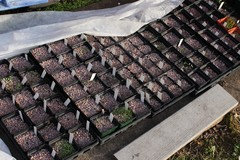
Everything goes into four inch pots here with a grit topping. One of my favorite things to do as the weather warms up is check and see what new stuff is sprouting every day and then thinning as they get bigger. Once things get growing and need watering and planting out, my interest really drops off. The dream is always more exciting.
- 9 years ago
These are such interesting discussions to have. Like Texasranger expressed, I can get very wrapped up about it. Especially when you realize there's a money trail at different points along the line that are merciless in the pursuit of that money, no matter what damage may be done. Just thinking about it, I feel the need for a good, stiff drink.
- 9 years ago
katob, are your pots outside or in a cold frame or greenhouse? What types of plants are you starting?
- 9 years ago
Babs, they usually sit on the concrete under the deck until things warm up, sometimes they just sit out in the open with a sheet of reemay over. I keep saying I'll build a coldframe, but the old windows have been sitting there for years and nothing's happened yet...
Mostly perennials, bulbs, trees, shrubs, annuals. Basically everything except vegetables and warm weather annuals like zinnias.
- 9 years agolast modified: 9 years ago
Aw...look at all those labels pointing the same way... I also use 4inch pots - I bought 1000 and 1000 labels because I was fed up with the hodge-podge of the usual containers and wanted some uniformity...but mine still don't look like your's Katob (jealous). I so relate to the enthusiasm of growing them and yep...as soon as they are up and doing, the idea of pricking out, potting up, potting on, watering...sigh. The very instant they are planted out...and I do it as soon as I possibly can...they are out of my hands and out of mind.
The world hunger problem which will only be solved through GMO is utter, utter BS. Monsanto are bullying greedy filth of the very worst order. They could not give a rat's fart if the entire third world starved in front of their eyes...but markets!!







User