Software
Houzz Logo Print
em_stevens

Fiddle Leaf Fig worries after root rot

Reposting here after mistakenly posting in the fig forum:

So, after spending a few hours reading all the excellent info on here about FLF trees, I still have a question about mine that I'm worried about. I got this tree over the summer, it was full and happy, and I repotted into a big pot in hopes that it would grow into it. I also repotted using MG moisture soil, which I have learned is a big no-no. I watered once a week like the rest of my plants and saw the lower leaves develop blackish brown spots that slowly spread. I finally realized I was severely overwatering about 2 months ago, removed those leaves and ceased watering. It has been 6 weeks since I have watered it and I'm totally afraid of watering again because I'm worried with this soil it will stay too wet. I should also mention that in the 5 months or so since I've owned the plant, it has had zero new growth. I have it in a south facing room near the window.

My question is, until next June when I can repot into better draining soil and address any root issues, how do I water this fig? I have read that I should flush the soil and then water deeply, but how do I do that using a moisture retentive soil? I also read that I should not repot during the winter, so I feel like the plant is stuck in its current pot/bad soil for several more months. Should I water by the cupful which I've heard is bad because it keeps the salts stuck in the soil, or should I try to flush and risk overwatering again? Should I try to fertilize now too even though it's December? I live in Atlanta, GA by the way. I definitely want to get it outside when the weather warms up to see if it will help the growth issue, but until then...?

Any help would be appreciated, I know the poor plant needs a drink asap.

Comments (19)

  • 9 years ago

    Continuing from the last thread.

    since you potting up and didn't repot, I'd remove it from the pot and get rid of all the MC soil.

    Place it back into the original pot or one of the same size.

    Look to repot in late June.

    Read these two threads. You'll learn everything you need to know.

    http://forums2.gardenweb.com/discussions/2842847/container-soils-water-movement-and-retention-xxii

    http://forums2.gardenweb.com/discussions/1476078/ficus-trees-in-containers-iv

    Color and Line Design thanked Dave
  • PRO
    9 years ago

    thank you, I will try it!

  • PRO
    9 years ago

    and thanks for the links!

  • 9 years ago
    last modified: 9 years ago

    No problem. Try not to disturb the original soil and roots much if you can. Since that soil you added holds so much moisture, I doubt a lot of roots have ventured in.

    If you leave it as is, there's just way too much soil for such a small plant and the fact that its moisture control makes it even worse.

    Please keep us updated and feel free to ask any questions.

    I know it's time consuming, but those two links will tell you all you need to know about container soils, which types work best and how water behaves in containers.

    Youll also learn all you need about ficus trees. While the link is mainly about ficus Benjamina, they share the exact same cultural needs as your ficus lyrata (aka fiddle leaf fig).

    If you want to start lightly fertilizing after you put it back in the original pot, id first flush the soil. Order yourself some Dyna grow foliage pro 9-3-6. Probably the best out there for your needs.

    Lastly, give it all the light you can. If you're in the northern hemisphere, right up in front of a southern window is best. Don't worry about reading they shouldn't have direct sun. Sunlight through a window is not direct, it's filtered by the glass. Direct sun means outdoor direct sun (which your tree would also love, once acclimated).

    Color and Line Design thanked Dave
  • 9 years ago

    Emily, I always like to share the success I've had with my ficus benjaminas because I know how encouraging a success story can be, having relied on so many of them in the past few months.

    My poor neglected benjaminas were potting in standard MG and had sat in dim corners for years without putting out more than a handful of new leaves, accumulating salts from poor watering, being gnawed on by spider mites, and filling their pots with useless woody roots in standard MG.

    About I started reading the threads Dave linked (and many more like it) two months ago I got rid of the mites, gave their pots a very thorough flushing with lukewarm R/O water (I swear I could hear them sigh with relief!), put them under 100W 5000k frequency ("bright white") LED and CFL bulbs in clamp--on fixtures for several hours a day, and started flushing & fertilizing with every watering. Result: they're both covered with buds and have several new leaves on every branch, which must be why their pots only take four days to dry out. it's clear that they'll recover from repotting in June quickly, so I'm already devising a pruning regimen that will have them looking as gorgeous as a Paul Mitchell model on a runway in no time at all.

    BTW, I use tap water filtered with a faucet mounted filter to water, but I prefer the R/O water for flushing; it's about $.39 a gallon at the grocery store, which isn't bad if you don't have dozens of plants to flush.

    Color and Line Design thanked litterbuggy (z7b, Utah)
  • PRO
    9 years ago

    Wow, litterbuggy, that is great! That gives me hope that revising this soil will be the answer. I have good sun in this south facing room, and will move the FLF plant closer to the window per Dave's suggestion.

    Now I am worried about what pot size to use for my plants. My mom told me to always pot up one size from the container the plant came in, but now it seems like if you re-pot and address root issues, that doesn't really matter unless there is severe crowding.

    Does anyone have links to how to prune roots? I'm a little afraid of that step when re-potting in June, too.

  • PRO
    9 years ago

    Hi Al! I have learned so much from your posts on here, such a treat to talk to you directly. I have read through both links above, and have a few outstanding questions. I apologize if you addressed this and I missed it, but does this above method of root-pruning apply to all containerized plants, or is it specific to tree species? I plan on repotting all my houseplants with better aerated soil in spring/summer, but should I plan to address root issues in all the plants, too, or do some plants not tolerate it well, OR is the method dependent upon the plant type?

    I am a novice at taking care of plants, but last spring I decided to take the plunge and create a zen space filled with plants and books and quiet. The plants are doing ok, but I have a lot of work to do to correct my mistakes. So happy to have a clear path to follow now. Many thanks for the help.

  • 9 years ago
    last modified: 9 years ago

    Emily, sorry about the blunt post I'm now deleting, I was living a few posts in the past.


  • 9 years ago

    I think we'd need to know what plants you have to comment on whether any of them are more sensitive to radical pruning or not. I'd suggest you continue to read followup posts about repotting and root pruning, starting with the threads Al linked. You can also use the search box to find the half a dozen other "Plants in Containers" threads... or just search for something like "money plant root pruning", etc., to find more specific discussions.

    Also, because FLFs are very popular plants, page back in the house plants forum and you'll see a very large number of threads about FLFs that include discussions about and even photos of root pruning in progress.

    I'm not really trying to avoid the question, and I'm sure Al will have more suggestions, but my experience is that reading about other people's experiences (which always include specific advice from Al) will fill in a lot of the gaps left by his more general posts a lot faster than just about anything else.

    Of course, I'm a real research geek, so YMMV.

    Color and Line Design thanked litterbuggy (z7b, Utah)
  • PRO
    9 years ago

    Ha! I have totally gotten lost in these threads and then forgotten what I initially started researching, LOL. My main problem is I have 3 kids ages 5, 3, and 9 months who interrupt me a lot. So I often lose my train of thought and then can't find the info again. Thanks for the pointers, I'm new to the forum, so I'll keep digging around (no pun intended). I have a couple different rubber tree plants, a majesty palm, the money tree you mentioned, aloe vera, an exotic angel fern, a philodendron, golden pothos, ivy, and a huge dieffenbachia.

  • 9 years ago

    You have my sympathy! I have no excuse for my rambling style aside from my "ooh, shiny!!" response to seeing something new.

    I've read that majesty palms can be difficult indoor plants, but I can't remember why. There are specific forums for some of your plants, although plenty of the house plants regulars grow many of them. I'm very limited because my only houseplants have been scheffleras and ficus benjaminas I've had for years which have survived my abuse only because they're tough as nails, and a newish dracaena marginata that seems to tolerate a variety of conditions. I plan to branch out (I can pun with the best of them!) next summer, but right now I'm focusing on getting the old ones healthy again.

  • 9 years ago

    Em - Thanks for your kind words!

    All plants benefit from sound root management of some kind, if only for the reason root congestion is limiting and continues to become increasingly limiting as congestion increases. Potting up can offer SOME degree of moderation when it comes to the severity of congestion, but repotting is a half-measure and doesn't resolve root problems or congestion in the center of the root mass that never gets worked on. Root management can take the form of simply doing a full repot, which includes bare rooting and root-pruning every 2-5 years (2-3 is probably best for most trees grown as houseplants); of doing a partial repot where pie-shaped wedges = to half the root mass are cut out out the root mass one year and a second set of wedges to remove the second half of the root mass is removed in the second year, followed by 1-2 years of undisturbed growth; or of dividing plants like peace lilies when root congestion starts taking a heavy toll on growth rate and vitality. There will always be someone around to offer guidance re certain plants and disagreement if the advice doesn't seem accurate.

    Al

  • PRO
    9 years ago

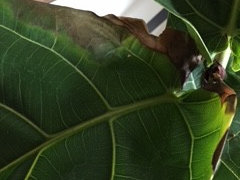
    Guys, I am stressing about this plant. Here is my update. I left it alone through winter and spring, and it looked fine, no changes to first pic. Then, about a month ago I took it outside and took it out of that huge pot and removed all the MC soil I could, without damaging the roots. There were some super fine roots that got pulled out with the soil, but otherwise I just tried to unclump everything and get rid of the MC stuff. Then I repotted in new all-purpose better draining soil with bark, watered until water came out the bottom, then fertilized it. Then I moved the plant to an east facing window and hoped for the best. I think my problem is I have NO IDEA how to water this plant. With the new soil, should I try a cup a week? I did like 2 cups one week, then skipped a week, then went to check on it today and it looks terrible. Can anyone tell me if this black on the edges is from too much water or not enough? The one glimmer of hope I have through all this is that there is a new growth at the bottom of the trunk. I have had this plant a year now, and this is the first new growth I have seen. Anybody have any suggestions? I am such a sucker for punishment, I actually bought ANOTHER fiddle leaf at Walmart a few weeks ago because it was $15 and nice looking. And that one has a black spot in the middle of each of the lower leaves now also...ugh.

  • 9 years ago

    To help you figure things out ...... if you're watering when you can still detect moisture in the soil with a finger, you can't be under-watering.

    If you can eliminate under-watering based on the above, it pretty much leaves you with over-watering or a high level of dissolved solids in the soil from the fertilizer you applied. What did you use for fertilizer, how much did you use, and how did you apply it? Was the plant dry at application time?

    I don't know if I mentioned this, but it's easy to monitor soil moisture levels with a 'tell'. A wood dowel (from any hardware or home improvement store) about 5/16" in diameter works best. They come 48" long. Cut it in half & sharpen all 4 ends in a pencil sharpener. Push it deep into the soil and don't water until the first day it comes out clean/dry.

    Did you read the thread I linked to upthread - the one that focuses on how to deal with unwanted water retention? The best advice I offered was to concentrate on making sure your plants are in a soil you can water to beyond the point of saturation w/o having to worry the soil remain soggy so long it limits root health/function. That means you either start with an appropriate soil of find ways to limit water retention, which brings us back around to the link that takes you to the thread about dealing with water retentive soils.

    It's hard to tell you precisely what to do w/o you having a basic understanding of what plants require to remain healthy. Particularly important and a prerequisite to a healthy plant is a healthy root system.

    All
    of the information you need to be an accomplished container grower
    fits together like a jigsaw puzzle under assembly. Each piece is connected to the other pieces - either
    directly or extraneously, but they ARE all connected. You probably remember that it’s
    easier to assemble a puzzle when you work toward getting the outer 'frame' together first. The
    outer frame is analogous to an understanding of the basic
    bits knowledge required for your success. Of the basic knowledge, most
    important is an understanding of how the soil/water relationship
    works & how the individual soil components interact relative to the whole. Basically we need to understand that a healthy
    root system is a requirement if the plant is to be
    healthy. Then, and easier to understand are a very few additional
    issues like the importance of light to your growing experience, how
    fertilizers work and what fertilizer is most appropriate ……. We
    also need at least a very basic understanding of how some of the
    other cultural conditions might affect plant growth/performance. Once this basic but essential understanding is part of your skill set, that is to say
    the framework of the growing puzzle completed, assembling the rest of
    the pieces will occur at a rate exponentially faster than the rate at
    which you progressed at the outset of your growing experience. Unless
    this basic framework is complete, you’re essentially relying on trial
    & error, which is probably never going to gain favor as a short cut to success.

    Al


  • 9 years ago

    Al beat me to it, but I'll just add that everything he said is true. Do read as much as you can stand about water movement and how different circumstances affect plants. That includes the excellent discussions throughout this thread, where a number of folks have posted and had complete responses to all kinds of situations similar to yours, including those (like me) with plants that have suffered from long periods of watering problems, unlike you, who's doing her research soon after the problems began!

    Anyhow, I just thought I'd share that I've learned more by reading posts and responses about the exact situations I have than I have from direct responses to my own!

    Oh, and about the roots: they're more resilient than you'd think, and those fine white roots that do all the heavy lifting will grow back just fine so long as there's enough air and water to keep them functioning.

  • PRO
    9 years ago

    Thanks! Love the wood dowel idea, and as it so happens I had some bamboo skewers in the drawer. These plants were dry as a bone! It's a good easy gauge for me while I figure out this new soil. I will continue to monitor and flush the soil and fertilize based on previous suggestions and research.

  • 9 years ago

    If indeed they were dry as a bone, there is plenty of potential for the soil to have become hydrophobic, a fancy word for water-repellent. If the soil has reached that stage of dessication, you might need to soak the pots in water for a half hr or so to rewet the soil. When soils are at that stage, it's very common for the soil to have shrunk away from the inside wall of the pot, allowing water to run between the wall and soil mass and right out the drain w/o actually wetting the soil, so be sure to guard against that. If you run across the advice to add a few drops of dishsoap to your water, resist following it. While that actually makes water wetter and better at rewetting the soil, the chemicals in the soap can dissolve root lipid membranes, which creates a whole new set of issues.

    Al

  • PRO
    9 years ago
    Al, you are a kind and helpful soul. Thank you for always making time. We had a gentle summer rain all afternoon so I moved the plants outside and let them soak in that for a few hours. They are now drying out on the patio. I think I will let them have some fresh air for awhile and see if it perks them up. I know it helps me! Thank you again for all your help/insight/hand-holding.
Sponsored
Hope Restoration & General Contracting
Average rating: 4.7 out of 5 stars35 Reviews
Columbus Design-Build, Kitchen & Bath Remodeling, Historic Renovations