Software
Houzz Logo Print
lite1

Would you split downstairs into two zones?

9 years ago
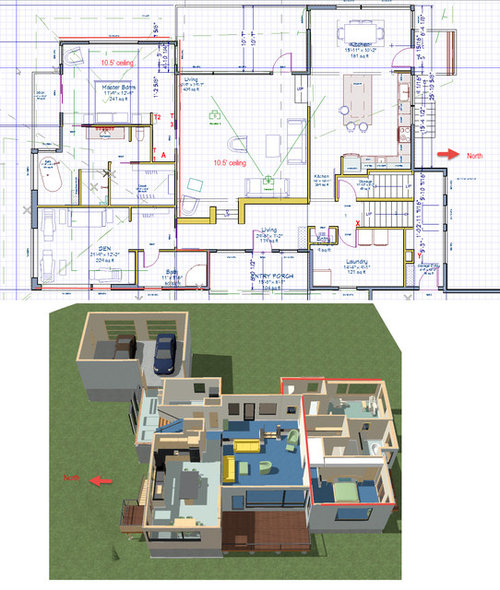
Extra cost for splitting into 2nd zone (area in red) is $650 which am willing to spend; however with Master having West & South exposure and Den having East & South not sure this'd be a meaningful zone. It does give more control and options than just the main Tstat for lower level at "X". Upstairs is over area NOT in red and not over GR; upstairs is separate zone.

Regardless of it being a 2nd zone, sub's design is for smaller air return at "A" in the dropped ceiling entry to Master (Main AR is in mid-stair landing at "Y"). Proposed Tstat for 2nd zone is at "T1", but I wonder whether that location would be too influenced by air from living room (at night this pocket door would be partly open). Alternatively, I wonder whether Tstat at "T2" set at about 36" off floor in pony wall would function better in reading air temperature for Master? T3 was rejected for Tstat as it'd get some end of day sun from windows. (I know 36" high Tstat placement is NOT standard height.)

HVAC sub indicated, I do have the option of postponing decision by pre-wiring for 2nd Tstat and splitting things at later date with cost being not much more.

Thanks for your input.

New construction modern home with lots of glass; 2300SF main floor; 900SF upstairs. Only electric. Predominantly 9' ceilings
(some 10.5'). Open floor plan Entry, GR, K, DR.

High desert climate in Oregon heating degree days 6926 cooling 151
both base 65.
Equipment

$23,090 Lennox XP20-048 heat pump, variable speed compressor, 9.6 HSPF, 19 SEER. Lennox CBX40UHV air handler, variable speed, with aux heat. I had gotten bids from Carrier and Trane both of which were much higher.

Sorry I couldn't get images with same orientation.


Comments (14)

  • 9 years ago

    This will depend a lot on how you're going to use the spaces.

    having a separate zone for your sleeping areas vs your living areas is super. We set our living areas to 50F at night, while our sleeping areas are a comfy 68F. During the day, the living areas are at 72 and the sleeping areas are at 60.

    If you think you will "retire to the den" in the late evenings, having the den and the master on the same zone is probably fine. But if you will be using he den a lot during the day, maybe zone it with the rest of the living space.

    at first glance, I would want the master on its own zone, separate from the den. I'd put the den with the rest of the living space.

  • 9 years ago

    @callights Thanks for comment and suggestion of perhaps having master suite be its own zone. Since my HVAC will be electric heat pump my understanding is that one would never have such large set backs as you are using in your own house - supposedly just not as efficient way to use HP.

  • 9 years ago

    It would not hurt if they could get it all to work correctly. Ask them how they plan to get the zoning to work correctly.

  • 9 years ago
    last modified: 9 years ago

    My understanding is that it is only inefficient to use large setbacks if your controller defaults to using the emergency heat source whenever it is faced with a long runtime or very cold outside temperatures. Modern controllers should be able to identify a "time to scheduled temperature" and just run the primary heat pump for a longer time starting earlier. I could be wrong, however.

    i would still say only zone the spaces that have different use cases (living vs sleeping). It does you less good to have two zones that share a use case. If you can separate your living and sleeping spaces, you'll definitely save money to cover the extra zoning costs and then some (even with modest setbacks).

    its also possible that the master by itself is too small of a zone for your system to condition efficiently. Your installer will know this info.

  • 9 years ago

    I'm not an expert (and I hope some will weigh in) but it seems to me that the contractor has picked lazy (work saving) locations for the returns and the thermostat. And not nearly enough returns.


    I'd think the main return would go best in the living room, because it's central. Same for the thermostat. And a return in the den as well as in the master bedroom.


    Zoning with a heat pump? I'm not sure that's a great idea because of slow recovery, as mentioned. But for sure I would have two units, one for upstairs and one for down.


    Is the quote for hard (metal) ducts?

  • 9 years ago

    Times have changed. Depending on the efficiency of construction, and the lifestyle, set-backs with modern, variable output, HVAC appliances can put them into poor efficiency operation at full output vs. lower fire (furnace or boiler) or lower speed (heat pumps). Set-backs can be counter productive even without hitting backup resistance heat. Better controls could fix this just like better thermostats fixed recoveries with single speed heat pumps by locking out backup heat and starting recovery earlier. The controls wold have to limit capacity to something less than 100% output, significantly less.

    See: Long-Term Monitoring of Mini-Split Ductless Heat Pumps in the Northeast Building America Report - 1407 December 2014 Kohta Ueno and Honorata Loomis.

    Keep in mind that a home with a very tight envelope will benefit less from zoning with respect to energy saving than an old, leaky home. Heat transfer room to room is much faster than to the exterior in a good building. Zoning will be more about comfort.

  • 9 years ago

    If the area highlighted in red has no second floor above it, then it will have higher heat gain in summer, and heat loss in the winter. For that reason alone I would recommend adding a second zone for that area. A large house is always going to have uneven temperatures if it controlled by one thermostat. Zoning is a good solution if it is done correctly.

    Setting back the indoor temperature will save money. This is true for cooling with either an AC condenser or heat pump. For heating the set back will work with a boiler or furnace. Heat pump heating set back is a little tricky. If you have a dumb thermostat which turns on the electric resistance heat when the difference of set and actual room temperature is more than two degrees, then a set back will not save energy and probably use more. If you have an intelligent thermostat then set back may save some money. Ideally you want the heat to be working the most when the outside temperature is warmer rather than colder. So if minimizing the heat pump during the middle of the night when it is cold and letting it run when the sun is shining should work well with a setback strategy.

    I don't understand the science behind why a mini split would not save energy from a set back. I did a quick look at the report and I didn't see any explanation or any data to back this up.

  • 9 years ago

    Mike_home, boilers, furnaces and heat pumps that have variable outputs have sweet spots for efficiency. The sweet spot is NOT at 100% output. At the highest output, the efficiency can be significantly lower. Heat exchanger capacity can approach saturation because air/fluid fluid flow is limiting. (You tell me, can higher operating pressures might increase causing compressor inefficiency?) There are a number of potential causes. I suspect that HX capacity is the root of most of this. Ask yourself what happens to efficiency if you double or triple the size of the indoor and outdoor HXs of a typical heat pump? Fan speeds can decrease with the ECM motors and efficiency will still be higher than at 100%. That will happen with a condensing boiler as well. As firing rate goes up, the the counterflow HX gets hotter, even on the "cool" end eventually limiting the condensing ability.

    As home envelope efficiency increases, set backs save less energy. At the same time, if the set backs decrease the efficiency of heating or cooling equipment, you end up in a poorer place especially if the equipment is sized very closely to the most demanding requirements.

    I have a couple of more global comments. First, If the controls are up to the job, set-back recovery could be efficient solving the problem by limiting output to that sweeter place. (Reserving full output to times when it is required by climactic conditions, power failures and the like.) Some residential modulating boilers can do that and in more than one approach. I dunno about furnaces. I've not seen it for VS heat pumps. That situation is somewhat analogous to the early days of heat pumps when there was a no set-back rule. The solution is a little more complicated than one-speed with heat strips, but not excessive given the development and price of microprocessors. I believe that it is being approached at the residential level. It already has been done at the commercial/institutional level. Second, meaningful official efficiency rating of variable speed equipment is at a very primitive state. Unless I've missed something, it does not exist. Some offer information for the engineer types. . (It is a lot of information!) Even if that information is available, it is difficult to apply to individual homes and climates because it requires a lot of calculations.

  • 9 years ago


    http://www.rehva.eu/publications-and-resources/rehva-journal/2012/052012/capacity-control-of-heat-pumps.html

    Some of the data here appears to explain why MSHP manufacturers limit the lower end of the output of compressors to 30%. At speeds any lower than that, efficiency falls off so switching off and on is a better way to modulate from an energy efficiency standpoint.

  • 9 years ago

    ionized_gw, I can believe that efficiency changes across the range of the lowest and highest operating output. But how many percentage points can it vary? When a furnace manufacturer claims their variable speed furnace operates at 96% efficiency, is that the highest or lowest rating?

    Let's say for arguments sake a furnace losses several percentage points in efficiency when operating at the highest output. If a set back is programmed for 10 hours and then the furnace has to run continuously at the highest stage for 30 minutes to recover the temperature, wouldn't you think there would be a savings even with the inefficiency factored in?

    I agree as homes are better insulated setbacks will save less energy. That is because less energy is need to condition the home. But what is interesting when you lower the temperature of the thermostat in a well insulated house, it may take hours for the temperature to drop 5 degrees. If the temperature never reaches the set back point the furnace never turns on. But if you left the thermostat at the same temperature constantly, then the furnace will likely cycle on and off to maintain that temperature.

    Setbacks in winter and summer work in my house. My neighbors who have smaller houses than mine are amazed by my heating and cooling costs compared to theirs.

  • 9 years ago
    last modified: 9 years ago

    I know heat pumps and boilers better than furnaces and the
    answers are that efficiency can vary a lot and the efficiency quoted for
    boilers by manufacturers is the maximum.
    My understanding is that heat pumps are rated at some fixed frequency
    and that does not reflect the best that they can do.

    With equipment closely matched to the demand, a setback
    recovery can easily throw the equipment into maximum output and that is an
    inefficient mode for boilers and heat pumps.
    For the former, in addition to the high fire penalty, unless you have
    extra emitter (radiator) capacity, you have to run at high water temperatures
    and that puts you into non condensing conditions. (Return water needs to be below 130 F,
    preferably way below.) You can see in
    the link that I posted in the last table that for the heat pumps with currently
    available equipment, COP can vary from 3.3 at full output through 4.9 at 50%
    to 5.3 at 20%. It looks to peak closer to 30% of max output (fig.
    5).

    This looks like a pretty good thread to start getting at
    furnaces. I am sure that there is a lot of detailed information that can be
    found with a search. One poster wrote
    that that a 96% furnace gets that at low fire and at high fire it only reaches
    90-92%. So if you setback gains you 5%
    on your bill, you may only break even if recovery is at high fire.. Figuring out what to do would require a
    lot of calculations, but, again, controls that allow recovery at less than full
    output can solve a lot of problems.http://www.greenbuildingadvisor.com/blogs/dept/building-science/how-replacing-furnace-can-make-you-less-comfortable

  • 9 years ago

    I don't see how manufacturers can get away with stating one efficiency rating for furnaces and boilers. If there is a big variation between the highest and lowest stages then buyers who want maximum efficiency should consider only single stage equipment. Heat pumps present more of a challenge since their efficiency is dependent on the outside air or ground temperature.

    A study was done in Canada several years ago where two identical houses sitting next to each other were used to measure how much set backs would save in energy. I don't recall if the equipment was a furnace or boiler. If I find it again I will post a link.

  • 9 years ago

    Mike, It has been a while since I evaluated boilers for dad's house so I don't remember how they give efficiency figures. I'd bet that they write something like "up to" or "maximum". You are not going to get maximum anyway if installation is not optimal.

    I hope that you get what I am trying to express about setbacks. It can really go either way depending on home construction and how the heating and cooling is designed. With the latter, it seems like the design can benefit by considering the lifestyle of the occupants which could drive HVAC people crazy to even suggest it :-)

    Below is a reasonably current study done for the DOE with three or four homes with hydronic heat in cold NY state. If you read it, you will see that they found that setbacks do work with HE boilers under some conditions. That is true even in these, new, relatively efficient homes. I am ready to be contradicted, but it seems to me that hydronic design is a lot more complicated and there are a lot more options that can be applied. What I do know is that it can be tough to retrofit a modcon boiler to an old system and get any efficiency out of it.. It takes some engineering sense to do it right. (On the other hand, I think it can be done easily if you punt and install an HTP Versa-Fame or Versa-Hydro.)

    Optimizing Hydronic System Performance in Residential Applications

    L. Arena and O. Faakye

    Consortium for Advanced Residential Buildings

    October 2013

  • PRO
    9 years ago

    To the OP: The whole purpose of a zone is for better temperature control in different areas of the home. Efficiency has a play in this as well, but the primary goal is better comfort for the area in the home you are in.

    The problem I often see are design problems. These design problems can be a wide assortment of problems, from in adequate return, poor choice of controls, over sized or under sized ducting can all be problems from one degree or another.

    From the look of the diagram it appears that the thermostats are all located close to one another for every zone. This basically means you aren't controlling zones by supply temp. The temp you feel in the zone itself, but rather return temperature.

    This design flaw could suffer from wide temperature swings during really hot heat waves in summer and or really cold spells in the winter.

    It's always best when designing zone systems that controls be within the zone they are controlling. This is only part of the overall equation.