Software
Houzz Logo Print
aegis1000

My Experiences With Thrips ...

9 years ago
last modified: 9 years ago

I posted this in another thread, ... but I think that it deserves its own ...

Obtaining Optimaras (or any other brand) African violets from a retailer like LOWES, Home Depot, WalMart, or a local grocery is just not the best idea, ... UNLESS you have a GOOD ISOLATION plan.

The problem, from my experience, with these violets, is as Ken states, ... you don't know WHAT they've been exposed to in shipping, storage, and worst of all ... in the retail indoor garden department.

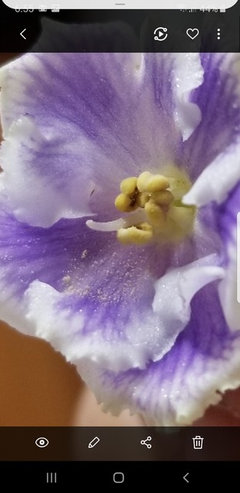
Because of such wide exposures, ... these plants will inevitably become exposed to Thrips. It used to be my practice that I would walk through the African Violet display in these outlets ... and see if I could find any plants that did not have the tell-tell spilling of bright yellow pollen on their blossoms that indicated the presence of Thrips (or, worse yet, evident Thrip damage ... shriveled, damaged, and streaked blooms ... caused by Thrip feeding). Even on those plants where I could find no evidence of Thrip presence, .... blowing a bit into the blossoms would more often than not, result in mature Thrips emerging out of hiding.

My biggest nemesis to African Violet growing has been Thrips. Twice, I have discarded collections of 50 plants or more because of them. The last problematic plant I purchased from a local outlet was a stunning Optimara Millennia in full bloom. I just had to have it. I blew on its apparently pristine petals, ... no Thrips emerged, .... maybe I would be safe. So I bought it, and took it home to my other violets.

Now this was also prior to the time that I REALLY LEARNED the lesson of ISOLATING NEW PLANTS. (I have bought a couple retail plants, since then, which I have successfully ISOLATED by the upstairs bathroom window for MONTHS ... before I let it join my other violets). But in the case of this Millennia, I was so desperate for COLOR, during a non-blooming period among my downstairs plants, ... that I plopped it right with a few plants next to our sliding glass door. The nearest other collection of plants was two rooms away, in the dining room (about 20 plants or so). Sure enough, in time (maybe a week or so), signs of Thrips showed on the Millennia. So, then the question became, ... HOW LONG would I let it remain .... before I either tossed it, ... or stripped it of its still beautiful blooms and buds. Eventually, I did get rid of the flowers and buds, .... applied what insecticide I was using at present, ... and crossed my fingers hoping that none of my other plants had been affected.

In the mean-time, two rooms away, I had a Picasso that was finally coming into bloom after a LONG struggle to finally get it to grow well. Its blooms opened ... and they were beautiful. It was only a few days later ... that I saw the Thrips. The long and the short of it is ... ALL of those downstairs plants (probably 25 or so), were eventually discarded, all because of one beautiful Optimara Millenia that was carrying Thrips.

Since then, I have much more careful with plants (maybe a couple) which I have obtained from a local outlet. I think that I have purchased, ... maybe an Optimara Modesty, ... and an Optimara Hiroshige. But these I ISOLATED by my upstairs bathroom window (and kept the door closed), so those experiences went a lot better. BUT, I still have obtained Thrips, at times, from other sources (online vendors). I do have a viable Thrip treatment plan now. I use a little Merit (from Bayer Tree/Shrub Treatment) in the saucers of plants where Thrips show up. And, generally, within a few weeks/months, I am seeing no more Thrips. Now I have to mention that some of my plants haven't taken well to such treatment. I lose a few out of every batch that I treat.

But, ultimately, I've found that it is so much better to start with leaves and/or plugs (from someone like Bloomlovers). Bringing in plants which are already blooming ... or in bud ... is a risk, if you don't get the ISOLATION piece right.

I've found, that, once I got my water/Chloramine situation in hand, raising plants from a leaf or plug is not hard at all, and, ultimately, will protect the plants you have (and all of your hard work and dreams) from the risk of Thrips (and/or or some other pest ... Mealybugs, Mites, .... I've had them all).

Leave the retail violets to the first-timers, ... who will throw their plants out soon anyway. If you want your Violets to provide you with beauty fro months, and maybe years, ... steer clear ...

Or ... if you see a plant that you just can't pass up ... have a good ISOLATION plan to protect your OTHER AV's. Doing so can save you weeks and months of having to fight against the Thrip scourge ...

Comments (16)

  • 9 years ago

    How about, if you see a plant that you just can't pass up just take one leaf, sterilize it and root it ?

    Just asking.

  • 9 years ago

    I am sure Aegis is not sending plants to the trash anymore when he sees thrips - these guys can come in through the window - and it is kinda wasteful.

    Yes - you can take a leaf and dip it in 1/3 rubbing alcohol, recut and root it. Or you can bring the whole plant , totally disbud it - preferrably outside, spray it, repot with Marathon and isolate - and spray couple more times week apart. Some thrips will be coming out of soil - so even disbudded and sprayed - is still can infect the rest - so isolation and repeated spraying is necessary.

    AND THEN A WELL MEANING FRIEND COMES WITH A BUNCH OF STORE BOUGHT FLOWERS... and off you go again. I kinda trained my Mom - when she comes to see us and wants some cut flowers - I say - you can take every single blossom from the yard and take it to your friends in Senior Living - as long as they all go out through the gate, not through the house.

  • 9 years ago

    How long do you need to isolate a suspected plant? Are we talking months, or will thrips show up if the plant is infected as soon as flowers appear? I have zero experience with these critters.

  • 9 years ago

    Thrips usually show up shortly after blooming ... maybe a few weeks. The longer isolation is to guard against Mites and/or Mealybugs, which can take longer to show.

    The problem is that, once any of these problems show up, they've had ample time to be passed on to your other plants ... if they were not isolated.

    Successful isolation periods for me have been 2-3 months.

  • 9 years ago

    Thanks, aegis. I usually just put any new plants in a plastic ziploc bag in with my others and keep an eye on them. Isolation isn't really doable for me but I only have 20 AVs.

  • 9 years ago

    I agree with Aegis. 2-3 months is a good number. Keeping the plants in a ziplock bags can mask some problems as well. Mites really do not like high humidity and will be hibernating in a bag - but will show themselves up when you get them out of the bag.

    So - devoting some growing space for the new arrivals in another room - preferrably as far as possible from the main collection - is the idea. You do what you need to do trying to sanitize them on arrival - and then just let them grow. There are pretty efficient new pesticides - bu they are ungodly expensive and for the small collection they are just not worth the preventable trouble.

    Pests are unavoidable. If you grow plants long enogh, if you make additions to your collection - trade leaves - it is just a question of time until something showes up. The correct approach is to try to do your best to apply prevention measures - and identify and deal with a problem as soon as it is here.

    Thrips is not the end of the world, mites are not too, root and foliar mealies are more persistent because they lay sleeper eggs that will resurface later.

    Virus is not treatable and nematodes are not. We didn't have nematodes for generations - but now we are trading with East European countries where some people still use the soil from their garden... and root knot nematodes are already on the rise there - and these guys live in a tissue of infected plant - so they can be passed with a leaf. And they will unfect the whole tray of plants if you water them together - mats, wicks etc.

    Just another reason - do not pick sick stunted plants and try to baby them back to health. Be very cautious with Round Robin and Russian varieties especially if ordering from abroad. If you got a new plant and it looks sad no matter what you do - off it goes. In this sense - Optimaras are safer - they are grown very healthy - and the only thing you can bring home with them - thrips, may be aphids. . Not the scary stuff. Especially you get straight out of the box - when they didn't have time to sit on the same table with Cyclamens.


  • 9 years ago

    Thanks for sharing the info. I hope someone can invent pest resistant av in the near future.

  • 9 years ago

    Aha - it is here already... made of plastic...

    We will overcome!


  • 9 years ago
    last modified: 9 years ago

    ... or silk.

    Why are we trying so hard to grow them ???

    This way ... buy 'em, ... stick 'em in a pot, ... and you're done.

    No watering, ... no feeding, ... no light requirements, ... just maybe a dusting every now and then ...

  • 9 years ago

    I actually have two, silk ones that is, haha!

  • 7 years ago

    Thank you for your article.

    I'm having a big thrips problem right now. I'm really afraid for my av's( 25 or more plus orchids, ferns, succulents, fruit trees outside, etc...)

    I'm feeling overwhelmed & stressed about having to trash everything.

  • 7 years ago

    I had a thrips outbreak a year or so ago, I have no idea where they came from - I hadn't put any new, unisolated violets into my plant room, but suddenly there they were, on 3 or 4 different plants in different parts of the room. Therefore, I knew I had to treat all my plants - about 35 in all. I disbudded all of them and sprayed them with an AVID solution - 1/2 t. per gallon of water - 3 times, a week apart. I also watered them with a solution of Bayer Advanced Tree and Shrub, which contains 1.47 % Imidachloprid - probably 1/2 t. per gallon of water. Yes, it was a pain in the neck, but the thrips were gone and haven't been seen since, thank goodness. I would hate to throw out my whole collection without first trying to save them.

  • 7 years ago

    do you have pictures of what your AV looked like when they were attacked by thrip? thanks

  • 7 years ago

    I only realized I had them when I noticed a small trail of pollen on one of the flowers. Thrips eat the pollen. When I looked very closely I could actually see the little buggers - tiny brownish thready things that move around if you poke them. When I checked the other plants, I found them on several of them. Other than that, the plants looked fine. I don't know what the plant looks like if you leave an affected plant alone.

  • 7 years ago

    I have one flower that has spill pollen and I checked other flowers on the same plant, I didn't see any spill pollen. so I guess I'm safe?

Sponsored