Software
Houzz Logo Print
marymcp_2

Useful Life of Fluorescent Tubes

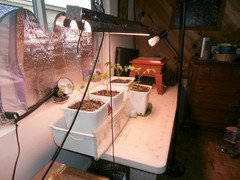
I started my tomato seeds too soon and we're having a lot of rain and cool temps so have four plants in 3 gallon [best guess] containers on a table in the back bedroom. When the sun comes back out and temps warm [next week probably, I'm in Phoenix] I'll put them back outside for natural lighting but have the following questions:

Have been using 2 - 4' 40W "Plant and Aquarium" fluorescent tubes in a shop light fixture. 1) Do these tube lights loose 'potency' after a while? 1a) What's the consensus please of useful life of the fluorescent tubes? and 2) Are the 'plant and aquarium' lights the best type to use?

I've used the same two light tubes for seedlings for years but these tomato plants are beyond seedling stage and are growing well, if a bit leggy.

Thanks much for any advice.

Comments (17)

  • 9 years ago

    I replace my aquarium grow lights every six months.

    MaryMcP Zone 8b - Phx AZ thanked kittymoonbeam
  • 9 years ago

    Dave, do you buy a particular spectrum, red, blue? kittymoonbeam uses the aquarium lights. Do you concur?

    Where in Vermont are you? I grew up in Brandon, have a brother in N Springfield, nephew in Underhill.

  • 9 years ago

    Fluorescents do lose their "potency" over time. Two seasons is max or about a year of continuous use. LEDs can last longer but the kind of lights you can buy is all over the place and lot of it is concocted marketing.

    For seedlings you are better off with daylight or cool whites. Those tubes need to be pretty close to the plants. If the plants are less than say 8-10 inches those work well. However, if the plants are taller then tubes are not enough. The lower leaves do not get enough light from those. In those cases a CFL works better. The 23W cool white CFLs (100W equivalents) throw out more concentrated light. Remember a 32W 4 ft tubes spread the light out lot more and so they are not as intense in a small area. A CFl tends to focus its light in a smaller area and so can reach a bit farther.

    CFLs are less efficient than the tubes. But for a few a plants with few bulbs the difference is not worth considering. Tubes are more helpful when you have a lots of small plants. With tubes you can increase its reach by having more tubes. So let us say you have to light up a 4x4 feet area with plants taller than say a foot, then I would 12 or more tubes in that area. If the plants are smaller may be 8 will do.

    You are also better off without those fancy full spectrum red/blue lights that are lovingly called "blurples". You end up paying a lot more upfront but for seedlings they are pretty unhelpful.

    I have never used Aquarium lights or anything marketed as fluorescent grow lights . Technically, there is not much difference when compared to regular fluorescents. And these days you can just mix warm white and cool whites to get what you want and they are a lot cheaper - unless you need UV and infra red for some reason.

    MaryMcP Zone 8b - Phx AZ thanked tropicofcancer (6b SW-PA)
  • 9 years ago

    I'm in Burlington.

    Id say you'd be wasting money buying specialty aquarium lights.

    As far as the spectrum, 5000k-6500k are great for seedlings and any green leafy plants.

    For plants that flower, you need some red. 2700k tubes or cfls for that would work but you'd need to mix 2700k red and 6500k blue for them as they'd need the blue for their foliage.

    MaryMcP Zone 8b - Phx AZ thanked Dave
  • 9 years ago

    VERY helpful information from all. I'll look at the CFL's as I only have four plants but they are about a foot tall now and can see your point tropic of how the light is difficult to disperse to the lower branches. Thanks so much!

  • 9 years ago

    May be you can get one or two cheap floor lamps and use CFLs. 23w daylight CFLs are quite common. Depending on the style you may be able to adjust it perfectly for your plants. Sometimes you can get 42W CFLs too but in our area it is almost always warm white. They are also big and tend to stick out of the fixture and throw light where it is not needed.

  • 9 years ago
    last modified: 9 years ago

    I've commendeered a floor lamp from the den for the time being, and a clamp-on one from hubby's shop! :-))

    Edited to add: I was looking through our stash of CFL bulbs and found several k-lite 65W "Warm White Light" bulbs. I'm thinking 65W may be too hot? And they are not CFL. Then found one K-lite that has a CFL bulb inside of the regular type glass for bulbs. It's 15W. I'm going to try this last one, see how it goes. If you're not yet bored with this conversation I'd be happy to hear any comments. I'm not a sophisticated lumins/watts/whatever sorta gal. Thanks!

  • 9 years ago

    That 65W bulb may be old style tungsten bulbs. It will give out way more heat than light. 15W CFL is on the low side but now harm starting with that. 23W CFL (100W equivalent) are quite cheap. In home depot you can often get 4 for $2/3. You will be more pleased with this bulb than your 15W covered in glass.

  • 9 years ago

    Thanks tropic, much appreciated.

  • 9 years ago

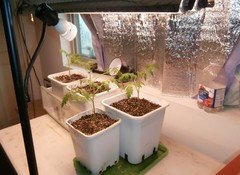
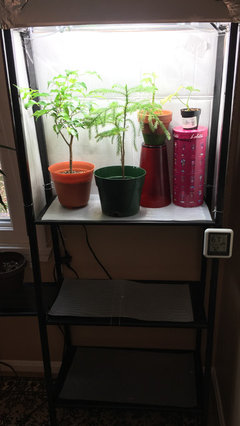
    These are 2 Silvery Fir Tree and 2 Black Cherry. Both favorites of mine.

    Lots of light from two 23W CFL's. Had to turn them off to get the pics. Thanks again for the help. Mary

    Different angle:

  • 9 years ago
    last modified: 9 years ago

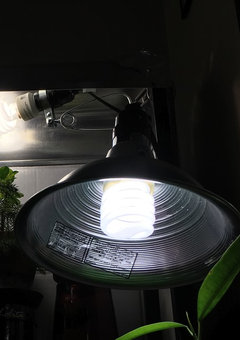
    You may want to get some reflectors or clamp on style work lights for the cfl bulbs.

    Currently, you'll be wasting a lot of usable light. Also, if they're not 5000k or 6500k I'd swap them out for those in the 23w (100w equivalent).

    like this:

    reflecting the light back onto the plants is very important. Having a cfl without a reflector will be wasting a good amount of the usable light.

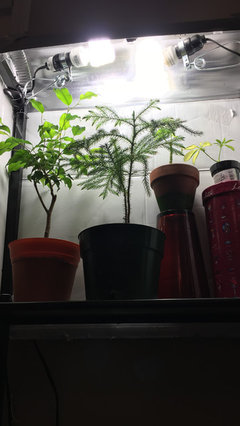
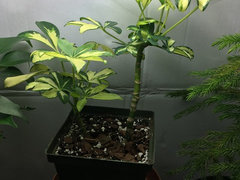
    heres a couple other photos of a little grow shelf I made. I used two 5000k clamp on lights with reflectors removed and used a piece of dryer bent ($5 at lowes) for the reflector.

    i also used cardboard I spray painted white around the back and sides to keep in the usable light.

    with just this artificial light, the two schefflera cutting to the right have grown into this in only two months.

    Also, those must be your aquarium bulbs in the shop light? Do they have a pink or purple color?

    id replace them with some standard 5000k or 6500k tubes.

    Is your lamp a T12 (40w) or T8 (32w)? Make sure you buy the correct bulbs. A T8 shop light with be a little more efficient and the bulbs have slightly higher lumen numbers too. Not like lumens matter to plants, but the T8's are a little brighter.

  • 9 years ago
    last modified: 9 years ago

    Ahhhhh, Googled the 5000k term, it's 'color temperature'. I'll get a couple of 6500k tubes today, light light bar is 12. And the reflector makes perfect sense. I have two cone collars from dog surgeries sitting in a drawer in that room, I bet I can make them work with tin foil on the lamps I already have set up. Remember, this is only temporary, until the sun comes out again and I can move them in and out day and night. Then into the ground around Valentines Day. I did want to know all this stuff though for a better understanding. Y'all have been so very helpful. Muchas gracias and many mahalo's!

  • 9 years ago
    last modified: 9 years ago

    In industry, we size lights with an additional aging and light loss factors. This considers the aging of the lamp, as well as dust accumulation on the reflector.

    The loss of light output each year is actually fairly low (based on my personal measurements) with running my flourescents 10-12 hours per day for the entire year.

    There is more deviation in output between bulbs due to manufacturing tolerances than actual decrease due to aging over 1-2 years.

    Personally, I built my light setup to be around 20-30% brighter than I expected my needs to be. I've been measuring the output of all my tubes each year but it will probably be many more years before I replace them.

    You may benefit more from a routine dusting of your fixture reflectors, depending how clean or dusty your grow area is. =)

  • 9 years ago

    Phoenix Aridzona, dusty? Pushah!! hahahah....thanks for those tips.

  • 9 years ago

    Mary, do be careful using plastic cone collars or anything similar for reflectors. CFLs run notoriously hotter. Can easily reach 150F at the base in open air and in a closed reflector even hotter. So monitor them to see if there are any heat damage. You do not want to start a fire. Over the years I had two CFLs that melted near the point where the glass tube enters the plastic ballast base.

    Mayo, you are right about light loss due to dust. A good quality tube setup should last quite a bit. Emphasis on good quality for both the tubes and the ballast. Cheap shoplights have very poorly designed ballasts that limit the lamp life. A good quality ballast usually costs more than the shoplights they sell in stores.

  • 9 years ago

    tropic, thanks - I had not thought of the heat. Good point.

Sponsored
Hope Restoration & General Contracting
Average rating: 4.7 out of 5 stars35 Reviews
Columbus Design-Build, Kitchen & Bath Remodeling, Historic Renovations