Software
Houzz Logo Print
carlssonjames80

Orange trees shoots turn brown and die

9 years ago
last modified: 9 years ago
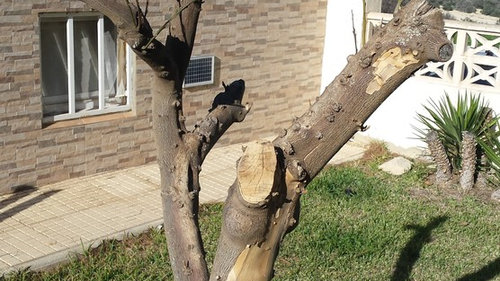

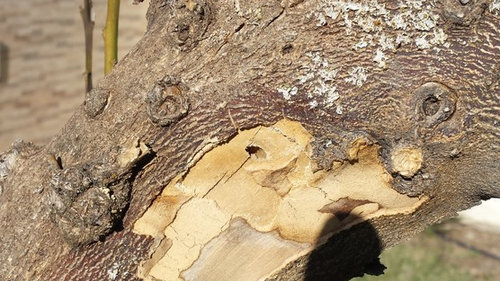
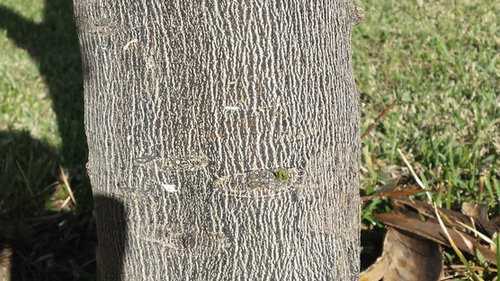
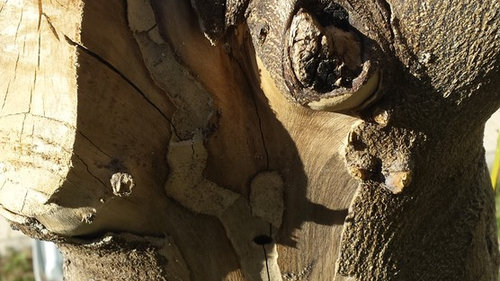
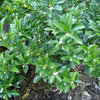
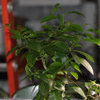
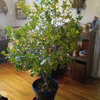
Hi guys. I live in Alicante Spain and i bought a fully grown navel orange tree in May and planted it in our urbanisation. It had quite a lot of foliage on but it has since progressively withered and seemingly dried out. It has been regilarly watered and fertilized but i recently found some kind of weavel boring holes in it. Parts of the branches have become very dry and powdry and i have fotographed the holes the bugs made (i sprayed them dead)

The tree sprouts new shoots but almost no leaves, the shoots go brown after a few weeks and you can snap them off as they are dry.

The bark is easy to pull of in places and some little kids did so while i was away.Im honestly perplexed and have no idea. Please any help would be great and check the photos!

Comments (15)

  • 9 years ago

    I would get another citrus tree and grow it in a container so that if this tree doesn't pull through you have its replacement in hand. If your tree pulls through you will have 2 trees. I don't know how to help with this tree. I had a meteor sour cherry tree bite the compost pile the same way. I did not find out the problem for another 5 years. In my case it was not insects. I am also very much in favor of buying a small tree and have it grow into a good producing tree.

    6b Steve

  • 9 years ago

    IMO it is nearly impossible to transplant a citrus that large and expect it to survive.

  • 9 years ago

    That tree was in a massive pot when we planted it. Why would it be impossible to transplant it? Spain is full of garden centers that sell such trees

  • 9 years ago

    5 gallon trees are the best for transplanting. A tree like yours of that size will just go into shock when the roots are disturbed. It has been proven time and time again that a 5 gallon tree will quickly catch up to and surpass the growth of a 15 gallon tree within a couple years. I'd pull it out and ask for a refund and buy a 5 gallon tree instead.

    Evan

  • 9 years ago

    Any ideas on the bugs? Why is a big tree behaving like this?

  • 9 years ago

    I didn't see any bugs. The tree was a large specimen that was transplanted too late in its life. Then, somebody hacked all of the branches off that had leaves that the tree needs to survive and provide itself with food. It might come back in the spring if you treat it carefully through the winter and start watering and fertilizing when it starts to warm up.


  • 9 years ago

    Pull the grass a couple feet in diameter. It gives off a bad gas for citrus.

    To me that tree looks like somebody hacked it out of their yard, stuck it in a pot a sold it.

  • 9 years ago

    I am also shocked that was sold as a container tree- it's huge and looks so mature! But I know nothing of how things are done in your climate to be fair.

  • 9 years ago

    This tree's health has absolutely nothing to do with grass. I have seen plenty of citrus trees planted in lawns with zero issues, that bear bounties of fruit annually.

  • 9 years ago

    The top half of the trunk is in very bad decline and is dying. Near the base of the tree there are little green growth buds and just above these I would carefully and cleanly saw the tree down for it to resprout with new growth.

  • 9 years ago

    My first reaction after seeing that lawn right up to trunk was whether any herbicide was used to treat it. That would severely compromise a newly planted tree/plant. My second thought was that it takes a lot of expertise to prep the ground to accept a large tree like that. And my third reaction (I know I am over reacting) was what was the container that held that tree.

  • 9 years ago
    last modified: 9 years ago
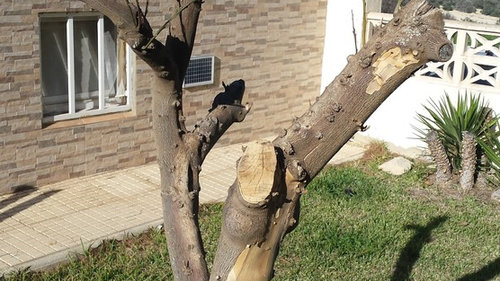
    I transplanted some citrus trees with the help of a worker who had done it professionally many times. For a tree with a 2" (5cm) trunk, we tried for a root ball about 18-24" in (61cm), 24" deep and that's a heavy root ball, more than one person can lift. Your tree looks like its 6-8"(15-20cm) in diameter so the root ball (and the pot) must have been pretty large. Around here(S.Calif) when older trees are moved, they have wooden containers built around the root ball, I don't think there are pots that large. And such a large pot would probably be easy to break when moved (with a forklift or a crane). So I also wonder if you really had a root ball appropriate for the size and age of that tree. BTW, my transplanted citrus didn't thrive and died after a few years.

    The top of the tree trunk looks mostly dead to me (at least on the right side) and it's hard to imagine spending any time trying to save that part. And I'm the optimistic type who in the past has tried to save half dead trees. I think the bug holes are just another sign of dead wood.

    I agree that the buds down near the bottom may be your only chance to save the tree and there's no reason to leave any of the dead/dying parts on. You didn't mention the variety of citrus, but if one of the shoots or branches on the left side is nice and green, maybe you could use it as scion wood and try a bark graft into the remaining stump.

    Even if the roots are healthy, it's still going to take some time for those buds to start producing fruit. So buying a replacement tree in a 5 gal container is a good idea. You can leave it in the container for years. In my humble opinion, you can never have too many citrus trees, especially when you live in Spain.

  • 9 years ago

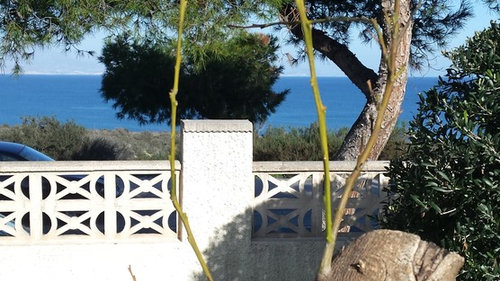
    Is that body of water in the back ground by chance contain salt. If so it is probably spraying a salt mist in storms and you will need a special rootstock to handle salt on citrus..

    Is it true that the rain in Spain fall mainly on the plane?

  • 9 years ago

    I think the rain falls mainly on the plain. Although the plain might be plane. And a plain plane could certainly fall on the plane plain, if there's rain.