Software
Houzz Logo Print
kamereone

Aphid control: drastic pruning, where to cut?

9 years ago

Taken in three sad pepper plants.

only natural light via eastern window since they came in for winter.

inconsistent watering

likely some nutrient deficiencies

and a hefty case of aphids

supposedly past attempts at eradication using a pepper/garlic/soap mixture after rinsing with a showerhead were relatively successful, but failure to keep up with treatments allowed them to resurge, eventually leading to declaration of defeat shortly before the holidays, and they've been ignored since.

I'm a bit more stubborn, so the (now quite dehydrated) pots went straight to the showers for an aggressive rinsing and removal of the dead leaves.

Less than 24 hours later, and the little buggers are back with a vengeance, in better health than before!

while I'd live to play cat and mouse and resume spraying every other day (eh, not really!), I'm leaving the country in less than three weeks and can't expect the house-sitter to continue the routine for the two weeks I'm gone.

plan is to trim all the worst infested (primarily new) growth and do daily showers and spraying with a soapy MG mixture seasoned with garlic oil and powdered hot pepper for good measure. Low fan at all times for circulation and to dry foliage.

after a week, stop treatments, and see if / how quickly the population recovers, which I suspect it will.

so, I'm considering an alternate route: Drastic pruning, and repotting with fresh potting soil.

I've seen some aggressive cut backs by folks making bonsai peppers (bonchi a la fatalii) and would like some advice on where would be the best places for pruning cuts should I have to go this route.

thanks!

- K


Comments (15)

  • 9 years ago

    Thank you, isgen - Sounds like peppers can take even more abuse than I thought!

    Good call on checking the rest of the populace - was horrified to find my snap dragons had aphids last night, my eye probably drawn to them after staring at the ones on the peppers. All of them were immediately banished to the garage, and while I didn't notice any on the succulents/cacti, spider plants, wandering jew or coleus, I'll be keeping a sharp eye out. (Unless they are immune and can be considered non-carriers?)

    Raises a question - what are the transmission vectors of aphids? I know at some point a colony will spontaneously create individuals with wings - how far can those fly, under what conditions? Can soil carry eggs/young/adults? How long can they survive off a host plant, are there environmental conditions that can force them from a host plant, etc. Should I be concerned about transmission via garden tools, clothing, skin, hair or pets? What needs to be done to consider an area aphid -free if ALL plants are removed; what's the potential of reinfection? I.e. How do I effectively quarantine an infected specimen(s)?

    I'm off to do some research on the above train of thought!

  • 9 years ago

    Yeah, pepper plants are fairly hard to kill. I trimmed a Scotch Bonnet back to a single stick-stem in early spring and it sprouted back to the same size as my other more-modestly trimmed SB and produced as much in the end, albeit a bit later.

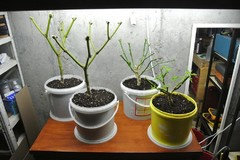
    Here's what I'm talking about, this year's roster:

    kamereone thanked isgen
  • 9 years ago

    There's a guy in San Antonio who let me into his greenhouse full of soil experiments one day. In one area he had three identical plants in 4-inch pots. The only difference between the three plants was the soil they were in. One was Walmart generic potting soil with no additives. He liked to use Walmart soil because anyone should be able to repeat his testing. The other two plants were the same Walmart soil with 10% compost. The plant in the plain soil was covered in aphids. The other two had none. All three plants were pushed together such that the canopies intermingled. Still the aphids were only on the one plant.

    Now this is not a definitive test with enough samples to make a statement, but it might suggest that getting your soil right would help keep the aphids away.

    kamereone thanked dchall_san_antonio
  • 9 years ago

    @dchall - whoa, that's crazy. Interesting concept, I wonder if it's a specific nutrient imbalance or simply the increased rigor of the plant that makes the difference. I'm jealous of whomever you visited who has the time and space to do experiments like that! I'm betting the soil my three are currently in is pretty depleted, so perhaps the fresh substrate will help.

    @isgen - a huge thank you for the photo, exactly what I needed. Best to cut branches above or below nodes? I can never remember...

  • 9 years ago
    last modified: 9 years ago

    kamereone, you're welcome!

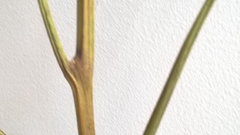
    Branches should be trimmed above nodes as far as I can tell. They are a point where new shoots may grow out. Cutting below a node would just leave a dead branch all the way down to the next node, no real harm, but useless. You can see it in my picture, especially on the two larger Rocotos on the left, where I leave about 1/8"-1/4" of the y-split branches I'm trimming.

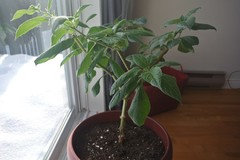
    That above picture was taken sometimes last fall, here's one of these Rocotos about 3 weeks ago. It has gotten even larger since, only on natural light from the east-facing patio door, but then again, Rocotos do well with little light. My Scotch Bonnet was somewhat sorry-looking all winter long in that same spot last year.

  • 9 years ago

    @ dchall & kamereone,

    While I never heard of compost repelling aphids I have read a few of worm castings doing this, here's one.> What Are Worm Castings and Why Are They Beneficial?

    Insect Repellency

    Testing has shown that several microorganisms found in worm castings work as effective repellants for a large array of insects. A key element for insect repellency is the level of chitinase-producing organisms. Chitinase is an enzyme that will dissolve chitin. The exoskeleton of bugs is made of chitin [so obviously they don't want to hang out where their skeletons will get dissolved!]. Bugs have various detection mechanisms to determine the level of chitinase in plants and soil. Once the chitinase level is high enough, they will leave the area. Worm castings test with a very high level of chitinase-producing organisms.

    Also, some elements in worm castings are able to activate the chitinase-producing organisms found inside plants. Once triggered, these organisms multiply to a level that can be detected by the insects. The repellency effectiveness has been tested and confirmed for white fly, aphids, spider mites and various other bugs. Twenty various plants have been tested showing effectiveness. The rate of repellency is in direct relation to the size of the plant. Spider mites will leave houseplants in about 2 weeks, aphids leave roses in about 6 weeks, and white flies will leave full sized hibiscus in about 3 months.

    kamereone thanked the_northeast_chileman
  • 9 years ago

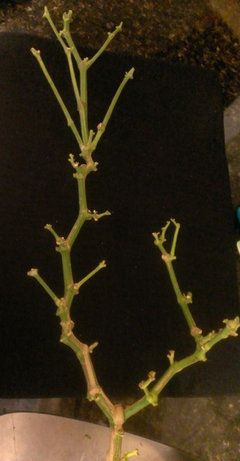
    de-foliage-ation complete! I was surprised to see all three were already shooting out new growth on the tips and sprouts at EVERY joint that I didn't notice / wasn't there when I started this thread. Kinda felt bad trimming it! Should I let the tiny stuff get big enough to remove before dunking? I know aphids like the young stuff and unfurled leaves would be a good hiding place...

    Second question, this bigger guy doesn't have a well defined Y and is woody all the way up to the second ring of the support cage. The lower branches aren't true Y splits but sprouts from trimmed leaf scars. Where do you suggest I trim him back to?

  • 9 years ago

    Everyone is out of their pots, soil wasn't bad at all, but man bad hair days all around. Lots of U-turns to cut out, and little Jiffy grow pod things to work around; gave up and left them there. Decompose, yeah, right! And the big one... I'm pretty sure its stem is tied in a knot somehow. Definitely some strangler issues but I can't get past the darn peat pod thing to tell for sure.

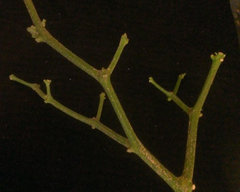
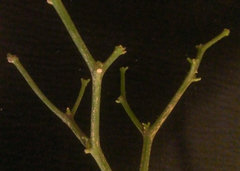
    here are some better shots of the branching now they're out of the pots. Would love some feedback on any additional cuts to make. :)

    subject A upper branches


    subject b


    and our ugly knobby duckling, subject C

  • 9 years ago

    Two months later, the year-old hungarian yellow wax pair are quite happy looking, leafing out and sprouting along the lower stem:


    Removed several bud clusters from the second one, overachiever!

    Unfortunately the two-year-old habanero doesn't look like it's gonna make it. Wasn't looking healthy beneath the aphids before, and since the bathing repotting and pruning, hasn't shown signs of resprouting and it looking a bit dessicated in the upper branches.

    Thinking its time to knock it out of the pot and see how the roots look.


    Thanks for everyone's help with this, not an aphid to be seen!


  • 9 years ago
    last modified: 9 years ago

    and it looking a bit dessicated in the upper branches.

    If you mean -brown/dead- then yes.......

  • 9 years ago

    "Desiccated" was my feeble attempt of hopeful avoidance of the certainty it was dead. Things don't look any more promising now it's out of the pot, so think we're going to have to call it quits on this guy.

    Would be much less reluctant to do so if my new batch of bell peppers would hurry up and sprout already!!

  • 9 years ago

    It's really hard to kill a chile, prune it where you want.

  • 9 years ago

    Hotdamn, willardb3, that's awesome! Was that grown in that teeny hydro basket? Or pruned tops and roots?

  • 9 years ago

    A pea chile grown in hydro and pruned root and branch. I pruned this to control size.

Sponsored