Software
Houzz Logo Print
unclewormy

Need Help With Bin Set-Up

9 years ago
last modified: 9 years ago

Hello All,

I am new here, though not new to worm composting. I've come here today for some advice on a problem I seem to be having with my bin set-up.

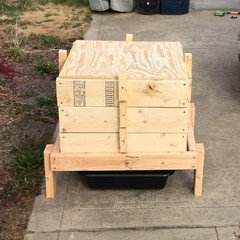
I started about 18 months ago with 2,000 red worms in a 5.5 gal. galvanized tub. That went great until I wanted to harvest the compost, and you know how that goes. So, after some research, I built a three-level vertical flow-through bin, hoping it would make harvesting much easier. I made the boxes from 2x6s with 1/4" hardware mesh on the bottom, and gave it a stand and a plywood lid.

After some time, it seemed like the new bin just wasn't "taking off" the way I had hoped. I had given a friend some worms about the time I made it, and it seemed like the population hadn't bounced back. So, this week, I caught a sale on worms and ordered 2,500 new guys to boost things up. When they came today, I think I found my problem.

After adding the new worms, I went back maybe 20 minutes later and they were crawling out from under the lid and between the boxes. There were already quite a few on the ground nearby. This was not just the random rebellious worm that wants to go rogue, it was really a good many. I don't think it was a matter of them wanting to escape, so much as "getting lost" and then falling out of the bin. I ended up dumping one of the bins out on a tarp and hand picking as many worms as I could back into the galvanized tub for now. I think maybe now I know why my population was down. My bin has too many places to get out!

Not really sure where to go from here, except that I want something that will hold a lot of worms in a reasonably small amount of space, and which will allow me to harvest compost easily. I would prefer to build something myself, as opposed to buying an expensive bin system. Any advice is appreciated.

Thanks!!!

Comments (17)

  • 9 years ago
    last modified: 9 years ago

    Thanks for the response. Here's a few more specifics:

    No treated lumber, just regular pine 2x6s.

    Bedding is peat moss. There are some recent kitchen scraps mixed in.

    I live in NC, zone 7b. I keep my worms in my crawl space (it's pretty tall at the low end of the house). They stay cooler there in the summer, and they're close enough to the furnace to get some extra warmth in winter (but they're not right beside it.)

    I've attached a photo of the bin (from when it was new). Any and all recommendations are welcome. I might go see about getting a clamp light to hang right above it, with an LED bulb so I don't burn my house down.

    Thanks!!!

  • 9 years ago

    How long did you set up the bin before you added the worms?

  • 9 years ago
    last modified: 9 years ago

    This bin had already been in use for about a year now. These worms were just intended to supplement the original population.

  • 9 years ago

    Good suggestion above re exposing the open bin to a light source......that will keep them below the surface. Couple of days should be enough.

    Have you made any major changes in your bedding or feed materials?

    I'm guessing your bin is about 20" x 20".......could the problem be that you have tried to house too many worms in your bin? I think that worms will regulate their own population but if you added 2000 all at one time maybe that was just too many.

    Just try to keep them in the bin using an overhead light - I'd be willing to bet that that will solve your problem.

    Good luck and let us know what happens.

    Harry

  • 9 years ago

    Thanks to everyone for the advice. I picked up a clamp light and hung it right above the bin, and that pretty much quelled their nomad spirits. I was even able to reintroduce the guys I had quarantined in the galvanized bin. I was pretty surprised how fast several hundred worms dug for the bottom of the bin with the light on it. I should have anticipated this, but, looking back, the last time I bought new worms, I was keeping the bin outside, so they pretty well stayed put during the day, and I wouldn't have noticed any that slithered off during the night. Thanks for getting me squared away. My worms, who are now tucked in nice and cozy under their new burlap blanket, nomming on coffee grounds and cornmeal, say, "thank you."

  • 9 years ago

    Good to hear.......sounds like they're settling in a bit. Let us know how things go once you've removed the light source - that will be the real test as to whether the bin conditions are OK.

    Harry

  • 9 years ago

    I see good advice in here.

    Recently I moved my wigglers from an 18 gallon tote to a 30 tote and started using peat moss as bedding. The worms decided they wanted to move out.

    The light trick kept most of them at bay but I still lost a few.

    I added shredded newspaper to the bin on the 3rd day of their migration attempt and it seem to satisfy them. No more problems after that,

    I suppose they just needed a place to roam.

  • 9 years ago
    last modified: 9 years ago

    I don't suppose this is a big deal but.... I use coco coir for my base bedding and add shredded newspaper/cardboard on top as needed. My reasoning is that I believe worms prefer pH in a higher range than peat gives it (4.7 to 5.2 for peat). You never see worms in a pine forest or amongst the oak leaf litter... I'm sure its because the pH conditions are not favorable to their "lifestyle" and low pH means low calcium in the soil... (as worms will require a calcium source in order to make the liquid calcium carbonate necessary for them to add to their food digest.) From my own observation worms seem to really like pH around 7.0 and above with lots of available calcium. Coco coir has a pH near 7.0 thus that is what I used for my base bedding and I'm always adding eggshells. If I were to use peat I would add lime to it to raise both the pH and calcium content of the bedding. Just a thought...

  • 9 years ago

    yes you are right, I started out just using shredded newspaper and cardboard mix in the beginning. They didn't seem to mind. When I changed bins i added the moist peat and I did treat it with some lime

    .I let it sit around 3 days before using. I placed wet newspaper sheet over the top of the peat after the worms went down . It seem to me they just got used to the newspaper in the bin. When I put it back in they stopped trying to get out.

    To be honest I think they really don;t care what they live in as long as it is moist and they have a food source.. I also think they get used to a certain life style so to speak., When I removed the shredded paper they did not like it.

    I never have used the eggshells, they seem to do fine without them.

    One thing I have done lately as a experiment is add finished compost to the bin from my outdoor compost pile. . They love the stuff!

    This may sound crazy but I have never messed with the ph at all. I figure that they don't have anyone in nature to test it, I figure they will regulate it there self..They are going on 3 years now and seem to be happy.

  • 9 years ago

    In the bin instruction it says any time introducing new guys leave the light on for 3 days.....


    As you can see I'm reading out the instructions so I'm new also,I have 5 tier bought plastic system.... I'm on box 2 but I'm starting to wonder am I putting to much card board newspaper, should it be damp or dry....


    What's there main type scraps.... Maybe I should tell what I get...I get Alot banana peels,egg shells, celery, tea bags, straw berry ends, veggie scraps things like that.... Is these things to wet to just add or should I add lil carbon with it every time an should it be dry or wet... Lol I've got so many questions after I've got started....


    I always chop my stuff up rather small no matter what to speed up production,I got 1000 next day then another 1000 week later or they sent me two 2000s OK thanks if any one can help this is my first time posting

  • 9 years ago
    last modified: 9 years ago

    Jim... How old is your bin? It seems to take a while for a new bin to get up to speed and balance out. The scraps you are feeding them are appropriate however... the worms will need bacteria to get things going before they can fully appreciate the food items you deposit into the bin... so give it time and try not to get too far ahead food-wise of what the worms can keep up with.

    and Jim... welcome to the forum.

  • 9 years ago

    I also have a tier system and everything that goes in the bin should be moist. There is no way for us to know how much food scraps you are putting in , but there is such a thing as putting in too much for the amount of worms and the space provided. If there is a way for you to speed things up by making a slurry out of your food it will help the decomposition.

  • 9 years ago

    Thanks for the help my bin is around a month old...I just added the second tier.... Maybe someone could take pictures of there feeding tray, this will kinda get what I'm trying to figure out...


    I guess mainly when you start adding all the things I'm adding sprinkled everywhere, then starts making almost thick layer...I always add some cardboard and paper pieces pretty much any time I add wet veggies or fruits.... Thanks for the help.

    I add around 4 egg shells every couple days.... Banana peels around 2 every other day, spinach lightly, whole oats dry, few raw noodles and rice (lady at place told me to,I asked cooked she said no)... Few celery sticks every couple days... Am I on the right track...


    I guess if I was to wet I would get liquid out the spigot and I'm not.... But feels damp but not wet...


    That's another thing if I lift the entire thing up and tiny pile castings have fell through and couple worms should I move them back to top tray....I already have activity in my new feeding tray...

    I never get any that try to escape, but I always use the damp paper as my instructions says to, occasionally there 3-4 worms on top of the moist paper....


    Thanks for info please help me thanks again

  • 9 years ago
    last modified: 9 years ago

    My set-up is not like yours... I use homemade bins built from plastic storage totes, however feeding should be similar so... be careful there as it is not a good idea to sprinkle the food everywhere... it is better to feed in one location just in case something bad develops then the worms will have the rest of the bin to escape to. Depending upon what you are feeding and the amount it could become too hot, or develop concentrations of ammonia or an alcohol build-up, a plague of mites, etc... in all these cases the condition is only temporary and will resolved naturally at which time the worms will return to the area and continue feeding. Once worms are happily feeding in the area, only then switch to a new location to deposit "fresh" food. If you scatter it everywhere in the bin the worms will not have a safe place to retreat to if conditions should turn unfavorable and it could end up becoming a crisis for the worms stuck in it.

    You should strive for a bin with damp bedding throughout... if you are going to error just remember worms can survive even underwater as long as there is oxygen dissolved in the water however worms cannot live for long if its too dry (anything below 50% moisture). If in doubt, adding a little more moisture is the better choice.

  • 9 years ago

    OK I only read a sec BC my instructions apparently must be way different then yours...


    BC I'm using the tier system we would never be able to add another tier if we wasn't adding food everywhere after first week or so..... Think about it for min.... The way our tier stack is setting evenly on top the old food tray (then this becomes processing tray and you stick new food tray on top and they process lower ones completely while you add more to top...


    If you was only adding in the one corner like in the beginning, then the trays wouldn't sit level, they would say lol sided

  • 9 years ago

    It's the upward migration system

Sponsored
Bella Casa LLC
Average rating: 5 out of 5 stars17 Reviews
The Leading Interior Design Studio in Franklin County