Software
Houzz Logo Print
rouge21_gw

Colorful non foo foos

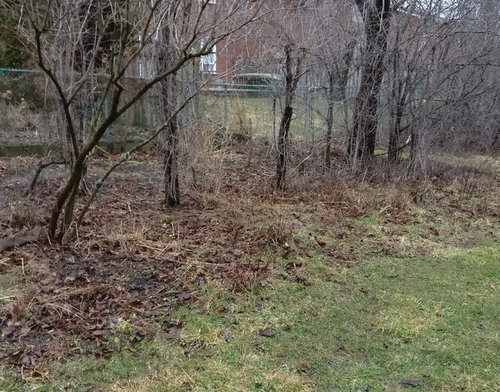
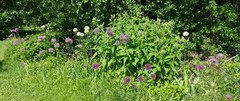
The area in question (10' by 30') is for all intents purposes...wild.

THE SETTING:

It receives 6 hours of sun each day (the area outlined by leaf litter,, this side of the trees). It will receive no supplemental water and no soil amendments. As well it is not and will not be weeded. And to cap it off, there is a deer presence.

In the spring it is very pretty with lots of daffs, forget me nots and then later the alliums.

But in the summer the lack of rain and encroaching weeds makes it problematic for desired perennial flowers to thrive.

I am looking for 'interesting' long blooming, very hardy perennials that will provide a variety of colour through what is usually now dry summers.

(I know I could plant something like "Goldsturm" but I am looking for more...'interesting' ;))


Comments (38)

  • 9 years ago

    My garden beds are laid out to make the most of whatever Ma Nature doles out in terms of moisture & soil. I do supplement my garden beds with layers of corrugated cardboard topped with pine bark mulch to retain moisture & suppress weeds. My Hellebores/Lenten roses start blooming early (they're blooming now) and seem to do well in my slightly acidic sandy loam. I do grow rudbeckia varieties and they're also apparently happy in my light/soil conditions.

    I love my false Solomon's seal since it offers textural contrast to other early-season bloomers. Alchemilla mollis/Ladie's mantle seems happy wherever I plant it as does astilbe, Carex 'Ice Dance,' and St. John's wort. One surprise was Stokesia laevis/Stokes aster. I winter sowed seeds and am amazed at how prolific they are in my growing conditions.

    rouge21_gw (CDN Z5b/6a) thanked gardenweed_z6a
  • 9 years ago

    I sowed colonising annuals and biennials such as hesperis, lunaria, foxglove, campion, betony, verbascum. asters, carex. many hellebores, especially our native h.foetidus, agree with alchemilla and also the little yellow agrimony, geranium sylvaticum and g.phaeum, amsonia, numerous anemones (leveleii, rivularis, barbata, multifida, ranunculous aconitifolius, various malva, pimpinella, cenolophium denudata, angelica sylvestris, echium vulgaris, hypericum perfoliatum, primula vulgaris, sanguisorba, helianthus diviricata, salvia forskaoli, salvia stolonifera, phlox subulata and p.stolonifera, heuchera and tiarella, various ferns(polypodies and asplenium), martagon lilies...and so on.

  • 9 years ago

    Morning sun or hot afternoon sun? Makes a big difference in terms of what you can grow.

    rouge21_gw (CDN Z5b/6a) thanked laceyvail 6A, WV
  • 9 years ago
    last modified: 9 years ago

    It is silly that I ask for planting suggestions w/o providing more information and so hopefully much further narrowing down the options.

    Some of the trees/tall shrubs that are pictured are the invasive common "Buckthorn". In the Fall they dropped their small black berries and the offspring are quite prolific and almost impossible to pull out by hand unless gotten early enough in their development.

    These "Buckthorn" seem to make the immediate area drier than might otherwise be the case.

    So mostly I can only cut back these small saplings using pruning shears.

    As I have alluded to in the past this area is just beyond our own property. That is it is town land which borders homes and a public park. And so whenever I add plant stock to this small area of public land ("guerrilla gardening") I try to do it surreptitiously. And what I add I don't want it to look too much out of place. For example I wouldn't include any....David Austen roses...you get the idea.

    So I am looking for just a few very hardy perennials to plant which will naturalize and so can compete with little help from me. One I think good example might be triloba; wonderful late summer and early fall colour and it easily propagates on its own.

    Thanks again for your ideas.

  • 9 years ago

    laceyvail, it is in sun from about 9 till 3 or so.

  • 9 years ago

    Buckthorn seedlings are indeed a PITA! They were a big problem here initially because the neighbour behind us had let many grow along the back fence. It took me several years but I finally convinced him to get rid of them because they are on the Ontario Noxious Weeds list. Your town should let you remove them - or do it for you! Have you asked about that? The seeds do last a long time in the soil - plus birds constantly drop in new ones... But getting rid of the trees keeps the problem to a manageable level. A walk around the garden every day or two, looking for tree seedlings, is the easiest way I've found to get rid of the seedlings before they've rooted themselves too deeply!

    Do you remember the pictures I've posted in the past of the 'guerrilla gardens' along the lakefront path near here? For some reason last year the town got huffy about them and ripped them out! So it might indeed be a good idea to keep the plantings as native and natural as possible. Perhaps focus on native smaller trees and shrubs such as serviceberries, dogwood and such. Perhaps, if you contacted the town re removal of the buckthorn you could talk to them about replacement plants - maybe they'd even provide them and officially allow you to plant and maintain them.

  • 9 years ago

    anything that self reseeds .. that you already have.. i would just throw seed overthere .... i know.. you asked perennials .... deal with it .. lol ...


    calendula.. poppy.. delphinium/larkspur ... etc ...


    in the meantime.. you can try your perens...


    is this your yard.. if so.. im a bit stunned ....


    ken

  • 9 years ago

    Not at all unlike my wood...so I went with the' throw everything at it and see what survives', method. As long as various seedy bullies are sown at the same time (silene, foxglove, honesty, forget-me-not etc...) it is fairly easy to cover a fair bit of ground in a vague equilibrium...and once you have things you want, there is no room for the continual weedy invasions. I am looking for plants which have a really good foliage presence - not caring how attractive it looks but how ground covering...so foxgloves for example, with huge hairy rosettes have been an excellent choice...and hesperis also.It is true, they are thuggish plants but entirely apt in a wild area.

    rouge21_gw (CDN Z5b/6a) thanked User
  • 9 years ago
    last modified: 9 years ago

    woodyoak wrote:

    For some reason last year the town got huffy about them and ripped them out! So it might indeed be a good idea to keep the plantings as native and natural as possible.

    'woody', I started this particular "guerrilla garden" in about 2011 and never once has the town made mention of it. The parks and rec people cut the grass right up to it every couple of weeks in the summer. I realize that all it would take is a resident to complain and that would put the kibosh to my adventure. it...but nothing in 6 years. (Over that time there have been people come by in the cover of darkness to dig out some perennials and attempt to snap off allium blooms (almost impossible to do w/o destroying the stem and all)).

    Many of the photos I post on GW come from this 'off limits' area. (I hope this isn't an example of "alternative facts" when I claim these are my own plants when they are not on my own property ;)).

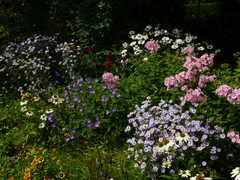
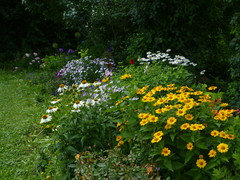
    Here are a couple of shots of this exact space from 2013 and 2014:

    The last two summers have been terrible for this plot. Lack of rain and encroaching extra vigorous weeds have led to many losses of plants that I would have thought could compete. I don't resent at all the time I have spent back here...love it but I have spent too much monies replacing perennials that can't cut it....hence my appeal to you for the hardiest ones to put in and so more or less be done with it.

  • 9 years ago

    The gardens along the lake that got ripped out had been there for 10-15 years in a lot of cases.... It does indeed take just one complaint from somebody - the town staff mowed the grass there regularly with no problems. Many residents were very upset with the town, but there was nothing to be done once they had been ripped out....

    I think there's a good chance you could do 'a guilt trip' on your town - play the righteous homeowner being concerned to find the town growing noxious weeds on their property - especially as they are seeding into your garden... Then be very upbeat and positive in wanting to assist the town if they 'do the right thing' and remove the weed trees and replace them with more acceptable natives or ornamentals. Suggest that, as an avid gardener, you'd love to participate in working with the town's arboriculture/horticultural staff to enhance the area. I'd guess you'd have a good chance at being able to shape/plant the area in a way that pleases you. Nothing ventured, nothing gained....

    rouge21_gw (CDN Z5b/6a) thanked woodyoak zone 5 southern Ont., Canada
  • 9 years ago

    How about good ole common milkweed - you know, save the monarchs and all?

    rouge21_gw (CDN Z5b/6a) thanked LaLennoxa 6a/b Hamilton ON
  • 9 years ago

    If it's any help, pliers help with the pulling of young buckthorn.

    Great idea. Thank you.

  • 9 years ago

    is this your yard.. if so.. im a bit stunned ....

    ??

    (As mentioned it isnt my yard).

  • 9 years ago

    But it is your plantings, Rouge, and it is stunning!

  • 9 years ago
    last modified: 9 years ago

    Thank for sure NHBabs. I was spoiled by those two seasons and thought 'it' would run like clockwork each year but Mother Nature can be fickle as in the last 2 seasons 'it' was pathetic.

  • 9 years ago

    NHBabs, I was out in the back with a pair of pliers and as you suggested it worked...worked brilliantly! (It is scary the extent of the root system on even very small saplings). I will now have pliers at the ready along with my much more traditional garden tools

  • 9 years ago

    It sure is easier on the hands to grab pliers vs. pulling by hand. In areas of loose woodland soil I can pull out ones as tall as I am, but my soil isn't clay-based like yours.

  • 9 years ago

    Vice-grips are handy for pulling things too because you can 'lock' them around the stem - DH uses them a fair bit.

  • 9 years ago

    UPDATE:

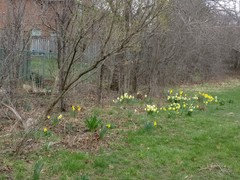
    Here is the same location 5 weeks later:

  • 9 years ago

    NHBabs, I want to thank you again for suggesting the use of pliers to remove the smaller seedlings...so helpful. It is particularly useful this time of year when the ground is still moist and so the pliers are even more effective.

  • 9 years ago

    Don't forget that echinacea are very hardy and native plants in some areas of the U.S. (don't know about Canada). I have seen some highways that have been landscaped with echinacea. Once established they are drought tolerant. They are also deer resistant.

  • 9 years ago
    last modified: 9 years ago

    A few other suggestions, Asclepias, columbine, goldenrod (Firecracker would be gorgeous massed), silphium laccinqtum, Culver's root, bloodroot

  • 9 years ago

    Don't forget that echinacea are very hardy

    I agree completely except on my property my previously wonderful coneflowers were infected with "asters yellow" or "sunflower moth larvae". I now have no coneflowers in our garden...a shame...maybe I will try again this summer.

  • 9 years ago

    "Culvers Root" is one of my favorites...thanks for reminding me that it might do well in this untended area.

  • 9 years ago

    do bluebells grow in your area??? That looks like a perfect place for them.

  • 9 years ago

    If you don't mind wanton self-seeding, Agastache foeniculum is tough as nails for me. The bees love it, and so do the goldfinches.

  • 9 years ago

    Aster yellows certainly makes coneflowers less attractive. If a few years have passed it might be worth trying again. I think leaf hoppers were thought to have contributed to spreading aster yellows.

    blue vervain, wild bergamot, geum avens, tiarella, pearly everlasting, wild shrub roses,

  • 9 years ago

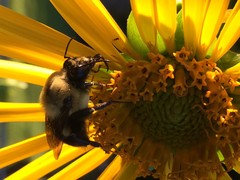
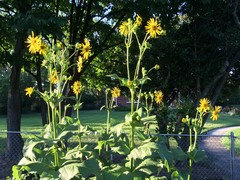
    Have you considered any silphiums? My cup plants are huge (8'), look awesome, and I don't do anything. S. Perforlatum or something like that.

  • 9 years ago
    last modified: 9 years ago

    Cool looking plant 'matt'. Any pictures of yours you could share?

  • 9 years ago

    Another thanks for the pliers suggestion!

    Something that will compete (and may want to take over) is Rudbeckia laciniata if you're OK with the height. I grow it in my guerilla garden. Monarda is another GG favorite, but Raspberry Wine and Jacob Cline are the only two I've found that really compete (the wild version did not). My GG gets no supplemental water, but yours may be drier, so not sure how monarda would do for you.

    Hesperis, ditch lilies (although the deer eat these), and chelone are other good survivors. (The deer sometimes eat the chelone blooms though.)

    I tossed hellebore seeds in the GG last year and see a lot of sprouts. Persicaria Painter's Pallet grows well there, although probably not the "colorful" you're looking for. Campanula glomerata is another possibility.

    rouge21_gw (CDN Z5b/6a) thanked ruth_mi
  • 9 years ago

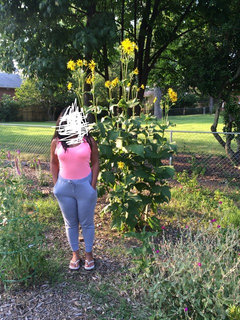
    Sure here's some pix of the cup plant taken July 2016. I planted it as a 1 gallon plant in 2015 and did NOTHING other than a few initial waterings. I was so happy with it I got 2 more planted next to it which I expect to flower this summer.


    (My now ex-wife is about 5'2")

  • 9 years ago

    That is the first pic I recall being posted to this forum with a face 'scratched out'!

  • 9 years ago

    I have a bunch of seeds of this (sliphium perfoliatum) if you would like to add this plant. I still think milkweed would be a great addition; actually the two together would be a great pollinator combination!

  • 7 years ago


  • 7 years ago

    Just one suggestion for an easy VERY self-seeding perennial that has been doing very well in my gardens, also good for pollinators, is a very tall blue salvia, Salvia transsylvanica 'Blue Cloud'. It has done very well in dry conditions (last summer was DRY) and I'm finding so many seedlings that last year I cut off the blooms before they could set seed. It's not your normal salvia. Very tall at 3', more airy, but nice. Seems to do well with the 6 hours of sun. I grew mine from seeds via Swallowtail Seeds.

  • 7 years ago

    Obedient plant; ditch lilies

  • 7 years ago

    Rouge maybe try what has reseeded heavily here for me. Cleome an Datura...both carefree!