Software
Houzz Logo Print
kamereone

Brom leaves browning from edges, any ideas?

9 years ago
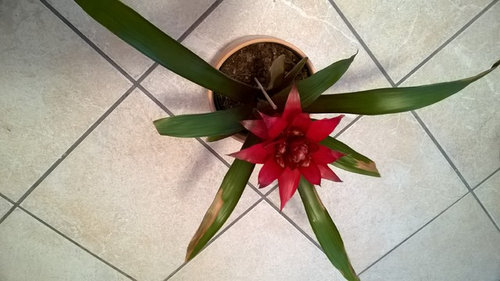
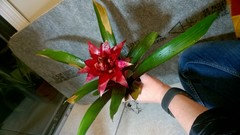
Got this guy off the uglies rack at the big box hardware store, lower leaves were all browned and dehydrated to a crisp, I assumed because it (and all the others) was dry as a bone. Took it home, trimmed off all the dead stuff... And a month later the same sort of crispy dry has been creeping in from the edges of the leaves. Doesn't seem to be restricted to the oldest/lowest/outer leaves, as there are some leaves totally unaffected outside/lower than affected ones.

No sign of pests. Ambient temp between 60-65, house humidity tops out around 35%, which I know isn't optimal (it's 12* F right now... You bet the heat is running!) but its in a mini-greenhouse, lots of water trays in there, I mist, keep the potting mix slightly damp, and fill/rinse the cup weekly. I have not repotted (read they weren't fond of it) but the medium looks to be along the lines of what I see sold as an 'Orchid Mix'.

This is my first Brom, so its new territory for me. The closest I can think of is how spider plants get brown tips if they're watered with tap water that's not aged... But this isn't just the tips, actually some tips are still green with the brown further up!

Any thoughts ideas or advice would be greatly appreciated!

Comments (17)

  • 9 years ago

    Be aware that as the bloom fades the leaves will all die off and the original plant will be replaced by new pups. Also check the potting soil it is in. It looks very peaty and may hold moisture too long. Broms like a very loose, free draining mix.

    tj

  • 9 years ago

    Hi. The orchid mix is proper since bromeliads largely don't grow in soil but attached to other plants.

    When you water, do you water the medium? The need water ON THE LEAVES vs the roots as they absorb moisture and nutrients from the foliage, especially the central tank in the center. I suggest you keep the tank 1/4 to 1/2 full and change the water every few days.

    As for spraying, that would be great as they like moisture and humidity.

    Another possibility is that your guzmania is dying. Bromeliads are monocarpic--meaning the lifecylce of these plants entail them to bloom, die, then produce offsets to continue the cycle. So this may simply be it.

  • 9 years ago

    Hi everyone.

    Jayvee - That's good advice you've given, especially the fact that bromeliads are monocarpic; unfortunately, I sometimes tend to overlook the obvious.

    Regarding the watering; as I don't live where I have to grow plants inside I'm not familiar with indoor culture so really can't give experienced based advice on watering plants inside, except to say that it's best to take them outside and water them there if possible..

    Growing outside is different story as you can splash plenty of water around with no problems. I always water the "whole plant" from overhead; including the underside of the foliage, (many insects like this drier part of the plant for breeding, and watering this area will act as a good deterrent).

    As I said I water the whole plant including the potting mix which I water until the water runs right through and out the bottom of the pot. The main thing is not to "over water"; over-watering is not caused by the volume of water given, but by the frequency that it's given, and the old nurseryman's rule was that if in doubt as to whether the plant needs watering or not, leave it for another day or two rather than risk over-watering.

    Remember that in nature these plants are growing on trees (as mentioned by Jayvee) and it doesn't matter how much water they get as they dry out quickly due to the abundant air circulation. This is not the case with pot grown plants and it's up to us to assess when watering is required. This is an observation that only comes with time and practice, but one of the best guides is the weight of the plant and pot. With practice you will soon be able to judge by the weight if the plant needs watering or not.

    The other very important thing I omitted to say in my previous post is to NEVER let a plant sit in saucer of water as this is a recipe for disaster in the form of ROT. You are best with a deeper saucer with very coarse gravel in the bottom so that the plant sits up on the gravel and not in the water. Any water in the saucer will provide extra humidity which is beneficial as it's usually lacking with inside-grown plants.

    All the best, Nev.

    kamereone thanked splinter1804
  • 9 years ago

    Hmm. Well given it is blooming, it is reaching the end of it's life cycle of blooming and death, which gives rise to pups.

    However, maybe it is in too much sun? It needs dappled sun, bright but not direct. Guzmanias like bright filtered sun, unlike Neoregelias which can do almost full sun.

  • 9 years ago

    WOW. You guys are awesome, that is a ton of great information! THANK YOU! I'm going to follow splinter1804's suggestion and unpot, trim back dead roots, and give it a good soak, since it definitely sounds like I'm dealing with a dehydration issue.

    The method for remedying too-moist roots sounds great too - I don't know why I never thought of just letting soggy roots "air out" - it sounds like the same concept as letting a cutting "scab over" before attempting to root it. I'm certain it's a technique I'll find use for!

  • 9 years ago
    last modified: 9 years ago


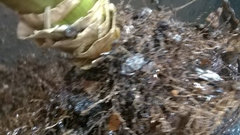
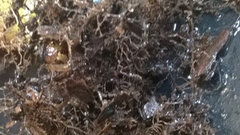
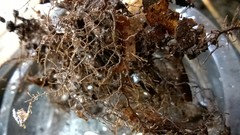
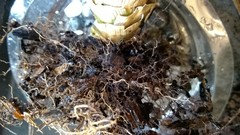
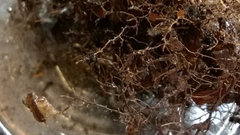
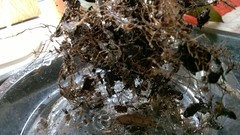
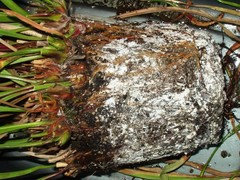
    Well we're out of the pot, some finer particles than I was expecting in the potting medium, and some compaction at the bottom. Thinking I'll dry out the mix a bit and sift out some of the real fine stuff.

    None of the roots were brittle enough to break off, but I'm sure some sections are dead as they were at the surface.


    Otherwise not too sure what I'm looking at... Input greatly appreciated :)


    edit: Better photos...


  • 9 years ago

    Hi everyone.

    Kamereone – I’m not quite sure as the pictures are a bit
    small to see the finer detail, however I’m seeing small areas of white
    speckling which may or may not suggest an insect pest called “Root Mealy Bug”.
    As I say, I can’t be positive as the detail isn’t clear enough. If it is Root Mealy Bug, it's only a very slight infestation.

    What cause me to suspect this is, that plants grown indoors seem more prone to this pest probably because the environment is drier than it is outside and these inspects thrive in a dry environment.

    When you took the plant from the pot was there a whitish fine
    web like substance on parts of the inside of the pot? If so, this confirms that
    you do have Root Mealy Bug.

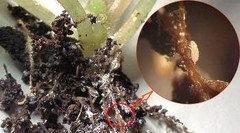
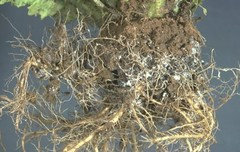
    Below are some pictures of root mealy bug infestations which you can use for identification purposes.

    ROOT MEALY BUG SHOWIUNG A CLOSE-UP OF INDIVIDUAL INSECT

    AN EXAMPLE OF A SLIGHT INFESTATION

    TWO EXAMPLES OF SEVERE INFESTATIONS

    If you do have Root Mealy Bug, it isn’t the end of the world (or the plant);
    just clean as much of the old potting mixture as possible away from the roots
    and mix up a bucket full of a good quality contact/systemic insecticide
    suitable for killing this pest and immerse the whole plant for an hour or two, then remove and allow to air dry and leave overnight before re-potting.

    I find this more effective than spraying because:

    (1) I don’t like spraying toxic chemicals around where
    the spray drift may get on things where it’s not wanted and cause further
    damage. e.g. good insects, birds, lizards, fish ponds etc.

    (2) Unless you spray the whole plant thoroughly including
    the roots and the foliage (including under-side of the leaves), you can’t be
    sure of a good penetration especially around the roots. By immersion, you reach
    all parts of the plant without contaminating surrounding areas.

    (3) Spraying certain insecticides have been associated
    with the killing of the honey bee population in some parts of the world;
    admittedly this is mainly from aerial spraying, however it can still be harmful
    to bees and good insects when sprayed indiscriminately around the home garden
    as well.

    I don’t know what insecticides are available in your country
    but below are two which are widely used by home gardeners here in Australia and
    both are effective against Root Mealy Bug when used as directed.

    CONFIDOR, is an effective systemic spray but contains IMIDACLOPRID
    which is fatal to bees - http://www.yates.com.au/products/pest-control/insects-ready-to-use/bayer-confidor-insecticide-ready-to-use/#YYLgOq1wEwlk8qzA.97

    MAXGUARD – is a three-way spray; it is systemic, contact
    and residual and is made up of different ingredients than Confidor and is not a not a scheduled poison.

    https://www.scottsaustralia.com.au/scotts-brands/defender/defender-pest-control-garden/defender-maxguard-insecticide/#Features3301

    Remember to always use insecticides as directed and with extreme caution and always wear the necessary protective equipment.

    All the best, Nev.


    kamereone thanked splinter1804
  • 9 years ago
    last modified: 9 years ago

    Gotta love tech, had a whole post with pictures written and the page refreshes and POOF! all gone...

    No evidence of mealy bugs, so I'm going ahead with the rehydration bath splinter1804 outlined above, though I'm not certain of an appropriate sugar:water ratio, so I went on what I think is the low side (~2tsp:gal), though I can't imagine a super crazy high concentration would cause any harm?


    edit: NM on the concentration, it was covered and I missed it, "soaking in a bucket of water to which a cup of sugar has been dissolved."

    though I've come to realize I may need a different clarification... Is the bath roots and all, or foliage only? I assumed the former, but now I'm conflicted due to the implication it can be left submerged for quite a while ("It can stay in this state for a couple of days") which seems a lot like the forbidden roots-in-standing-water. I'm guessing this is one of those fine line situations, swimming is ok until hydration is achieved, and then its time to get out of the pool?


  • 9 years ago

    On the topic of mealy bugs, while I'm pretty sure that's not an issue in this case (no webbyness in the pot, etc), I believe I've seen similar before on houseplants while visiting family; on orchids, some succulents, and walking iris IIRC. I've seen some of those "spikes" that supposedly are just stick-and-forget and claim to address mealy bugs - any experience with those?

  • 9 years ago

    Hi everyone.

    Kamereone - Regarding the treatment of de-hydrated plants
    using the sugar and water method. I soak the whole plant (or as much of it as
    possible).

    As plants absorb moisture through their roots and leaves
    alike, it stands to reason the more of the plant that can be soaked the quicker
    the fluid will be absorbed. Usually I soak the whole plant, but with tall
    plants where they whole plant won’t fit in the bucket, I place as much of the
    lower half as possible in the mixture and fill the centre well of the plant
    with the mixture as well as occasionally taking the plant out and inverting it
    so that I can dunk the upper foliage as well.

    The ratio quantities of sugar to water aren’t critical
    nor is the amount of time immersed, but I like to keep them soaking for at
    least 2 -24 hours (or even up to a couple of days) depending on how severely
    dehydrated they are. Usually the plants I’ve treated were plants that came in
    the post and they had been wrapped in newspaper and packed in a box for several
    days; in one case, a little over two weeks when the parcel went astray, and
    even those plants after a couple of days of this treatment responded well and
    after a week or two you would never have known they had been severely
    dehydrated.

    When the plants first arrive and were unwrapped, they
    look a bit like a butterfly when it first comes out of its cocoon; all squashed
    up and wrinkled. After an hour or two in the mixture the wrinkles seem to
    gradually disappear as the leaves straighten themselves out again and return to
    their normal shape; again the comparison with the butterfly fresh out of its
    cocoon is a good example.

    You mention those, "spikes that supposedly are just
    stick-and-forget and claim to address Mealy Bugs”, I’ve never seen or heard of
    them here. But I did read where as an alternative to toxic chemicals, you can
    sprinkle “Fossil Flour” (Diatomaceous earth) on the top of your potting mix and
    water it in and it will kill Root Mealy Bug.

    I did a trial with this last year when I found a plant
    with Root Mealy Bug after knocking it out of the pot in preparation for
    dividing and re-potting. I cleaned off as much of the potting mix that I could
    and removed about half of the roots that were covered in the root Mealy Bugs
    and re-potted in fresh potting mix and new potI sprinkled about ½ teaspoon of Fossil Flour over the top
    of the potting mix (it was a five inch pot and as the fossil flour is very fine
    you don’t need very much, just a dusting) and then added a topping of fresh mix
    and watered in well.

    When the plant was knocked out of the pot again after six
    months, there was no sign of any active root Mealy Bug (even under a
    microscope) and I was so pleased to have found a natural insecticide that didn’t
    harm other insects, It’s now become part of my normal re-potting routine and I use
    it on every plant I re-pot as a preventative.

    To read more about this natural product, go to : https://en.wikipedia.org/wiki/Diatomaceous_earth

    CAUTION: As
    it’s a very fine powder you should take the same precautions you would when
    using any other dusty products and wear a dust mask with an appropriate filter to
    prevent inhaling this powder.

    All the best, Nev.

  • 9 years ago

    (pardon the brevity, I'm about to scream at the internet, typed a response here TWICE with photos to have them vanish...)

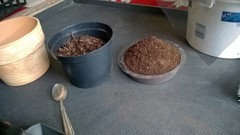
    brom bathed. potting medium sifted through window screen. Photos hopefully explain themselves.


    hitting submit and crossing my fingers!!

  • 9 years ago

    Kamereone – I’ve had posts get swallowed up on me so many
    times when posting on various forums it almost drove me mad. What I do now is
    type my message in M.S. Word and then when it’s finished I just cut and paste
    to the forum, that way if the forum “eats it” you still have it and don’t have
    to type it all over again.

    Now back to the main topic; I can follow what you are doing
    OK but my question is, “Why are you sifting the old potting mix?” I hope you
    don’t intend re-using it for your bromeliads, because this isn’t a very good
    idea as any disease, Root Mealy Bug or other harmful insect eggs etc. will just
    be passed on the plant that’s potted in it. If you suspect a problem with any
    plant, definitely don’t re-use the same potting mix.

    It seems OK to re-cycle it and dig it into the garden although
    in theory, the same thing could happen. However I know many growers who do this
    on a regular basis and they don’t have any problems, perhaps because it’s going
    into another area and another micro-climate which may eliminate these problems,
    but I don’t know for sure.

    There is of course another line of thought followed by many
    of my orchid growing friends and that is, if the plant is in good health and
    growing well, they often mix in part of the old potting mix with the new as
    they say this has all the good bacteria and by doing this you are giving these
    bacteria a “kick start” to build up in the new potting mix. I don’t practice
    this method myself so I can’t advise from experience. But I definitely wouldn’t
    re-use your old potting mix.

    All the best, Nev.

    kamereone thanked splinter1804
  • 9 years ago

    I'll admit to being a slacker in the reuse regard... Most times I'll sun bake soil till it's so dry it won't condensate in a plastic bag if left in the sun, and that (knock on wood) seems to have been working out.

    Of course don't have that option this time of year, and while I considered putting it on the dehydrator or in the oven, I was getting antsy about soaking too long or leaving in the open air, so both those thoughts flew from my mind and I repotted in the (un baked) old stuff yesterday. Oops.

    And I now am just remembering that there's a half-bag of orchid mix in the barn from back when Gran was around and still able to fuss with plants.

    Which is worse, reusing mix, or using mix from a bag that's been sitting for who-knows-how-long among other bags of soils, mulches, and seed in a moist barn and has probably been visited (or inhabited!) by mice? Maybe it's stayed continuously dry and unmolested; still old and potentially exposed to whatever grew on other bags. Hmm.

    Yeah, yeah, I know... Suck it up and go buy new stuff...

    Thanks for the reminder on the perils of reusing mix!

  • 9 years ago

    Old unused mix should be fine but look at the mix. Many orchid or succulent mixes are still too peaty and need to be mixed with extra perlite.

    tj

    kamereone thanked tsugajunkie z5 SE WI ♱
  • 9 years ago

    Hi everyone.

    Kamereone - Just to add to tsugajunkie's comment above about old unused potting mixes; because many are organic and contain natural fertilisers, they will break down naturally even though they aren't supporting a plant, so it's pretty important to know just how old it is, because if it's too old there will be insufficient nourishment left to adequately support a plant. Also because these old mixes are dried out, they are hard to satisfactorily re-hydrate again. Also beware of breathing the dust!

    All the best, Nev.

    kamereone thanked splinter1804
  • 9 years ago

    How does one determine if a mix is "too peaty" - is sitting out the fines a sufficient solution?

Sponsored
Bella Casa LLC
Average rating: 5 out of 5 stars17 Reviews
The Leading Interior Design Studio in Franklin County