Software
Houzz Logo Print
bob_brooks100

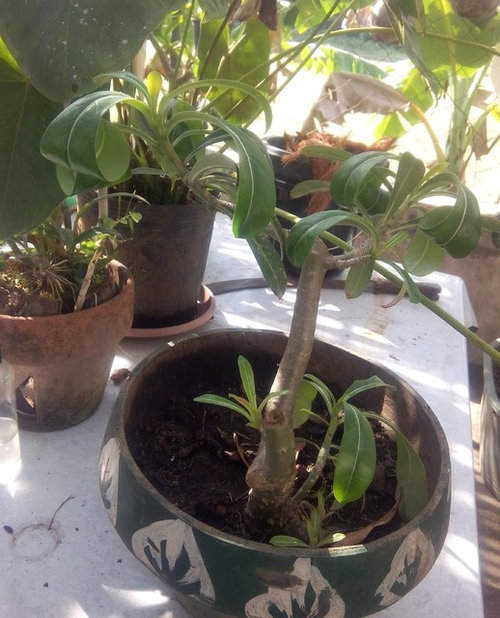
Need help with my adenium plant.

9 years ago
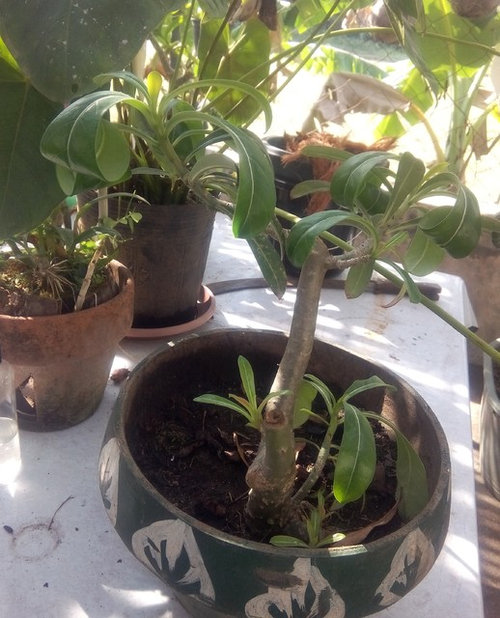

The leaves on my plant have started curling under. I have had this plant for about 3 years. I have a photo but do not see how to upload to this site. email is
2dumbdog@gmail.com.
Thank you for any help.
bob

ps I figured out how to post the photos.

Comments (19)

  • 9 years ago

    Is it a grafted plant? Where are those sprouts springing from at the base of the plant? If it is grafted, and those are below the graft mark, they will be from the stock plant which are usually not too interesting, the best flowers would be from above the graft point from the part called the scion and should be superior to those below. Perhaps some more pics from different angles would help us decide......

    Gill

    Bob Brooks thanked greenclaws UK, Zone 8a
  • 9 years ago

    Thank you for the advice. I will provide more content on my User name.

    The pot is what it came in. I did not purchase the plant I found it in the yard of the house I am renting. I noticed the flowers were nice and lasted a long time, so I started caring for it. Since I have found a couple more plants in a local nursery and have started more plants from cuttings from those plants. I am trying to learn about adeniums as they are beautiful plants.


    The soil is an issue here. I live in western Luzon Philippines. I have not found a place to buy either perlite or potting mix locally. I have even looked on the internet and found small amounts for a high price plus shipping. What the local nursery's do is make a mixture of rice husk and soil, looks like mostly rice husk. I have not re-potted any of the plants yet. I am planning on making a mixture of rice husk, coconut core (husk) with river sand and some animal fertalizer. not sure of the ratios yet. I just harvested for seed pods from a plant I purchased and would like to try starting some of those. Wrapped the pods in netting and waited for them to split. I will try and see how many germinate.

    Again thank you for you friendly responses.

    bob

  • 9 years ago

    Welcome aboard, Bob! Glad to have you join us. I'd look around at your gravel and landscaping options. Any lava rock pebbles maybe? Tufa? If need be you could probably mix some of the local soil and rice husk option with some sharp sand, small gravel, bark, and natural charcoal which if need be you can make yourself and break up with a hammer. Small bits of shell could even be added to keep the PH stable. The bottom of your pots can be layered with broken pottery pieces, gravel, or even packing peanuts (don't laugh, it works) to assure drainage.

    Bob Brooks thanked Hyn Patty, Western NC Mountains (USA)
  • 9 years ago

    Great suggestions, I am planning to use rice husk and Broken coconut shell with shredded coconut husk with sand/gravel on top. The Thais seem to use something like this. My concern is the nutrieion which may not come from soil. I have choice of cow/goat/carabao or commercial fertilizer of some sort. Commercial fertilizer could be mixed with the waterings. Trying to work out ratios now. have been googling and reading archives of this group. I am also trying to come up with a local seed starting mixture. Thank you for the suggestions. When I do this I will try to post photos of the outcome.

  • 9 years ago

    The word sand always makes me shudder, cover my eyes with my hands, and then peep through my fingers....please, please only use the very coarse sand if you must....it needs to be almost gravel like in appearance, no fine itty bitty grains whatsoever. They will just clog up every air space you will have provided and defeat the object. Gravel, either horticultural, sometimes called alpine here, or even aquarium substrate is often used as a top dressing by many of us here......but not generally 'sand'.

    Maybe show us a sample alongside something that we can get a size comparison with? That would really help :-)

    I appreciate there is a lot of difference not only with our languages but also how different people describe things here on the forum (and also on other US based ones that I frequent), so hope I don't come over as a U.K. nit picker when I see members using terms which can mean something very different to me.......just wanted to mention :-)

    Gill

    Bob Brooks thanked greenclaws UK, Zone 8a
  • 9 years ago
    last modified: 9 years ago

    While I understand your not liking any kind of fine particles I use a little sharp sand in my mix. I also note that almost all of the notes on wild collected adenium also mention gritty sandy soils as common, even when the plants aren't growing in very arid conditions. Photographs of plants in the wild often back that up as well as adenium I saw planted in the ground when I lived in China. Further, at least two botanical gardens I have visited grow their adeniums in mixes rich with sand which drains pretty freely. In nature they aren't growing in these carefully balanced artificial mixes. While I agree you should be mindful of what works best in your cultural conditions, I also think it's appropriate not to ignore nature. Sand and clay however should not be confused.

    Many people also shudder at the thought of using any peat based humus mixture incorporated in with the gritty mix but Mark Dimmitt swears by it and so far my adeniums also like it. Though humus and sand are only small components of my mix and I'm using a lot of perlite.

  • 9 years ago

    That mix I suggested btw is right off of a Philippino blog. If you do internet searches there are a few pages for adenium growers in the Philippines. I would suggest you skim over them and consider also contacting some of them to advice for your specific growing area. The major one I found is this one:

    https://www.facebook.com/davaoadenium/ or if you don't do Facebook:
    https://davaoadenium.wordpress.com/

    I found a few more bits here and there but he may be a good go to source for questions after you look over his website.

  • 9 years ago

    However, we do need to be mindful, and I'm sure you are, that there's a great difference between growing in a constrained environment such as a plant pot as opposed to growing in a sandy soil in the wild. If using sand as a top dressing as the OP is suggesting, I bet it wouldn't be there in a couple of months time as it would have washed down through the media:-)

    As you say, we have to use what we have available to us, but wanted to point out that it shouldn't be normal fine sand. The OP just said sand / gravel, and to me they are very different animals.

    Also, I dare say the botanical garden staff are more experienced in tending their adeniums in their optimal conditions than our OP is (and that's not meant as an insult the OP in his novice years in any way, for I am still learning myself after growing adeniums for several years) so their experience leads them to be able to manage their plants much better.

  • 9 years ago

    Agreed, agreed. Though I've been using sharp sand with my succulent and cacti mixes for more than 40 years and they thrive. So far my adeniums and particularly my seedlings seem to benefit from it. Time will tell but no, I do not suggest it as a top dressing.

  • 9 years ago

    I am trying to be more clear and shall try harder. Sorry if I raised a touchy subject, there are many varied mixtures used by others. I do not have the ability to buy at store and am out searching for the best things to use I can find in nature. My sand is collected from a creek and may have some fine parts. I will sift to remove the very small portions. This post ahs made me question whetner to use creek sand or try to make my own by smashing my own rocks. Creek sand in not really grit or sharp sand but rounded from erosion. Thank you guys for mentioning that if to fine it may clog the air pockets in the rough materials. I haave the availability of lots of Lahr material. That is used for construction here, I could sift to remove the small particles. It is porous and can even float. I am concerned about the water retention and the PH of the sand. I think it is somewhat acidic. I need to go now will work more on this.

    Wondering how to find profile section so I can provide more info for location.

    thank you all.

    bob


  • 9 years ago

    Hi Bob. Welcome. Good to see someone from sunny Philippines. I was beginning to wonder I am the only one. I started growing DR 4 years ago after moving here from UK. I share the same problems with the the compost. Yes I ended up using rice husk too. I mix rice husk with charcoal, shredded bamboo leaves and goats droppings. Ratio 1:1:1:1. It gives a very free draining growing media. At times I have to water them daily. By the time the rice husk and bamboo leaves rotted down in app 6 months time, it would be time to repot and refresh with new compost. So far, touch wood, it works for me. Some growers use building sand. I am reluctant to go down that route as the concern expressed by Gill.

    Bob Brooks thanked Kawolski Yu
  • 9 years ago

    Bob,

    The soil mix which we use is all relavent to what we have access to and/or affordable, based on our geographical location. As long as you try and have all the particle sizes of each ingredient in your mix of similar size.

    Keep it free draining.

    Many in more Tropical locations can get away with a mix with Coco Peat in it, but if mix with larger particles, the Coco Peat will be eventually washed to the bottom of the pot, creating a perched water area. Restricting water from moving out of pot freely.

    Many in parts of the world, Australia in particular use Coarse River Sand. It is larger particles than Beach type sand. About the size of wha we might find here called "Grit". Otherwise sand is not the best.

    Peat & Cocnut Coir are two different things. Stay away from Peat Moss.

    Coconut Husk Chunks is one of my favorites. In Thailand they use Rice Husks, Raintree leaves.

    Bottom line. Keep in a free draining mix so water flushes out the bottom whole right away.

    Rick

  • 9 years ago

    Rick nailed what I was talking about. The sand I've been using is very gritty, smaller than pea gravel but much coarser than 'sand box' type sand. Builders use it precisely because it drains so well. That's why I had mentioned it, is because being used in construction, it may be easy to find. Certainly didn't intend to start an argument.

  • 9 years ago

    neither did I, life's too short for that :-)

  • 9 years ago

    kawolski, I finally decided and am using coconut shell in bottom of pot, Coconut husk chunks in middle and a rice husk and sand/manure in top. The water is flowing well now. I will check after a few months if they grow well by potting. I donot use construction sand as in my area it is really lahr from mt. Pinatubo.

  • 9 years ago

    I do not think any argument was intended with anyone. People giving their personal choices and ideas, of which work for each of us.

    All good healthy feedback.

    Rick

    Bob Brooks thanked rcharles_gw (Canada)
  • 9 years ago

    Bob. Your recipe sounds good. At least we are using what is available locally. Apart from the convenience it works out far cheaper too. Sorry if I sounded a cheap skate. I find the need to water mine daily as the compost dry out the next day. With the addition of coco chunks in yours how often do you need to water your DR?

  • 9 years ago

    I don't know, am watching and trying to learn. I feel that daily would be right and that is what I am doing now. Seems to be working. The leaf curling may stop but it does not look like the old leaves will get straight again The plant needed to be repotted as the main root had mostly filled the pot. Thank you for the help.
    bob