Software
Houzz Logo Print
zkathy

Dying Red Dragon Japanese Maple

9 years ago
last modified: 9 years ago
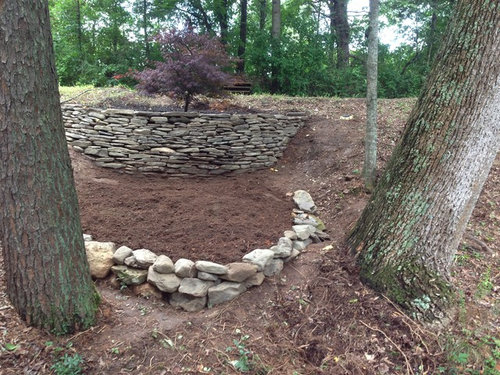
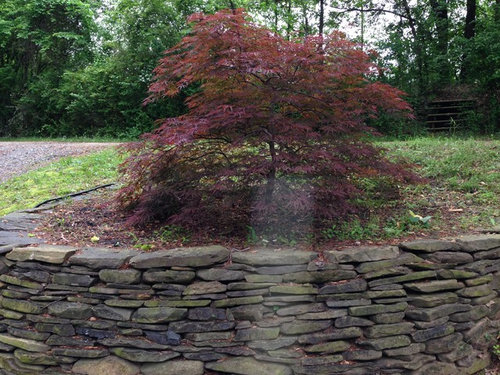
We built this home for this Red Dragon Japanese Maple in July of 2013.

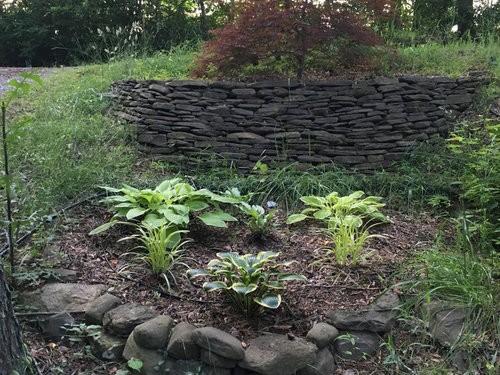
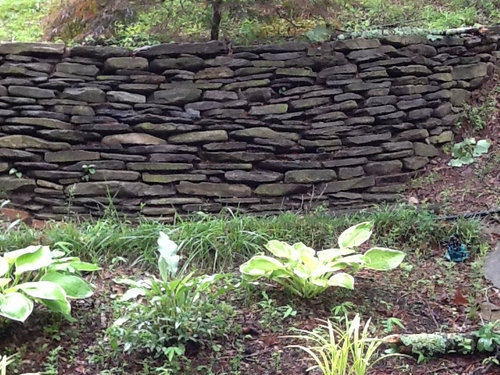
My Hosta addiction started shortly after that and this next picture is from May 2015. I have no 2014 pictures.

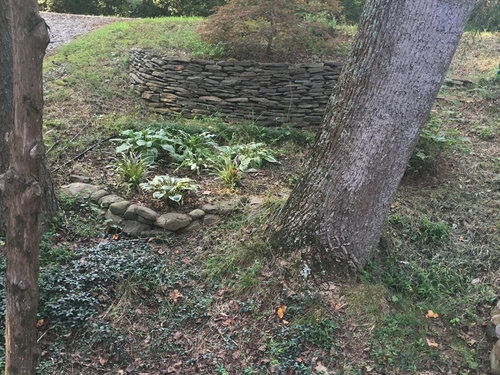
This pic is from June 2015.

This pic is May 2016.

This pic is also May 2016.

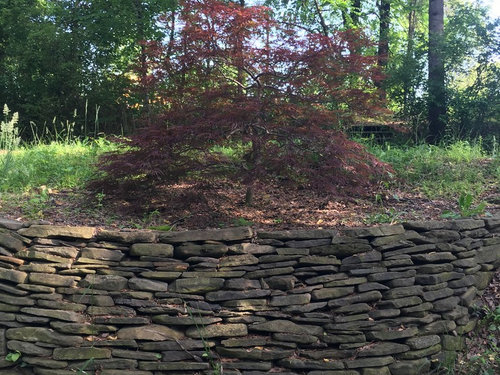
This one is the end of August 2016.

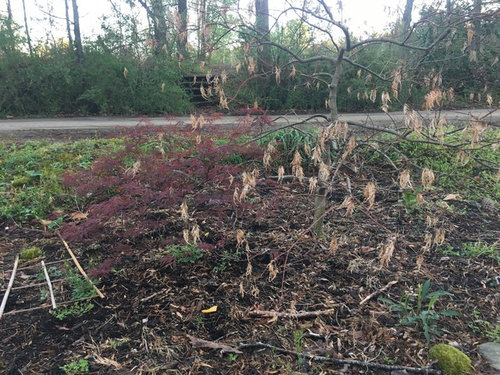
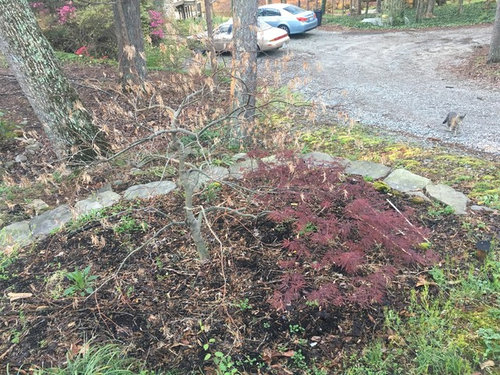
These two pics taken today.

I compiled this collection this morning, so looking at the progression pictures it's obvious that the tree was doing poorly last year. I probably wasn't watering it enough. I just couldn't see the decline.

I am so sad about this.

So the question is what do I do? The big poplar it's planted by lost some roots when the bed was built and it's probably put a bunch of feeder roots up into the bed. Do I dig up the Maple and clean out the poplar roots? Cut down the poplar? Water enough this year for both trees?

The branch that's still alive looks like it may have been grafted in at some time by the scars on the trunk around it. Is that a factor or even possible? Can I save the Maple? And if I can should I? It was a very expensive tree.

Comments (19)

  • 9 years ago

    There are various soil pathogens that could cause die back or even death. But they are virtually impossible to diagnose accurately just based on photos. You need to take samples (cut off a dead limb close to the trunk and lower on the tree) and take it in to your local county extension service for a diagnosis.

    North Carolina Extension Service.

    Has the tree been stressed at all? Summer drought? Abrupt shifts in temperature? Damage or disturbance to the root system due to cultivation in the immediate area? Any or all of these can create a suitable host situation for an opportunistic pathogen like Verticillium wilt.

    zkathy z7a NC thanked gardengal48 (PNW Z8/9)
  • 9 years ago

    Thanks gardengal48. Please see my explanation that I edited in.

  • 9 years ago

    "The branch that's still alive looks like it may have been grafted in at some time by the scars on the trunk around it. Is that a factor or even possible?"

    Highly unlikely. Virtually all named Japanese maples are grafted trees but the graft will be low on the trunk, not as individual branches. The gradual dieback of branches is often a symptom of VW, as well as the entire tree potentially succumbing almost overnight. Often the problem is not evident until the tree leafs out - or fails to - in spring. Verticillium wilt (VW) is not recoverable and Japanese maples tend to be very susceptible. You should also not replant with another maples or other susceptible species in that same location if this is what is the problem. But you can't know for sure without a diagnosis.

    zkathy z7a NC thanked gardengal48 (PNW Z8/9)
  • 9 years ago
    last modified: 9 years ago
    If you added purchased topsoil to fill in behind the wall it was probably infested with Verticillium. It also looks like the tree is planted too deep but on the face of it at least it seems the shriveling would be likely to be something like the Wilt.

    I had spontaneous, thriving native Vine Maple seedlings here get what was clearly Verticillium (clogged conductive tissue quite visible) after I placed some purchased "black dirt" near them. They had grown above head height at the time. The species is related to Japanese Maple but doesn't blight off in local plantings with any regularity, unlike cultivars of Acer palmatum.

    zkathy z7a NC thanked Embothrium
  • 9 years ago

    The VW pathogen is already present in most soils - it doesn't need to be "imported" although it certainly could be. In most cases, it remains dormant or inert - often for decades - until stimulated into activity by some sort of transmitted plant stressor.

    zkathy z7a NC thanked gardengal48 (PNW Z8/9)
  • 9 years ago

    The firstl or second year the tree was planted we had a sudden 19F night in the fall that killed all the Japanese Maple leaves in the area before they could change colors. 2016 was dry locally. This winter it was very warm (my first daffodil bloomed the middle of January) then we had three nights in a row down to 22F. It's not been all chocolate and flowers for this tree. And I'm sure I bought dirt to fill behind the wall, my local soil is poor, mainly sand.

  • 9 years ago

    Sorry to hear about your tree :(. I know how you feel.

    As a suggestion, on the branches with no leaves try the scratch test and see if there's green underneath the bark. Maybe the Japanese Maple needs time to leaf out completely.

    zkathy z7a NC thanked stuartlawrence (7b L.I. NY)
  • 9 years ago
    last modified: 9 years ago
    • Do not track soil from infested areas into clean areas. Clean boots, equipment, and tools before leaving an infested area.

    https://pnwhandbooks.org/maple-acer-spp-verticillium-wilt

    zkathy z7a NC thanked Embothrium
  • 9 years ago

    We did try the scratch test and there is green under the bark. I'm waiting for a response from the Extension Service about where to send a sample. Thank you all for your fast responses and kind suggestions.

  • 9 years ago

    The presence of green under the bark does not always indicate a viable growth situation (live branch or tree). Depending on the issue, it can just mean that wood may be dead but has not had sufficient time to dry out.

    zkathy z7a NC thanked gardengal48 (PNW Z8/9)
  • 9 years ago
    last modified: 9 years ago
    I have found some good results with the fertilizer Superthrive. One of my conifers last year was stressed and after using this the tree seemed to improve. I guess at this point you have to nothing to lose so maybe give it a try.

    zkathy z7a NC thanked stuartlawrence (7b L.I. NY)
  • 9 years ago

    Just an FYI, but Superthrive is NOT a fertilizer. At best, it is a vitamin and plant hormone mixture that is supposed to reduce transplant shock and encourage root development but its actual ingredients other than B1 and NAA are not disclosed. btw, applications of vitamin B1 (thiamine) have been proven to not provide any measurable benefits to plant growth, as it is present in all soils and is manufactured by plants themselves in sufficient quantities.

    The debates over the benefits - if any - of Superthrive are long and heated. However there is only anecdotal reports that it provides any positive stimulus to plant growth. Scientific trials have demonstrated NO measurable benefit.

    And FWIW, if the tree in question is infected with VW, no amount of fertilizing with anything is going to help - fertilizer does not kill off plant pathogens.

    zkathy z7a NC thanked gardengal48 (PNW Z8/9)
  • 9 years ago

    There are little red leaves growing out of the trunk below the live branch on this tree. I've come to the conclusion that although this tree looks like it's planted in the ground it is actually a container tree and I have not watered it enough. This is the report from the extension service:

    "Based on your correspondence of April 17, I am going ahead and close out the sample of Japanese maple. As I told you earlier, despite the excellent material you submitted to the clinic, I was unable to find any evidence of disease either on the dead branches or the roots, even though many of the small roots were dead and larger one."

    i also cut down a tree nearby so it should get a little more sun this year and I will water more regularly. I have high hopes!

  • 9 years ago

    Sooo, it was a lack of water and not any disease. Get it out of the container and plant in the ground after you take down the Poplar. Poplars are water hogs with an extensive root system.

    zkathy z7a NC thanked Mike McGarvey
  • 6 years ago

    Correction on a previous reply someone wrote: Superthrive is NOT a fertilizer. It's a plant tonic. 😉

    zkathy z7a NC thanked Harmony Saunders
  • 4 years ago

    Harmony Saunders, what's the difference between a fertilizer and a plant tonic? What does a plant tonic do and how does it do it? Curious here.

    zkathy z7a NC thanked Mike McGarvey
  • 4 years ago

    Mike, a fertilizer contains one or more of the required plant nutrients. SuperThrive contains none so is NOT a fertilizer.

    A plant "tonic" is anything some marketing yabbo promotes for enhanced plant health and hopes to rake in a few bucks from its sale. The exact formulation is up to the promoter but there are rarely ever any scientific trials to establish a concrete benefit and most often it is just an amalgam of already occurring or readily plant-manufactured substances or off the wall supplements, like aloe or various herbal infusions or bentonite clay.

    A classic example of the P.T. Barnum effect! 🥴

    zkathy z7a NC thanked gardengal48 (PNW Z8/9)
  • 4 years ago

    That's what I thought. Thanks for the clarification. :-) My only 'fertilizer' for my ornamental garden is woodchips and composted leaves. People always remark how soft my ground is.


    zkathy z7a NC thanked Mike McGarvey
Sponsored