Software
Houzz Logo Print
okcst1300

asparagus

9 years ago

wanting to prepare for a bed next year & was wondering if i'am overdoing it, wanting to plant probally 30 plants, heres where it get nutty, have read the roots can get 3-5 feet deep in good soil thinking about renting a backhoe & digging down 3 3.5 feet & filling it with quality soil my soil is decent for a foot but after that its red clay this is probally going to cost 1000 1300 $$$ for soil/back hoe, this will be a big hole 3.5 x10'x50' app. probally nutty but if the asparagus is going to be there for 15-20 years might as well do it right what ya think???

Comments (16)

  • 9 years ago

    I know that Dawn gave you all the info you'll ever need.

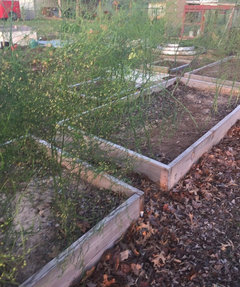
    But here's what I did with mine. I did not dig or replace any soil, however we built 2 raised beds on top of the soil after digging out all the grass and weeds. We then added "brought in" garden ready soil and my compost. The beds are 4ft by 8ft beds. They are only a foot tall. There are 10 crowns in each bed. They seems to be growing well even though the soil underneath is just regular Oklahoma soil/clay. Maybe at some point we'll have a problem because this is only their 2nd year. So far, so good though.

    While we are talking asparagus, here's a question: Do I need to do anything for asparagus "ferns" that have been bent by the wind? Some of them are really just lying down now. Should I stake them up? The wind has been brutal.

  • 9 years ago
    last modified: 9 years ago

    Hazel, I never do anything for wind bent asparagus ferns because my bed is pretty big. Eventually the ferns will stand back up if they aren't broken. If they are broken, you can remove them and another spear will grow to take its place.

  • 9 years ago

    Usually if the wind is strong enough to bend them, it breaks them anyway and I just remove them. If they are lying down on the ground, they may be broken at or just below the ground level. My asparagus bed is much smaller than Dorothy's, so I do clip off and remove any lying on the ground. New spears come right out to replace them.

  • 9 years ago

    s for the info okiedawn i really didn't want to spend the time or money doing this i never thought i was making a swimming pool, what did you make your raised bed borders out of??? 16"" above ground. also hazels response after yours i believe says she has 10 crowns in a 8'x10' bed isn't this really crowded i thought ther suppose to be 3' apart thanks

  • 9 years ago

    We used regular old lumber, and I believe it was either 2 x 8's or 2 x 10s, stacked on top of each other and held together with metal deck plates and corner brackets. It isn't pressure treated and will rot in a few years and, when it does, we'll likely replace it with pressure-treated lumber. Actually, one of the boards on the lower, more downhill side of the bed is rotten already, so we may replace all the lumber in that bed next winter after the plants are dormant.

    For decades, back when pressure-treated lumber was treated with arsenic, we wouldn't use it for anything. Now that it is safer and treated with copper, I feel like it is safe to use again. We just replaced rotting wood in one old raised bed with pressure-treated lumber about a month ago. You also could use landscape timbers stacked one atop another, or beds made with a wood framing and corrugated sheet metal. Stay away from railroad ties as they contain creosote and, therefore, really are not suitable for growing edible plants.

    Asparagus plants do fine if the in-row spacing is at least 12" though some people prefer 15-18" spacing within the rows. You can easily fit two rows of plants in a 4' wide bed and, if you do that, stagger the two rows so the plants are offset from one another instead of being lined up in matching pairs. I believe that when we planted ours we put the crowns about 8-10" away from the lumber sidewalls of each long side of the bed, so they still had a couple of feet in between the two rows. They've now just grown into two big, massive rows, which is fine. There's no reason for me to ever try to move them as they are permanent plantings.


  • 9 years ago

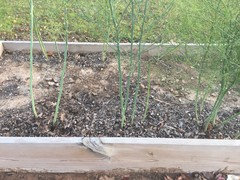
    I'll try to attach a couple of pictures of the asparagus that was taken this morning. I'm horrible at precise spacing and accurate measurements. I'm more like, "that looks good. Let's go with that." I think my crowns were planted about 2 ft apart. About.

    I do wonder about those little seed things that are on the ferns. And can new asparagus grow from seed in your garden? There are a couple of small ferny things coming up.

  • 9 years ago

    Spacing? Spacing? We don't need no stinking spacing. ::wink wink:: I think most spacing recommendations are for planting in rows in "flat" gardens. There plants may have to deal with compaction from people walking around them and there needs to be room for those people to walk. If you have the room for that kind of garden, it's great. I don't. In raised beds you can grow more intensively, as long as there is good soil. You never walk on the bed so it doesn't compact. Mulching helps keep the soil fed and "soft".

  • 9 years ago
    last modified: 9 years ago

    I put in some Purple Passion and Pacific Purple last year. I purchased the crowns from Nourse Farms and they recommend 8" spacing for these purple varieties because they produce especially large diameter spears and the closer spacing will cause them to produce more normal sized spears. These purple varieties appear to be a little later to wake up in the spring than my Jersey Knight and Jersey Supreme which I've already been harvesting for a couple weeks.

  • 9 years ago

    Hazel, Yes, new plants can sprout from seeds self-sown the previous year. I just pull them out because I don't need more plants. Some people move them to start a new bed, or to fill in any bare spots in the current bed.

    Amy, Exactly? I probably worry less about spacing than any gardener on earth. Truthfully, no one goes into our woodland and properly spaces out the tall trees, the understory trees, the shrubby plants or the ground covers and somehow they all manage to survive, grow and look great, so I try to apply that to the garden and not worry overly much about plant spacing.

    Raised beds are my favorite way to grow. That's why we keep adding one per year. Some year the whole front garden will be raised beds, and then I'll start working on building them in the back garden. I've noticed every year in late winter/early spring that there's a significantly smaller weed problem in the raised beds than in grade level soil (especially since our property slopes downward and rain runoff from adjacent property runs through my garden like a river, depositing weed seeds every time it rains enough to cause runoff) and the weeds are very easy to pull out, as opposed to sometimes having to dig them out of the grade level soil.

    LoneJack, Purple Passion does produce huge spears and from a young age, but my green asparagus, which is one of the newer all-male Jersey hybrids, has caught up now with Purple Passion and also produces big spears. It amazes me to see them. Of course, as the season goes on, the spears get smaller but the big ones are an incredible sight to see as long as they last.

    The only real difference I've ever seen with asparagus planting is that plants that are spaced very close together may produce fewer spears or smaller spears per plant, but they're still tasty. Usually my purple asparagus sprouts first. This year it didn't, which is a total reversal of what is normal here. Well, not that anything is really normal in our climate, but you know what I mean.....

    Dawn

  • 9 years ago

    I am still learning on asparagus. We planted in two 4 x 4 raised beds last year - Minnick Materials garden ready soil and they have been doing great. We've harvested 1/2 this year and are letting the other half grow into ferns. Interesting development tho - in one we planted Millenium which are all male and are producing large stalks this year like CRAZY. Our Martha Washington are still very thin and we haven't cut one.

  • 9 years ago

    One advantage of the all male hybrid varieties is that they put all their energy into producing spears instead of putting some energy into producing seeds. Because of that, the newer male varieties can produce at least three times the yield of the older OP varieties like Martha Washington which have both male and female plants and, therefore, put a certain amount of energy into reproduction. The male hybrid asparagus varieties also seem to have increased vigor and disease tolerance.

  • 9 years ago

    i have a few more questions. what does the asparagus tast like compared to store bought(dumb question probally). is varmits a problem moles/gophers birds rabbits. fall planting compared to spring planting. does asparagus produce all summer? thanks

  • 9 years ago

    My supposedly all male hybrid plants ALL have flowers right now. At least the bees like them.

    I believe you harvest in early spring (I haven't gotten to eat mine yet, darn it). Eventually you have to let the spears grow up into "fronds" so it can grow and get the energy to produce again. Someone who's been doing it longer can give you more details.

  • 9 years ago

    Amy my males do too ROFL! Are they not supposed to? okc1300 - This is our first year to eat and what we've noticed is the water content is higher and the stalks are sweeter than store bought.

  • 9 years ago

    Amy and Katie, Asparagus plants are dioecious, so both females and males flower. Whew. What a relief, huh? It is just that in the absence of females, the pollen from the male, which normally is transmitted by bees, has no female flowers to pollinate. That is more or less true. In reality, a few of the all-male hybrids of any given variety will be females, but usually not that many in any given batch of purchased crowns. So, theorectically, a few plants from a so-called all-male variety might produce berries. The newer supposedly all-male asparagus varieties (I think) arise from breeding regular female plants with supermales instead of regular males to get a higher percentage of male offspring. Asparagus reproduction is not always cut and dried, because occasionally a male plant produces a hermaphrodite flower, so sometimes you get what you get.

    Fresh asparagus, to me, tastes sweeter and milder, in comparison with store-bought asparagus. You begin harvesting, once your plants reach the right age, as soon as spears begin growing and reach harvesting size. You harvest by cutting off a spear or by snapping it off right at or right below the soil line once the spear is about 8" tall. In the first year you are able to harvest, you might only harvest for 2-3 weeks. The way you'll know when to stop is that the spears will gradually get smaller in diameter. Once they are the same diameter as a pencil, it is time to stop harvesting. This allows the plants to grow and fern out and store energy to provide the following year's crop. After the plants are a few years old, you'll notice your harvesting period is getting longer and longer. In general, mature plants can be harvested for around 8 weeks, and sometimes longer if they are extra vigorous and keep producing large enough spears.

    Varmints have not been a problem with our asparagus, although we do have voles. Our garden is fenced with an 8' tall fence, which excludes most all wildlife so we've never had wildlife mess with the asparagus. Birds are in the garden a lot but they don't pay any attention to the asparagus.

    The general time to plant is when the crowns are dormant, so generally in winter or early spring. I don't know how late retailers ship crowns. I bought all mine in bags (there were 10 crowns per bag) in a local retail store in early January the year that I planted the asparagus.