Software
Houzz Logo Print
travisb88

Yew Bonsai From Hedge - First Time

Hello,

This is my first time posting here. I have always wanted try try my hand at growing a bonsai. We have an old yew hedge growing in front of our house that my wife insists we remove this summer. Do you think this could be suitable material to start with? I hate tearing out plants, but if we must do it I'd like to save some of them. I'm completely new to this so I appreciate any advice from anyone with some experience. Thanks!

Comments (40)

  • 9 years ago

    Taxus offers a lot of species well-suited to bonsai, but not every example of every species is well suited as a bonsai candidate. Also, the difference between a good/bad/indifferent prospect is often determined by the skill level of the person in possession of said prospect. I remember buying a VERY large yew left over from a workshop in Cincinnati 10-15 years ago, only to discover the roots were wrist thick and at least 12" deep. I've been working on the roots during that time, but the tree only just told me what it wanted to be last year, which is when it finally got its initial styling.

    Have fun. Don't expect it to be easy coming out of the ground.

    Al

  • 9 years ago

    It so happens two weeks from now I will be at a Yew workshop by Sean Smith. Looking forward to it.

    I tried saving an unwanted yew. Taking it out was very very hard. As Al said huge fat roots made it very difficult. It died subsequently. It should be an interesting experiment for you. Take your time taking it out of the ground and having a second person would help a lot.

  • 9 years ago
    last modified: 9 years ago

    Recent lifts ^^^
    Ideally, Travis would have pruned some of the plants large roots last fall. The pre-lift pruning effort stimulates the same kind of "back-budding" of roots that pruning a branch does to encourage back-budding of branches. I always fall prune roots of plants I intend to lift in spring.

    Al

  • 9 years ago

    Those look great Al. A good bit of prep is definitely worthwhile. I do not have a good source but I let most of my neighbours know to remember me if they are getting rid of something.

    Where do you get those shallow plastic pots? I am looking for something large - 18 inches or so.

    Travis: I think every plant poses a different challenge. I would say start by digging a trench about a foot wide and at least 18 inches from the base of the trunk. This will give you an idea as to what the root ball looks like. As you dig down start digging towards the base as if you are making a cone shaped root ball. Follow the big roots and cut them as much as possible leaving behind clusters of finer roots (if you find any). You want the smallest possible rootball with the most amount of finer roots. Easy to say and hard to do.

  • 9 years ago

    Thanks everyone! I agree its going to be a challenge to remove (either way). That gives me an idea of how to start at least. When digging mature plants like this do you start with a large root ball and slowly reduce the size or start small and hope it survives? Unfortunately we didn't know until a few weeks ago it was going to be removed. Otherwise I would have prepped it more. Knowing that this won't have to be gone until late summer/early fall is there something I should do this spring and summer before digging it all the way out?

    Also, is there a way to identify what type of species it is? It was here when we moved in. Are there any good resources to start learning about how to grow bonsai you'd recommend? I've done a fair amount of reading throughout the years but haven't found a good comprehensive source.

  • 9 years ago

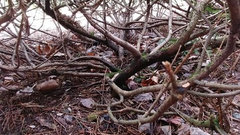
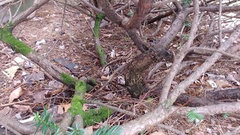
    Here are a few pictures to help give you an idea of what I'm working with.

  • 9 years ago

    Wow. You have a lot to work with. .All those low branches are going to make it tough. And you want to keep some of those low branches selectively. I cannot identify which type it is.

    I have removed only a few in-ground plants I have. I would start with a large imaginary root ball with eventual goal of making it as small as possible. Otherwise it is difficult to lift out without damaging roots. The weight of the soil is going to tear apart the finer clusters of roots leaving you with you only large thick roots with hardly any fine roots. There will be large clumps of fine roots but those are the ones that will break away easily because of the weight of the soil - as you try to lift the rootball.

    So you have to work in towards the base starting a bit farther away. The trench will have to be wide enough to allow tools, crow-bars, etc. I assume that below a foot or so there should not be usable fine roots.

    If you can wait till fall/winter I would try this. Just thinking out loud here. Dig a trench around each plant and remove whatever big roots you find. Remove as much of the soil as you can. You may find that there are sections/wedges all the upto the base of the plant with no roots. Cut as many big roots as you can. Backfill the area with mix of native soil and mulch. In winter get someone with proper equipment to help "lift it out" and dump them in another area of your yard that has been prepared beforehand.

  • 9 years ago

    Al - Thank you for those article links they help a lot! Also, they'll give me some guidance on my other houseplants. Good thoughts on focusing on being able to keep it alive first. I think that's where I was struggling. I start looking at ll the design aspects and get lost/overwhelmed.


    How do evergreens act vs a deciduous tree as far as sap movement in spring? Would it be beneficial to prune the tree down first and let it start putting new branches then work on digging it up? The idea of digging it up in stages is also interesting. I think that may work as long as it can definitely wait until fall to remove them. If we end up taking it out the middle of summer it might be hard on the tree. I don't know that's just my thought.


    ToC - You're saying start with a large root ball away from the plant and work my way in as time progress? This would give it a chance to produce it's finer roots near the tree?


    Travis

  • 9 years ago

    I am assuming you are digging the plant out in one session.

    What I am trying to say is that when you start digging begin with a large imaginary rootball but your eventual goal is reduce the rootball to a more manageable size. Otherwise it is very difficult to lift it out without damaging the finer and more fragile roots. Just the sheer weight of the soil will tear away chunks of soil with roots in it.

    I like to start big and work my way in, digging away dirt trying to locate where clusters of finer roots are present. The usually will be a bit away from the base. Then chop away large roots saving only those portions with fine roots. Not all large roots will have useful sections of fine roots - those can be chopped severely.

    Doing this over two sessions involves basically the similar steps. Just that it increases the chances of survival. But as Al said doing the prep in fall and doing the final digging out and repotting in spring increases the chances of survival a lot better.

  • 9 years ago

    I start looking at ll the design aspects
    and get lost/overwhelmed.
    One of the hardest aspects for me was the artistic part of bonsai. I memorized the guidelines, but nothing I put together ever seemed to work like it should. Gradually, from looking closely at high quality trees and paying attention to the different growth characteristics, things came together. I've always stood in wonder at those to whom the artistic part was so much a part of their make-up that it was essentially like it didn't even need to be learned. There is no substitute for getting your hands on the tree and in the roots. Pay attention to how the tree reacts to your ministrations. Take notes and pictures if you like. I enjoy seeing the progress of my trees and often marvel at what is, was.

    How do evergreens act vs a deciduous tree as far as sap movement in spring? Evergreens don't go dormant like temperate deciduous trees do, so they're capable of growing any time. Would it be beneficial to prune the tree down first and let it start putting new branches then work on digging it up? No. If the tree back-buds before you lift it, the much reduced root mass will have a load so heavy the plant could simply collapse under the strain. If you lift a tree that is essentially bare of foliage. the latent buds won't be activated until the plant's chemical messengers tell it it's able to support the newly emerging growth with water/nutrients. In the natural course of metabolic activity, root growth always precedes top growth.

    Al

  • 9 years ago

    ToC - I understand what you're saying now. Thanks for clarifying! I may try to dig one up this weekend or next and see how it goes. Our soil is very sandy. I have a feeling the roots are pretty extensive to find water.


    Al - My next question was about overwintering. Do evergreens not need any overwintering period outdoors? What do you do with your trees over the winter to protect them from getting killed?


    I'll make sure and prune and lift it at the same time to prevent as much damage as possible. That makes sense after you explained it like that.


    Travis

  • 9 years ago

    Travis: Good luck and let us know how it goes. You may find fine clusters of root hanging on to a large root quite a bit away from the base and none near the base. That is why I start out in a large circle. Although I have done only a few and it is hard work.

    BTW, Al is the expert and so heed his advise on reading/learning about plant health and container growing fundamentals. Getting to a decent looking bonsai is a long journey.

    If you are going to pot it up then it needs winter protection. Ideally, it should be just above freezing and below 40F or so. Unheated garage/shed is good for this. The first winter after digging out it is going to need some TLC.

  • 9 years ago

    Our soil is very sandy. That doesn't bode well. Unless the water table is very near the surface, there might not be any significant volume of roots within a reasonable distance from the trunk.

    Do evergreens not need
    any overwintering period outdoors? What do you do with your trees over
    the winter to protect them from getting killed?
    All but a few temperate trees overwinter in my attached/unheated garage. The soil does occasionally freeze, but that isn't a problem unless temps reach killing low temps, which varies by species. Water in the soil can freeze w/o issues, as can water between cells, but when water within cell walls freeze, it kills the cells. A couple of years ago, my wife came home late and forgot to close the o/h garage door. It happened to be -12* that night, so I lost most of my zone 7 & 8 trees. I was pretty sick come spring because many of the trees had been under my care for more than 2 decades. It's a bit like losing a pet.

    Many larches, pines, and junipers stay outdoors on a low rack on the N side of my garage. The low shelf is inches above the ground, and I stretch a tarp so it provides protection from the wind and helps retain geo heat rising from the ground. That works well. I open it up and toss a shovel full of snow on the trees every 3 weeks or so. There are a lot of over-wintering strategies, but the key points center around keeping your trees as cold as possible for as long as possible w/o flirting too seriously with potentially killing low temps.

    Al

  • 9 years ago

    I appreciate the advice on how to keep them over the winter. I'm glad to know it seems relatively easy if you don't let them get very cold. I would be really sad if one I had for 20 years died.


    I'm hoping the fact that the trees are next to the roof will have given them enough water to create some extra roots near the surface. They usually get quite a bit of runoff.


    Now I just have to convince my wife to let me try and dig one up early.


    Travis

  • 9 years ago

    Just tossing this thought out there as I have zero experience with such tree removal....

    Would Travis be able to use a stream/blast of water as from a hose to remove the old soil from the roots -- particularly in any area that might possess the finer roots? And would doing so allow soil to be removed without destroying those fine roots?

  • 9 years ago
    last modified: 9 years ago

    That's commonly done after the tree/shrub is lifted in many cases, but it probably wouldn't be a workable plan while the plant is still in the ground. A hose end fitting called a Foggit nozzle is one of the tools I commonly use for root work.

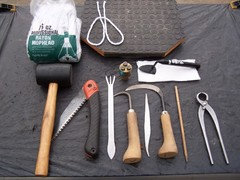
    For lifting trees, you'll need a spade or shovel with a VERY sharp blade and an unbreakable handle, a sturdy garden trowel, loppers, and a pair of pruners.

    AL

  • 9 years ago

    Would it be acceptable to remove the trees and transplant them somewhere else to develop them before potting? I have several acres of woods that I could put them out of the way.


    Travis

  • 9 years ago

    So I convinced my wife to leave the hedge until next spring. What prep work would be good to do this fall? Al, you mentioned doing a pre lift? Would you be able to explain in a little more detail how to do that? Thanks!

    Travis

  • 9 years ago

    There are specialized shovels available that make short work of roots. You could prune the shrub back to a manageable top size and sever half of the roots about 12" out from the trunk. Imagine a stop sign/ an octagon. You would use the shovel to sever the roots on 4 of the flats on the imaginary octagon this fall, and the other 4 flats next spring as soon as the frost is out of the ground. Do N,S,E,W in the fall, and NE, SE, SW, NW, in the spring. Unless your memory is better than mine - make a note to remind you which of the flats you cut in the fall. Do watch the new buds carefully and lift the shrub at the very first little sign of bud movement.

    Most of the important feeder roots won't be found near the trunk, and that is a problem. Severing half the anchoring roots in fall gives the plant enough time to push new roots proximal to the point of truncation, increases the probability of a successful lift, and gives the second half of the roots you'll truncate in spring a headstart of several weeks before you lift. You can cut the yew back to bare branches if you need to - it will back-bud.


    Al

  • 9 years ago

    Thanks Al! Any suggestions on when I should do this, or is any time ok now?

  • 9 years ago

    I'd do it now, but I'd also make sure the soil surrounding the plants I'm going to lift is moist enough to support new root growth at the soil's surface. That might mean regular watering until the fall rains kick in. It also wouldn't hurt to provide a healthy dose of synthetic fertilizer at this point.

    Al

  • 9 years ago

    Now is a good time, the soil is warm and air is cool. At least here in Pittsburgh. Less stress for the plant. I am in the process of doing something similar to hardy hibiscus so that I can move them next spring.

  • 9 years ago

    Al already said that. Did not see his post while I left mine in the middle of writing.

  • 9 years ago

    I like that shovel Al! I might have to see if I can pick one up.

    Travis, In lieu of spending $50 on a shovel you might only use once or twice, you could sharpen your garden shovel. I put a razor edge on mine at least once a year. It will do a fair job on small to middling size roots, just watch your toes!

  • 9 years ago

    That shovel does look like it has a mean business end. I need to get one of those. Usually, I end up getting out a bunch of tools including several shovels, crow-bars, picks, saws, 2x4s, case of beer and a lot of cussing.

  • 9 years ago

    Great! Maybe I'll try and attack it next week then. I've got some dry NPKS blend from the farm store I can spread and water in I also have urea and some liquid fertilizers I can apply. I'll make sure and get the grinder out and make sure everything is sharp. Judging by how I am with gardening hobbies I'm sure I'll be getting that serrated shovel eventually.


    Tropicofcancer: does the cussing increase or decrease as the case of beer gets empty? Lol

  • 9 years ago

    I think I mellow out enough after a few beers.

    You have sandy soil and may be it will be easier. I expect to hit pieces of rocks and brick but I am usually quite patient and determined.

  • 9 years ago

    Let's hope it's NOT sandy soil. In sandy soil, due to absence of adequate moisture for long stretches of time, the first fine roots might be found many feet from the trunk. I've lifted yews and junipers from sandy soil conditions that usually 'make it', but it's usually nip and tuck for a year or two.

    Al

  • 9 years ago

    Yeah it's definitely sandy soil.... My last soil test showed a OM of 0.6 and CEC of about 11. They are by the house and everything else had black dirt hauled in so hopefully they're planted in the same. It does get quite a bit of water runoff from the roof so I'm hoping that'll help.

  • 9 years ago

    Well I finally did it! I'm really looking forward to spring now. Went ahead and cut them all back pretty hard. Dug around 3 to 4 sides of them depending on what I could get to and back filled it with soil. Topdressed some 9-16-31-3S and am now giving them a good soaking.

  • 9 years ago

    Great. Spring should be fun for you.

  • 8 years ago

    Well I decided to get ambitious tonight. Got the first one out!

  • 8 years ago

  • 8 years ago

    I bet you won't have THAT in a bonsai pot by next spring. ;-) How much of it is alive; and do you have any sort of plan?

    Al

  • 8 years ago

    Al,

    I spent quite awhile washing the roots and pruning some of the bigger roots and really low branches. It surprisingly had a lot of small fine roots near the base! Most of it is alive, there's a few branches that died. I got the rootball down to about 18 in I have it soaking overnight because I ran out of light tonight.

    I'm trying to decide how many branches to remove now. I don't want to cut off too much, but still want to be able to have some flexibility depending on how/if it recovers.

    For soil would you go with a gritty mix right away, or a something like 5:1:1 for a few yrs while it recovers?

    Travis

  • 8 years ago

    PS: I bought the root slayer spade and it worked amazing!

  • 8 years ago

    It would really be helpful to others if you would document your progress through images and a description of what you're doing.


    Al

  • 8 years ago
    last modified: 8 years ago

    Sure! Here's some I did today.

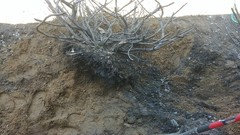
    First I dug a trench around the root ball. It was pretty easy since I had dug around it some last fall. On one of the sides I dug down deeper and undercut the root mass kind of like a stream bank that's been eroded. That allowed it to roll over and put some tension on the thicker taproots when I got to the other side making it easier to cut.

    After I rocked it free I pulled it out of its hole, this would be easier with help lol.

    Once it was up I pulled it on the mound of dirt I made from digging so I could access the roots easier. I used a saw and cut a few branches off I knew I wouldn't want. Then I used the hose and a spray nozzle to wash away the soil from the smaller roots.

    Once it was light enough I turned it upside down to help clean up some of the soil and river rock. The decorative rock had grown in the roots. there was also some old landscape fabric I had to get out.

    I sized it to the container and trimmed the roots that were too large to fit.

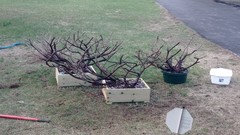
    And here's a couple more done. Hopefully I didn't mess it up too much and they recover.

    Two more to go!

    Travis

Sponsored
NME Builders LLC
Average rating: 5 out of 5 stars2 Reviews
Remodeling Company in New Albany, Ohio