Software
Houzz Logo Print
whirlpool_trainee

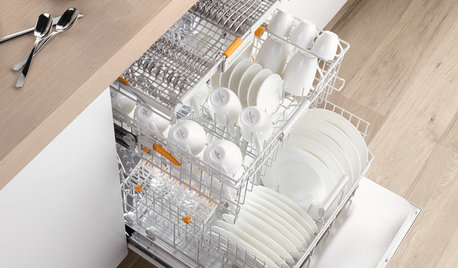
Miele 2017 Dishwasher Models

9 years ago
last modified: 9 years ago

I found these two reviews on YouTube. The first one is really informative.

Comments (10)

  • 9 years ago

    I downloaded some of the manuals and for the first time they have program tables showing the temperature and cycle times.

  • 9 years ago

    That's good to hear. Finally, Miele treats North Americans like the rest of the world.


  • 9 years ago

    Hopefully we see more than a 10% discount on outgoing discontinued floor models.

  • 9 years ago

    Have they updated the "dishwasher is running" indicator at all? That's really my only gripe with our year old Futura Lumen: it's quiet enough that you can't really hear it running and the "on" light is a nearly-invisible little red light that shines on the underside of the countertop so you can't see it if you're anywhere near the dishwasher. The little knife holders in the center of the top rack are a nice addition too though. Ah, dishwasher envy . . . .

  • 9 years ago
    last modified: 9 years ago

    I found this in a product manual for some of the new Miele dishwashers:

    "The heat exchanger should only be used in conjunction with a cold-fill water supply. This function should be switched off if your dishwasher is connected to a hot water supply."

    The heat exchanger is only one of the new for 2017 features, the other notable feature is onboard WiFi. However the translation of the above quote is, even though the EcoFlex feature is marketed as a break through, it is only advantageous if you hook up a cold water supply only, with no hot water water supply.

    I'm going to guess that very few owners of Miele D/Ws hook up only cold water. The Heat exchanger feature is might nudge a few more people to use cold only, but it seems like a lot of effort (and additional cost) to eliminate the energy used to hear a few gallons of hot water.

  • 9 years ago

    Thanks for posting!

    General thoughts: I'm probably in the minority, but I don't like those bumpy racks. It makes it hard to fit items that the racks weren't designed for, whereas fairly flat with adjustable tines makes it easy. The accessories are good. I like that the center part of the top rack lowers. I don't get putting work knives in, though. As usual, the top rack wouldn't work with my flatware, which has acrylic handles.

    Re cold water in, back in the day that was what Miele DW's and clothes washers were prized for in the U.S. They didn't have nearly the market penetration, but that the machine would heat up its own water from cold, and would heat it to the correct temperature, rather than so many watts for so many minutes, was a big selling point in certain milieus.

    I'm surprised that the heat exchanger makes that much of a difference--oh, wait...in other climates cold water is actually cold so that even hot water that's not so hot anymore would be a lot hotter. It's a great idea! Passive capture and all that. Solar swimming pool heaters run the water through dark cloth under the sun. A friend who lived in the mountains routed water pipes through a very efficient fireplace he'd built, which gave them as good hot water as a heater would have, and the fuel was free (not including the costs of burning wood releasing toxins). This seems like the same kind of principle. Oldie but goodie. I'd think just efficiently getting the wash water into and out of the tank would be the big deal for the engineers, not to spend all the energy savings on the pumps. :)

    The one hour intense wash is fab! Especially for people who entertain and don't generally need two DWs but consider it because of 2 hr. cycles for the days they have company.

  • 9 years ago

    plllog, interesting comments od older Miele appliances. I think but am not 100% certain existing/current Miele D/Ws and Washing machines have on board heaters.

    Both products, before the EcoFlex feature came out on the D/Ws, have install instructions for how to hook up with cold water only. In fact they have this odd statement (for a D/W) that makes you wonder what is happening under the covers:

    The dishwasher can be connected to
    a hot water supply for further economies.
    If the water is heated by for example,
    solar panels, this would be
    energy efficient.
    However, if your water is heated by
    electricity we would recommend connection
    to cold water.

    Above from a manual for an G6365SCVi SF D/W, a model no longer showing as available after April 2017


  • 9 years ago
    last modified: 9 years ago

    Well, the dishwasher uses hot water, and uses the remnant heat from the hot water for drying. If you don't have to have a hot water hookup, then the dishwasher itself is heating the water. Some people have passive solar water heating (close to free), and others have a solar panel that is exclusively for heating their hot water supply. Many years ago I lived in a place that had the latter--the panel would heat the water during the day, and the water would cool off during the night. There was also an electric switch inside the apartment which would turn on a heating coil for the water tank when there wasn't sufficient sun (like during several days of storm). With those systems, any kind of heating inside the dishwasher would have to come from electric mains, and be less conservational, therefore they'd encourage a user to attach the hot water supply.

    If you have inexpensive gas water heating, which I do now, it also might cost less to use your water heater, though I don't know how total energy use compares. In Europe there's plenty of nuclear electricity in many places, but gas may only be LP balloons, and even if piped may be expensive. They usually have much smaller hot water tanks than we do in the U.S., and many have tankless. For them, point of use electric water heating (i.e., inside the DW) may be more energy efficient.

    If they've removed the ability to hook up outside hot water, it's probably so the machine can better control the temperature of the water in the heat exchanger system. It may operate at a lower temperature than what some people heat their water to, for instance.

    Whatever the reason, I promise you there's hot water in the dishwasher. Otherwise the dishes would come out wet, and in the video it was pointedly said that the new fast wash setting gets the dishes dried. Hot water is also an important part of cleaning, but that's just a value judgment. :)

  • 9 years ago

    All European washers and dishwashers have heaters in them.

    The reason for the statement about a hot water supply being favorable when using green power sources, is that anything is cheaper than using electricity to heat the water. At least this is the case in Germany, where the manual was written. The average cost of one kWh in 2016 was almost 30 Cents, so you do not want any of that - expensively generated - heat go to waste. Thus the recommendation to let the insulated dishwasher do the heating, rather than losing heat in long water lines etc. I suppose having to heat a small storage tank under the sink or even heating the coils of a on-demand heater means some sort of heat loss.

    As for means of water heating: all the homes I have lived in so far used oil to centrally heat the water and store it in (up to) 100 gallons tanks. The place (multi-family home) I live in now uses piped gas and supplemental solar heat for the hot water supply. Larger apartment buildings may use on-demand water heaters. Electricity is the most expensive way to heat, folowed by oil, than gas and finally solar heat, heat pumps and all that.

    Because energy costs are much higher here, manufacturers do whatever they can to save electricity. Bosch, for example has lowered the final rinse temp on some cycles to 95 F because they came up with an energy efficiency way to heat and dry the air during the drying cycle - just so that they could squeeze out some extra .xx hWh in energy savings.

    In the end, let's also not forget that the Eco Tank is a European invention that makes the most sense in its main market (where dishwashers are traditionally connected to cold water). Bosch has been using this technology since the 90s and never brought it to the US, because their heat exchanger, like Miele's, doesn't make sense if you have hot water instantly available at the dishwasher.