Software
Houzz Logo Print
need2seegreen

repots = June here... what about separating plants/unearthing them?

Hello:


I did a search but perhaps I used the wrong terms. Also I am posting to both House Plants and Container Gardening.


I know that repots are best done in June for the northern hemi… but what about separating ficuses (that came in the same pot) and also digging something out of the ground to be put in a pot instead? Should I do those in June too?


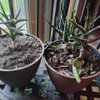
I bought an FLF in March … well, possibly 3 of them in a pot … and I have been wondering what to do next. I am watching it and so far, only the tallest is making new leaves. The other two are just sitting there (but still alive…)


Can I separate them now, or is it better to wait? (And the plant in the ground is going to be a bear to get out… I maybe should have done it after it rained?)


Thanks for all suggestions!!!!

Comments (12)

  • 9 years ago
    last modified: 9 years ago

    MOST houseplants/tropicals that are in good health will respond more enthusiastically (greater profusion of back-budding and faster recovery from the work) to heavy work if it's done when the plant has the highest energy levels of the growth period. It also happens that high energy levels correspond with the longest days of the year, which occur about 2/3 of the way through June. For most of the country, scheduling repots and hard pruning/chops between Father's Day and July 4th makes the most sense because you're working in harmony with the plants' natural rhythms instead of against them, as you would be doing if you repotted in fall through early to mid spring. Early to mid-spring is about the worst time to do heavy work on tropicals/most houseplants. In the deep southern parts of the country (FL, SoTex, SoCal), a week or two earlier than Father's Day yields the same kind of results that later repots/hard pruning yield farther north.

    Temperate plants should be worked while still dormant, and tropical/sub-tropical plants should be lifted from the ground early in spring to give the plant some recovery time before temps get so hot there is jeopardy of overwhelming demand on the root system to keep the top of the plant hydrated. If you DO lift plants from the ground while in leaf and during hot weather, it may be necessary to prune the plant hard or defoliate it to prevent the entire organism from simply collapsing. I get a lot of push-back on that latest observation because most growers want to paint with a brush too broad and try to apply the conventional advice that pruning the top isn't appropriate when transplanting. People who insist that one size fits all haven't done any degree of serious root work on trees in the summer or they would know better than to simply recite a generalization by rote, as though it fits every application.

    Al

    Need2SeeGreen 10 (SoCal) thanked tapla (mid-Michigan, USDA z5b-6a)
  • 9 years ago

    Thanks so much!!!! Al to the rescue again!!!!

  • last year

    hi again!


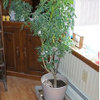
    So, I am in a similar situation again, only this time, the ficus is a volunteer edible fig which I would like to dig out of the ground at a friend's house, stabilize in a pot, and then give to another friend.


    I believe figs are considered either tropical or sub-tropical?


    So, does that mean that I should have dug it up in June? Or, is it that since I am digging it out of the ground, instead of a normal re-pot, now is an okay time? Or is early spring best? (It's looking like a mild winter, so there may not be much difference between now and February. Still, I can wait longer if that is better. Or until June, for that matter.)


    The fig seems to be losing a few leaves. I only noticed it this year - I don't really know how old it is, but can't have been long. Probably just one year. About 5' tall already! No figs yet. I think its parent lives 2 houses down. (If I manage all this, I may take a cutting just for fun. Figs are so lovely to look at.)


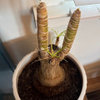
    In my original note, the plant in the ground was/is a dracaena. It is fine where it is, but it doesn't get any attention where it is - and, it's kind of neat-o. I don't know that I'll get up the energy to dig it up this year either.


    And, if anyone has any tips about helping a plant adjust from the ground to a pot, please share!

  • last year

    If anyone's interested, here is more on the dracaena.


    https://www.gardenweb.com/discussions/4269701/digging-up-plants-in-the-yard

  • last year

    Btw, is there a term for digging something out of the ground and putting it in a pot? Because you aren't just transplanting it or just moving it (though I am sure it is major trauma either way). You are putting it in a totally different situation.


    And speaking of that, what soil mix might be easiest? I usually just use micro bark. Should I use a good commercial potting soil instead - is that somehow easier? (I don't know that I have time to make up a gritty mix. I know that is the most permanent.)

  • last year

    I believe figs are considered either tropical or sub-tropical? Nearly all figs are plants that do best in subtropical climates. They do not generally grow well in the wet tropics, but can be grown at higher elevations in the drier to moist tropics. F carica, the common fig, is something of an outlier in that it is considered to be a temperate deciduous tree and will show its appreciation when plants are grown in relatively dry climates where a cool season alternates with a hot season.

    So, does that mean that I should have dug it up in June? No, not for the common fig. That guideline is primarily for broad leaf evergreen perennials like F benjamina, elastica, lyrata, ..... .

    ..... is it that since I am digging it out of the ground, instead of a normal re-pot, now is an okay time? Or is early spring best? I don't know if the plant goes completely dormant where you live. If it does, and there is no danger of the roots being subjected to freezing temps, you can lift the tree from the landscape in which it resides and pot it anytime after the leaves fall and before the spring push.

    The fig seems to be losing a few leaves. That might well be because of the natural decrease in light levels, a powerful influence with regard to advancing the plant moving toward a state of 'predictive', as opposed to 'consequential', dormancy

    I may take a cutting just for fun. They are are easy to propagate from cuttings.

    And, if anyone has any tips about helping a plant adjust from the ground to a pot, please share! Whenever you move a plant in leaf from the landscape to a pot, especially in summer, a hard pruning or partial to complete defoliation and temporarily siting the plant in shade and out of wind will increase the chances for survival very significantly. The same can be said for repotting (which includes bare-rooting and root pruning).

    ..... what soil mix might be easiest? I usually just use micro bark. Should I use a good commercial potting soil instead ..... I'm not sure if micro bark is a reference to Orchiata in precision size or the Dr Earth product. Both have a pH too low for figs to do well. My suggestion would be to make the 5:1:1 mix using either product, or, you could purchase a fast-draining, commercially prepared potting medium. Keep in mind that, if you place the pot on the ground and leaf the drain hole open to provide a bridge between the potting medium inside the pot and the natural soil below the pot, you'll be growing in a small raised bed (from the perspective of hydrology/ how water behaves in the grow medium) as opposed to a pot.

    In order to do well over the long term, the tree will need a repotting yearly or at longest, every other year.

    Al

    Need2SeeGreen 10 (SoCal) thanked tapla (mid-Michigan, USDA z5b-6a)
  • last year

    Thank you so much, Al!! That is so interesting, I would never have known that it is deciduous. As much as I admire figs for their beauty as plants, we never ate them much - except for fig Newtons! - and so I haven't observed them closely before, out in the world.


    I will keep an eye on it for a couple more weeks as to the leaf drop situation - and, I'll also need to figure out what pot to put it in. Maybe I'll try to find more than one size pot just in case.


    And thanks also for the bit about the pH - I didn't know that either. It's a good thing I remembered to ask these questions online - though, I probably should have put this somewhere else, and maybe with a better title? - because this way I have some time to figure out the soil.


    I think the friend who's going to get the fig will put it in the ground soon. I guess next fall, assuming it makes it. He has a bunch of fruit trees already and does really well with them.


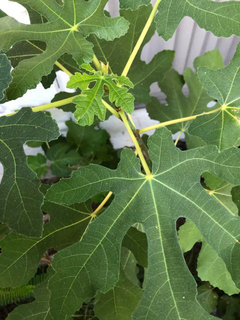
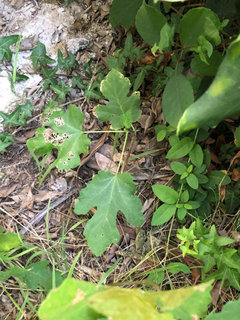
    Just for fun, I'll try to put up a couple pics from the summer. I am not sure what kind it is.

  • last year
    last modified: last year


    It will be interesting, as it could be more than one plant. (It's behind some shrubs and it's not easy to get over there. I am waaaay behind in the process of learning to prune things. These photos are from July, and the shorter bit may be separate. Or, not.) Though, maybe the leaves that look different were just new?


    Anyhow, it will be quite a fun caper. This friend is always giving me food, so it will be nice if I can give something back.

  • last year
    last modified: last year

    hi again -

    Al, if you happen to see this - do I need to wick or bridge the gap between the bottom of the pot, and the open soil/dirt it is placed on, to get the raised bed effect? (I haven't chosen the pot yet - it will probably be an old black plastic 5 gallon ... )

    Also, if anyone has thoughts, how big of a root ball should i be expecting? It is about 5' tall now, and it is just a stick - all the leaves are off.

    I will buy some soil - I didn't do the 5-1-1 ahead of time - and bare root in a bucket first, I guess. Fingers crossed. (This so does not belong in the House Plants forum. Oh well.)

    Thanks in advance!

  • last year
    last modified: last year

    "..... do I need to wick or bridge the gap between the bottom of the pot, and the open soil/dirt it is placed on, to get the raised bed effect?" Yes. Continuity of a soil 'bridge' between the grow medium and the soil below the planting is essential if you are to take advantage of the added capillary pull of the earth. IOW, that bridge changes a conventional container planting to a mini raised bed from the perspective of how water behaves in the pot. The bridge is an essential element if you wish to take advantage of the wicking action of the soil below the pot. This can be a very important consideration for those who suspect they are seeing symptoms of excessive water retention as it allows the grower to effectively use media they would otherwise consider to be too water-retentive. In most cases, employing this strategy can remove all perched water from the planting.

    "..... how big of a root ball should i be expecting? It is about 5' tall now, and it is just a stick - all the leaves are off." You needn't be too concerned about how large the root mass when you lift the tree if you lift it while it is still dormant. Dormant temperate deciduous trees typically have no problem moving enough water from roots to shoots to keep the plant hydrated while dormant. Additionally, if the volume of roots is on the small side as the plant begins the spring push, the tree won't activate more buds than it can supply with water/nutrients. Root growth always precedes top growth, and as the volume of roots increases, additional buds which might have been suppressed by a water deficit suppressed will be activated.

    No worries about which forum it's in. Much of the info applicable to houseplants in pots.

    Al

    Need2SeeGreen 10 (SoCal) thanked tapla (mid-Michigan, USDA z5b-6a)
  • last year

    Update if anyone's interested ... well I kind of did it all wrong, bc I did buy a bag of cactus soil, but I forgot to bring it in, so it was kind of hard to get to when the time came. Then once I had the plant dug up, I sort of panicked and just stuck it into a pot with the orchid bark.


    There wasn't a "root ball" to speak of. There was like a couple of thick roots that went down into the heavy mud, and I really didn't see much coming off of them - few to no smaller or medium roots, and not even many fine ones. (Though, those may have come off in the process. But I think I'd have seen them.) I tried to pack the mud around the roots that where there, so they wouldn't dry out.


    And, it may have been at least 2 plants, and now, it is 3. ! (It was in a tight area, not much room to maneuver.)


    This was the last weekend to transplant though, they are already starting to leaf out just a bit at the tips. I hope they make it. I did a bit of reading on fig trees and it is pretty complex. I guess it is not likely that these will bear fruit, but I don't care, they are beautiful plants.