Software
Houzz Logo Print
chickencoupe1

Realistic Spacing for Pole Beans

9 years ago

My greedy brain is saying to space the pole beans 6" apart along the chain link fence and string/train them to grow diagonally so they "fan" out along the fence for easier harvest.

I'm wondering if 6" is enough spacing for the root zone for pole beans?

Soil: excellent clay loam soil.

I know ya'll are busy. No hurries. I hope ya'll have a good time and travel safe tomorrow.

bon

Comments (20)

  • 9 years ago

    Seed packet? As in "read the directions"? haha I'm suck a dork. I didn't think of this. However, I went and looked and no longer have the packets.

    After seeing some videos, I think 3" is not uncommon and 6" is probably more manageable. I wasn't certain because I've heard all different kinds of spacings.

    The soil is good, but it's a new bed and probably riddled with weed roots. I think I'll set them at 6". Maybe lettuce or spinach at the base.

    bon

  • 9 years ago

    OSU recommends 8" to 12" spacing and I think that's about right. If you plant them too closely together, they get really thick and shade one another and that actually can result in a reduced yield. Also in wet years, when they are planted really close together, diseases are more common, and it can be surprisingly hard to find and harvest all the beans before they get too big and tough.

    Bon, can you experiment with one spacing for half your planting and different spacing for the other half and then see which half seems to perform best? That's my favorite way to figure out what spacing works best in our garden, our soil, our conditions. Of course, what works best in a hot dry year likely won't be the same thing that works in a cooler, wetter year but experimentation is the fun part of gardening.

    Dawn

  • 9 years ago

    Bon, can you experiment..

    Yes! I'm so proud of myself for cutting loose this year and just really going hard on seeding and planting and, by golly, just let 'er rip without thinking too much. Having fun, by gollies!

    I dug another bed in a better place, today. Extras. Want BEANS. hehe

    bon

  • 9 years ago

    I tend to crowd my beans when I'm planting. But realistically, I think I often get the best yield when I space most pole varieties at about a foot apart. Still, I usually plant more closely to compensate for rabbits, etc.

  • 9 years ago

    I have wabbits, too, but probably not as many as you. Bill watched as a hawk snatched a bird out of a tree a couple weeks ago. Hopefully, they've thinned out the rabbit population. I really wish they would thin the squirrel population, especially those hiding in our attic!

    I've planted Frank Barnette's pole bean as well as the Wood's Mountain Crazy bean among other common varieties. Do I need to hand pollinate these two to avoid cross pollination or are they pollinated before the buds open? They are not isolated and I have an enormous amount of pollinators.

    bon

  • 9 years ago

    George, I just looked at the Meso. Our meso station rainfall amounts are second to yours. Did you teach your beans to backstroke?

  • 9 years ago

    No. Not second to yours at all. Wow @ Stigler and Tahlequah's rainfall.


  • 9 years ago

    And the rain is still falling.

    Is it just me, or is this starting to resemble 2015? Let's hope not!

  • 9 years ago

    Bon, those are all common beans and will cross. My experience is that here in Oklahoma beans cross more readily than in most other places I've gardened. If we have a wetter summer, that will most likely help lower the amount of crossing, as beans' flowers seem to open wider when they are in drought conditions.

    You can still save seed. If you want to maintain a variety, just save seed this year and when you plant that seed, give it about 15-20' distance from other beans. It helps to plant a taller barrier crop between varieties of beans. Then, when that crop starts to produce, rogue out anything which seems off type. Only once in my life have I seen such crossing that the seed would have been nearly impossible to purify through selection.

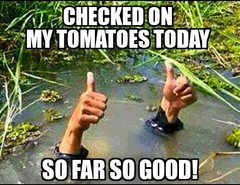
    Haven't planted beans yet. But I do have a few tomatoes in the garden:

    George

  • 9 years ago

    Thank you! This year is all about using and tasting beans. Yay!

  • 9 years ago

    I didn't make it out to check the rain gauge before it got dark, but suffice it to say it might be topped after this evening's rain. Holy baloney.


    I think this rain answered my lettuce problem. The lettuce that hasn't gotten waterlogged is nice and crunchy. Maybe I need to water more? Ya think? lol I ran out earlier before it started storming again to grab a few leaves for a sandwich, and figured it out. It is growing so fast that it might grow legs and climb out of it's pot.


    However, the peppers are pouting, like, hardcore. And the weeds in back are up to my knees, but the guy who mows for me couldn't fit me in last week, and now who knows how long it'll take to dry out enough to do it.


    I think I'm going to spend a fortune in fertilizer for the potted stuff this week, just trying to replace what's been washed out. The stuff in ground I may not need to water until Memorial Day, at this rate.

  • 9 years ago

    Rebecca, I've noticed the same with my lettuce. I hate watering. I think I'll plant them up next to the house this fall so I can easily water.

    My peppers are looking pretty lame, too.

  • 9 years ago

    I think I thought I was on the month thread, lol. Oh well, only one more day.

  • 9 years ago

    Rebecca and Amy you're cracking me up. Read the directions? What a novel concept, eh? Rebecca. . . yeah I'm in May, already. Dawn. Dawn, Dawn. SO nice to meet you in person!

  • 9 years ago

    George, I loved the photo! I hope you and your plants are not underwater. I've been watching the rainfall totals (and forecast crest of the Illinois River near Tahlequah) in total amazement.

    Rebecca, Lettuce does like water, but be careful not to overwater or it can get diseased and even can rot off at the soil level if enough rain falls.

    Some of the pepper plants I planted later are a bit yellowish-green. I think their root systems just aren't big enough to deal with the strongly fluctuating soil moisture yet, but the ones I planted earlier have great root systems and great dark green color. I haven't had nearly as much rain as most of you so that might be why. The one or two cold nights in the 40s each week haven't been good for the pepper plants either. It is May now, so hopefully the weather will be more to the peppers' liking.

    Bon, Enjoy the Year of the Bean. I love beans and grow far too many of them, but that freeze well, so its all good. This year I'm planting fewer green beans (STILL have some in the freezer from last year) and a lot more southern peas, so for us, I guess this will be the year of the pea.

    DIrections? Directions? We don't need no stinikin' directions! I admit that I haven't read seed packet directions in years, and I always take them as suggestions, not commandments anyhow, because I am stubborn that way.

    Nancy, It was so, so great to meet you too!

    Good-bye April, hello May!

    Dawn

  • 9 years ago

    Dawn, thanks for the explanation on the rain on roots on small plants. All my pepper plants are small because the weather just didn't work for them much this spring. Usually, I can get them out during the day for some heat and sun, but nada this year. I don't know why the tomatoes are much bigger and better, but they are.

    We've more rain and more cold nights coming, so I'm germinating peppers all over again for the fall garden.

  • 9 years ago

    George, we really were 2nd to Tahlequah (for the month). Holy moly! Fourteen inches! (Oilton Meso)


    Mesonet Rainfall for April

  • 9 years ago

    Bon, You're welcome. Hopefully the pepper plants you have in the ground now will hang in there and those root systems (and the plants themselves) will enlarge and get growing again once the soil dries out a little. You've had an awful lot of rain, and that's a lot for them to deal with. The good thing is that peppers can grow and produce all season here. The pepper plants I put in the ground in April will produce until frost, and I generally don't start a new crop for fall since the spring-planted ones just keep on producing. Sometimes I sow seeds of ornamental peppers to put in the ground in early through mid-summer, just for fun....because that's often when the stores get new shipments of ornamental peppers here, and then I want some the minute I see them. So, instead of being lazy and waiting and buying theirs, I try to sow seeds of ornamental peppers in May so I can have my own at home ready to plant about the same time they arrive in the stores.

    Everything that I grow in my garden is not in raised beds, but the peppers, tomatoes, onions and potatoes always are in raised beds to help protect them from the torrential rainfall we sometimes get here and there. I don't know how pepper and tomato plants can survive the sometimes-heavy springtime rainfall when planted in grade level soil---clearly when that happens, those plants must be growing in well-drained soil that drains so well that raised or mounded beds aren't necessary. I'm thinking back to May 2015 when we got 24+" of rainfall that month and a foot of it fell in one day. While the onions and potatoes suffered greatly even in raised beds, I was surprised at how well the tomatoes and peppers did overall. Some years all we can do is plant and then cross our fingers and hope for some cooperation from the weather. Sometimes we just don't get that cooperation at all. I hope this is not going to be one of those years.

    Dawn

  • 9 years ago

    24" is a massive amount of rain. I gulped when you wrote "May is the rainiest month.", to paraphrase. **tightens seat belt**