Software
Houzz Logo Print
sorie6

weed or flower?

9 years ago
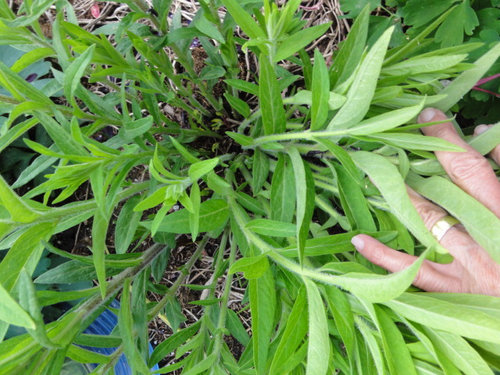
I planted a butterfly weed here but I don't remember it being fuzzy like this?

Please help!!

Thank you


Comments (23)

  • 9 years ago

    Looks/sounds more like a butterfly bush (buddleia). But I admit I'm not that familiar with many plants in OK.

  • 9 years ago

    Don't think it's butterfly bush. I have one and its leaves don't look like that.

    thank you tho.

  • 9 years ago

    Agree, after inspecting. :)

  • 9 years ago

    How about the possibility it's Butterfly "Milkweed"? If so, blooms will be orange, and they make a clump along roadsides.

  • 9 years ago

    I agree that it might be butterfly weed. I think their leaves are sorta fuzzy.

  • 9 years ago

    Welcome Millie so glad to see you here. This is a great group of crones and beginners all helping each other. I did not grow up gardening but I am learning fast with all the super people here.

    Kim

  • 9 years ago

    Hi Millie, Welcome to the group. Based on your lifetime of experience and all the garden wisdom you've accumulated, we will let you be the official garden crone and I'll be the garden crone in training. How does that sound? We aren't all that far from each other, are we? I mean, relatively speaking, of course. My dad grew up across the river in Montague County, TX, so even though I was born in Fort Worth and spent my first 39.5 years there, I feel like I 'came home' when we moved here because we're so close to where my dad grew up.....also, relatively speaking.

    When we cross the Tayovayas Bridge in western Love County (pretty close to the Love/Jefferson County line) and then go west from there, we are in Spanish Fort (pretty much a ghost town now, though the old school still stands and the cemetary is still there) where Daddy grew up. When we are having an awful hot and dry summer and I'm thinking "I can't stand this, I can't bear to garden in this heat", I think of my dad and his siblings hauling water from the Red River one bucket at a time to try to water the fruit trees enough to save them, and then I keep on plugging along for a bit longer...at least until the next gigantic water bill arrives.

    Dawn

  • 9 years ago

    Hi, to all who responded to my chatter. It will take time to sort all of you out. Many years ago, before Houzz, I used to hang out on the Antique Rose forum as that was what I was into at the time. Have always found plant people to be a friendly lot.

    Dawn, I can relate to what you had to say.. in fact, I may have been there. ;-) For us the power lines stopped about 100 yards short of making it to our house, then WW11 started and there it sat until I was 11 years old. I was the official water girl for canning season and laundry days. However, we did have a well with a bucket and windlass to pull it up. It wasn't so bad, at the time, since we didn't have anyone around telling us we were deprived. Grandparents were telling us how hard it was in their early lives. When the rains failed, we did carry buckets of water to the garden. There was a nice little clear stream flowing just past the garden fence, but it would have been too expensive to buy a gasoline powered pump just for that. Anyway, gasoline was rationed.

    On the plus side, we still had hens that would set. Animals got themselves born and neighbors helped each other with butchering, etc. I can't remember a vet bill. I guess the world was less polluted by big Chemical Companies back then. Grandma's home remedies seemed to take care of people and animals. I think we were too afraid of her remedies to get sick. LOL We kids had much safer surroundings to grow up in. Creeks to fish, swim, or just wade in once our chores were done.

    OK, that's enough of that... I need to find something useful to do. ;-) Take care all. Millie

  • 9 years ago

    Millie Personally I think you sharing with us is very very useful. I miss my grama so much and I soooo enjoy hearing the stories about life before modern conveniences. Share every chance you can we all love it here

    Kim

  • 9 years ago

    Good to meet you Millie!

  • 9 years ago

    Thank you very much Kim and Amy. I have already learned things here that I had never considered. I've been hidden away from major farming areas for so long I was unaware of herbicide contamination of hay/straw and manures. My son was having so much fun hauling shavings and animal bedding materials from the local fairgrounds... all went well for 3 years. I am unable to stoop or get up and down to garden, so I had been passing on what I knew to him. He found a partial bale of hay... shredded it and added it to a summer compost pile last year. When fall came he cleared his no-till in-ground beds and dressed them with fresh compost and shavings for this year. (Think he needed space for more compost.) Anyway, we got a big surprise this spring when early peas came up all gnarled and twisted looking. Then I read all about the contamination problem here on the forum... we ran the bioassay test. Wonder if anyone on the forum has had to deal with this and how long it took for the soil to recover? We have had some luck planting in what was our walkways... they were only covered with wood shavings. Naturally he removed all the shavings and compost from the top of the beds, but it had already washed into the soil. He is pretty aggravated, but planning for the future like most people hooked on gardening. Millie

  • 9 years ago

    Millie, Bruce and Dale have had it and I believe both used different forms of mitigation to help clean up the soil. I sent them a message on Messenger asking them to drop by when they are free and tell you what they did in their gardens.

    You do know that y'all can plant onions or corn there in the contaminated areas because the herbicides that have the persistent carryover issue only target broadleaf weeds.

    If we don't hear from Bruce or Dale today, I'll list some ways to mitigate damage---but I haven't used them myself because I've avoided herbicide carryover damage by not bringing in outside material from off our own place. I figure the carryover won't end up in my garden if I don't put anything in it that could be contaminated.

    Some people I know here have acreage, so they just plowed up a new spot and made a new garden after their garden developed herbicide contamination, but that's not a workable solution for everyone.

    Most folks with herbicide carryover can find their garden unusable for at least 1 to 3 years, depending on how much herbicide they have in the soil and also depending on how much mitigation work they do.

    Dawn

  • 9 years ago

    Like many, I pretty much ignored warning about using manure products. A few years back I got a real dose of 'wake up and pay attention'!

    My herbicide issues came from a load of horse manure compost from a local source that looked great. I worked in some decent amounts in the rows where I later planted my tomatoes. Some went in with potatoes and various other crops, but in lesser amounts.

    About the time the plants really took off and started growing, I started noticing a weird leaf curl and a serious decline in growth. I posted a few pics on here and Dawn mentioned the possibility of herbicide residue. That got me to researching and setting up a meeting with our County Extension Horticulturist in hopes of identifying what was going on. He took one look at the pictures I had and the plant I had potted up for backup using some of the compost mixed in the potting blend.

    Fortunately George was prepared to give me a game plan that ended up breaking down the herbicide in a matter of months rather than the 3-4 years it would take if left alone. He explained that increased microbial activity in the soil would accelerate the process and recommended I plant mustard, as in mustard greens. Multiple plantings in fact. As soon as it reached 12-16", the plants were chopped up and tilled under. Then the entire area was reseeded and it started all over.

    I managed three crops using the same technique and by the next spring I had volunteer tomatoes sprouting and showing no signs of herbicide.

    Activated charcoal and solarization can be used, but can be cost prohibitive. I chose not to use either, so I can't attest to how well they work. Another option is to only grow unaffected crops such as onions or corn.

    I did move 8 of the affected plants over to a portion of where the compost had been added and experimented with trying to save them. I fertilized and watered on a rigorous schedule. The tomatoes did in fact grow out of the melted leaf stage and went on to produce like a person would expect. We couldn't make ourselves eat the tomatoes. I harvested them and simply tossed them on the ground. Hence, the source of seed for the volunteers, the next spring.

    Millie, I really enjoy reading your comments and welcome to our 'crazy' bunch of gardeners!


    Bruce


  • 9 years ago

    Crazy? Bruce, we aren't crazy. We are the sane ones. It is the rest of the world that is crazy.

  • 9 years ago

    We might have been just a little crazy on Sat, maybe? At least we were in good company!

  • 9 years ago

    I doubt I will ever have that problem, because I had such good teachers the last few months. Dawn, I was SO bummed about not using the chicken fertilizer from the kids, but by gosh I did not! Although the tomato samplings I planted with it in the mix look the same as the rest, that stuff is still piled next to the compost. Better safe than sorry--you guys' lessons and warnings worked in spades for me. It can just sit there for a good good long while. . .like maybe a few years, maybe more. LOL Thank goodness we didn't have a whole truckload of it! And the rest of the gardens are doing just fine, I can find enough other stuff. Right? :) Thanks for all the good you guys do!

  • 9 years ago

    Dawn, what was the old saying about everybody being crazy except me and thee and not too sure about thee. ;-)

    Nancy RW, lots to learn about the real world for me. I have been living an insulated life for the past 35 years.. away from BIG FARMING. I knew all my sources, but didn't know I needed to know them until now. If I hadn't read about it on this forum, I would still be wondering what went wrong. Millie

  • 9 years ago

    Me, too, Millie.

    It's nice to "see" you here!

  • 9 years ago

    I went for a couple of years where I wouldn't consider bringing in any kind of manure or compost, but with my mix of deep sand transitioning to brick clay, I realized I needed more than I could come up with on my property. I finally broke down and started bringing in manure and sometimes hay, but I always run a bio-assay before I bother to haul it. So far, I haven't run across any that have tested positive, but I won't quit testing!


  • 9 years ago

    okoutdrsmann,

    We took your advice and made the first planting of mustard today. Thank you for the advice.

    I used to get composted pine bark which was recommended for our soil in MO. I have been wondering about using the natural pine bark mulch run through a shredder for the brown in compost that is mostly our own grass clippings. The rest would come from two elderly neighbors who not only would not spray herbicide, but are not able physically for financially. My son has been mowing for them to help out, and catches the grass already. I now wonder if vegetable scraps other than home grown would be safe to use? This has really been a wake up call for us as well. We are both pretty bummed out over this whole experience.

    Guess we'll be concentrating our efforts on training young fruit trees for this year. Millie

  • 9 years ago

    Hi Millie! Nice to have another kindred spirit in the group! Sorry about your herbicide problem!

  • 9 years ago

    It's wonderful to hear from you, Millie. I look forward to seeing more of you. :)

Sponsored
Peabody Landscape Group
Average rating: 3.5 out of 5 stars8 Reviews
Columbus' Reliable Landscape Design & Contracting