Software
Houzz Logo Print
ilovemytrees

Is this a fungal or bacterial problem?

9 years ago
last modified: 9 years ago
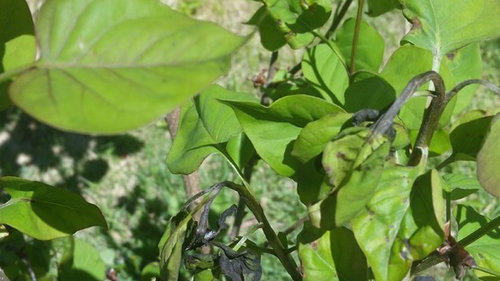

4 of my 5 four foot tall Declaration Lilacs have their leaves turning black, and so are the buds. This may sound weird, but it looks like it's spreading from shrub to shrub because my outer lilac looks by far the worst and the one next to it looks slightly better and the one next to that looks like it's just starting.

Do I get an antifungal spray?

Comments (16)

  • 9 years ago
    last modified: 9 years ago
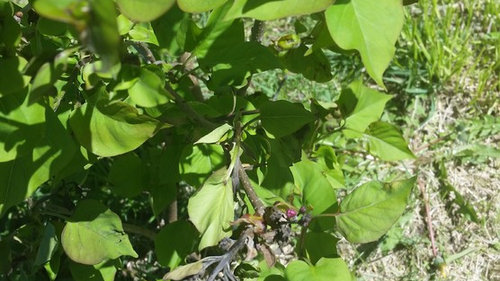
    Compare with effects of Pseudomonas syringae, a bacterium.

    ilovemytrees thanked Embothrium
  • 9 years ago

    What spray do I use?

  • 9 years ago

    From the page linked to above:

    Chemical Management: Pesticides should only be
    used if the disease is severe. In New York State,
    homeowners may be able to use Phyton 27 (EPA Reg
    # 7758-99-8) for management of Bacterial Blight.
    Apply once in September, and make another before
    the fall rainy period begins. Other products may also
    be registered, but be certain any pesticide purchased
    is labeled for this use, and follow label instructions
    for managing this pest.

    ilovemytrees thanked Embothrium
  • 9 years ago
    last modified: 9 years ago

    We have to dig up 6 of the 10 older lilacs. There's no way around it. 5 of them are fully engulfed in blight, one is only 50% full of it, but dh and I decided that we'd rather not keep one that has it, to protect the 27 other lilacs we planted recently. I sprayed the copper fungicide on all of my lilacs that don't have it.

    I will be buying the Phyton 27 in September, for sure. This blight will never happen again, because now I know what to look for in terms of signs of this infection, and we will be taking on preventive measures..

    I knew there were risks planting the same plants together; I just didn't think the consequences would be almost immediately, and I will definitely be on top of this come next spring, you can bank on that.

  • 9 years ago
    last modified: 9 years ago

    ilovemytrees, we did some research last year because we thought that our lilac was infected by bacterial blight. A combination of two ingredients, copper and mancozeb, are reported to be effective against this type of blight. The copper fungicide you have is a different form than what is usually recommended as effective against lilac blight and this other form can be found in Phyton 27 (or other products but only this one has been approved so far for distribution in NYS).

    As for mancozeb, there are several products, including Bonide which is in the dust form.

    I read in more than one source that this combination should be applied both in spring and fall. For the prevention in spring, "If you have had problems with bacterial blight, you may want to use a combination of copper and mancozeb-containing fungicides for control. Apply fungicides two to three times at seven to 10 day intervals as leaves emerge, but before symptoms develop" This looks consistent with what gardengal suggests as a precaution.

    http://hort.uwex.edu/files/2014/11/Bacterial-Blight.pdf

    Several lilacs on our street showed the same symptoms as ours -dead canes and dried leaves & buds- last summer but I don't think it was bacterial blight as is probably with your lilacs. In any case, only one neighbor decided not to prune his lilac to the ground and it's the only one that is now standing as an ugly dead shrub in his frontyard while the rest of us have new growth - no blooms of course this year, but it turned out we were right to prune them down because it saved our (affected) lilacs.

    ilovemytrees thanked vesfl (zone 5b/6a, Western NY)
  • 9 years ago

    Looks like frost damage.....

  • 9 years ago

    Yes, before doing anything drastic make sure it is in fact bacterial blight. If you can get to a USDA Cooperative Extension office near there when they are open try taking some good examples of what you have there for comment.

  • 9 years ago

    So, don't rip them all out :). How are the viburnums doing?

  • 9 years ago

    Yes, I think you are best advised to check with your local extension office. Since you are also in Western NY, it's likely the Cornell branch... We chose to prune ours down to the ground only after it was completely dried out and not a single leaf was green any more. The canes were brittle and some were falling apart. It's still unlikely that it was blight but there was no point holding on completely dead canes and branches no matter what caused it. Your case is very different, though you do want to act quickly if it's blight so best is to contact the extension office to see what's going on.

  • 9 years ago
    last modified: 9 years ago

    It couldn't have been frost damage.

    When the lilacs began leafing out and blooming this year, any time we had a frost or freeze forecasted we wrapped the lilacs in light blankets, like we've always done. For the newly planted lilacs we put 5 gallon buckets over them.

    The yard looked hilarious with buckets all around the back yard. We've even done that the last few days because of frost forecasts. There has never been a single time that frost touched any of those leaves. I am 100000% sure of it.

  • 9 years ago

    Frost doesn't have to touch leaves to do damage, it's the temperature near the ground. Hard plastic pails have a near zero insulation value so if the temps stay below freezing for a long enough period of time, it is soon as cold inside the pail. I'm not saying for sure that you have freeze damage, although it appears that way but I've had a number of plants damaged even under blankets.

  • 9 years ago

    wish i could figure out how to mail you a real L.. without posting an address on the WWW


    ken

    ilovemytrees thanked ken_adrian Adrian MI cold Z5
  • 9 years ago

    i 'liked' you.. see if you can send me an email .. thx

    ilovemytrees thanked ken_adrian Adrian MI cold Z5
  • 9 years ago
    last modified: 9 years ago

    Like bill-minn says, putting covers over plants (especially black ones) may not fully protect from frost -- I did it before & frost damage went right thru it. Again, the way the plant tips are blackened/wilted looks just like the current frost damage on my plants...

  • 9 years ago

    Frost damage would not just manifest at the branch tips - it would affect more developed leaves as well. Also, the OP indicated that there has been NO frost since receiving these plants and lilacs - even in leaf - are pretty darn cold tolerant!! It would take a late freeze........not just a frost....to do any serious damage.

    Diagnosing plant problems online from just a photo is always risky. To confirm if this IS bacterial blight, the OP needs to take a sample into their local extension office for an accurate diagnosis.