Software
Houzz Logo Print
vvasabi

Containerize B&B’d JM Mikawa Yatsubusa

9 years ago
last modified: 9 years ago
Opps. I thought I did double posting and tried to delete a duplicate. It turned out that there was no double posting and I killed the original. Here is what I wrote again.

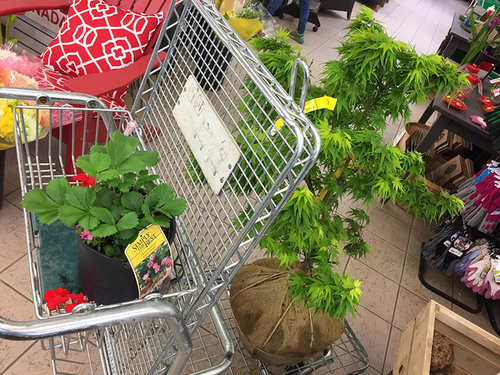
Last weekend I found a JM Mikawa Yatsubusa that was balled and burlapped. I paid CA$200 at a local nursery (Sheridan Nurseries). The whole thing was really heavy. The twines would cut into my palms as I tried very hard to lift it. Being an office worker I must grow more muscles... Below is my beginner’s attempt at planting this tree in a 10-gallon container.

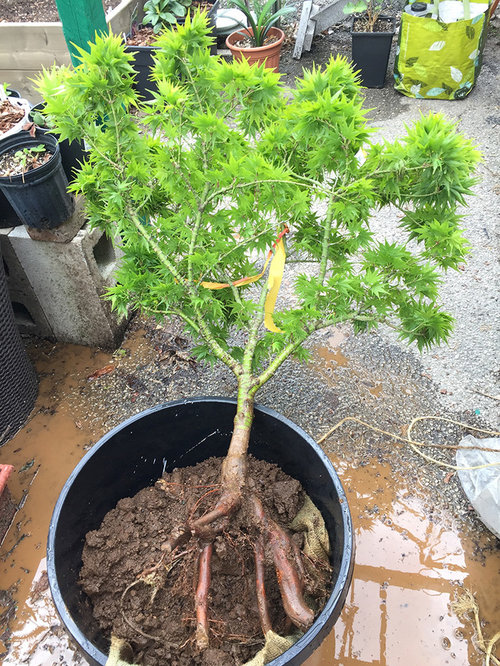
I started the process the day after I bought this JM. It didn’t take me long to separate the tree from the burlap and clay/mud. The tree alone weighted lighter than a brick.

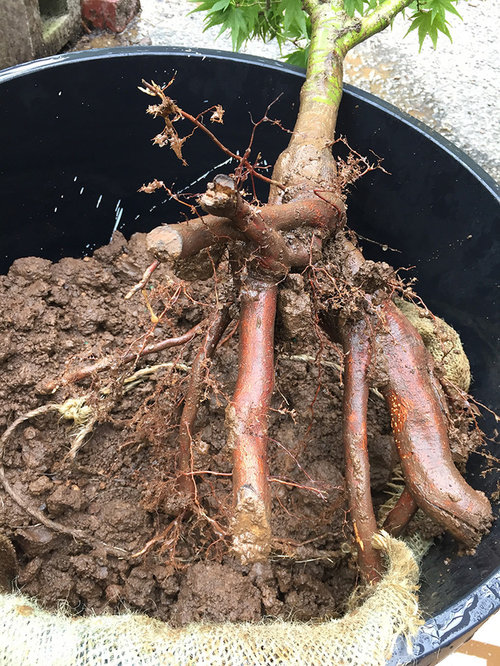
Despite the foliage above, the roots looked really sad! It must have been harvested recently, as there was no new growth on the roots.

Since people are expected to plant the dirt and some of the burlap that come with a b&b’d tree, I wonder how this JM was supposed to thrive in the heavy clay.

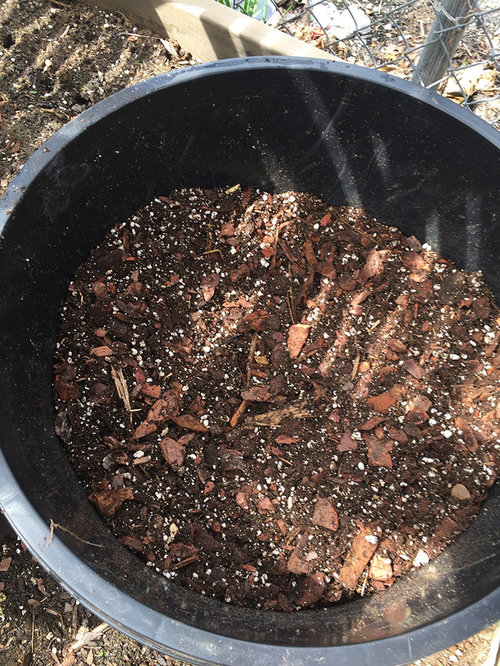
My soil mix was based of Al’s 511 mix. I put in 5 parts of Fafard Pine Bark Mini Nuggets. I did not screen the nuggets, and there were some larger pieces and sapwood. I used them anyways, as they have worked well for me in the past in other containerized woody shrubs. The other ingredients were 1.5 parts of recycled Fafard Agro Mix, 0.5 part of the clay that came with the tree and 1 part of perlite.

I also amended it with greensand, rock phosphate, azomite and kelp meal, each at half a cup. I have no proofs that they actually make a difference. Since they were what I already had, I threw them in anyways. I plan to use nothing else, fertilizer-wise, this year.

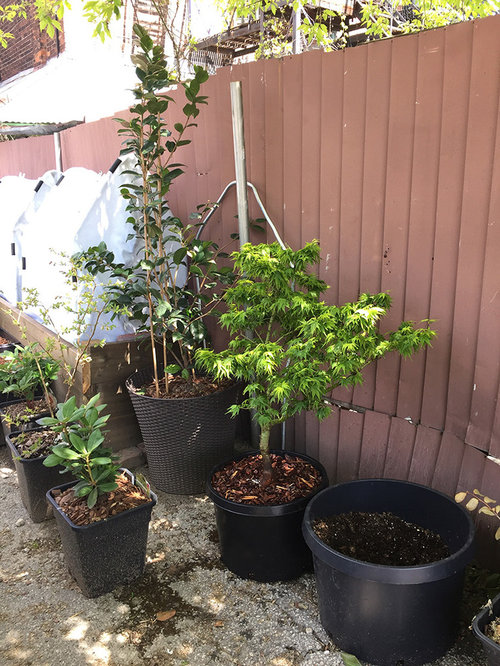
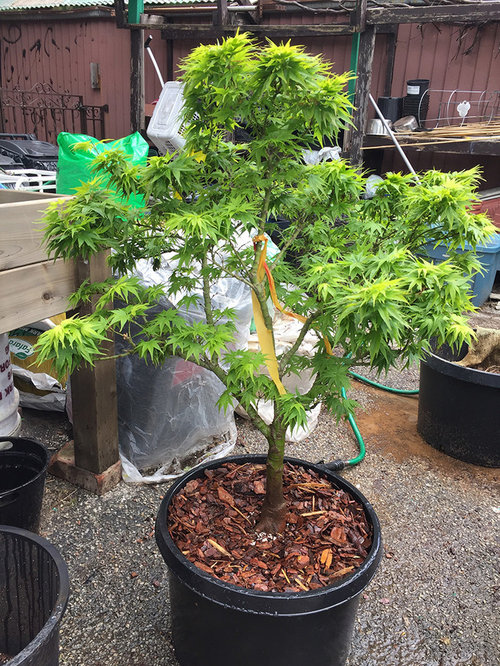
This is how the JM looks like after the process. Mikawa Yatsubusa writes as 三河八房 in Kanji, literally meaning 3 rivers and 8 houses. The branching structure does look like a few main trunks leading to smaller compartments. Without any further work, this tree already looks quite pretty. I have removed dead/damaged twigs and will do further pruning later in the future.

It joins my camellia in the shade for now. Thanks for reading.

Comments (22)

  • 9 years ago

    Most JM growers no longer cultivate field grown trees - those that are commonly sold as B&B - in favor of containerized maples. The reasons for this are pretty straight forward: JM's have a very sensitive root system that does not respond well to disturbance. And harvesting field grown trees involves a LOT of disturbance, with up to 85% of the root system severed or missing. Removing the clay - and all field grown trees are grown in heavy clay for ease of harvesting - can often create even more disturbance, as it typically will pull off a lot of the fine feeder roots, which really support the growth of the tree. Many nurseries will negate any warranty provisions they may offer if the clay rootball is broken at planting or removed.

    Not saying this to alarm you but only so you can be aware. I would never purchase a B&B tree for container planting because of this reason. I would also never attempt to bare root one at this stage of the growing season, but so far, yours looks OK. I would continue to monitor it closely this season.........root shock can often have delayed symptoms and reactions and I would not consider this tree to be out of the woods until it leafs out again next spring.

    vvasabi thanked gardengal48 (PNW Z8/9)
  • 9 years ago
    last modified: 9 years ago
    Yes, I am totally voiding my warranty. In my area, the weather is still quite chilly, and my summer veggies are still covered for another week. But, you are absolutely right that I am doing something risky. Even under the shade, I wouldn’t be surprised if it sulks for a while this season.

  • 9 years ago

    Japanese Maples grow just fine in clay soil.

    vvasabi thanked tlbean2004
  • 9 years ago

    Japanese maples' ability to grow in clay is not at issue :-) What IS at issue is dealing with that clay rootball that all field grown trees come with if you intend it for container culture. The OP's process was dead-on for preparing the tree for a container - it is just a significant risk to remove that clay surrounding the rootball (and more particularly, at this time of year!)

    And just an FYI but JM's only do well in clay if that clay is well draining. Fast drainage is absolutely essential for these trees or you WILL have problems down the road.

    vvasabi thanked gardengal48 (PNW Z8/9)
  • 9 years ago

    There are SOOOO many JM's planted around my town and we have clay soil. There are just fine. I guess the clay is well draining..

    vvasabi thanked tlbean2004
  • 9 years ago
    last modified: 9 years ago
    Yes I believe trees grow fine in clay, too, since container mixes are just a recent human-made invention. I was more curious about how long it would take a JM to become eatablished and to thrive in heavy clay soil vs. a loose and airy mix.

    gardengal48, I appreciate that you point out the risk of this process. It is certainly not something people should try to do everyday and especially not with leaves all grown out. I put my JM under shade and I plan to mist the foliage as frequently as I can. Even so, there is still a good chance that it may not survive. We will see. :-)

  • 9 years ago

    I think it will be fine. The best practice is to repot or bare root the tree early spring. But I had to move one in the middle of summer once and barerooted it in the process and it did fine. And I dont have the benefit of your much cooler summers. Now that's just an anecdote, not a guarantee, but I think you have a real good chance. Keep it really well watered. It sounds like you used a good container mix that drains well. I will even go as far as to say that a real small amount of slow release fertilizer would be a good idea, like 1/4th the reccomended amount, of even less. That's controversial to some but I dont think a complete deprivation of fertility is helpful for any plant or even a good.idea good luck its a nice tree

    vvasabi thanked Todd C
  • 9 years ago
    last modified: 9 years ago
    I would also add that I wouldnt necessarily shy away from a field grown tree, but if I did buy one, I would do exactly what you did and bare root it, just earlier. And I would do so knowing there is a small but not insignificant chance of failure. If it does survive you are probably better off than you would be had you purchased a container plant that size because there is a high likelihood the tree would have been underpotted with root defects

    vvasabi thanked Todd C
  • 9 years ago

    My Mikawa Yatsubusa was even larger than the OP's when purchased but container grown. As are most JMs in my area. Very few Japanese maples are ever presented as field grown trees in this area (all the local wholesalers grow them in containers) unless they are very large specimen trees. And those are typically ones that have been reclaimed/recycled from private gardens. Wholesalers just turn them over too fast for them to reach a significant size in the ground :-))

    I would say that in all my years of selling, acquiring and growing JM's in this area, I have found very few that were not well grown for container plants. Few to none circling or girdling roots and pot sized appropriately. May not be the cases elsewhere.

  • 9 years ago

    > The best practice is to repot or bare root the tree early spring.

    One reason why I had to do this at this time, aside from the fact that I just bought it, was due to with how late JMs hit stores here. Nurseries don’t really sell JMs without leaves, and, when stored outside, they don’t have fully grown leaves until late April or even early May. (That shows how dreadfully long winters are up here...) The Mikawa Yatsubusa I found was in the store for less than 2 weeks.

    > I dont have the benefit of your much cooler summers.

    This is the first time that I consider my cool climate to be a “benefit.” (LOL) The summer is indeed quite cool here. It probably gets warmer than 90 °F for less than 2 weeks in a year. The AC unit is practically an ornament of my house. In mid-May, it still rarely gets above 70 °F, and nights are usually below 50 °F.

    > I will even go as far as to say that a real small amount of slow release fertilizer would be a good idea, like 1/4th the reccomended amount, of even less.

    If my JM doesn’t show significant decline in a month, then I might toss in something at a small dose. I did put in some kelp meal, so I think it is not completely deprived of nourishments.

  • 9 years ago

    How long does it take for a JM trunk to get that thick?

  • 9 years ago
    last modified: 9 years ago
    tlbean, I think it depends on the variety of Japanese Maple but I would say maybe 10 years for the Mikawa Yatsubusa.

  • 7 years ago
    last modified: 7 years ago

    vvasabi, I am curious how your MY has done since its potting?


    Also I would like to know where you obtained the "Fafard Pine Bark Mini Nuggets" as I need similarly to pot some soon to be purchased JM. (I too reside in Ontario and am having difficultly sourcing "bark fines" or the like for such a purpose.)

  • 7 years ago

    Hi rouge21_gw, others in this thread were right that what I did was a bad idea. It was mostly bad timing, as it was better done before the maple leafed out. My maple survived the surgery, lost a lot of leaves but died after the winter. My other JM’s that originally came in containers survived the winter just fine. If you are about to repeat what I did, you will want to plant your JM somewhere in the ground and wait until the next spring.

    I got my mini nuggets from Sheridan Nurseries. They are indeed hard to find, as Home Depot, Lowe’s, etc. carry only the bigger, non-mini version. I believe there are also specialized mulch suppliers who sell by yards that may have something similar. While what I did in this post was not recommended, I did have a lot of success using mixes containing pine bark, both for indoor and outdoor plants.

  • 7 years ago

    Sorry it didn't make it but not exactly unexpected, given the treatment and its timing :-(

    OTOH, I repot JM's at any time of year, generally soon after I acquire them. But I have never worked with one that came B&B and most growers here use a container mix that is very close to the 5-1-1 (heavily bark based) so no need to remove the existing soil before repotting.

    vvasabi thanked gardengal48 (PNW Z8/9)
  • 7 years ago

    I got my mini nuggets from Sheridan Nurseries.


    I will check at Sheridan but as far as a I can tell I can't see on the Farfad website any "Pine Bark Mini Nuggets" product.

  • 7 years ago

    vvasabi, thanks for the update. How do you overwintering your other JMs? I have a few that I always bury the pot into ground and then dig them out coming spring. But I am wondering if I can forgo this step as the pot getting bigger and heavier. Will they survive our winter if just leave them and pot outside? (New England zone6b) thanks.

  • 7 years ago

    Hi rockdale, I do exactly what you describe here and would not recommend otherwise.

  • 7 years ago
    last modified: 7 years ago

    Thanks, vvasabi! Guess I will keep digging holes in fall. :) was hoping there are other options. Burying in the ground works fine for overwintering but in the spring it always ends up with garden soil in the pot plus you kind can only use the plastic pot (mostly I just reuse the black nursery pot) and in summer, it is like walk in a nursery :) I just repotted one into glazed pot, guess I have to bury that one into ground too.

    vvasabi thanked Rockdale (RI Z6)
  • 7 years ago

    Light is not necessary? That’s great news. That means I can put them in my attached garage or basement then. I will try that on one of the trees this winter . Thank you gardengal!

  • 7 years ago

    Yep! No photosynthesis when no leaves so can easily do without light.

Sponsored