Software
Houzz Logo Print
westes

What Is Wrong With This Rhododendron (Horizon Monarch)

9 years ago
last modified: 9 years ago
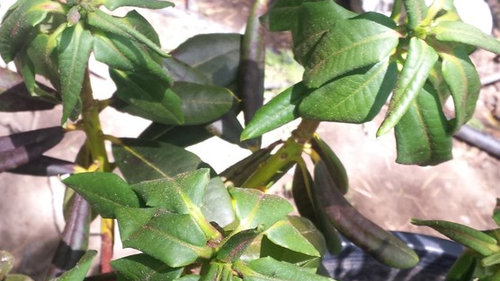
I just purchased a five-gallon Horizon Monarch rhododendron. I temporarily planted it in a 15-gallon container loaded with high-quality orchid bark, which is almost certainly redwood. After about a week in that container, the leaves are starting to wilt. See the two attached photos. What are likely causes?

I felt into the soil and it is moist not wet. I'm waiting for it to dry out before watering again.

I measured pH of the water at that plant's water source, and it tested 6.1.

I am going to buy a soil pH meter, but some crude tests pressing the soil against pH paper suggest the pH might be around 5.0.

The plant is in the shade of a tree, but it is probably getting direct sunlight periodically during the day. Here is information on the breed:

http://www.greatplantpicks.org/plantlists/view/1312

The grower is near Arcata, California, and I am near San Jose, California. The grower had this plant in the ground a few weeks before selling to me. The plant looked fine when it arrived and for its first few days in the new container.

Any ideas on what might be shocking this plant? It looks like a very robust rhododendron, and I would hate to lose it.

Comments (9)

  • 9 years ago

    That sounds like a good guess. I am going to give them a long and thorough soaking. If it is water, I guess the leaves should come back quickly?

  • 9 years ago

    Not all leaves will come back quickly. Some in the bottom photo will probably retain the crisped edges and may not plump up at all. Misting will be very helpful in restoring the leaves as most rhododendrons can absorb a good deal of water through their leaf surfaces. Until the roots are functioning properly, misting is probably the best thing you can do to bring the plant back to good health. Maintaining high humidity through misting or a poly tent will prevent the plant from losing more water than it can take in through its roots.

  • 9 years ago

    @akamainegrower, you were right! I gave it a thorough soaking in the morning, and it is coming back rapidly.

    I want to see if I can generalize this experience to learn from it. When a plant has its roots cut, is the wilting of leaves you see after that mostly about the inability to take up water from the soil because of the shortened root structure? If yes, do you need to compensate for that by more frequent waterings until the plant grows new roots?

  • 9 years ago
    last modified: 9 years ago
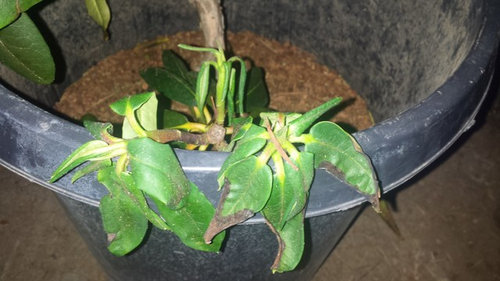
    @akamainegrower, what I also don't quite understand here is that when the soil was "dry" and the leaves were wilting, the soil beneath the surface felt moist to the touch. The redwood bark under the surface was stained dark, showing absorption of water. Is the issue here that the bark is not able to release moisture to its surroundings easily? I had (incorrectly) believed that the plant root ball would be creating some negative pressure and sucking water out of the humid surrounding bark. It looks like the water in that bark was somehow trapped and not usable to the roots.

  • 9 years ago

    The movement of water in planting media of various types is a surprisingly complex subject. The Gardenweb Container Forum contains a great deal of information about the subject. In general, the more dissimilar the new medium is from what a rhododendron has been growing in, the more difficult the transition. Many commercial rhododendron growers do use pure bark as a planting medium in pots, but what they use contains particles of many different sizes which retains water more effectively than highly screened bark intended for orchids, many of which are epiphytic growers. This coarse bark mainly retains water as a thin surface film which rhododendron roots have great difficulty accessing. The 5-1-1 mix of Container Forum fame is a good mix for rhododendrons in pots, but must be changed every 3 years or so. Whenever you are trying to establish a rhododendron in a new environment, avoid direct sun, try to maintain high humidity, water - if needed - with a trickle at the plant base from a hose. If you still get wilting leaves, don't hesitate to soak the rootball again if it is dry. Submerge in water, pot and all, for a half hour or so. Re-dig, soak and re-plant ones in the open garden.

  • 9 years ago

    @akamainegrower, just one other question there, as I really want to learn from experience:

    "I want to see if I can generalize this experience to learn from it. When a plant has its roots cut, is the wilting of leaves you see after that mostly about the inability to take up water from the soil because of the shortened root structure? If yes, do you need to compensate for that by more frequent waterings until the plant grows new roots?"

  • 9 years ago

    If the rhododendron is dug from the ground, it's the fine root tips which are usually severed. These regenerate quickly in the right conditions, but for a time the plant's ability ability to move water is lessened. Moving from one container to another would not usually involve losing any significant portion of the root ball, but especially for root bound plants, roughening and teasing out the roots to encourage growth into the new planting mix is important.

    It's a very fine line between making sure the rootball does not dry out excessively and not keeping the roots so wet that they rot or receive insufficient oxygen or become subject to one of the various fungal root diseases. it is probably better to err on the side of dryness rather than the reverse. A moist but not sopping rootball plus misting or maintaining high humidity by another means, plus avoiding direct sun especially during hot weather are the best means of insuring success. Occasionally, however, a rhododendron will resist becoming established in the ground or container even though everything would appear to have been done correctly.

    westes Zone 9b California SF Bay thanked akamainegrower
  • 9 years ago

    @akamainegrower, what if the transplant is a tree or hedge that has a large section of its roots severed? Is the "transplant shock" that results in wilting leaves primarily about the reduced ability to uptake water through a shortened / severed root structure?

Sponsored