

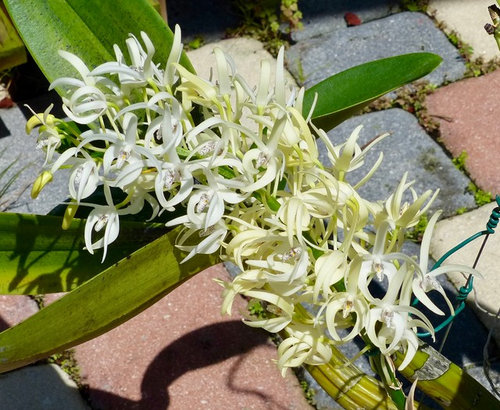
dendrobium speciosum var hillii
Comments (23)
 9 years ago
Although habitat for "hillii" covers a big range some plants come from altitudes to 1000 metres amsl so chilling would be built into their system. There are other varieties which would have less need of chilling.
shavedmonkey (Harvey in South Fl.)Z10b
Original Author9 years agoI have other varieties that bloom. Hillii would work here in normal winter weather. I'm betting on a return to normal winter weather.
Related Professionals
Fargo Landscape Architects & Landscape Designers · Ithaca Landscape Architects & Landscape Designers · Milwaukee Landscape Architects & Landscape Designers · San Bernardino Landscape Architects & Landscape Designers · Pensacola Landscape Contractors · Emporia Landscape Contractors · Galveston Landscape Contractors · Pittsfield Landscape Contractors · Orange County Landscape Contractors · Kalispell Landscape Contractors · Seattle Landscape Contractors · Spokane Landscape Contractors · Sanford Landscape Contractors · Natchez Architects & Building Designers · Lewiston Architects & Building Designers- 9 years ago
My father had var speciosum that I originally gave him. It grew massively and flowered prolifically each year. I moved to a different climate but when I got some of my father's plants they declined rapidly. First they flowered and then over a couple of years they declined and disappeared.
I've often wondered if I should try some var pedunculatum or carnarvonense. They're not as impressive as some of the other varieties but 'impressive ones' aren't much good if they don't survive. shavedmonkey (Harvey in South Fl.)Z10b
Original Author9 years agolast modified: 9 years agovar does not precede speciousum. It goes before hillii or pedunculatum. Only used for species. Fortunately my var hillii is thriving. We just need a normal winter. Normally I start heating in November. But last year, the warmest of the last three, I only heated once for a few days in January. I usually heat for 50 to 60 days in the winter. Each winter of the last 3 has been warmer than the previous. It wants to bloom due to its vitality but needs the cold.
- 9 years ago
The southernmost growing variety is referred to as 'var speciosum' by the experts. They recognise 9 varieties. Some were previously described as subspecies but they were only accepted as varieties.
shavedmonkey (Harvey in South Fl.)Z10b
Original Author9 years agolast modified: 9 years agoWe subscribe to different experts... http://www.sborchid.com/plantdisplay.php?ocode=CBO3841 See how these experts do it...You need to inform SBOE what is proper...
- 9 years ago
Shavedmonkey, you can't be serious. SBOE aren't experts, they're only a nursery, only sales people. I'm talking about actual D. speciosum experts.
Thanks Arthur, I've seen that site. It's Gerry Walsh's, a real expert on D. speciosum. He's been studying them in habitat for over 40 years as well as collecting and breeding them for as long. I was actually thinking of approaching him for his opinion on which variety I should try. But thanks for your recommendation, it makes a lot of sense. shavedmonkey (Harvey in South Fl.)Z10b
Original Author9 years agotropic, SBOE needs your advice. You can help them improve. Be nice and help them...
- 9 years ago
They may not want to improve. If they do, get them to contact me and I'll give them links to whatever sources of relevant information I know of that might be of help them. Always willing to help if I can.
shavedmonkey (Harvey in South Fl.)Z10b
Original Author9 years agolast modified: 9 years agoActually the confusion is that there is a variety of den. speciosum called speciosum. Or Dendrobium speciosum var speciosum. Selected Clones.html Look at this site. There are several varieties of speciosum names and pics. It should create clarity for you...and show the proper grammar form.
- 9 years ago
You seem to be confused. Those images are named cultivars. They've been selected by people for particular characteristics which are seen as desirable and stable during further propagation. They are selections from varieties (or from varietal hybrids). However, the basic varieties are still varieties, from discrete geographic areas, and one of those is Dendrobium speciosum var. speciosum, which is as I stated a few days ago but which you contradicted. I also stated there were 9 varieties recognised by the "experts". Hopefully this helps you understand how these things are named.
shavedmonkey (Harvey in South Fl.)Z10b
Original Author9 years agoNo varietal hybrids in orchids. var is only for species. They may be from different geographic areas but it in not required. There are the same species from the same area that are different varieties. var is not a condition of where it is. var is what it is. With the exception of one natural hybrid the pictures from the link are all species. Been around for the millennium. Hybrids are man made modern versions.
The thing that amazes me the most about all you wrote is your opinion of SBOE. Considered a premium source with exceptional knowledge and enormous experience. And you think you know more than they do? I wouldn't bet on it.
- 9 years agolast modified: 9 years ago
"Varietal hybrids" means crossing two varieties of an orchid, in this case speciosum.
The boundaries of where some of the nine varieties occur overlap so some plants are difficult to classify.
At the local orchid society winter orchid show where I am the show marshal there is only one Category. i.e. Den. speciosum. Might be more categories at Australian Native Orchid Shows.
I think my plant that was handed down in the family over 40 years ago is Dendrobium speciosum var. speciosum but because it never had a name tag I have never written a variety name on a show or orchid meeting night entry form.
- 9 years ago
Shavedmonkey, number one, I think you need to go back and learn about English comprehension so that you can understand what's written, not only by others but also by yourself. Within a few sentences you completely contradict yourself! And two, on SBOE, if you're gullible enough to be taken in by the marketing hyperbole of some sales people then that's your problem and no one else's.
Arthur you're probably right, if your plant was from the Sydney area then most likely it was var speciosum. With the number of varieties, I leave it up to the experts to define, it is difficult drawing lines around 'Mother Nature'. And as you say, the overlap areas are always tricky. But there are many natural hybrids in nature, as anyone with a knowledge of plants would know, and some types of plants are very prone to that.
As far as "varietal hybrids" go you're right, that's a term commonly used by many plant breeders, not only for orchids but other types as well. They like to keep tabs on what they've put together so not only do they name the variety itself but often add the specific location of that varietal specimen within its geographic distribution. Sometimes for the end result they'll abbreviate it all by using a cultivar name.
Where they don't have any detailed provenance history they have other methods to keep track. But these are all systems that have been established to work for people, and for the most part they work. People love pigeon-holing everything. shavedmonkey (Harvey in South Fl.)Z10b
Original Author9 years agoTropic, I'm done trying to help you understand. I will need to leave you to your own confusion and distortions. Perhaps in time you will figure it out.
- 9 years ago
Tropic is not confused! He knows what he is talking about. Orchid nomenclature is difficult for many growers. The grapevine says that more people fail the theory part of becoming an orchid judge than the actual judging part in Australia. Probably true for the USA as well.
- 9 years ago
Arthur, I wouldn't worry about it. gets back to the old saying, "There are none so blind ........" After all, he does grow very beautiful orchids, which is good in itself. It doesn't matter that he doesn't understand about the nomenclature. Thanks for your comments.
- 9 years agolast modified: 9 years ago
Looks like a single very variable species with many synonyms.. in case anyone has trouble falling asleep, here is some reading material
from Jay's orchid species website
http://www.orchidspecies.com/denspeciosum.htm
Found in New South Wales and Victoria Australia from the coastline to about 150 miles inland on rocks at the base of cliffs in open forests with good air movement as a small to medium sized, cool to hot growing lithophyte with swollen or clavate, several noded, slightly sulcate stems covered with sheathing bracts and carrying 2 to 5, towards the apex, ovate or oblong, thick, coriaceous, obtuse leaves. They bloom in the spring with fragrant flowers on an erect or pendant, to 18" [45 cm] long, many flowered raceme and need cool to warm conditions, and a drier winter rest with no water or fertilizer. The pleasingly fragrant flowers open in the daytime and close as the cooler evening temps take hold.
Synonyms Callista speciosa (Sm.) Kuntze 1891; Dendrobium curvicaule (F.M.Bailey) M.A.Clem. & D.L.Jones 1989; Dendrobium hillii Hooker not F. Mueller 1861; Dendrobium pedunculatum (Clemesha) D.L.Jones & M.A.Clem. 1989; Dendrobium speciosum f. hillii (Mast.) Dockrill 1969; Dendrobium speciosum subsp. capricornicum (Clemesha) D.P.Banks & Clemesha 1990; Dendrobium speciosum subsp. curvicaule (F.M.Bailey) D.P.Banks & Clemesha 1990; Dendrobium speciosum subsp. grandiflorum (F.M.Bailey) D.P.Banks & Clemesha 1990; Dendrobium speciosum subsp. hillii (Mast.) D.P.Banks & Clemesha 1990; Dendrobium speciosum subsp. pedunculatum (Clemesha) D.P.Banks & Clemesha 1990; Dendrobium speciosum var. blackdownense Peter B.Adams 2006; Dendrobium speciosum var. boreale Peter B.Adams, Jac.M.Burke & S.D.Lawson 2006; Dendrobium speciosum var. carnarvonense Peter B.Adams 2006; Dendrobium speciosum var. capricornicum Clemesha 1990; Dendrobium speciosum var. curvicaule F.M.Bailey, 1896; Dendrobium speciosum var. delicatum F.M.Bailey 1884; Dendrobium speciosum var. fusiforme F.M.Bailey 1883; Dendrobium speciosum var. grandiflorum F.M.Bailey 1896; Dendrobium speciosum var hillii Hkr. f 1877; Dendrobium speciosum var. pedunculatum Clemesha 1981; Dendrobium speciosum var. typicum Domin 1915; Dendrobium tarberi M. Clements & D. Jones 1989; Dendrocoryne speciosum (Sm.) Brieger 1981; Dendrocoryne speciosa var. fusiforme (F.M.Bailey) Brieger 1981; Thelychiton capricornicus (Clemesha) M.A.Clem. & D.L.Jones 2002; Thelychiton curvicaulis (F.M.Bailey) M.A.Clem. & D.L.Jones, 2002; Thelychiton pedunculatus (Clemesha) M.A.Clem. & D.L.Jones 2002; Thelychiton speciosus (Sm.) M.A.Clem. & D.L.Jones 2002; Thelychiton tarberi (M.A.Clem. & D.L.Jones) M.A.Clem. & D.L.Jones 2002; Tropilis speciosa (Sm.) Butzin 1982
- 9 years ago
There is also some other info on wikipedia, this post shows first half
https://en.wikipedia.org/wiki/Dendrobium_speciosum
Dendrobium speciosum
From Wikipedia, the free encyclopedia
Dendrobium speciosumScientific classificationKingdom:Plantae(unranked):Angiosperms(unranked):MonocotsOrder:AsparagalesFamily:OrchidaceaeSubfamily:EpidendroideaeTribe:DendrobieaeSubtribe:DendrobiinaeGenus:DendrobiumSpecies:D. speciosumBinomial nameDendrobium speciosum
Sm., 1804Dendrobium speciosum is not only a widespread Australian orchid but also a very variable orchid, forming a species complex. Its varieties can be found in wildly varying habitats as an epiphyte (on branches of rainforest trees) or a lithophyte(on sandstone in open forest) in a continuous distribution along the east coast of Australia and in distinct populations along the Tropic of Capricorn. As a lithophyte, it forms gigantic spreading clumps on rocks and cliff faces, often in full sun, with its roots forming dense, matted beds across the rock. It can be found from sea level to mountain tops.
Contents [hide]
Description[edit]
There are two to five thick, leathery leaves originating from the top of each pseudobulb. These leaves can remain on the plant for up to 12 years. The erect or curved pseudobulbs are rather large, up to 45 cm long. They are thickest at their base (5 to 7 cm), and often taper towards the apex (3 cm). The showy flowers grow in long racemes on straight or slowly arching, long, starchy stems with over 100 small sweetly fragrant flowers per stem from August to October. Their color varies from white to creamy yellow. The white labellum is covered with purple dots and veined with red and purple. The roasted stems are edible.
This orchid is popular in cultivation, growing into a large specimen that does well outdoors in climates with a mild winter. It may be grown in an open mix, on a sturdy tree with an open canopy, or as a terrestrial in a well-drained position. It requires very bright light to full sun. Watering is year round in moderation. It is very temperature tolerant as long as it is not severely frosted and receives good warmth during the growing season. Even in ideal cultivation conditions it may not flower every year, especially so in plants from more southern populations.

arthurm2015