Software
Houzz Logo Print

Comments (30)

  • 9 years ago

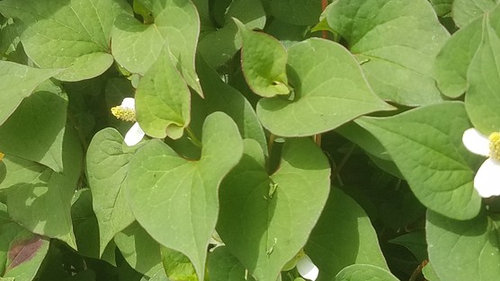
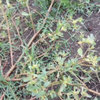
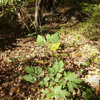
    Houttuynia cordata.

    james_devary thanked floral_uk z.8/9 SW UK
  • 9 years ago

    It's taking over.. owned the property for 2 years . It was already here. It is even starting to grow in my lawn.

  • 9 years ago

    Yes, it will. And everywhere else it can get to. Check here for previous discussions about this thug. (FYI, 'chameleon plant' is the common name of the variegated form of this plant - the straight green species like yours is even more aggressive)

    james_devary thanked gardengal48 (PNW Z8/9)
  • 9 years ago
    last modified: 9 years ago

    The variegated is what I grow in an isolated area, I find it quite attractive. Yours is, as said much more aggressive. The only upside - it is edible fresh or cooked.

    james_devary thanked peren.all Zone 5a Ontario Canada
  • 9 years ago

    I don't want to use spray killers but I may not have a choice.

  • 9 years ago
    last modified: 9 years ago

    it might be possible to mow it and then put down a biodegradable barrier like newspaper (can we even get that any more?) or cardboard, then mulch over the top

  • 9 years ago

    That is what I suggest. I weed whacked an area of a problem plant that had spread, then placed newspaper over top, then a layer of 4 inches of wood chips .

  • 9 years ago

    Thinking about a weed burner as well..

  • 9 years ago

    You may have a different experience but I do not find that practice of smothering with cardboard or newspaper and mulch at all successful when dealing with plants that spread rhizomatously, like the houttunyia. It will just grow under the cardboard and mulch until it senses clear growing ahead and then pop and start claiming territory from that point. I have seen this happen numerous times where the homeowner had planted it in a bed thinking that it would be contained by a concrete walkway.......NOT!! It just extended its root system under the concrete and came up on the other side.

    If you read through past discussions, the group consensus is that this is a very difficult plant to eradicate.

  • 9 years ago
    last modified: 9 years ago

    That's why I'm thinking heat.. everything I have read about how they spread just amazes me.. I don't have a few, I have hundreds in 5 locations.. covering them is not an option in my case

  • 9 years ago

    A weed gun would kill off the top growth but I doubt the roots would be bothered.

  • 9 years ago

    it might be possible to mow it and then put down a biodegradable barrier
    like newspaper (can we even get that any more?) or cardboard, then
    mulch over the top


    ==>>> good luck with that .. i cant kill it with round up ...

    i have also seen it show up.. on the other side of a sidewalk ... so i dont see where any topical weed barrier is going to do much of anything ...


    double dig the entire patch ... and remove as much of it as you can ... and by loosening the soil.. you ought to be able to easily pull out whatever pops back up .. and then start spraying with round up ...


    it might be easier to move.. as apparently the prior owner decided that was the case.. lol ..


    ken

    https://duckduckgo.com/?q=double+dig&t=ffcm&ia=web

  • 9 years ago

    Move? Never, lol at least I'm saying that now.. I used a saltwater mix on it yesterday.. that should get me started.. then I'm going to dig and remove as many as I can. Then I will till the area up and torch it with the weed burner.. I know I'm not going to get it all in the first attempt butvim going to war against it and I won't give up...

  • 9 years ago

    Keep in mind that the salt will stay in the soil and cause problems with any new plantings.

  • 9 years ago

    Good point.. I should have stated that myself but I didnt.. I used sea salt as well, that's the salt I use in my fish and reef tanks.. I sprayed it at the base of my deck and at the very edge of my house and 1 small part of a fence row.. I didn't spray any beds with it.. so for folks that are reading this. The water will evaporate leaving the salt behind.. so use it in spots that you don't want anything to grow in or you are going to need to swap the soil out... Epsom salts don't seem to be as bad but sea salts are wicked... thanks Jay.

  • 9 years ago

    I think Epson salt are very good for plants. I use them for growing exceptionly vigorous plants into monsters.Good luck removing your Houttuynia, I've done it before,It wasn't so bad. It could be worse,it could be Bishop's weed (Aegopodium). When I grew Houttuynia I realized right from the get go that it was going to be be trouble so I nipped it in the bud early on. I imagine a large area filled with it is another story. I think you will get it done in less time than you think.And when you replant the areas please don't replace them with Aegopodium no matter what anyone on here tells you! LOL;.)!!!

  • 9 years ago

    To be completely accurate, according to scientific literature, Epsom salts has no real benefit to plants other than supplying a small amount of magnesium, should that nutrient be of limited availability.

    The Myth of Epsom Salts

  • 9 years ago
    last modified: 9 years ago

    Myth? Well 10% mag. And 13% sulfer can boost any soil... there are way more benefits from adding it than there are from not adding it.. from germination to cell growth into uptake of nitrogen. The list goes on and on. I have used it in gardens for years ..

  • 9 years ago

    It makes no difference whether you use sea salt or rock salt, apart from the extra cost. My favourite way of getting rid of persistent perennial weeds is digging. Not pulling, but consistent and thorough cultivation using a garden fork, not a spade.

    Regarding the myth, read the link.

  • 9 years ago

    The link isn't what I would call impressive... this whole Epsom salt thing could be in it's own thread.. one would have to get their soil tested to even know the amount of Mag. In it... that test isn't gonna be cheap.. so to me there are 3 kinds of soil. Clay, silt, Sandy. Out of these 3 , I would say Clay soil has enough.. the other 2 silt and sandy are going to be lower . Sandy being rated at poor.. as far as store bought soil, read the bag.. I have Clay soil . I have never worked a garden so much in my entire life.. trying to keep it from hard panning is a huge job. The love hate relationship. Love the minerals hate the extra work.

  • 9 years ago

    Concerning the myth, I don't believe Epson salts are the great heal all and that they grow bigger plants,kill bugs,cure diseases,and give your hair extra luster.Most soils do have enough sulfer and magnesium already.If I'm growing a plant into a monster and it's an accumulater plant I just might like to add a little to the water in case the monster accumulated most of the sulfer and magnesium in the soil.Anyways it can't hurt and it's very hard to kill a plant with too much Epson salts and it has a neutral ph which won't harm plants.


  • 9 years ago

    As a long time horticulture instructor (as well as avid gardener both personally and professionally), it is constantly frustrating to try and impart some documented science and well-founded horticultural practices on these forums when 75% of the posters religiously cling to unfounded beliefs and practices!!

    "The link isn't what I would call impressive... " Hmmmmm.......apparently science isn't impressive enough but instead we would rather adhere to anecdotal reports that are essentially meaningless and just based on word of mouth??..........oh well, I guess it takes all kinds :-))

    Understanding your soil is critical to one's success as a gardener and a soil test is one of the best ways to go about it. A basic nutrient test is standard and is often done for free by extension services or for a nominal fee by a testing lab. And that WILL tell you how much magnesium is already in your soil and IF you need to add more. There is usually very little need to ever add any of the minor nutrients/trace elements unless a soil test indicates they might be required. And it IS quite easy to kill a plant with an excess of Epsom salts - overdoing magnesium can be extremely toxic.

    btw, while there are three different components of soil - the clay, silt and sand referred to above - few soils consist of just one type and all three different components are typically present in one of a nearly infinite number of combinations.

  • 9 years ago

    Gardengal48 , I understand your frustration. I'm used to reading Purdue universities studies and university of Kentucky.. they are written in a totally different manner... I just wasn't impressed, sorry you want to hound me over my opinion.. so yes, I guess it does take all kinds...

    I think most folks are just going to test for PH and go from there.. fact is, the faster your soil drains, the less it's going to hold... you know that and I do to.. so it's not going to hurt anything to add Epsom salt as long as it's with a light hand in moderation. To much of anything is bad, not like people are shoveling it in..

  • 9 years ago

    Oooh, I hope you don't think that I religiously cling to unfounded beliefs and practices. I don't want to frustrate anyone. I regret even mentioning Epson salts.I regularly only use good compost and organics like kelp and such.I was still wondering if you knew a sure-fire way to distinguish Tellima from Mitella? I asked you before and you never replied. I don't think it's logical to make an I.d. just on the basis of " that species is much more common here on the west coast than Mitella".Well maybe the o.p. just happened to have the less common Mitella in their post.That logic isn't going to fly.So come on west coast girl/ horticultural instructor,do you know the way????? The o.p. accepted your logic,but I can't.

    james_devary thanked Jay 6a Chicago
  • 9 years ago

    Yes, I almost felt like apologizing to you for going so far off course.Sorry,are your Chameleon plants all in moist locations? Maybe starving them of water (if at all possible) might weaken them while you try to totally obliterate them.Breaking the work up into sections may make it easier to deal with.A small section at a time and before you know it done.Then there is always goat's and chickens.

  • 9 years ago

    Been a wet season so far. Clay soil. Their growing like mad.

  • 9 years ago

    Well then. Perhaps you should re-read gardengal's second comment. In it you will see a link she gave to literally hundreds of previous discussions on chameleon plant. Of which the very first one

    http://forums2.gardenweb.com/discussions/1699407/help-chameleon-plants-gone-wild?n=65

    has comments from people who have tried getting rid of it. Seems to me like she was trying to help you a bit by passing along information. But I guess you didn't see it that way.

    Rodney

  • 9 years ago

    Jim, I have really enjoyed talking with you in between all the muck and the mire.It's great to be making new friends on here.Hope to be talking with you again real soon and hopefully tolerance will prevail.Please keep us updated on your progress,that would be awesome.How do you kill a Chameleon Plant? Stop feeding it bugs!

  • 9 years ago

    Rodney she did post that. I'm man enough to say I'm sorry.. I'll reread the article on my home computer tonight.

Sponsored
Peabody Landscape Group
Average rating: 3.5 out of 5 stars8 Reviews
Franklin County's Reliable Landscape Design & Contracting