Software
Houzz Logo Print
nika_plants_zone6b

Why do people cut leaves in half on plants?

I've seen people cut the leaves on their cuttings in half? I would like to know why, I think is has something to do with encouraging root growth. I'm wondering if it also can encourage new leaves to grow? What would happen if you cut the leaf in half on a plant with an established root system, would it encourage new leaves to grow? Just some questions :)

Comments (12)

  • 9 years ago

    It's to reduce the surface area of the leaves so that less water is lost through evapo-transpiration. Leaves have hundreds of stomata on the underside of their leaves through which water, pulled from the soil via the vascular system (which starts at the roots), is evaporated into the air.

    When we take cuttings, the stem is severed from it's root system. Reduce the surface area to reduce evaporational loss until the brand new root system is formed.

    nika_plants_zone6b thanked rhizo_1 (North AL) zone 7
  • 9 years ago

    Auxin stimulates root growth/division and it's primarily manufactured in apical meristems (the growing tips of branches, but it's also manufactured in leaves and especially in younger leaves. Defoliation, and partial defoliation, which includes cutting leaves in half is techniques used to attain any one or more of several potential results.

    A) Sometimes cuttings completely collapse if you leave more leaves than a cutting with no roots can supply with water. By removing or cutting leaves in half, you limit the amount of water that can be lost via transpiration.

    B) Partial defoliation can be used to stimulate back-budding by allowing more light and air movement to the branches inside the perimeter of the canopy.

    C) Experienced bonsai practitioners use it for several reasons. 1) For the reasons mentioned 2) We use it to balance the tree's energy flow. Branches near the top 1/3 of apically dominant trees typically get 2/3 of the energy the tree makes from sunshine/ water/ carbon dioxide. That means the tree WANTS to allot many times as much energy to the top than the bottom. This causes bottom branches to die and very heavy (thick) branches above thin/weak branches. The lowest branches on trees in landscapes/nature are the thickest. Practically speaking, it's very difficult to achieve that natural look indoors or in pots w/o some form of active energy management. Cutting leaves in half on strong branches or removing them altogether forces the tree to direct energy to the weaker branches. So it's an effective means of managing energy flow/allotment.


    It also allows us to limit the amount of food/energy a plant can make. Small leaves and short internodes are coveted as parts of high quality bonsai. By cutting leaves in half or removing some/all leaves, not only can you slow the increase in a tree's mass, you can also limit the size of leaves and distance between leaf attachment sites, nodes. I worked on 7 or 8 trees today, pruning and wiring. As I remember, partial defoliation was a part of the work I did on all of those trees.

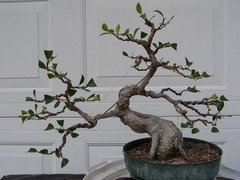
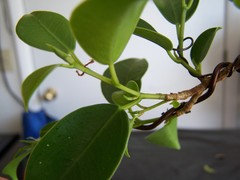
    FWIW, in most cases, if your tree is healthy, it's best to remove all leaves that have sprouted a branch from their axil (crotch formed by leaf stem and branch). Example:

    Note the very large leaf in lower foreground moving down and left. This tree is very healthy because you can see the apical meristems are still on the tree, yet the tree is back-budding profusely. This means very large leaves and very long internodes can be expected. As soon as a bud starts growing in the axil of the leaf, you should remove that leaf if you want to keep your plant compact. I can see at least 4, maybe 5 new branches with leaves at their base that should be removed.

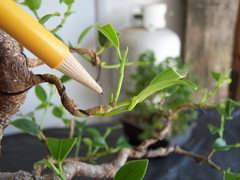
    Remove the leaf by cutting through the stem about half-way between the leaf base and the branch:


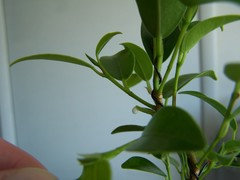
    ^^^ The pencil above shows the tag end of the leaf stem (petiole) I cut through with scissors. The image immediately above illustrates the drop or 2 of sap you can expect to leak out of the cut end.


    Al

  • 9 years ago

    My personal experience is that it derives from cloning under a dome, and you don't want any leaves touching the cloning dome during this process because it slows down rooting. The plant will wick moisture from the dome causing it to rot or slow growth. Often times you can't just remove a whole leaf, so you half it.

    In other cases there might not be too much of a cutting and a whole leaf can't be sacrificed. Ideally you want to prune off as much as possible to promote both top and root growth. within reason of course. As well, the plants aren't photosynthesizing as much so they don't need much leaves during the cloning process and by removing the leaves, you stress and trigger them to regrow.


    Short answer, not necessary to half the leafs. removing leafs or nodes yield the same results.


  • 9 years ago

    Because what you are saying doesn't mesh with what's known about plant physiology, I have to disagree with almost all you said.

    When you have cuttings under cover of a tenting structure, you don't want leaves to contact the walls of the 'tent' because it traps water in liquid form at the point where leaves contact the walls of the tenting structure. Since fungal spores require an extended incubation period under constantly moist conditions, fungal infections become much more likely. Also, the wet spot between leaf and wall deprives the tissues at the contact point of life-sustaining oxygen, which creates a necrotic area with no natural defenses against fungal infection. Combined with the ideal conditions for fungal development provided by a tenting structure ..... draw your own conclusion.

    I can't imagine a reason you couldn't remove an entire leaf to decrease o/a leaf surface area, unless the cutting only has a single leaf; even then, removal of all leaves doesn't necessarily ensure failure of the cutting.

    Pruning off "as much as possible" doesn't promote top OR root growth. In fact, it does the opposite, limiting root/top growth because you lose a measure of current photosynthate that is directly related to the area of leaf surface removed.

    While it's not necessary to remove half or more of a leaf, it does have it's merits. For one, if you're interested in a plant with a whole leaf or two here & there, by all means, remove whole leaves. When you do this, and to be on the safe side, you should leave a leaf at a point on the branch to which you absolutely want the branch to remain viable. Also, removing a leaf entirely doesn't ensure a branch will form in the axil because auxin from above is still suppressing lateral breaks (back-budding). In many plants, removing all the leaves from a branch can cause dieback of the branch. I've never had a branch die back from cutting leaves in half or to as little as 1/4 their original size, and I've performed the technique thousands of times. In fact, between rain drops I'm about to go out and do it again on some of the Ficus I've been bringing outdoors while on staycation.


    Al

  • 9 years ago

    I have seen it done in cuttings to reduce water loss through leaves and encourage new growth.

  • 9 years ago

    @Tapla If you disagree with my post then I beg to differ, if your plants are too wet and are touching the dome or your constantly spraying them, it slows down rooting because they are happy enough with the water they are receiving, thus not stressing and encouraging root growth, fungal issue takes longer to take a hold, but of course that's a possibility too, but doesn't limit root growth. The same would be true with a rooted plant living under a dome and being constantly foliar fed, root growth would be reduced and not encouraged. The dome itself provides enough humidity to keep a plant hydrated, any extra, or for that matter even too high of humidity in certain strains will slow down the process. That says something and is a huge piece of logic.

    Removing big photosynthesizing leafs is possible too, but it's not as efficient in recovery time after rooting for obvious reasons that I shouldn't have to point out, it's another reason they get halfed instead.

    In some instances the leafs are also halfed to reduce weight and plants wilting over, instead of sacrificing a big photosynthesizing leaf, which would ultimately slow down plant growth once rooted, if entirely removed.


    Marijuana growers are notorious for halfing leafs instead of removing it entirely. When you're turning over 50 clones a month into a vegetating aggressive plant, you do everything possible to achieve this result in the fastest amount of time possible, and trust me, if anyone has their science down pat on this matter, it is them.

  • 9 years ago

    Fastlink: I had a hard time following your logic. Cutting propagation is all about about managing humidity, air and temperature and at the same time making sure that the cutting itself remains viable. So the fact that you have to balance all this factors is nothing new. In fact it has been known and practised long before marijuana growers perfected the science/art for that one type of plant. But that is not the only plant on earth and there are various techniques to deal with different cutting types - leaf cutting, root cutting, softwood, hardwood, herbaceous, dormant cuttings etc and different plant types - tropical, temperate, conifers, succulents, epiphytic etc. They all have their specific needs. So marijuana growers are not the only ones who know how to propagate. If you want bleeding edge of science try cell level clones that professional orchid growers do.

    Cuttings are in a compromised situation without roots and that makes them susceptible to diseases. Some more than others. Being too wet, besides other factors, will impair their ability to perform basic functions in the least and cause diseases at the worst. Not allowing the leaves (not leafs) to touch something just good hygienic practice - that is all. Some plants will not mind - such as a ficus - because they are very resilient and root fast. Succulents will rot in no time inside a humidity dome. In case of succulents you do not even have to worry about cutting any leaves half or whole.

    Nika: I just read the original question again and missed the fact that you also asked about cutting leaves in half for established plants too. Al (Tapla) already answered that much better than I could have.

  • 9 years ago

    I have to thank the OP for asking the question. All, you've talked about this before, but your post here really hit the mark because I'm studying to think hard about post-repot pruning. Of course, that doesn't mean I won't have more questions!

  • 5 years ago

    Is it true that if you plant a rubber tree leaf it can be rooted but it can never have stem or new plant?

  • 5 years ago

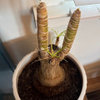
    There might be some type of manipulation that can be done in a lab to create a full plant from a leaf cutting of F elastica, but you won't accomplish it by employing any of the techniques commonly used outside of the lab, except perhaps by grafting a bud to a rooted leaf stem (lots easier to use a propagule that includes a node.) Here's why the leaf cutting won't root:

    Many woody plants can be propagated from leaf cuttings, which, for the purpose of this discussion is a leaf with a portion of the petiole (leaf stem) attached, and the petiole has been cut through between the leaf blade and where it attaches to the branch, so the cutting will be absent the node that occurs at its attachment point.

    Whether or not a leaf cutting is capable of forming a complete plant with a stem depends on whether or not the propagule is capable of forming adventitious buds. Some plants have groups of cells that descend directly from embryonic cells engaged in meristematic activity. These cell groups can differentiate into buds/shoots from foliar (leaf) embryos that formed as the leaf was forming. More commonly though, wound-induced (where you cut the leaf is the wound) secondary meristems can form when existing tissues already acting as part of an organ dedifferentiate into NEW meristematic regions (see 'de novo regeneration'), then redifferentiate into new organs (buds).

    If you want to be fairly certain that you'll be successful in your ficus cloning attempts, make sure you include the suppressed axillary bud located just above where the leaf is attached to the stem. The downside to propagating from stem cuttings with a singular leaf in water is that often the bud is destroyed by rot, and/or, the type of root tissue that forms in water is physiologically very different from root tissue that forms in a solid, well-aerated medium. This difference is made manifest in the water-formed roots being very poor at taking up water from a solid medium, along with the fact that water roots are very delicate, almost brittle. As such, they handle the transition from water to soil poorly. I hope you got all that. If not, feel free to ask .......


    Al

  • 5 years ago

    steph.. start your own FREE post next time.. your topic has nothing to do with the old post.. so al's great answer is not searchable .... if you had put a good title on it ...