

Heartbroken and need advice on Monarch parasite control
I am just heartbroken and need help from all you butterfly experts.
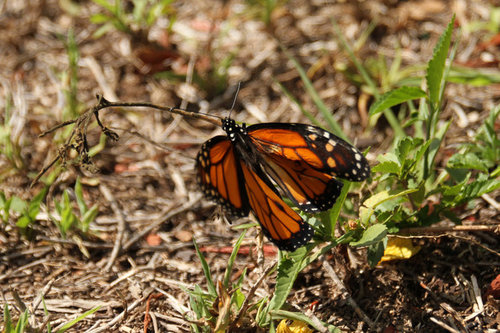
My first concern is for the adult male monarch shown in the first two pics below. I found him on the ground near the milkweed a few days ago. His right (as I'm looking from above) fore wing and rear wing are rolled under towards the bottom. Plus he has discolored patches. He must have been newly emerged as he kept trying to pump his wings up and could only fly a few inches off the ground. He could crawl onto the leaves of the pentas and lantanas and eventually make his way to a flower to feed. I placed a banana on a plate under the lantana and he crawled onto it to eat. He lived for three days before a mockingbird flew in for an easy meal.
1) Am I correct in assuming that he is infected by OE? Was the female that laid the egg infected and therefore the egg, caterpillar and the new adult were infected as well?
2) According to this article from the University of Georgia on OE, there are 3 major monarch populations in North America: a population that breeds east of the Rocky
Mountains and migrates every year to wintering sites, a population that breeds west of the
Rocky Mountains and migrates to areas
on the coast of California and a non-migratory population that breeds year-round in southern
Florida which doesn't migrate and reproduces throughout the entire year. The site says that more than 70% of these South Florida monarchs have OE infections.
a) Is there any reason to try and collect the eggs (almost impossible to find them with my never ending fight against aphids) and raise in an enclosure knowing that the eggs would most likely already be infected with OE?

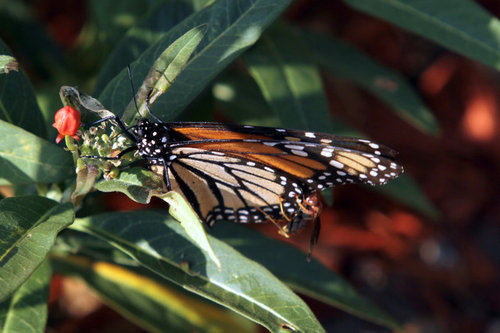
My second concern is wasps. I didn't notice the one below that was clinging to this female who was laying eggs until I looked at the pictures later. (This pic was posted a few weeks ago on another of my posts).
1) Is this a type of wasp that would lay it's eggs in the abdomen of the female adult or in the egg or caterpillar?
2) How do I get rid of them without spraying the plants? I'm not quick enough to catch one and kill it with my gloved hands.
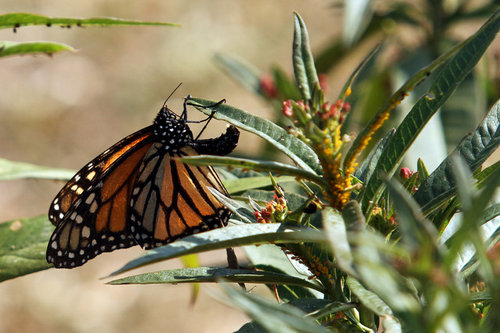
My last concern is aphids.
1) I have been hosing and picking these things off daily. It's a losing battle. And when the females are laying their eggs in aphid infested areas as shown below, it's almost impossible to collect the eggs.
a) Will the aphids eat the eggs? I've been told no but I have seen so few caterpillars as compared to the number of eggs laid.
b) Are there effective methods to fight the aphids without killing or washing off the eggs?
I just feel hopeless. I put in 12 nice, healthy, aphid-free milkweed plants to attract monarchs. I had plenty of females laying eggs but had just a few caterpillars (assume that the aphids or wasps got them?) and only a few new adults of which this one is obviously deformed. And, I haven't seen a female laying eggs for a few weeks.
Since I'm in South Florida, am I fighting a losing battle trying to attract monarchs when I know that OE infection is almost guaranteed?
Should I just pull out the milkweed and focus on nectar plants?
Any advice would be greatly appreciated. Thanks!
Rhonda
Comments (13)
 9 years ago
You can raise OE free monarchs if you start with eggs but it is work. First you have to clean the eggs:
http://www.butterfly-fun-facts.com/raising-butterflies/raising-butterflies-from-eggs/disinfect-butterfly-eggs-monarch-or-any-species/
Then you either have to provide milkweed that has never been touched by a wild monarch or you have to kill the OE by soaking the leaves in a 10% bleach solution. You should also be disinfecting your rearing enclosures with the same 10% bleach solution.
Parasitoid wasps/flies are kept at bay by raising your pillars inside. They are not social insects so there is no big nest for you to hunt down. The main ones that affect monarchs lay their eggs in/on the caterpillar. As for the one you saw, I've never heard of a parasitoid wasp that lays eggs in adult monarchs but it would not surprise me that at least one exists.
Aphids are no fun but they are not going to hurt your monarch eggs or pillars. I know some people use soapy water to discourage them. Any aphid predator you introduce will also probably eat any 1st instar monarchs it finds. The quick and dirty way to deal with them is with your thumb and forefinger pressed together as you pull them across a leaf covered in aphids.Rhonda thanked KC Clark - Zone 2012-6a OHRelated Professionals
Baltimore Landscape Architects & Landscape Designers · Augusta Landscape Architects & Landscape Designers · Lincoln Landscape Architects & Landscape Designers · Toledo Landscape Architects & Landscape Designers · Eau Claire Landscape Architects & Landscape Designers · Poplar Bluff Landscape Contractors · Aurora Landscape Contractors · Bangor Landscape Contractors · Grand Rapids Landscape Contractors · Bronx Landscape Contractors · Crestview Home Builders · Concord Home Builders · Mankato Home Builders · Redding Home Builders · Bend Home Builders 9 years ago
Rhonda, I know this is a shock and I'm so sorry for the little guy and for you. Nature can be so harsh and sometimes hard to accept. I had something like this happen one year when I first began raising butterfly cats by unknowingly allowing one of these Parasitoid insects inside my rearing cage. I didn't know what it was and didn't know what it could do until it was too late. The end result was shocking and put me off leaving my enclosures outdoors.
Regarding your question about continuing to grow your milkweed or pull it. IMHO, one small home garden isn't going to impact, one way or the other, the elimination or containment of OE for the Florida Monarchs. Let it grow and bloom for a while, then cut it back so it can produce fresh growth. Bag and destroy the clippings. This way, if there are OE spores on the plant, this will help contain the spores and keep them from infecting healthy Monarchs. The milkweed blooms provide nectar for many pollinators and butterflies and even if mama Monarch's eggs never reach maturity, at least she has milkweed to use to deposit her eggs. I've often wondered what happens to a mama Monarch if she can't locate milkweed to use for her eggs? Does her body reabsorb the eggs or does she continue to carry them to the end of her life if she can't locate milkweed?
I agree the aphids are a bother and ugly. In my experience, they will suck the juice from the new leaves to the point the leaves become deformed and unhealthy.
Oleander Aphids - how to controlThey can be contained in a home garden but when first spotted, I've found it takes a daily effort to bring them under control. Once I've squished all I see, I do a daily check to take out the few that manage to escape my attention. I walk my garden at least once a day because I enjoy this activity and often, several times a day so it is easy for me to stay on top of the aphids. In the past two or three weeks, I've only come across a few on a couple of milkweed plants and they were quickly dispatched so their spread can be contained. If I didn't do this, my milkweed plants would be covered in those awful little sucking insects. Only you know what amount of time you want to devote to this garden chore. Just work out what works best for you. Don't give up on your butterfly garden as it obviously gives you joy (plus we all enjoy seeing your lovely garden photos).
Mary
Rhonda thanked Mary LeekRhonda
Original Author9 years agoSherry, KC and Mary,
Sorry it took so long to get back. I'm glad to hear that it may not be OE but rather a birth deformity. I will try to kill the wasps with my gloved hands and be more diligent with the aphids because their appearance really bothers me. I'm going to leave the milkweed but cut it back a little to get rid of the aphid eaten leaves and any parasites.
Thanks for the informative links....I will read them and research more on my own. I might try planting onions and marigolds around the milkweed to repel the aphids as mention in the one link.
I am more optimistic now as I have had several sightings of beautiful, bright males the last two days. So, at least some of the cats made it to adult hood.
I would love to try rearing the eggs/caterpillars inside an enclosure. But, I'll be going back to work soon and won't have as much time to devote to the care of them as I should.
I do have pipe vine, passion vine, cassia, fennel and parsley for hosts for other butterflies. And, those caterpillars don't seem to be affected by parasites or disease.
Thanks for making me feel better :)
Rhonda
- 9 years agolast modified: 9 years ago
Rhonda, I've been thinking about your aphid situation and wonder if growing Asclepias
fruticosa aka
White Swan Milkweed or Cottonbush might help.I don't remember them attracting the aphids like the tropical mw tends to do. Of course, we live in two different areas but since I get the aphids, too, on various milkweed, just thought I'd mention it. I have one grouping of about 8 Swan Milkweed plants right now and haven't yet found aphids on them this season.
Maybe other forum members who have experience with this plant could comment. Because they don't naturally bush a great deal, I usually grow about 5 or more plants in a grouping. Their leaves are smaller and more narrow than Tropical but these plants are totally acceptable to mama Monarch. I have found eggs on them and have used the leaves to feed Monarch cats.
I've seen forum members from Florida mention buying this plant. If you ever come across one at your local nursery, you might consider giving one a try to see if it repels the aphids better than tropical.
Mary
Rhonda thanked Mary Leek Rhonda
Original Author9 years agoMary,
Thanks for the recommendation. The leaves look much thinner than those of the tropical milkweed, so would probably need to plant more to sustain the cats. And, I like the look of those cool seed pods :) I'll look for some this week.
This morning I went out and squished and sprayed off all the aphids and planted tall yellow marigolds (per the link you provided) around and interspersed within the milkweeds. I'll let you all know if that helps any.
Thanks again,
Rhonda
 9 years ago
Rhonda, I haven't been in this forum very much lately. I have been busy with my monarchs, a graduation and learning more about rearing butterflies more successfully. I want to recommend a Facebook group -- The Beautiful Monarch. It is over 13,000 members disussing only monarch butterflies -- feeding them, raising them, watching them, etc. It is am amazing wealth of information, from member stories and ideas to the information files linked at the home page. I have learned more in a short time there than in all the previous year reading various articles and such on the web. You might want to check it out and join.
Rhonda thanked lascatx- 9 years ago
I'm betting that you will be finding Monarchs consistently soon. We have been aware of OE on our Monarchs for some time now in Florida, but we still have plenty of healthy ones emerge and do well. I'm sure you know that you will be finding lots of little milkweed plants once the ones you have start to throw out seeds.
It's always painful to see the caterpillars we have worked so hard to grow die by various means. For me, the worst is seeing them eaten by wasps.
I think we have to be ready to accept the fact that many eggs will disappear and many caterpillars will be eaten or come out deformed.
I think all the advice given above is excellent. We do what we can.
The only cats I try to raise are those of the Eastern Black Swallowtail. I can see the eggs and cats easily on the fennel and notice when they disappear. Just last week I was watching six of them grow pretty large and then one day later they were all gone. Birds and wasps find them and then just keep coming back. I now have six in a cage that are doing well--somewhat surprising since I've not been very good at helping them in years past. We'll see...
Keep us posted, Rhonda. Good luck with your new job. They will be getting a tigress.
Rhonda thanked Tom Rhonda
Original Author9 years agolast modified: 9 years agolascatx,
Thanks for the tip, I'll check the group out. Any info can prove helpful.
Tom,I
appreciate your concern and advice. I admire those who take so much
time to raise the eggs/cats/butterflies. I have always left the process
to nature, mainly because I just can't devote the time to it that they
deserve. However, I have seen several very healthy males and a few females all day long. So, there is hope yet :)Thanks for the "tigress" comment....I have been accused more than a few times of being overly energetic and somewhat aggressive. LOL
I can't start work for at least two months now as they scheduled Joe for surgery next week. I want/need to be around to help him recover and drive him to his doctor's appointments and physical therapy. I have never had a break in full-time work since the day I turned 16 (a LONG time ago) so this is all alien to me. I just hope that I can get back into the groove quickly :)
Rhonda
- 9 years ago
Rhonda, just yesterday I was surprised to see how clean my MW was, no aphids at all, not one, at least that I could see. When I looked at the biggest of my tropical milkweeds, I saw a ladybug running up and down the stems. I have to think this is the reason, and that ladybugs really do the job of eating aphids. I've heard you can order ladybugs, but I don't know any more about it than that.
Sherry
Rhonda
Original Author9 years agoSherry,
This morning when I checked the milkweed, I noticed that it had very few aphids (normally, when I hose them off they appear back the next day). There were more ladybugs and I planted lots of marigolds around the milkweed yesterday, so I'm keeping my fingers crossed and remaining diligent on the aphid elimination.
Thanks!
Rhonda
- 9 years ago
Wishing you and Joe the best with his surgery and rehab.
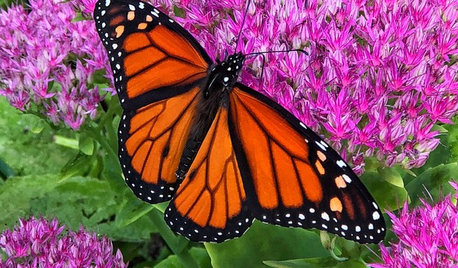
Even in Florida where there is a lot of OE, bleaching the eggs and feeding sanitized leaves can break the cycle.



MissSherry