Software
Houzz Logo Print
dougald_gw

Observations on Growing Great Expectations

9 years ago

I have not posted since GW moved to Houzz but I have been
following along. You have presented some
marvellous pictures of your hostas which can only serve to inspire – enable is
I think the correct term here!

Just at the time of the movement, I had begun a study of H. Great
Expectations to better understand the challenges of growing such a beautiful
specimen. In this post and a few more to
follow, I want to present what I have learned.
First off, the disclaimers. This
study is not scientifically accurate and is presented more as informed
observations than concrete proof. Also I
am not a botanist by training – the subject begs for a thorough scientific
report through the eyes of a botanist specializing in photosynthesis. In other words, take my thoughts here with a
grain of salt – informed observations but observations nonetheless.

My methodology was to review every mention of GE on the
Hosta Forum going back at least 10 years.
From this I built a catalogue of thoughts folks had regarding their
success or lack of success with GE. In
addition, I took careful note of the location and correlated success rates to a
number of climatic factors. USDA Zone is
not especially helpful here since most hostas will withstand the max winter
cold – what is important is the summer heat and rainfall.

I will present the results of my efforts in the next several
posts in this thread.

Comments (14)

  • 9 years ago

    It is strikingly apparent in my review that GE grown at
    latitudes north of approximately Chicago
    seem to have much greater success than those grown in more southerly
    locations. This is not, of course, a
    hard and fast rule as many fine examples have been grown south of that latitude
    and similarly, there have been many sad endings north of there as well. But on balance, the tales of woe increase the
    further south one goes and large beautiful examples increase in more northerly
    places. Hence the commonly heard lament
    that the only good GEs were grown in MN or WI or ON.

    GE has developed a well deserved reputation for:

    1. needing

    a great deal of sun

    1. needing monumental amounts of water especially in

    hotter conditions

    1. being

    exceedingly slow to grow

    1. being

    very touchy about transplanting

    In general as Ken has often put it, they are a fru-fru hosta
    that demands more effort than they are worth.

  • 9 years ago

    I took a number of leaves from mature GE’s and measured the
    light coloured central area. Generally,
    this ranged from 55% to more than 70% of the leaf. Even so, the darker border was not a robust
    green but a lighter green colour which in total gave GE its refined and elegant
    appearance. It was time to consult with
    some real botanists.

    The first reaction that I received was that this is clearly
    a human produced plant as nature would never allow such a “freak” to
    propagate. Essentially, the amount of chlorophyll
    in the leaf was very low leading to the requirement for enormous amounts of
    light for successful photosynthesis.

    This was further brought home when the leaves that I had
    measured were correlated with sunlight received. Those from plants grown in more shade had a
    higher % of green and as well the green tended to be somewhat deeper. This observation is from a limited number of
    plants and may not stand close scrutiny but it is what I found in my sample. Is this a possible reason why GE is so
    difficult to transplant?

  • 9 years ago

    In photosynthesis, a plant leaf containing chlorophyll, in
    the presence of sunlight is able to extract carbon from the air to build plant
    cells. The byproducts are oxygen and
    water which are given off to the atmosphere.
    Given the very small amount of chlorophyll present compared to other
    hostas, GE requires more sunlight. The
    result, when GE is planted with other hostas in normal (for hostas) light
    conditions, is a very slow growing plant which sometimes simply cannot survive
    in low light.

    The solution is to plant GE in areas with greater sun which
    typically means afternoon sun which can be very hot. Unfortunately, those large light coloured
    leaf areas lead to high levels of transpiration and the giving off of large
    quantities of water. This leads to the
    conclusion that extra watering is needed for GE. But that is only part of the issue.

    Photosynthesis as a mechanism is not fully understood. Botanists have suggested to me that summer
    heat may cause the transpiration rate in GE’s leaves to exceed the ability of
    the plant’s roots and veins to supply water.
    This could happen with GE in summer afternoon sun when the temperature
    climbs above about 28C – the plant feels distress. Plants are well able to adapt a bit to extreme
    conditions so a single warm afternoon can be taken in stride. The difficulty comes when the plant faces
    those same burning conditions daily for weeks on end.

    My observations seemed to suggest that GE had the best
    chances for success when summer cooling degree day measures were less than 400
    for the summer months in total. Success
    diminished as the heat increased. Put in
    simple terms, GE can easily withstand the “short cool summers” of the north but
    hotter summer afternoons cause either photosynthesis to shut down for lack of
    water or transpiration to shut down to conserve water within the plant.


  • 9 years ago

    To complete these observations, I would be remiss if I did
    not speak about the many many new hostas which have been introduced the last
    few years. A great many of these push
    the envelope in terms of larger lighter coloured areas of the leaf. The results are striking. They make for good sales for hybridizers and
    for the expansion generally of hosta interest.
    However, they share many traits with GE (which may well be at the
    extreme) making them difficult for most enthusiasts to grow successfully. These plants earn the title fru-fru honestly!

    My observations came from studying first hand examples of GE
    in my own garden and other gardens in the OttawaValley
    along with examining the accounts of the many enthusiasts who post pictures on
    the Hosta Forum. As well, many growers
    have spoken about their successes and failures all have which have enriched my
    understanding.

    What is needed now is a real botanist, who can study
    photosynthesis in depth. Such a study
    would possibly provide a proof for my observations and speculations or perhaps
    show me wrong. This would point the way
    to growers being better able to adapt their growing methods to the hostas at
    hand.

  • 9 years ago

    Interest stuff......

    I've never had a problem with this one.

    I've had 2.

    1 I left at my old house it was doing fine. Afternoon sun from 3 to about 6 or 7. It was slow but steadily increased for the 3 years I had it.

    Currently: I bought a 1 liter 3 division plant last year, planted it where it recieves similar sun conditions. It popped out 7 bullets this spring and is doing better than a similar sized Dreams Queen ( roughly the same size as last year)

    I agree that it is a thirsty plant, but may have more to do with its "Sieboldiana" heritage than the lack of chlorophyll.

    All those types for me anyways do better in a wetter area of the garden.

    In drier beds they shrink and the crown dissolves over a couple of seasons

    I also agree that once you plant them, moving them even once will kill them. Again this is what I've found with all the Sieboldiana types (I've killed color glory, thunderbolt, Frances Williams , 2 dream weavers and a Linda Sue) by repositioning them for aesthetic purposes......took me awhile but lesson learned. Lol.

    J.

  • 9 years ago
    last modified: 9 years ago


    The best one I've ever seen is growing along a gravel road and I seriously doubt it is ever watered by humans. It is near Hayward, Wi., which is about 80 miles north of Minneapolis.

    I don't think it's in a lot of sun either. This thing doesn't appear to be babied at all and could easily have tire tracks on it.

  • 9 years ago

    Thanks, Dougald_gw. My little GE is slowly growing here in the hot and humid south. I planted it very high, which was the recommendation of dhaven. It's still alive after two seasons. We'll see.

  • 9 years ago

    Never had a problem with mine. It's in full sun and grows like a weed.

  • 9 years ago

    I've not had a problem with mine. 4 years old, moved once, Morning sun, zone 5 under a maple tree. It's actually my favorite.

  • 9 years ago
    last modified: 9 years ago

    Dougald, you have certainly done your homework! An interesting compilation of observations, some of which apply to my own GE.

    Linda, yours is doing great!

    Jessica, you have a beautiful one as well.

    Musky, I thought I spotted some tread marks too, LOL!

    Will return in moment to add photos of mine. ;-)

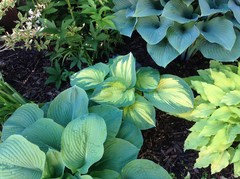
    I need to remove the Blue Angel eye closest to GE soon...as well as an eye of KR above it. Looks like an easy op. on both too with easy access and separation space as it turns out.

    And this one was moved...but survived - leaves a tad smaller but it will catch up.

  • 9 years ago

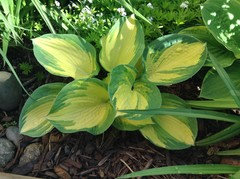
    I would venture to say that the only thing GE doesn't like in my garden is to be moved. It doesn't mind any amount of sun; in fact, the more the better. It grows as well as all the others I have with the same growth pattern - a gain of eyes about every three years. The most pronounced difference I found with GE is that the size of its leaves get larger faster than the increase in actual eyes.

    These two replacements I have had since 2014 - one had 3 eyes plus two wee ones. (I killed my older one when I moved it.) This year it has 4 uniform sized shoots. The larger one in different location has 7 eyes this year compared to 5or6 in 2014. This one however was originally grown out in its pot a bit longer according to information on its sticker.

  • 9 years ago

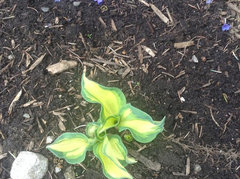
    I had to go and take a pic of my Great Expectations. It's been growing for about 4 years. The hosta grower I go to gave it to me, because it was just so tiny and we have called it "No Expectations" It has about quadrupled in size since I got it and anyone who knows how long I've been growing it and how small it was has to check on it's progress. I'm not giving up on it

  • 9 years ago

    Jimr66,


    quote, “….also agree
    that once you plant them, moving them even once will kill them. Again this is
    what I've found with all the Sieboldiana types (I've killed color glory,
    thunderbolt, Frances Williams , 2 dream weavers and a Linda Sue) by
    repositioning them for aesthetic purposes......”

    I’ve never moved my GE, but I have moved my largest Frances
    Williams at least 5 times, divided it also. Since the last division into 3
    parts early this spring, it’s exploded in growth. I’ve moved 3 Elegans a couple of times too with no ill
    effects.