Software
Houzz Logo Print
marticus

design recommendations. SC zone 8a

9 years ago
last modified: 9 years ago

We are in the midst of a large back yard landscaping project.

There will be 3 main segments:

vegetable/herb garden with paver paths

mulched area under trees

sodded lawn area

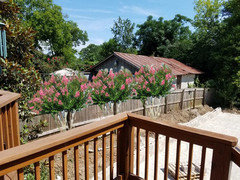
I'm having a large vegetable garden put in on the east side of the yard (full sun) about 50 x 20. It will have a retaining wall against a privacy fence (wall about 24-30" high). This long bed created by the retaining wall will be about 4 feet wide and will be about 50' long total. Unfortunately about half of this bed/fence area looks into my neighbor's yard (not a beautiful view at all) and I would like to put a small tree there. But, I don't want it to get too big, because it would shade out my vegetable garden/push on the fence/etc. Maybe 20 feet high at most.

I was thinking of putting 3 lattice panels on the fence to grow something vining and pretty, with probably some easy care grasses or shrubs for pollinators near the front to drape over the little wall. But what should I use for height for the privacy screen?

for this area, so far I've considered:

Little gem magnolia (messy 2 x a year)

cedar (slow growing/ doesn't seem it would provide much privacy)

natchez crape myrtle (too big?)

Need some suggestions to make this wall area beautiful: drought tolerant a plus!

any other feedback/suggestions on layout a plus.

Comments (28)

  • 9 years ago
    last modified: 9 years ago

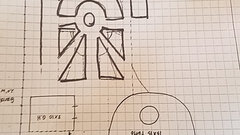
    bubble diagram (sorry it's blurry)
    vegetable garden layout concept for new garden


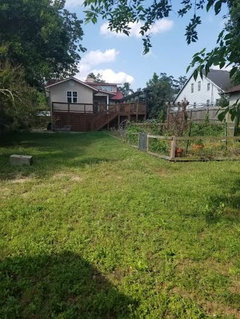
    view from bottom of yard to house (pre-demolition)

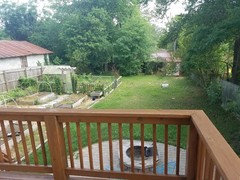
    view from house into back yard (pre-demolition)

  • 9 years ago
    last modified: 9 years ago

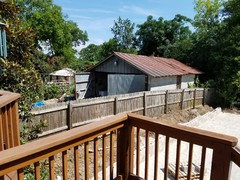
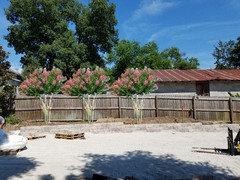
    Current view of retaining wall from ground level, in progress. Located in previous vegetable garden location.


    view of neighbors from deck, new retaining wall being built can be seen on left side.


  • 9 years ago

    I'm trying to understand what you are describing and have in pictures. If I am correct, looking from the deck, you have an existing vegetable garden on the left. This new landscaping bed will be on the right along the fence, and behind a low retaining wall. You describe it as 4 feet deep by 50 feet long. Is that correct? Is the vegetable garden going to expand or stay the existing size?

    Anything less than 6 feet deep for a bed will limit your options because a lot of shrubs and trees that will reach your desired 15-20 foot height will get wider than 4 feet.

  • 9 years ago
    last modified: 9 years ago

    Sorry my post was confusing!

    Yes, the raised beds are being replaced with a new garden in the same spot, which will now have paver paths. Finished size approximately 28x50'.

    The new retaining wall bed (shown in the last 2 photos) against the fence will be 4 feet deep, which I know limits options, but that's what I have to work with, and a small tree was the first option to screen the view that I thought of.

    I thought a crape might work better because you can prune it to a vase shape which could limit it's protrusion into the garden.

    So in a 4' x 50' bed, I was thinking one small tree, 3 lattice panels for climbing/flowering vine ( maybe one climbing rose, and two something else?)

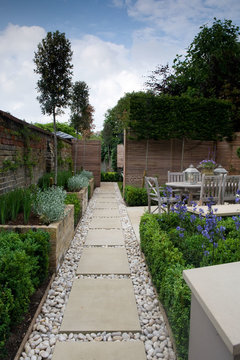
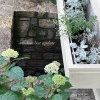
    This was an idea photo from Houzz, only i wouldn't be using planter boxes.

    Mountain View Contemporary · More Info

    And then some repeating clumping grasses/ small trailing plants?


  • 9 years ago
    last modified: 9 years ago

    Is this a full sun area? If so, crepe myrtles might work. They are deciduous, though, so they won't screen as well in winter. They also put out new leaves fairly late so won't screen as well through a lot of the spring as well.

    I like your original idea of little gem magnolia but it will get more than 4 feet wide. Camellias (you could alternate Sasanqua and Japonicas could extend the bloom season) could be another consideration but they will also get more than 4 feet wide. Most of the good evergreen small tree and shrub choices that would provide an effective screen will get 6-8 feet wide and will quickly outgrow a 4 foot space.

    If it's your yard, why wouldn't you make the bed 6 - 8 feet deep to accommodate the plants you need?

  • 9 years ago
    last modified: 9 years ago

    Yep, it's full sun all day until 7pm or so. I like the camellia idea, although they would take forever to get as big as I need. I have a Little Gem close to the house in line with the retaining wall bed. It's lower branches are pruned to make it more "tree like" instead of full, I thought maybe another one would make a nice repetitive look..

    The previous retaining width of the bed was about 2 feet off the fence so I thought doubling it to 4' would give more options.

    The new garden area will be 28' and in order to make the bed and path scheme work has to be close to that measurement work. Also it will be taking up almost 2/3 of the width of the yard. The new yard will be 1/3 of the space (shady). I just didn't want the garden to take up any more space than planned, because it looked off balance, like the lawn was an afterthought.

    Plus, the site work was already prepped, so it would be back pedaling, and more $$.

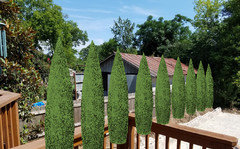
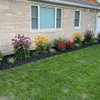
    Traditional Garden · More Info

    I thought this pic was kind of cool, what kind of trees do you think these are? I know they don't block too much view but I thought they looked neat.

    So if you think a small tree wouldn't work, are there any other cool screening ideas? The main problem is the deck is high off the ground and provides a clear viewing area into the neighbor's yard.

  • PRO
    9 years ago

    For screening but not impeding into the garden space, I think you are limited to a skinny, needle-like shape for the bulk of screening. It would be a factor of spacing as to how dense the screening will be. If you use a trellis for part of the screening, it will need to be VERY tall if it is to screen out the background ... especially from the deck level. I think the needle "tree" does the job better. Are you trying to screen the view 100% from the deck area? If that's the case, the spacing would need to be quite tight. If you only need to distract a bit from the background, the spacing could be wider.

    marticus thanked Yardvaark
  • 9 years ago

    Camellias aren't going to work well in that much sun. With a narrow bed like that you will be pretty limited with planting options.

  • 9 years ago

    Yaardvark,

    no I don't need 100% screening. More of a distraction, like you said. Do you have any recommended cultivars?

    I guess I'm just concerned how to plan a nice repeating border that looks good both from the deck and from ground level.

    I did see a dark leaved crape myrtle at Lowe's this AM called Delta moonlight, which is purported to get 8-12' high and 4-6' wide

    http://southernlivingplants.com/trees/plant/delta-moonlight-crapemyrtle

    I would like to use 2 of these somewhere in the bed, and think it would work if I train them properly and cut off suckers.

  • PRO
    9 years ago

    The sizes given by nursery tags are estimates of a plant's size at X years in the future --- not ultimate size. Doubling the figures usually will bring you closer to the plant's real potential.

    "I would like to use 2 of these somewhere in the bed, and think it would work if I train them properly and cut off suckers." The way landscaping works is that you have a place that has a goal that plants can fulfill and you pick the type and quantity that will do the job. To pick plant type and quantity first is the cart leading the horse. It it OK to start out with a vague wish to use a certain plant, but many times the yard cannot offer a way to fulfill it. That you will "cut off suckers" does not describe the finished form of the plant. While crapes are many times grown as standards, it's not their nature to be that way so cutting off suckers is a never ending battle.

    One of the Juniper cultivars has a decent shot of being the plant that can give you a screen that is not too fat.

  • 9 years ago
    last modified: 9 years ago

    So I should plan on the plant doubling the size listed on the tag? That's really misleading!

    I was offering this as a possible option to use in the specified place I was inquiring about, based on the info listed on the cultivar tag. I'm not set on any one plant.

    I had read up on crepe myrtles on Clemson Ag. They come in different growth patterns and heights- this one seems to be vase shaped with a overall height that would work in the location. I didn't mean to imply training it as a standard, removal of suckering in the spring of each year is just recommended in order to maintain the overall shape. I'm not opposed to multiple trunks, as I have a few others in the front yard in this shape and think it looks very nice.

    Anyhow my question is, could I do something besides or in addition to the tall junipers? I don't love they way they look but I see how they could fulfill the needs of the site.

    Three of these in a row would look nice- what do you think about spacing between them?

    http://www.thetreefarm.com/juniper-skyrocket

  • PRO
    9 years ago

    Juniper spacing would depend on what YOU are trying to accomplish ... solid screen or intermittent.

    "Anyhow my question is, could I do something besides or in addition to the tall junipers? I don't love they way they look but I see how they could fulfill the needs of the site." If you don't love the way they look, what look would you love? What else might fulfill the goals in a way that suits you? I don't know enough about your preferences. 3 in a row ... and then what is the rest and how is it arranged?

  • 9 years ago

    Pinkmountain, thanks for the suggestions. The columnar crabapple and apples are very interesting! I'll have to research more into those.


  • 9 years ago

    Yaardvark, intermittent screen would be best to allow for airflow. These junipers say app. 4 feet wide. So plant them 5' from center to center?

    I'm a bit uncertain as to what sort of finished look I would love- I often buy plants just because I'm attracted to their general appearance, but it's hard for me to envision an overall completed bed all at once.

    Since I'm starting from scratch, I was trying to overcome that tendency and plan ahead for once instead of just trying to make it fit in my garden.

    Most of the examples I've seen for softening a privacy fence/screening a yard are larger beds. So I'm just trying to scale down from those while still achieving those goals.

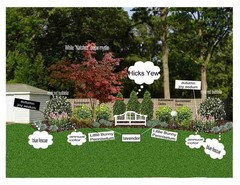
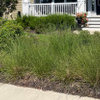
    I saw this on a different site and thought the array of textures and heights was interesting.

    Obviously I can't fit all that in my narrow bed, but maybe the repetition or alternation of plants was good?

    So maybe:

    3 skyrocket junipers or columnar crabapple

    a dwarf crape myrtle for interest

    a couple of maiden grass (miscanthus sinensis)

    I have 56' feet of privacy fence to cover. In terms of arrangement the columnar trees would go in the spot that would screen the neighbors the most. But not sure about number/arrangement/ or suitability of the rest.

  • PRO
    9 years ago

    I think the problem most people suffer when they attempt an alternating planting scheme is that the alternating elements are undersized -- out of scale with the overall surroundings -- so end up looking too cute and too "busy," like granny did it. The length of your retained planter is not that great. If you want symmetrical balance, you might think in terms of creating a "bookend" arrangement where one something is at each end and another something fills the central run. If it is an alternating scheme, I can't see that there is room for more than 5 elements that are comprised of two types ... ! - ! - ! These would not be alternating plants .... but alternating groups of plants. A simple truth is that if you want it to be good looking, while there are a variety of ways to achieve it, you cannot break too many rules and still get there.

    When I look at your inspiration photos, I see that there is actually almost NO screening potential if they were to be employed in your situation. So how important is screening? I cannot yet tell if you intend anything to be screened from the upper deck level. Since this is a pretty crucial question, I think you should determine the answer before you start thinking about plants or planting schemes. If you determine that some screening IS necessary from the upper deck level, then you must determine HOW MUCH THICKNESS you will allow the screening to have. Then, you can start thinking about the arrangement scheme ... bookends, alternating, etc.

  • 9 years ago

    A word about Natchez CM. They get huge! Well over 25 feet in a 15 year period with a canopy nearly as wide. Beautiful trees but big.

  • 9 years ago

    Thanks. I agree Nachez would probably get too big.

  • 9 years ago

    Yaardvark, You are right about the inspiration photos. Just have'nt seen any yet that depict this situation. Those were about as close as I found.

    Screening is necessary. That is why I was asking how close to put the junipers.


  • 9 years ago

    Both sand cherry and purple leaved plum could be maintained as small reddish-leaved trees to compliment the junipers. I have a purple-leaved crab apple, called "Prairie Fire" although that would probably be too big for your situation in the long run.

  • PRO
    9 years ago

    For screening with the junipers, you'd need to space 2' - 5'. Why such a wide range? It's a factor of length of time it will take for them to grow together into a screen wall. If I wanted a solid wall, I'd probably space at 4' because I am patient and because plants usually grow faster than we think. You would not be able to plant something that will produce shade on them too close to them. There must be a gap.

    I don't think you have ever answered the question of where you expect the screening to be effective from. Only from the lower level yard? Or from the upper level deck? It will certainly make a difference in how you resolve it. In either case, it will still be important what the side of the yard looks like when one sees it from the lower level. You might take the camera to the center of the yard, opposite the garden (near the fence line below the trees) and take a series of slightly overlapping photos shooting left to right, so we can see how the retained area looks when one is down in the yard. have the camera be lined up with the center of the scene ... not at a long angle as we are seeing it in most of the above pictures.


  • 9 years ago

    The 5th picture I posted shows the retaining wall from ground level. But I can take some more when it quits raining.

    It is more important to have the screening from the deck level than the ground level. Because from ground level, the fence does the job. There will also be a small 8 x 10 shed there( in front of the area that needs to be screened), but it is no taller than the fence.

    I did some more measuring and drawing. The portion of the bed responsible for the tall screening (from deck level) is actually closer to 6.5 feet at the end closer to the house, and 5' at the other end, and is approximately 22' long.

    I'll try to post some more pics later.

  • 9 years ago

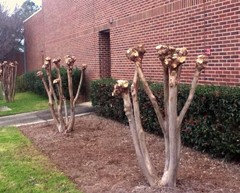
    Marticus, I'm thinking you're correct to lean toward crape myrtles. You can get quite tall ones that take to transplanting really well, so you won't have to wait forever to get some screening. Because your deck is high, you will need a lot of height to give you any screening. Given the 22' foot length before you get to the shed, you will probably have room for just 3. Consider the ones that get over 20 feet tall because the bare trunks will be 6-8 feet. tall. Only choose from the ones with upright growth habit. Even with that, you may have to trim some errant branches from the back side that may intrude over the fence onto your neighbor's side (unless they don't mind). Just please don't ever commit crape 'murder'! Bare crape myrtle branches in the winter are quite beautiful. I've included a couple of pictures to give you an idea. The interest and variety will come from all of the things you can plant underneath. Trees with such a high canopy allow for a lot of choices.


    Crape 'murder'

    By the way, even if you're planning to do all of the planting yourself, you might want to consider having the crape myrtles planted by the nursery. The tall ones that are worth having are back breaking.

    marticus thanked marshaaa (5b CO, Castle Rock)
  • 9 years ago

    seeing the virtual mock ups of the different options is so very helpful. I wish it was as easy to just pop different plants in and out of the bed to see what looks best, lol.

    I would never commit crape murder, don't worry.

    The shed is pretty small compared to the rest of the space. I know it will cast a bit of shade, but probably not much until after 3pm.

    I'm glad to have some different options to consider.


  • 9 years ago
    last modified: 9 years ago

    Matrices, I am not sure if you are still considering skyrocket junipers, but if you are, find another narrow evergreen to use instead. Skyrockets are a cultivar of J. scopulorum, which is a western tree that doesn't do well in humid areas. Unless it is in a relatively dry area it is likely to get fungal diseases on the foliage and so even if it doesn't die directly from them, the view won't be pretty. I also suggest that you check to see if there are healthy purple leafed sand cherries in your area since they are often denuded of leaves due to insects or foliage diseases in humid areas. I honestly can't offer a lot of positive suggestions of specific plants since I don't know what will grow well in your area.

    I do have a couple of general observations/suggestions to offer for you consider. The last photo you offered with the various labeled plants has a very different feel from the more regular look of the strictly alternating plants of the photos you posted near the beginning of the thread or the formal look of Yardvaark's mockup of a hedge of all one species. Figure out which look you like and then use that. I am glad to see that you are using at least some repetition since even a bed that has more irregularly placed plants looks more pleasing with repetition rather than one of each.

    Another suggestion is to at least consider whether having screen on or by the deck might be more useful to provide screen on that level, which would free you to be less restricted in your plant choices in the fence bed since the fence blocks the next yard from ground level. For instance, would having an obelisk or three with vines in that corner of the deck work, or planting a bushier tree closer to the deck that eventually would be limbed up provide both seasonal shade and a visual screen for the neighbor's yard?

    Also, there is a Detroit area designer, Deborah Silver, who often deals with narrow side areas that need screening. I will see if I can find a way to filter her blog posts (Dirt Simple) to get just a listing of the ones with your issue so you can see some images of solutions that both provide the screening and are well designed since you have mentioned not finding inspiration photos that address your needs. Edited to add: I just searched for the term screen. So some posts won't apply, but there are a bunch that do show narrow beds planted to provide screening. Dirt Simple screens

  • 9 years ago

    Agh, the humidity always wrecks everything. That's a bummer about those skyrocket junipers, but I will continue to look for something good for my zone.Glad you told me before I hunted them down and put them in.

    I haven't ever noticed a sand cherry growing in my area, so that probably answers that question! Columnar crab apples might still work for my zone, but don't provide a ton of screening.

    As far as screening goes, the whole side of the deck is a large "louvered" structure which blocks the view but allows ventilation and privacy. So I didn't want to put anything else up there. But if nothing else presents itself I'll certainly consider it.

    I would like a bushier tree that could be limbed up, as long as it didn't get too big in the end. Sounds like maybe I should post in the tree forum, which has been noted earlier.

    Thanks for the blog recommendation. Some good reading there and I will definitely note down any bright ideas.


  • PRO
    9 years ago

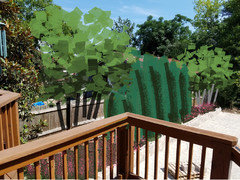
    Not trying to present a plan or specifics, but just a concept -- bookending -- something bushy at each end and something capable of creating a screen-"wall" at the center. The exact plants and configuration which you select, creates the specific scene and character.

    marticus thanked Yardvaark
  • 9 years ago

    I like this idea. I definitely want something that looks intentional, and not haphazard. Thanks for the mock-up!