Software
Houzz Logo Print
debbie1000

How many years before your bathroom looks dated?

9 years ago

We did a major remodel of our 1988 master bath in 2005. We were thrilled, even our realtor neighbor said "this room will sell your house." We had no intention of selling but 12 years later our "dream bathroom" is looking tired.


One trendy thing we did was faux painting the walls to give it a Tuscany look. I now want to change it to light gray which is a little tedious as it is a large room but one of the easiest things to do.


It is pretty traditional and everything I have done in our home since has been very contemporary. I know what changed that--the first flat-screen tv we got! After that, everything was contemporary. So I think it's a combination of 12 years plus a change of my style.


I have traditional cherry cabinets and brushed nickel "busy" fixtures. The fixtures could be changed but probably won't. Will just do the paint (DH will go nuts over this!!) and a few decorative items. That should spruce it up.


So anyone have a remodel that was done around 10+ years ago that is looking tired?

Comments (20)

  • 9 years ago

    The reno I did on my condo 7 years ago I think still looks fresh even though I used travertine tile. I sold the place last year, so it's no longer mine.

  • 9 years ago
    last modified: 9 years ago

    I think dated is in the mind of the beholder. I still love the kitchen I did twelve years ago. It is most likely considered dated by those who follow blogs as gospel and those who worry about keeping up with the jones. But I still get compliments on it when someone sees it for the first time and more importantly to me, it still works well, the finishes are still clean as the day installed and I chose things I wanted for a long time and researched well. I am of a one and done mentality and do not care if my interiors have mass appeal. I want to love my space for its unique expression of myself not because it is a ubiquitous reflection of trendy fashion.

    It is very hard to not use trends when redoing a room. Tile, vanity, fixtures are stocked by trend influence so my new bath is somewhat marked by the year it was built same as my older kitchen was but I picked things I would still find attractive in a vacuum I think this why I still like my choices years later.

    Paint is an affordable way to refresh a room easily. Give it a try. Editing, recaulking and a deep cleaning are another to refresh a bathroom too.

  • 9 years ago
    last modified: 9 years ago

    The better a kitchen or bath fits in with the style of the house in general, the less "dated" should be an issue.

    A 2000s slab door, transitional kitchen will always be more at home in a 1970s ranch than a white shaker and subway tile kitchen that is 1930s inspired. So in 2020, the kitchens may both be dated but the one that fits the house better may stand out less.

  • 9 years ago

    Pal's comment about fitting the bath to the style of house is dead on.

  • 9 years ago
    last modified: 9 years ago

    Yes, all this is true. Whenever I stay in a hotel and walk into the black and gray bath, I'm filled with ennui. But lately I'm noticing something else, too. I recently tried to buy a 1940 house where the PO had combined the impossible kitchen (6 ft wide and the stove must have stuck out into the doorway) and the dining room to make a big eat-in kitchen.

    It was clearly done in 2004-2006 because it had everything from the trendOmeter for those years: glass mini-brick subway backsplash; giant, giant handles on every door and drawer; staggered height cabinets, etc., none of which I ever liked even when they were the latest and greatest.

    And yet, after looking at the kitchen for a bit, I realized I wouldn't change any of it, because it was already such a period look--millenium kitchen, maybe.

    So maybe the whole process is speeding up and things are also becoming off-beat classics quicker, as well.

  • PRO
    9 years ago

    What's dated yesterday will be the next 'in' thing tomorrow.

  • 9 years ago

    I think the replies you have pretty much nailed it.

    If the overall style of the remodel matches the overall style of the house, you're usually good to go.

    If you follow the latest trend when you remodel, then you can be "out of style" in 3, 5, 7 years.

    A couple of weeks ago I was asked to look at a bathroom. A brand new remodel where the sellers built a slick, clean, modern, blingy (lots of crystal bling with mosaic mirror tiles) almost all stark white bathroom in what was otherwise a very well maintained and period correct craftsman house.

    Someone thought it was a good idea.

    Quite a few people since think it was a bad idea.

    When selling, fresh paint is always good. Buyers like to see "fresh clean", you can always work with "fresh clean." But unless something is absolutely horrific; water damage, decay, broken and splintered? It's usually best to discount the selling price for the horrific versus remodeling for resale. Depends on your neighborhood and the local housing market, etc.


  • 9 years ago
    last modified: 9 years ago

    The better a kitchen or bath fits in with the style of the house in general, the less "dated" should be an issue.

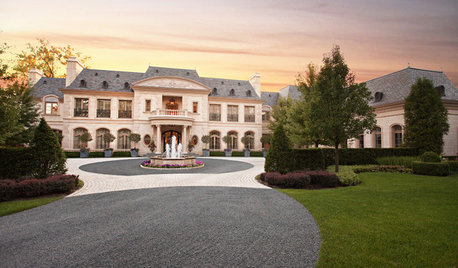
    That's great advice if you live in one of these houses -- they look like they belong to a time period, a definite style of architecture:

    Doesn't work nearly as well if you live in one of these houses, none of which suggests an interior design:

    My best advice: Stay very simple with your bathroom, especially with your tile choices (tile is expensive and difficult to replace). Go with simple white tub /toilet /sink and a very basic vanity top. Chrome fixtures are standard; avoid trendy metals. Insert personality through paint color and linens.

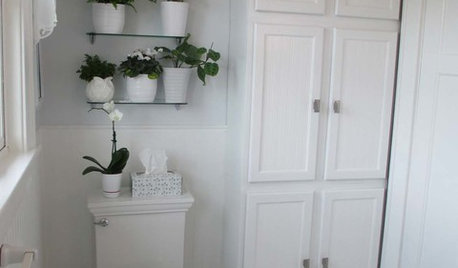
    For example, these bathrooms are pretty basic; if you were to change the wall color and linens, they'd look entirely different:

    On the other hand, if you go with a strong personal statement or trendy item -- like these bathrooms -- you run the risk of growing tired of it:

  • 9 years ago

    Hmm, to me the second row of houses you post still suggest what the bathrooms and kitchens look like, I think. And I think most of the housing stock that people live in in the US is more heavily represented by the second row than it is the first.

    The house on the left is most likely post 1990. The bathroom is probably medium-to-large format tile compared to before, meaning 6"-12" square, no rectangles. The main bathroom has a garden tub if the house is large enough. The tile around the tub goes up to chair rail height. If there is a separate shower it might be an acrylic one piece. The secondary bathrooms might be an acrylic tub shower alcove and there may be no tile at all on the walls. A fancier bathroom may have Listello borders. The tile is white, off-white, or beige of some sort.

    The house on the right is the general form of a house built between 1950 and 1980. Before 1970 the bathrooms would be 4-1/4" tile with mosaic porcelain floors almost exclusively, varying in color with whatever the popular colors were in the period. After 1970 a cheaper house may have had sheet vinyl on the floors and a plastic tub surround.

    If the house on the left was built after 2000 it may have started to have subway tile in the bathroom, white only, accent tiles, and things like chandeliers or non-bathroom lighting in the bathrooms.

    That said, there is no need to Duplicate an original bath to match the old bath if you are remodeling. But the old one should probably give you some cues in the decision process for the new one.

  • 9 years ago
    If you select based on trend and popularity, your space will probably appear out dated in, as Mongo says, 3-7 years.
    The link to the rest of the house is extremely important. However, if the entire house is designed around trend, a few more years, and it will quite possibly give the same dated feel.
    That doesn't mean you shouldn't design according to what you like if it happens to be the current trend, it means don't design according to only the trend

    OP, if you still have no intention of selling, you have all the time you need to redo your bathroom if you wish. paint does wonders in the interim
  • 9 years ago

    And then there are houses in Europe that are hundreds of years old with very modern kitchens and bathrooms. Difference is that they are relatively simple, i.e. no accent tiles, plain door/drawer fronts, no embellishment.

  • 9 years ago

    You bring up a good point about Europe, but there are some key differences between Europe and the US and the way things are handled in Europe vs. the US and you touched on this in your second sentence. And this also applies to antique houses in America, too.

    Then there is the concept of what is a "natural progression" and I think this concept is something that has not been well followed in the US and that's why there is a problem with "dated".

    Many people live in houses that are hundreds of years old in Europe. There was no such thing as a "bathroom" in many of these houses for the first couple hundred years of their existence. So, whatever is the first "modern" (~20th c.) bathroom that would have been put in a particular house is always appropriate. And then any subsequent bathroom style up to about 1980. (And not much beyond 1980 or so, imo, which I will get into in a bit).

    In America, most houses probably got bathrooms in the Edwardian Era up to the Depression, and new houses built after 1900 probably had bathrooms, although I've seen plans without. However, for example, I lived in a building that had no kitchen until 1965, and it had several toilet compartments and probably a room with a sink and bathtub in it somewhere, but not a modern bathroom until 1965. So what's proper in this house? And is a bathroom that was redone in 1955 improper in a Victorian house? Probably not. Really any bathroom that is "newer" than the house (again up to about 1980 or so, imo) is appropriate to the house. Why? because innovations were taking place, and most houses aren't house museums.

    What happened after 1980 and what is still happening that's problematic in America today? (And maybe not so much in the rest of the world). First, in general, it's one thing to see a very slick contemporary bathroom and kitchen in a 300 year old house, but it's another thing to see a slick contemporary bathroom in a 50 year old colonial revival house. There is much more contrast in the 300 yo house.

    And what happened after 1980? Up until about 1980, new styles were --new--. the end of the Late modern period was in the 1980s or so and was followed by Post-Modernism which was more or less a statement about reaching an end point in modernism. There is not much left after the white box to pare down.

    So in the 1980s they started with the fake "Victorian" style bath fixtures and this was followed by revivals of other historic fixtures and elements, and now a prevailing style for kitchen and bathrooms contains a lot of Edwardian and VIctorian inspired elements. It's hard to find a bathroom faucet that is not either a basic style but exceedingly cheaply made; or extremely modern, or faux -Victorian.

    And that's the crux of the problem: natural progression of bathrooms was always moving forward with technology and new fashions, but now the new fashion is in retrograde, so people are putting in bathrooms that have many elements that are taking stylistic cues from 1910 -1930 more or less in contemporary houses from 1980. It doesn't make stylistic sense. People argue that this is the "current" style going into new construction so it's appropriate but I am not sure. If the current style going into new construction was a bathroom taking design cues from 1955, I think people would see that that looked goofy in a 1980 house. And then there are decorative styles in America that are displaced by geography or are version of something that doesn't really exist. To go back to the OP, there really isn't any such thing as a "Tuscan" bathroom, even in Tuscany. Not how it would be interpreted in America. And while much about the building style may make a bathroom in the Southwest look very appropriate: adobe and or adobe style plaster, wood ceilings, saltillo and talavera tile---that, isolated in a bathroom in New Jersey, when the rest of the house is not that style--again, was never really right, so when that's out of fashion, it looks really wrong.

    Finally, in new construction, kitchens and baths have gotten larger, more expensive, and higher quality material-wise, than before, and somtimes this is just too elaborate for a house from the middle of the century. There is nothing the matter with improving on quality, there is no need to replace a plastic tub surround with another. But a marble bathroom with detailed nickel fixtures and a crystal chandelier in a modest Cape Cod or rancher just looks displaced. It's the fashion now, so it's what people will do, but it's going to look more dated than something that fit in with the rest of the house better.

  • 9 years ago

    Pal-great post. I really appreciate your perspective.

  • 9 years ago
    last modified: 9 years ago

    Hmm, I'm going to cavil a bit, I think. Yeah, in Europe you constantly see beautiful old buildings that have been totally ikeafied inside, and you know what? It isn't cool. It's often hideous and horrible, only we're so brainwashed that "European" = superior that we think somehow it's much nicer just because they did it. No. There are plenty of truly awful interiors in Europe, too.

  • 9 years ago
    last modified: 9 years ago

    I agree with that entirely. There are plenty of awful or at least banal European interiors. But I think among the examples where thought and money went into putting a kitchen into a historical property they may have an edge over American antique houses with expensive and thought-out kitchens.

    Maybe it's because I am so familiar with the subtleties and distinctions of different architectural periods in the US that I often see what is "wrong" about the kitchen versus the house it's in. When people go for "traditional" in an effort to match the architecture of the house, usually subtle details are wrong at the very least, or the kitchen is awfully twee, or completely elaborate and overwrought. And very few Americans will do high end modernism in an antique house, it more often ends up to be cheap modernism that ends up looking cheap compared to the other original details.

    My favorite kitchens in antique houses directly reference the simpler details of the original house, and in a large antique house my favorite kitchen is a well built sturdy functionalism as if the house still had staff using the kitchen: good appliances, durable materials which could include stone or marble or stainless or butcher block counters or a combination of those; and sturdy painted or stained plain cabinets and functional lighting. This kitchen would be just as or perhaps even more expensive than an overwrought kitchen hung with Crystal chandeliers...however it seems like many people who spend really big bucks on a kitchen are inclined to make it look like they spent money with vulgarity displacing quiet quality.

    I have nothing against very nice kitchens or kitchens that are the most expensive room in the house but I don't think they need to mimic the former formal dining room or living room in elaborateness. Particularly when the details and furnishings if the rest of the house fall short of the kitchen and master bath... The reason and excuse being that a kitchen can be mortgaged and decent furniture can't.

  • 9 years ago
    last modified: 9 years ago

    Oh, I agree palimpsest. Part of the trouble is that very few Americans have any idea about anything related to previous times. Try to persuade anyone that there was no such thing as "mid-century modern" in 1955, for instance, or that most people back then didn't require canned styles like they do now, or that a clawfoot tub was the cheap-o bagain bath in 1930, for instance.

  • 9 years ago

    Mid-Century Modern was a phrase coined in the 1980s (subject to some controversy). And while lots of people lived in houses that are at least identifiable as mid-century, characteristic wise, not all of these are MCM, and many people had furniture that was inspired by modernism but was really transitional. (Even colonial revival furniture from the 1950s-70s is distinct to the period --unless it was a complete reproduction).

    Many periods of furniture and design are really named in retrospect because they are the "contemporary" of their time.

    I had a great deal of difficulty when I lived in an HOA of historic buildings and was on an adjunct committee dealing with relatively minor decorative updates because a very vocal person on the board was completely misinformed about the actual age and style of the buildings but was very self-assured about it.

    Finally I just had to say "Stop. 6 of the 8 buildings are from the 1830s, they are not all from the 1870s (none of them were, the other two were 1880s and 1860s) , 6 are Greek Revival, one is Italianate and one is Medieval Revival"

    They had already made some errors in updating light fixtures and colors in the vestibules, because they were assuming a different period, and they did not understand that the paper and carpet installed in all the hallways in 1965, which was a brilliant blue and white scheme was actually more fitting.

    Anyway when I went into the specific dates I got a bit of eye-rolling like "What is the big difference between 1830s and 1870s?" And I said "I don't know what's the big difference between 1960 and now (2000)?" After that some people started to get it.

  • 9 years ago

    Oh, I totally get it. There is nothing, NOTHING harder than trying to make people understand that a hundred years was just as long in, say, the 14th century as it is today (not speaking of decor, just life in general).

  • PRO
    9 years ago

    Perhaps a change in the paint scheme and adding some minor accessories?

Sponsored
J.Holderby - Renovations
Average rating: 5 out of 5 stars4 Reviews
Franklin County's Leading General Contractors - 2X Best of Houzz!