Software
Houzz Logo Print
hkiwi1846

Show me your elephant ears!

9 years ago
last modified: 9 years ago

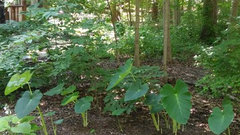
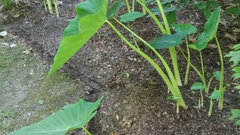
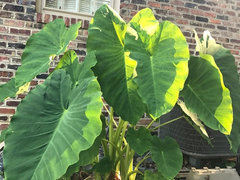
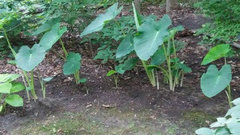
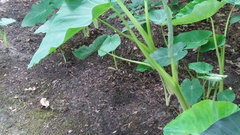
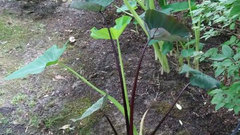
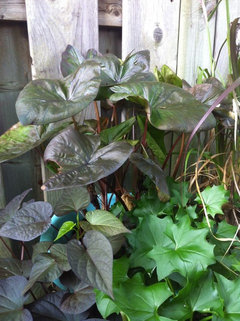
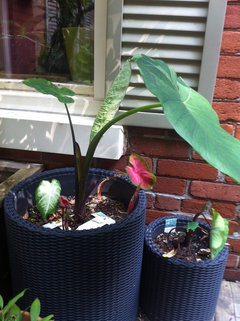
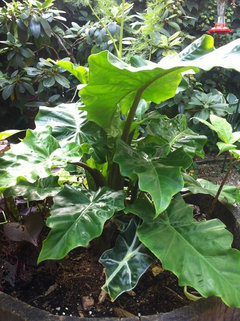
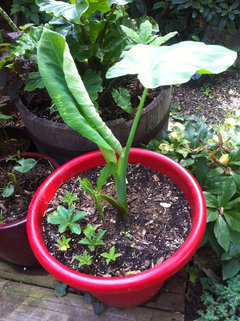
Hey y'all! Elephant ears are some of my favorite plants and I'd love to see yours! Alocasia and colocasia are both welcome just show me! I have a small Thailand giant, colocasia "black magic" and some standard green ears all over! I'm trying to get the balance of nitrogen just right so mine are a little hungry but I'm sure all of yours will be stunning!

Sorry for the mess I can't wait to see your photos!

-k

Comments (66)

  • 9 years ago

    That's amazingly large Tropicbreeze, are the rhizomes eaten in your area? I've seen a list of Xanthasoma species, there were 75 different ones and I thought there were only a dozen or so. I assume your plant will become a forest in time, or do you dig up the offsets?

    Russ

  • 9 years ago

    Christine, aren't "games" those things you play on a screen while sitting in a chair?

    Russ, in some places Xanthosomas are important food items but not here. The only Taros that seem to be eaten here are the Colocasia varieties and that's mainly by the Pacific Islander community, not the general public. The Colocasias turn up in supermarkets often but they're not a big item.

    My Xanthosoma don't get any attention except water, and even then they should probably get more. I tend to just leave them to their own devices.

    Two other less than usual EE's I grow are Typhonodorum lindleyanum and Cyrtosperma merkusii. They get very large and that's why many people don't want to grow them.

  • 9 years ago

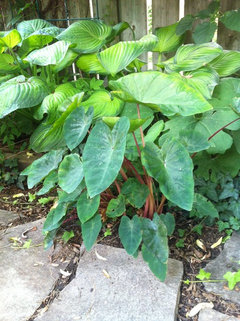
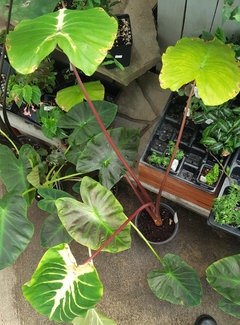
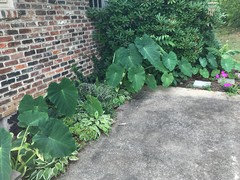
    these amaze me!..had to stand 10 ft away to get all of them in the pic..tropicbreezent - are you able to ID if you zoom in on a leaf?..to me mine look like christine's - just smaller with more subtle variegation..

  • 9 years ago

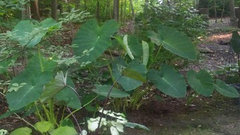
    Thought I'd update y'all! They are exploding

  • 9 years ago

    K..yours are ridiculous! Lol..I'm happy with mine even if they didn't grow any more..but of course if they do what fun!

  • 9 years ago

    Nicholsworth55, those in your last photo look like Colocasia esculenta, but don't know which variety.

  • 9 years ago

    tropicbreezent..thanks..plant names are tricky..

  • 9 years ago

    nicholsworth, yours are looking great, I just love the woodlands back ground, they fit perfectely where you put them, they will get bigger you can count on that, every morning you will see they grew over night. I'm so glad you are keeping track of their growth, we still have at least 3 1/2 months before we have our first frost.


    K, nicholsworth said it perfectely, yours are ridiculous, is it the lighting or are they beautifully shaded ? They are gorgeous !!!

  • 9 years ago

    I think that may be the lighting if you're talking about the lighter green! The darker green is their actual color. They are 100% organically grown too! I've only used liquid fish fertilizer and just recently some bloodmeal! It's working like a charm!

  • 9 years ago

    Jay, amazing ears, you have a beautiful collection !!!!

  • 9 years ago

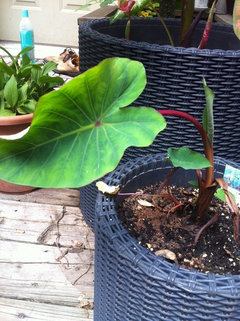
    Jay..beautiful elephant ears!..pics of mine this morning..don't all fit in the pic anymore!..bought Hawaiian Eye yesterday for $2.25..

  • 9 years ago

    tropicbreezent - will the Xanthosoma robusta grow in MD z7 and prosper like other EEs do? That looks like a house plant that grew to a surreal size. If it's not too much to ask, what distinguishes Xanthosomas from Alocasias and Colocasias? To me your Xanthosoma robusta has leaves like an Alocasia but grows like a Colocasia Thai Giant. But the stems don't seem to be bowed from what I see.


    nicholsworth55 - is the bottom one that is potted a Black Magic? I potted a Colocasia Esculenta from a Walmart $5 bulb in mid March. It really took off and looks like most of yours. It didn't need much care either. Just sun and water. Are yours Colocasia Esculenta?

  • 9 years ago

    jay..both of mine are colocasia esculenta..the green ones are Jack's Giant and the one I just bought is called Hawaiian Eye..I especially like your alocasia esculenta..

  • 9 years ago

    Jay, I tried to search hardiness and only came up with these (only the Dave's Garden site specifically listed X. robustum)

    Dave's Garden (Xanthosoma robustum)
    USDA Zone 7a: to -17.7 °C (0 °F)

    International Aroid Society
    Xanthosoma - 57 spp.
    Xanthosoma atrovirens (Zone 8 Baton Rouge, LA)
    Xanthosoma sagittifolium (Zone 8, 10F)

    Learn2grow.com (Xanthosoma sagittifolium)
    USDA Hardiness Zone 8 - 15
    Sunset Zone
    H1, H2, 12, 13, 16, 17, 21, 22, 23, 24

    I don't know whether this helps but Xanthosoma are from the New World Tropics (Central/South America) whereas Alocasia and Colocasia are from the Old World Tropics (Asia/Australia/South Pacific). Otherwise, your observations are accurate.

    But, if you can handle it a little more "deep and meaningful":

    Xanthosoma-
    Small to gigantic terrestrial, evergreen or seasonally dormant herbs with milky latex, stem tuberous and hypogeal or aerial and erect; leaf blade usually cordate or sagittate to pedatisect, submarginal collective vein present, fine venation reticulate; spathe strongly constricted, tube persistent, blade deciduous after flowering; spadix male and female zones separated by conspicuous zone of sterile flowers, fertile to apex; flowers unisexual, perigone absent; male flower a truncate synandrium. Differs from Chlorospatha in having a subglobose, inflated spathe tube, female zone of spadix free from spathe, styles normally discoid (laterally swollen) and coherent (except Xanthosoma plowmanii ), synandrodes (sterile flowers) between male and female flowers well-developed, ± prismatic.

    Alocasia:
    HABIT : medium-sized to rarely arborescent and gigantic, seasonally dormant to evergreen herbs, stem thick, often hypogeal, sometimes stoloniferous and bulbiferous, epigeal stem usually erect, with clear to milky latex. LEAVES : few to several in terminal crown, sometimes each subtended by a cataphyll. PETIOLE : long, sometimes asperate or glandular, sheath relatively long, sometimes deciduous. BLADE : sometimes pubescent, juvenile blade peltate, at maturity usually sagittate, less often ± hastate or cordate, peltate in some species, margin entire, sinuate or slightly to deeply pinnatifid, posterior lobes ovate or triangular; basal ribs well-developed, glands present in axils of primary lateral veins and midrib, primary lateral veins pinnate, forming submarginal collective vein,1-2 closely adjacent marginal veins also present, secondary and tertiary lateral veins arising from the primaries at a wide angle, then arching strongly towards leaf margin, sometimes forming interprimary veins,higher order venation reticulate. INFLORESCENCE : 2-many in each floral sympodium, appearing with the leaves. PEDUNCLE : usually shorter than petiole. SPATHE : strongly constricted between tube and blade, tube with convolute margins, shorter than blade, ovoid or oblong, persistent and then splitting irregularly in fruit, blade oblong, usually boat-shaped, rarely fornicate, at anthesis at first erect, then reflexing and later usually deciduous; in Xenophya group blade is persistent, erect, convolute, gaping only basally. SPADIX : shorter than spathe, female zone short, conoid-cylindric, separated from male by a much narrower zone of sterile flowers, male zone usually cylindric, appendix conoid to cylindric, surface with irregular, labyrinthine network of fissures. FLOWERS : unisexual, perigone absent. MALE FLOWER : 3-12(-36)-androus, stamens connate into an obpyramidal, subhexagonal, truncate, rarely linear (A. brisbanensis) synandrium, thecae linear-oblong, lateral, dehiscing by apical pore. POLLEN : extruded in strands, inaperturate, spherical to subspheroidal, medium-sized (mean 35 µm., range 31-39 µm.), exine spinose. STERILE MALE FLOWERS : synandrodes shallow, obpyramidal, compressed, truncate. FEMALE FLOWER : ovary ovoid or oblong, 1-locular or partially 3-4-locular at apex, ovules 6-10, orthotropous, hemiorthotropous, hemianatropous or anatropous, funicle short, placenta basal, style short, stigma depressed-capitate, ± distinctly 3-4-lobed. BERRY : generally reddish, ellipsoid or obconic-ellipsoid or subglobose, 1-5-seeded, stigma remnants persistent. SEED : subglobose to ellipsoid, testa thickish, smooth or scabrous, embryo broadly conoid, shortly cylindric or elongate, endosperm copious.

  • 9 years ago
    last modified: 9 years ago
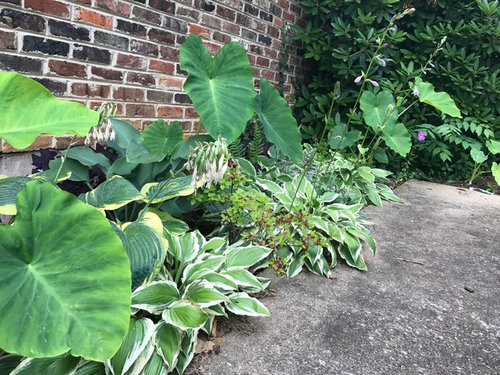
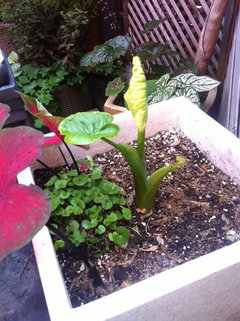
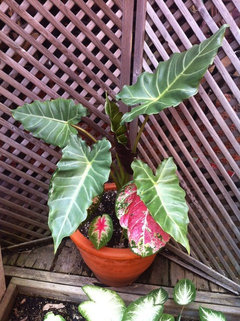
    My elephant ears only started kicking in a few weeks ago. I learned last year that without a greenhouse, etc., they will only really start when the hot, humid temps kick in. Some were purchased more recently and were already growing, but the majority you see here where started from dormant tubers/corms. Anyway, here are my pics, taken today!

    1) Colocasia 'Black Coral'

    2) Alocasia 'Plumbea Nigra'

    3) Colocasia 'Hawaiian Punch'

    4) Colocasia 'Thailand Giant'

    5) Colocasia 'Mojito'

    6) Uknown - Alocasia 'Frydek'?

    7) Alocasia 'Low Rider'

    8) Colocasia 'Thailand Giant'

    9) Colocasia 'Red Stem'

    10) Alocasia 'Calidora'

  • 9 years ago

    LaLennoxa..I'm jealous!!..you have more ee's than I do!..like jay a lot of variety.. just one in the ground and the rest in pots?..do you dig the tubers/corms out of the pots or just store them as is?..the one I just bought (Hawaiian Eye) I might grow in a pot..

  • 9 years ago

    Then it looks like they'll surely thrive from mid May to late October outdoors here before bringing them indoors.

    Yes, that all text helps. Thanks. Like Colocasias, they aren't arboreal which I'm interpreting as not trunk forming.

  • 9 years ago

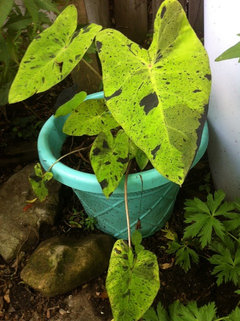
    LaLennoxa - which kind is that in the 2nd-to-last photo? Is that a young Colocasia White Lava? Below is one at a nursery today. Note the non-variegated leaf top right. Also, are those all Rosebud Caladiums in the 6th photo or is the large oval leaf on the right another cultivar? The one on the left appears to be a Rosebud.

  • 9 years ago

    Wonder what the difference is between White Lava and the old Nancy's Revenge, if any. Maybe a renaming?

    LaLennoxa, what's the philodendron just below Mojito? Maybe superbum or billietiae? Beautiful specimen and very well grown!

    Russ

  • 9 years ago

    Thanks for all the kind words, I'm glad people enjoyed the photos! I've updated the post to add the names that I had noted or what was on the tags. But as you probably already know, half the time these things are mis-labelled or they have a bunch of different names, due to crazy patents etc. So sometimes it's just my best guess.

    @nicholsworth55 - Yes, the majority of mine are in pots. It's easier that way as I'm moving them to/from storage. And honestly, my ground space is actually at a premium and usually saved for my perennials. My storage method is pretty simple: chop down, dig up roots and all, throw in a paper bag with some newspaper in the basement. I don't wash off or any of that. I have a dry basement, so there are no issues with moisture.

    @jay - #9 is Colocasia 'Red Stem' according to the tag. I can't even remember what caladiums I threw where...last fall, I tried to identify and sort them (they were originally bought as a multi-pack from Lowes) - I even started a thread to that end. I tried to bunch the different kinds I had sorted into the same area (as in the same pot). But I may have gotten mixed up along the way - it's been a strange year...

    @Russ1023 - Okay, #6 was my unknown plant purchased from a nursery in March I think, and they just pulled out old stock and were getting rid of it cheap. It had two spindly leaves, but I thought no worries, as these things really only take off with the hot weather anyway. So now we're up to 5 leaves with more on the way. Love a good, cheap, plant rescue :-)

  • 9 years ago

    LaLennoxa..thanks for the info..sounds simple and doable..I buy rescue plants too..then you can buy MORE!

  • 9 years ago

    LaLennoxa #6 unknown frydek is Mayan mask

  • 9 years ago

    I collect aroids with special interest in philodendrons and aglaonemas. Not knowing #6 was bought as a bulb-type plant, there are a couple of philodendrons that are dead-ringers for it. On a search of Mayan Mask pics, I saw none with leaves this narrow but I think the ID is right for this young plant. Leaves will probably widen a lot with size.

    Russ

  • 9 years ago
    last modified: 9 years ago

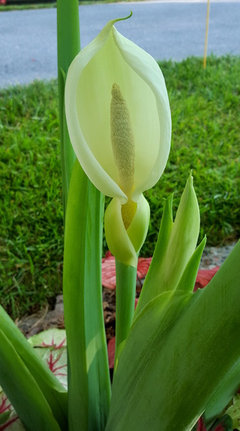
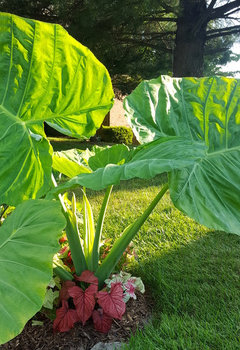
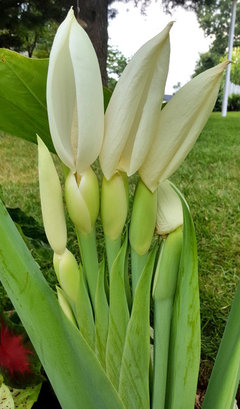
    Colocasia Gigantea, AKA: Leucocasia gigantea 'Thai Giant' inflorescence from today:

    Here is a leaf (center) that followed the first flag leaf. It is about 1/3 smaller than the previous full leaf:

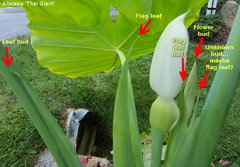
    Some notes on the leaf/bloom/buds that followed the first flag leaf on the plant. In about a week or so I'll know exactly what the 2 buds I question are:
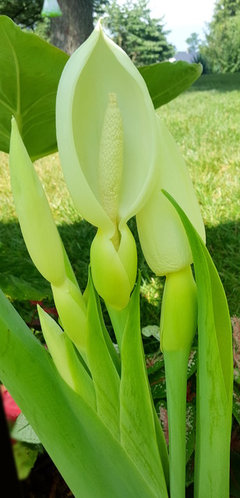
    Here it is 3 days later in a photo taken from the opposite side. The flag leaves in question above are in fact flag leaves. And since then a 3rd and 4th inflorescence began appearing as well as 4th flag leaf. That looks quite tropical. Two winters ago in that very spot was a 4-5 ft pile of snow:

    Since the above pic was taken 4 days earlier, a 5th and 6th inflorescence have begun appearing. The 6th one is the smaller bud on the lower left:

  • 9 years ago

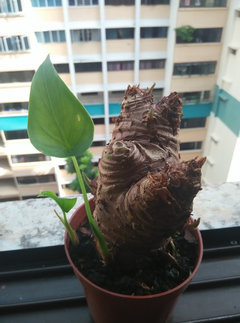
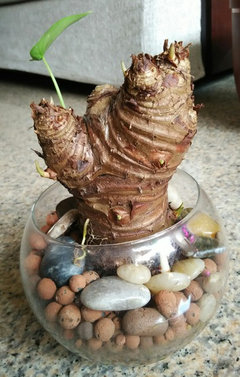
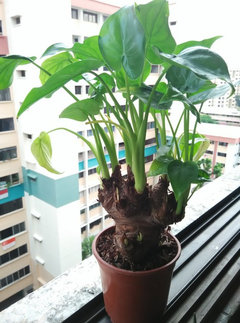
    Alocasia chunk

  • 9 years ago

    Ycloh1, you probably realise it but your Alocasia will get too big for that pot very quickly. A bit hard to tell when small but it looks like A. cucullata. If it is, I grow mine with the pot sitting in water.

  • 9 years ago

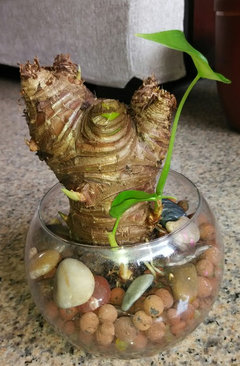
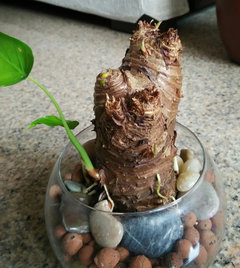
    Tropicbreezent, I just clean it up. And re pot to a glass ware. The bottom of the stump was rotted or chew up by some small white worms. But all was removed n clean.Will up date photo.

  • 9 years ago

    Update photo of re pot

    Not good at deco. But will do.

  • 9 years ago

    The only thing I might add there is to say mine are in a pot with drainage holes. What happens when they get watered is the fresh water moves down inside the pot and pushes the old water out the bottom (it's sitting in a pond). That keeps fresh water around the roots. The glass you have there looks like it doesn't have any drainage holes so water could sit in the bottom and stagnate. That wouldn't be good for the plant, and it could smell, which wouldn't be good for you ;)

  • 9 years ago

    Actually the stump is sitting on the gravel n clay balls. Only roots in the water. Water level very low.

  • 9 years ago

    Did a headcount of my EEs yesterday, up to 49 individual plants....it's fine....their house now not mine

  • 9 years ago

    K..this evening your count will be higher lol..

  • 9 years ago

    K they look fabulous, I did get a chuckle out of nicholsworth comment, they do grow over night LOL....

  • 9 years ago

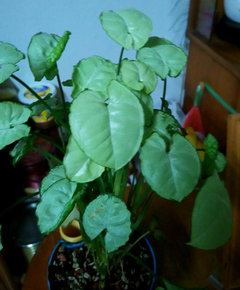
    Small ears?

  • 9 years ago

    I don't know that one Ycloh1. Do you have a name for it?

  • 9 years ago

    That plant looks like a syngonium hybrid to me, with immature leaves.

    Russ

  • 9 years ago

    agree with Russ..looks like syngonium..today's pics..pic#1 bananas planted and growing..ee's top left..pic#2 ee's..2 Hawaiian Eyes still need to be planted..

  • 9 years ago

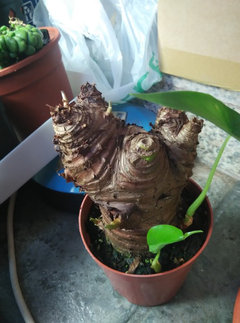
    Alocasia cucullata stump.

    Got another one.

    Less than $10. Deal?

  • 9 years ago

    I think so..LOTS of leaves..

  • 9 years ago

    I have to clean up all the old dried growth on the stump. Make sure no insects harbouringin.

  • 9 years ago
    last modified: 9 years ago

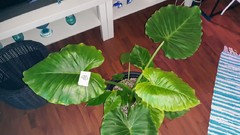
    In mid August 2 of my Elephant Ears reached 6 feet tall. I just water them a lot and apply Expert Gardener Plant Food 15-30-15 every 3 weeks. I turned the soil and added about 20% top soil but they're in mostly clay. They get 3/4 to 1/2 day sun respectively.

    Colocasia Esculenta 'Black Magic' - I got this in June 2016 and it was in a 1 gallon pot and about 18" tall. It got to about 4 1/2 ft tall 4 mos later with 3 tubers and 3 pups. But it was crowded by 2 other E. Ears. Then in Oct it wintered indoors without much sun. During that winter the base stem/trunk circumference went from about 19" to 7" and it went down to only 2 leggy leaves. Right now it has an 18" base circumference with about 10 tubers and 5 pups. It seems the new leaves with their stems continue to grow until the 2nd subsequent new leaf has unfurled. It's leaves shed water as if they were wax. Water just rolls right off. It's impossible to get them wet:

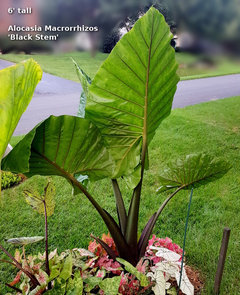
    Alocasia Macrorrhizos 'Black Stem' - I got this in the spring and it was about 2' tall in a 2 gal pot. Sometimes when breezes come through it makes creaking noises like an old wooden ship deck creaking or vinyl rubbing together. I occasionally forget that when I'm near it and the noise startles me:

  • 9 years ago
    last modified: 9 years ago

    Yours are tall!!..have only colocasias..love to get an alocasia next year..funny in pic#1 how similar in size the black ee and red caladium are in the lower left corner..

  • 9 years ago

    The C. 'Black Magic' is now 6'4" and the A. 'Black Stem' is 6'1" since 3 days ago. The black EE is a Colocasia Esculenta 'Illustris'. The red leafed Caladium is a Brandywine and it is larger than the Illustris.

  • 8 years ago
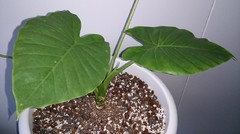
    This is my Alocasia gageana. My A. gageana has been in my backyard growing all summer. There are nights so cold here so I brought it inside. I keep it under the growhlight. He makes lots of pups.

    This pic is taken today


    8.5.2017

  • 8 years ago
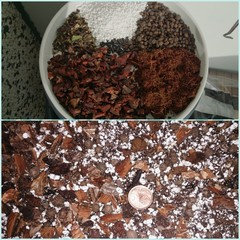
    That looks healthy. What soil breakdown do you use if you mix it yourself? I think I see perlite, small pine bark chips, and crushed stone added to the soil.

  • 8 years ago

    Coco fiber, perlite, pine bark, crushed leca-gravel and coarse sand. My made.

  • 8 years ago
    Thanks for the well laid out details. I will try this or close to it if I can't get all the ingredients.

  • 8 years ago
    jay (7MD)
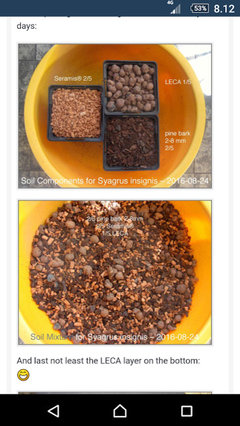
    If you want to try something else, then this is an easy way to do it yourself. Seramis, pine bark fines and leca-gravel. I grow Palms in it and they love it. Then you will need to add fertilizers yourself


  • 8 years ago
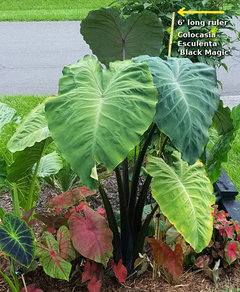
    Nice. I still don't have the exact ingredients for that goal but with each new plant or bulb that I pot, I get closer. So far no fungus gnats and the plant I have in the new mix is doing better than one recently put in standard soil. It's tougher to tell when the plant in the aerated-type soil needs water than does the plant with less aerated soil.

Sponsored
Wannemacher Interiors
Average rating: 5 out of 5 stars26 Reviews
Customized Award-Winning Interior Design Solutions in Franklin Cnty OH