Software
Houzz Logo Print
sabrena_simon

Limelight hydrangeas

9 years ago

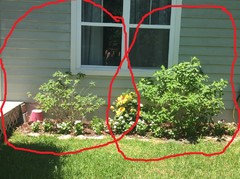
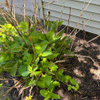
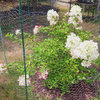
Planted two, about 4' apart 2 years ago. One is stunted. Didn't even get leaves until a month after the other. What can I do to help it along?

Comments (8)

  • 9 years ago
    last modified: 9 years ago

    Limelights are notorious for showing their feet as the growing season progresses but it is a little rare for two to leaf out a whole month apart when so close to each other. Mind you, I am not saying it could not happen, only that it would be odd. Also, I would never expect two originally potted (by the plant wholesaler) hydrangeas to grow at the exact same rate since one's root system may have been cut shorter than the other's root system, for example. So, I think we need more information. Let me ask you a bunch of questions to rule out other stuff...

    Does the one on the right -which is closer to the hose- get more water than the one on the left? Hoses sometimes leak water where they connect to the spigot and I am wondering if the area by the right Limelight then gets all this extra "leaking water".

    I am also noticing that the annuals in the extreme left appear to be slightly smaller than the annuals in the middle. It may be normal but I was wondering if the annuals were originally of the same size and were they planted there at the same time?

    So, exactly how much water does the one of the left get and how often do you water? Do you water both of them the same amount with a sprinkler or do you water manually?

    Have you ever had similar issues with other plants in that spot suggesting soil or watering problems?

    Is your soil hard clay that may sometimes be difficult for the roots to penetrate?

    Do they receive the same amount of sun (include indirect scenarios such as when the sun is reflected from the large windows towards the plants)? Is it somehow warmer or more windy closer to the step up?

    Does the general area in which they are planted suffer from underground pests that may disturb or damage the roots (think voles, etc)?

    Could the one the left be suffering from circling roots because it was pot bound for too long? Do you remember cutting off the roots that may have been growing on the sides of the pots?

    Where are you? Do you live where nematodes are present? Approximately when do they leaf out for you?

    Is your soil acidic or alkaline? Have you tested soil pH in that bed? Do you know if your soil has any type of mineral deficiencies?

    Do you fertilize these eventually large shrubs? When? How much? Does one shrub get more fertilizer than the other one?

    Any stories that you remember when you planted them? For example, did you notice when planting that the area near the left shrub was more rocky?

    Sorry for sooo many questions. I am hoping one might trigger an 'aha' moment though. I wish we could just "ask the plants"! ;o)

  • 9 years ago

    I also wonder about gutters and the roof line and how that effects the amount of rainfall in this area.

    Do they get the same amount of light, or is there a structure or tree that gives one more shade than the other?

    Is there some type of foundation under the deck or step on the right side of the photo that might be effecting the one on the left?

    Generally where are you in the world? Something like too much sun might be more likely to create issues for one plant if it had other issues in Luis's part of the world than in my area.

    Also, it might be a trick of the photo, but the bed they are in looks too small front to back for these shrubs, which IME aren't easy to control for size with pruning because they regrow quite quickly. Limelight gets to be at least 8' in all directions, and even Little Lime gets to be 5' by 5'. It looks like they will be rubbing against the building. I try to leave at least a foot between the predicted size of the shrub and the building, so a regular Limelight would be planted at least 5' (half the 8' width+1') from the building. If they aren't 5' from the building, I would widen the bed and then transplant them farther out in the early fall. At the same time, think about how likely they are to grow in front of the window and whether this will be an issue for you. That may solve some of the growth issues as well, ones caused by lime in a concrete foundation altering pH or a rain shadow caused by the eaves, for instance.

  • 9 years ago

    Thank you for your comments/questions! I live in Charleston, SC. The soil is very sandy, but has decomposed organics in it. I have added to both plants a time release miracle grow fertilizer in April, plus a liquid with 1 tbsp of Epsom salt early June. Prior to them having leaves, I added an organic acid based fertilizer for hydrangeas and azaleas. The larger plant has a slight bit more shade from the neighbors pine tree, but not a lot. I have them on sprinklers - one near each plant. 8 minutes every 2 days. Last season, the one on the left did have some leaf burn October/November ish. We only have cold weather here January/Feburary ish. It does freeze, but only a few days out of the entire winter season. I was thinking of adding manure or mushroom compost to the soil? I actually thought it was dead when it didn't have any leaves on it until May! Maybe it needs more water also?

    I also didn't know they grow so large! Maybe I need to re-think my entire garden!

  • 9 years ago
    last modified: 9 years ago

    1 hour once a week of a slow trickle would be better than 8 minutes of a sprinkler every two days to my mind. Your goal is to get water as deep as possible so that the roots will grow deeper. If the water stays in the first few inches, so will the roots, leaving the plants more vulnerable to drought. To actually know if it needs more water, stick a finger several inches into the soil near the plant to see both how deep your watering is going and how long it stays damp. Adding a top dressing of compost or well-rotted manure and then shredded bark mulch will help keep the temperatures cooler and the moisture more even as well as add nutrients for the plant as it breaks down over time. I rarely if ever use standard fertilizers on anything other than occasionally the veggie garden and potted plants. I'm of the philosophy that if I feed the soil with organic matter, the soil will feed my plants, and the organic content will help with moisture and nutrient retention and less runoff of both.

    I am wondering about the amount of sun also since you are in a much hotter zone than I. For me, this is a plant that does fine in full sun without irrigation (after two or three full growing seasons) but as far south as you they appreciate some shade in the hottest part of the day.

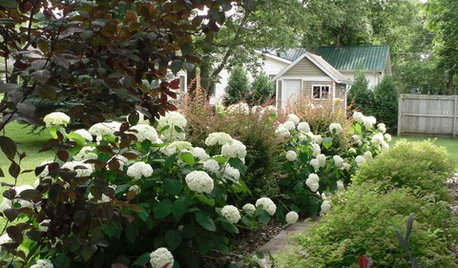
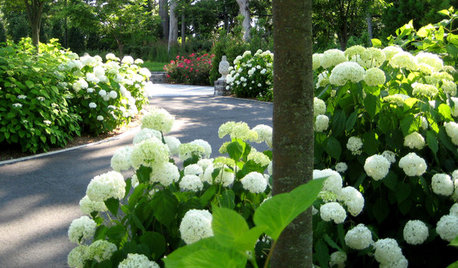
    If you are going to move these, I would do it in fall to reduce the stress on the plants. It's really too hot to do it in your area now. It is a really great plant, long-blooming and not fussy, but it is not a small one. Here's a thread that if you scroll down, there are a couple of posters who have added photos every year for a number of years to give you an idea of the kind of space they need.

    Generally, I rarely make a garden bed less than 6' deep, and some are much deeper than that. I like the opportunity it gives me to layer plants rather than planting them in a straight line.

  • 9 years ago

    "Generally, I rarely make a garden bed less than 6' deep, and some are much deeper than that."

    Amen.

    Folks always comment on the depth of my beds- I like to be able to walk between the back of the beds and the fence. I think the most shallow bed I have is eight feet and I have one that is over thirty.

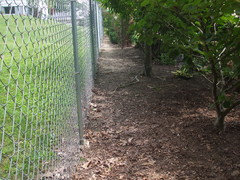
    Here's a good photo of the type space I leave in the back of my beds. Initially it is because dogs will run the fenceline whether you have plants there or not, so I make allowances. But once I got in the habit of leaving some access space I find moving around in the beds to be so much easier. I can get a wheelbarrow or sprayer or wagon back in there easy.

  • 9 years ago

    The one on the left definitely isn't growing anywhere near the way it should. My guess is that at some point it underwent tremendous heat stress likely around the time of planting and never developed a good root system. At this point I don't think there is a way to bring it back to normal viability,

  • 9 years ago
    last modified: 9 years ago

    I might lean towards some type of chemical issue in the soil. Like a weed controller or insect treatment, possibly. ALL H paniculata are supposed to begin leafing out in March-April on average.

    Also, the location is incorrect for Limelights They're too close together and too close to the house. Need to be moved out 1-2 feet at least. Within a decade, that other plant in the middle as well as everything along the front border will be entirely engulfed, not to mention the entire window, part of the yard, and the corner of that porch.

    ..Assuming these grow up properly. Little Lime (mine's 6.5 feet high) or some other dwarf might be more suitable for the location.

    Try searching here for some people's pics of mature Limelights - you might be horrified. My oldest started as a 1-gallon in 2010 and is passing 8'hx5'w, I also added two 3-gallons just this year in different spots (sun and shade) and they're already hitting 4 feet.

    Fully grown they should be masking the areas shown within the read ovals: